“MY BROTHER SOLD MY LATE FATHER’S FARM WHILE I WAS CARING FOR MY DYING HUSBAND—THEN HE ARRIVED WITH A MOVING TRUCK AND ORDERED ME TO LEAVE. HE DIDN’T KNOW MY FATHER HAD LEFT ONE FINAL DOCUMENT WITH THE COUNTY JUDGE.”
PART 1 — THE FAMILY THAT THOUGHT I HAD NOTHING
“Pack your things, Claire. You have until Friday to get out.”
My older brother said those words while standing in the kitchen where our father had taught us to make pancakes.
He wasn’t alone.
Behind him stood his wife, Vanessa, holding a set of house keys. Two men in work jackets waited outside beside a moving truck. And parked in the driveway was a black luxury SUV I knew my brother couldn’t afford on his ordinary salary.
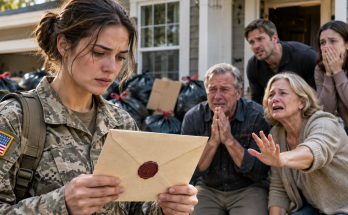
I looked down at the envelope in my hand.
Then I looked at the man who had once promised our father he would always protect me.
“Get out of my house?” I asked quietly.
Daniel smiled.
“Dad is dead, Claire. The farm belongs to the family now. And since I’m the oldest son, I’ve handled the arrangements.”
I was thirty-six years old. My husband, Michael, had died four months earlier after a long battle with cancer. I had spent nearly every dollar of my savings on his care, and I had returned to our father’s farmhouse because it was the only place left where I could breathe without remembering hospital corridors.
I had barely finished unpacking when Daniel appeared.
He didn’t ask how I was sleeping.
He didn’t ask whether I was eating.
He didn’t even mention Michael.
He simply announced that the property had been sold and that I needed to leave.
“You can’t sell Dad’s farm,” I said. “He never gave you permission.”
Daniel laughed.
“Dad gave me power of attorney before he died. I signed the papers. The buyer has already paid the deposit.”
Vanessa crossed her arms.
“Honestly, Claire, you’ve been living here long enough. Daniel has a family to support. You don’t even have children.”
Those words hurt more than I wanted to admit.
Michael and I had wanted children. We had spent years hoping, praying, and visiting specialists. Then his diagnosis changed everything.
My brother knew that.
He also knew that our father had been the only person who never made me feel incomplete because of it.
I swallowed the pain and looked at Daniel.
“Did you read the entire document Dad signed?”
His smile faltered for half a second.
“Of course I did.”
“Every page?”
“Claire, don’t start pretending you’re a lawyer.”
I didn’t answer.
Because Daniel had made one enormous mistake.
He believed that because I was grieving, I was helpless.
He believed that because I had no children, I had no one.
And he believed that because our father had trusted him with paperwork, he had been given ownership of everything.
He was wrong about all three.
My name is Claire Bennett, and I grew up on a 160-acre farm outside a small town in Ohio.
My father, Thomas Bennett, was a quiet man who measured love through actions rather than words. He woke before sunrise, repaired broken fences himself, and never complained when a neighbor needed help.
My mother died when I was seventeen.
After that, Daniel became the center of Dad’s world.
He was older, louder, and better at convincing people that he knew what was best. He wanted a new truck, Dad found the money. He wanted to start a landscaping company, Dad helped him buy equipment. When his business struggled, Dad paid his debts.
I never resented my brother for receiving help.
I resented the fact that he treated every act of kindness like a permanent obligation.
When I went to nursing school, I worked nights at a care home and paid my tuition myself. Dad was proud of me, but Daniel always found a way to make my achievements sound small.
“Claire likes helping people,” he would tell relatives. “It’s not exactly a career that makes you rich.”
Then I met Michael.
He was a high-school history teacher with a gentle laugh and a habit of bringing me coffee when I worked late. He loved the farm, especially the old red barn where Dad kept his tools.
Michael used to say that the property felt like a place where time moved slowly enough for people to remember what mattered.
We married in a small ceremony beneath the maple trees.
Dad cried during his speech.
Daniel complained that the reception food was too cheap.
That was my family.
After Michael became ill, I left my nursing job to care for him full-time. I used my savings for medications, travel, and treatments that insurance didn’t fully cover.
Daniel visited once.
He stood at the foot of Michael’s bed, checked his phone twice, and left after fifteen minutes because he had a business meeting.
When Michael died, Dad held me while I cried on the farmhouse porch.
“You don’t have to be strong every minute, sweetheart,” he whispered.
It was the last time I remember him holding me like that.
Three weeks later, Dad suffered a stroke.
He survived, but his health deteriorated quickly. During his final months, Daniel began handling more of his paperwork. He said he was protecting the family from unnecessary complications.
I wanted to believe him.
I was busy caring for Michael. By the time I realized my father was getting worse, Daniel had already taken control of the bills, bank correspondence, and legal documents.
One afternoon, I found Dad sitting at the kitchen table with a folder open in front of him.
“Claire,” he said, “if anything happens to me, promise you’ll never sign something just because someone tells you it’s what I wanted.”
I sat beside him.
“Dad, what are you talking about?”
He closed the folder.
“Your brother has a way of making people feel guilty when they ask questions.”
I waited for him to explain.
He didn’t.
Instead, he reached into his pocket and handed me a small brass key.
“This opens the bottom drawer of my old desk in the barn.”
“What’s inside?”
“Something I should have dealt with sooner.”
He looked toward the window.
“And if Daniel ever tries to sell this farm, go to Judge Whitaker. Don’t go to your brother. Don’t argue with him. Go straight to the judge.”
I was frightened by the seriousness in his voice.
“Why would Daniel sell the farm?”
Dad squeezed my hand.
“Because some people believe that being loved means they’re entitled to everything.”
Two days later, Dad died in his sleep.
At the funeral, Daniel stood beside the casket and told everyone that he would take care of the family.
I watched him accept condolences and shake hands.
I didn’t tell anyone about the key.
I wasn’t ready.
After Michael died, I returned to the farmhouse and finally opened Dad’s desk in the barn.
The bottom drawer contained a stack of old photographs, a sealed envelope bearing the county courthouse stamp, and a copy of a property document.
The envelope was addressed to Judge Eleanor Whitaker.
Across the front, Dad had written six words:
“Only open this if Daniel sells.”
I took everything to Martin Cole, a local attorney who had known Dad for more than twenty years.
He studied the documents for almost an hour.
Then he looked at me.
“Claire, your father was much more careful than you realize.”
“What does that mean?”
“It means your brother may have authority to manage certain matters. But authority to manage property isn’t necessarily ownership of property.”
He tapped the sealed envelope.
“And this may change everything.”
I wanted to open it immediately.
Martin stopped me.
“If your father arranged for the original to remain with the court, we need to follow his instructions. Let the judge verify it. That will protect you and prevent anyone from claiming you’ve altered anything.”
For the first time since Michael’s death, I felt something other than grief.
I felt hope.
The next morning, I went to the courthouse.
Judge Whitaker reviewed the file privately and instructed her clerk to verify the recorded property documents. She then asked me to leave the original sealed envelope untouched until a formal review could be arranged.
I followed every instruction.
I didn’t confront Daniel.
I didn’t tell Vanessa.
I simply returned to the farmhouse and waited.
Then Daniel called.
“Claire, we’re coming tomorrow. Vanessa and I, the kids, and Dad’s old furniture. We’ll need the upstairs bedrooms.”
“Why?”
“Because this is our property now.”
“Daniel, you haven’t even shown me the sale documents.”
His voice sharpened.
“I don’t owe you an explanation.”
“Then why are you calling?”
“Because I’m giving you a chance to leave without making this ugly.”
I looked at the brass key on the kitchen table.
“Come early,” I said.
He laughed.
“You’re finally being reasonable.”
“No, Daniel. I’m just ready.”
The following morning, at 6:10 a.m., a moving truck turned into the driveway.
Daniel climbed out first, carrying a box of framed family photographs. Vanessa followed with a clipboard. Their children climbed from the SUV, confused about why everyone was there so early.
Daniel walked toward the front door.
Then he stopped.
A woman in a charcoal suit stood on the porch holding a leather briefcase. Beside her was a uniformed county deputy.
Daniel frowned.
“Can I help you?”
The woman held out her identification.
“I’m Judge Whitaker’s court-appointed representative. Are you Daniel Bennett?”
“Yes. Why?”
She opened her briefcase and removed a document bearing the county seal.
“Mr. Bennett, before you unload anything, you need to read this.”
Daniel scanned the first page.
His expression changed.
“What is this?”
The woman pointed to a paragraph near the bottom.
“Your father’s property transfer was subject to a condition you appear to have overlooked.”
Vanessa stepped forward.
“What condition?”
The woman looked directly at Daniel.
“Your father anticipated this dispute. And the judge has ordered an immediate review of the sale.”
Daniel’s face went pale.
Then the woman removed a second document.
“This one concerns the power of attorney you used to authorize the transaction.”
My brother dropped the box.
Family photographs scattered across the porch.
And for the first time in my life, Daniel looked at me as though he had no idea who I was.
Because he was about to discover that our father had left behind more than a farm.
He had left behind the truth.
And that truth was waiting inside a sealed envelope.
PART 2 — THE DOCUMENT MY BROTHER NEVER READ
Daniel refused to believe the woman on the porch.
“This is ridiculous,” he snapped. “I’m Dad’s son. He gave me the power to handle his affairs.”
The court representative remained calm.
“Power to handle affairs is not the same as unrestricted authority to transfer real estate. The exact wording matters, Mr. Bennett.”
“Then call my lawyer.”
“You may do that. But no one should move property or occupy the house while the court reviews the disputed transfer.”
Vanessa grabbed his arm.
“Daniel, what does she mean?”
He ignored her.
Instead, he pushed past the representative and stepped into the farmhouse.
I was standing in the living room with Dad’s brass key in my hand.
“Claire, tell her this is a misunderstanding.”
I looked at him.
“You told me Dad gave you the farm.”
“He did!”
“Then why didn’t you tell me about the conditions?”
Daniel’s mouth tightened.
“What conditions?”
I didn’t answer.
The representative entered behind him, accompanied by the deputy.
“Mr. Bennett, the judge has requested your presence at a hearing this morning. The original estate documents have been located, and the county recorder has confirmed that a transfer restriction was filed before your father’s death.”
Vanessa went completely still.
“A restriction?”
The woman nodded.
“The sale is disputed. The court will determine whether the transaction can proceed.”
Daniel turned toward me.
“You did this.”
“No,” I replied. “Dad did.”
His face reddened.
“You’ve been waiting for this, haven’t you? You always wanted me to look like the bad guy.”
I thought about the money Dad had given him. The years of bailouts. The business debts he had covered. The way Daniel had accepted every sacrifice and still believed he deserved more.
“No, Daniel. I wanted you to be my brother.”
For a moment, he looked almost ashamed.
Then the expression vanished.
“You’re going to regret this.”
He stormed out, leaving Vanessa and the children standing beside the scattered photographs.
I bent down to pick up a picture of Dad holding a fishing rod beside the river.
Vanessa watched me.
“Claire,” she whispered, “did Daniel really sell the farm?”
“I believe he signed a contract. The judge will determine whether it was valid.”
She looked toward the driveway.
“I didn’t know about any restrictions.”
I believed her.
But I also knew that not knowing didn’t undo the damage.
At the courthouse, Martin was waiting for me.
Judge Whitaker entered the room a few minutes later. She was in her late sixties, with silver hair, sharp eyes, and the kind of quiet authority that made everyone stop talking.
Daniel arrived with his attorney.
He looked confident again.
His lawyer explained that Daniel had acted in good faith under the power of attorney. He argued that the sale should be honored because the buyer had already paid a deposit and relied on Daniel’s representations.
Judge Whitaker listened without interruption.
Then she turned to Martin.
“Counsel, please present the recorded documents and the sealed letter.”
Martin placed the records on the table.
The judge examined the property deed, the power of attorney, and the filing date.
Finally, she opened the envelope my father had addressed to her.
She read the first page silently.
Then she turned to the second.
Her expression grew serious.
“Mr. Bennett,” she said, “did you know your father had placed a restriction on the sale of this property?”
Daniel shook his head.
“No.”
“Did you review the complete estate file before signing the contract?”
“My father trusted me.”
“That wasn’t my question.”
Daniel swallowed.
“No. I didn’t read every page.”
The judge folded her hands.
“Then we have a serious problem.”
She explained that the documents required careful review before any final decision could be made. The court needed to establish what authority Daniel had been granted, whether the transfer restriction was enforceable, and whether the buyer had received accurate information.
Then she read one sentence from my father’s letter.
“If my son Daniel attempts to sell the farm without my daughter’s written consent, I ask the court to examine the transaction before allowing it to proceed.”
Daniel shot to his feet.
“That’s impossible! Dad never told me that!”
Judge Whitaker raised her hand.
“Sit down, Mr. Bennett.”
He sat.
The room became silent.
The judge continued.
“Your father also included a statement concerning the reason for this restriction.”
She glanced at me.
“Miss Bennett, are you aware of a separate trust established by your father?”
I shook my head.
“No, Your Honor.”
Martin looked at me with surprise.
The judge opened another page.
“Your father established a preservation trust to protect the farm and its surrounding land from an unauthorized sale. The trust’s terms name you as a potential beneficiary, subject to the conditions in the complete agreement.”
Daniel stared at the document.
“A trust? What trust?”
The judge continued reading.
“The agreement also requires an independent review if a beneficiary uses a power of attorney to transfer property for personal financial gain.”
Daniel’s attorney leaned forward.
“Your Honor, my client did not know the trust existed.”
“That may be relevant,” the judge replied. “It does not eliminate the need to examine the transaction.”
Then came the detail that changed the entire hearing.
The judge turned to the final page.
“Your father attached a sworn statement concerning a loan he made to your business, Mr. Bennett.”
Daniel’s face drained of color.
The loan had been for $180,000.
Dad had told our relatives that he was helping Daniel get back on his feet. Daniel had promised to repay him once his company became profitable.
But according to the statement, Daniel had signed an agreement acknowledging that the loan was separate from any inheritance and that the farm could not be used as collateral without additional written authorization.
The judge looked at him.
“Did you disclose this loan to the property buyer?”
Daniel’s attorney whispered something to him.
Daniel didn’t answer.
The judge placed the papers on the table.
“Until the court completes its review, the disputed transfer cannot be treated as settled. The buyer must be notified, and the relevant financial records must be preserved.”
Daniel’s lawyer asked for time to review the documents.
The judge granted it.
The hearing was adjourned.
Outside the courtroom, Daniel cornered me.
“You knew about the trust.”
“I didn’t.”
“Then why did you go to the courthouse?”
“Because Dad told me to if you ever tried to sell the farm.”
He stared at me.
For a few seconds, I thought he might finally ask what Dad had wanted us to understand.
Instead, he said, “You could have warned me.”
I looked at my brother, the man who had given me an ultimatum while I was still grieving my husband.
“You could have asked me before trying to take my home.”
He had no answer.
That evening, I returned to the farmhouse alone.
The rooms were quiet. The moving truck was gone. The family photographs had been placed back on the shelf.
I sat at Dad’s desk and opened the copy of his letter Martin had prepared for me.
There was one final paragraph I hadn’t seen.
It read:
“Claire, if you’re reading this, then I failed to keep a promise I made to your mother. I spent too many years believing that giving Daniel more would somehow make him responsible. I thought I could save him from every consequence. In doing so, I taught him to expect rescue instead of learning to stand on his own.”
My eyes filled with tears.
Dad had understood more than I knew.
Then I reached the final lines.
“The farm was never meant to be a reward for the child who demanded the most. It was meant to remain a place where people could find shelter, dignity, and a second chance. If Daniel has forgotten that, I hope the truth will help him remember.”
I pressed the letter against my chest.
For the first time since Dad died, I cried without trying to stop myself.
But the next morning, Martin called with news that made my stomach tighten.
“The buyer’s attorney has contacted the court,” he said. “They discovered something in the transaction file.”
“What?”
“Your brother signed a statement claiming the farmhouse was vacant and that no one had a right to occupy it.”
I closed my eyes.
Daniel hadn’t merely ignored the possibility that I had rights.
He had told the buyer that I wasn’t there.
Martin continued.
“And Claire, there’s another issue. The buyer says Daniel promised that the entire 160 acres would be transferred free of restrictions.”
I stared at the farmhouse window.
Dad had spent his entire life protecting that land.
Now my brother had placed the whole property at risk.
“What’s going to happen?” I asked.
Martin paused.
“That depends on what the court finds. But there’s one more thing you need to know.”
“What?”
“The judge wants you to attend the next hearing. Your father’s letter includes a personal statement that she believes you should hear directly.”
I felt my heart pound.
“What statement?”
Martin’s voice softened.
“It’s about why your father left the farm in your care.”
And suddenly, I understood.
The case wasn’t just about whether Daniel could sell the property.
It was about why Dad had trusted me to protect it.
PART 3 — THE LAST PROMISE MY FATHER KEPT
The second hearing took place two weeks later.
By then, the story had spread through our small Ohio town.
Some people believed Daniel had simply made a mistake. Others thought he had tried to sell the farm because he was drowning in debt. A few relatives called me privately and suggested I should withdraw my objections to keep the family together.
One aunt told me, “Your father wouldn’t want you and Daniel fighting over land.”
I answered quietly, “Then Daniel shouldn’t have tried to sell it without asking.”
I wasn’t interested in humiliating my brother.
I wanted the truth established, the property protected, and the family home kept out of a transaction that might never have been authorized.
At the hearing, the buyer’s attorney confirmed that the company had paid Daniel a deposit after receiving his representations about the property’s ownership and restrictions. The company had not yet completed the purchase.
Martin presented the recorded trust documents, the power of attorney, the loan agreement, and the sworn statement my father had left with the court.
Daniel’s attorney argued that Daniel had misunderstood the limits of his authority and had never intended to violate his father’s wishes.
Judge Whitaker listened carefully.
Then she turned to Daniel.
“Mr. Bennett, you have an opportunity to explain your actions. Why did you state that the farmhouse was vacant when your sister was living there?”
Daniel looked at his hands.
“I thought she would leave.”
“That is not an explanation.”
He swallowed.
“I thought the sale would solve my debts. I believed I could pay everyone back afterward.”
“Did you tell your sister about the sale?”
“No.”
“Did you ask for her consent?”
“No.”
“Did you disclose the loan agreement to the buyer?”
Daniel’s silence answered the question.
The judge leaned back.
“Your father entrusted you with certain responsibilities. That trust did not automatically make you the owner of every asset you managed.”
She reviewed the documents one last time.
Then she announced that the court would not allow the disputed transfer to proceed as though it were an unrestricted sale. The relevant agreements and financial records would be reviewed under the applicable trust and property rules, and any further action would have to comply with the court’s orders.
The judge also directed that the power-of-attorney transaction be examined to determine whether Daniel had exceeded his authority.
Daniel lowered his head.
For the first time, he didn’t argue.
But Judge Whitaker wasn’t finished.
She opened the final page of my father’s letter.
“Mr. Bennett, your father included a personal statement. I believe both of you should hear it.”
She began to read.
“My dear children,
If these words have reached the court, then I am no longer here to settle this matter myself.
Daniel, I loved you from the moment I first held you. I wanted to give you opportunities I never had. When your business struggled, I helped. When you made mistakes, I helped again. I told myself I was protecting you.
But I see now that I sometimes protected you from the very lessons you needed to learn.
Claire, I know you often felt forgotten. You rarely asked me for anything, and I mistook your independence for proof that you needed less love. That was my failure, not yours.
When Michael became ill, you gave up so much to care for him. You did not ask for praise, money, or recognition. You simply showed up every day.
That is why I wanted you to have a voice in protecting this farm.
Not because you’re my favorite. Not because your brother deserves nothing. But because I have seen you care for people when there was nothing to gain.
This farm fed our family. It gave us work, shelter, and a place to return when the world became difficult. I want it protected from anyone who sees only its price.
If the law allows, let this land remain a place where people can work honestly, receive help when they need it, and begin again.
And please, don’t let my mistakes become the reason you stop loving one another.
Dad.”
The courtroom was completely silent.
I wiped my eyes.
Daniel sat motionless, staring at the table.
When the judge finished, he asked for a moment to speak.
She allowed it.
He stood slowly.
“I thought Dad trusted me because I was the oldest,” he said. “I thought that meant I was supposed to make the decisions.”
He looked at me.
“And when the debts started piling up, I was ashamed. I didn’t want anyone to know how bad things had become. I convinced myself that selling the farm would fix everything.”
His voice cracked.
“I told myself Claire would understand later.”
He paused.
“But I never asked her.”
For the first time, Daniel sounded like the brother I remembered from childhood—the boy who once held my hand when I was afraid of thunderstorms, before money and pride became more important than honesty.
“I was wrong,” he whispered.
Judge Whitaker reminded everyone that an apology did not settle the legal questions. The court’s review would continue, and the property could not be transferred contrary to the applicable restrictions.
But Daniel’s admission mattered.
The judge ordered the parties to preserve the property and financial records while the transaction was reviewed. The buyer was formally notified of the dispute. Any decision about the sale, the trust, and Daniel’s authority would follow the legal process rather than his assumptions.
After the hearing, Daniel approached me in the courthouse corridor.
Vanessa waited several steps behind him.
“I don’t expect you to forgive me,” he said.
I looked at him for a long time.
“I don’t know if I can yet.”
He nodded.
“I understand.”
“I loved Dad, too, Daniel. I was losing Michael, and then I lost him. I came back here because I needed somewhere to grieve. You didn’t even give me a chance to breathe.”
His eyes filled with tears.
“I know.”
“No,” I said gently. “I don’t think you did. But I hope you do now.”
He lowered his head.
“I am sorry, Claire.”
I didn’t hug him.
Not that day.
Forgiveness was not a document someone could sign on my behalf. It would take time, honesty, and actions that matched his words.
And for once, I wasn’t going to rush just to make everyone else comfortable.
Over the following months, the legal review continued. The disputed sale did not go forward on the terms Daniel had originally promised. The property was handled according to the court’s findings and the applicable trust documents, and the farm remained protected while the remaining financial issues were resolved.
Daniel had to face the debts he had tried to escape.
He sold his luxury SUV, reduced his expenses, and began working with a financial adviser. He also agreed to repay the portion of the family loan that the records established he owed.
I didn’t celebrate his difficulties.
I simply stopped rescuing him from them.
Vanessa eventually came to the farmhouse alone.
She stood on the porch holding a small box.
“I found these in the back of our closet,” she said.
Inside were photographs of Dad, Mom, Daniel, and me at different stages of our lives. At the bottom was a picture of Michael standing beside the red barn, smiling with one hand resting on my shoulder.
I began to cry.
Vanessa looked down.
“I knew Daniel was in trouble,” she said. “But I didn’t understand what he planned to do. I should have asked more questions.”
“Why are you telling me this?”
“Because I don’t want our children growing up thinking that family means taking whatever you can get.”
I looked at the photographs.
“Then teach them to ask before they take.”
She nodded.
A few weeks later, Daniel came to the farmhouse without a moving truck, without a lawyer, and without a demand.
He brought a toolbox.
“The gate near the east pasture is broken,” he said. “Dad used to repair it every spring.”
I studied him carefully.
“Are you here to fix it?”
“If you’ll let me.”
I stepped aside.
“There’s coffee in the kitchen.”
It wasn’t a grand reconciliation.
There was no dramatic embrace or sudden return to the way things had been.
There was only a broken gate, a toolbox, and two siblings who finally understood that repairing something takes more than pretending it was never damaged.
That evening, we sat at the kitchen table where Dad had once warned me not to sign anything I didn’t understand.
Daniel looked toward the window.
“Do you think Dad knew I’d do this?”
I considered the question.
“I think he knew you were capable of making a terrible mistake.”
Daniel gave a sad laugh.
“And he still loved me.”
“Yes,” I said. “He did.”
He stared at his hands.
“I wish I’d understood that before I tried to take everything.”
I reached for the old photograph of Dad and placed it between us.
“Then understand it now.”
Outside, the evening light fell across the fields. The red barn stood where it had stood for generations. The maple trees moved gently in the wind.
For the first time in months, the farmhouse felt peaceful.
I still missed Michael. I still missed Dad. Some wounds in our family would take years to heal, and others might never disappear completely.
But I no longer felt powerless.
I had learned that protecting yourself doesn’t mean you don’t love your family. Sometimes it means refusing to let the people you love destroy what matters most.
My father had left me more than a legal document.
He had left me a responsibility—to protect the land, to demand honesty, and to remember that love without boundaries can become permission for someone else to hurt you.
And as I watched my brother repair the gate our father had built, I finally understood the real meaning of his last promise.
The farm was never just property.
It was a place where we could make mistakes, face the truth, and begin again.
And this time, nobody would be allowed to confuse family with ownership.