My Stepdaughter Called Me “The Hired Help” at Our Family Reunion—My Husband Stayed Silent, So I Left With One Secret That Destroyed Their Perfect Family Image
PART 1 — THE WOMAN THEY THOUGHT THEY COULD HUMILIATE
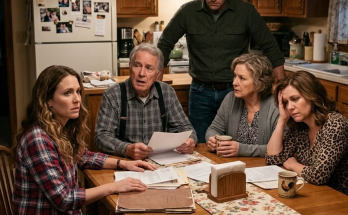
I had spent six hours preparing food for my husband’s family reunion when my stepdaughter shoved a paper plate into my hands and announced, “The hired help eats in the kitchen.” Thirty-two relatives burst into laughter, and my husband continued eating as if nothing had happened. Then my mother-in-law pointed toward the parking lot and ordered me to apologize or leave. I chose to leave. What none of them knew was that I’d already discovered where their money was going—and I had brought the final piece of evidence with me.
My name is Claire Bennett, and for nine years, I believed that loving someone meant standing beside them, even when their own family made it difficult.
My husband, Richard Cole, had a charming smile, a successful-looking business, and a family that knew exactly how to make outsiders feel unwelcome.
I was the outsider.
Richard had a twenty-three-year-old daughter named Madison from his first marriage. His mother, Eleanor, treated Madison like a princess and expected everyone else to follow her lead.
When Richard and I married, I tried hard to build a relationship with them.
I remembered birthdays, bought thoughtful Christmas gifts, organized family dinners, and helped whenever someone needed money.
When Richard’s catering company nearly collapsed during a difficult year, I used my savings to keep it operating.
When Madison couldn’t afford her final semester of college, I paid the tuition.
When Eleanor received a notice about overdue property taxes on her lake house, I quietly covered the bill to prevent a public dispute.
I never demanded gratitude.
I thought we were building a family.
But over time, I noticed something painful.
Whenever they needed something, I was family.
Whenever I needed respect, I was suddenly an outsider.
That Saturday, the reunion was being held at a lakeside pavilion near Virginia’s Lake Anna. Eleanor had invited relatives from three different states, and everyone seemed determined to make the gathering look perfect.
I’d started cooking before sunrise.
I prepared roasted vegetables, baked chicken, fresh salads, and my grandmother’s peach cobbler. I even brought decorative serving dishes because Eleanor had complained the previous year that disposable trays looked cheap.
When I arrived, Madison was standing near the buffet in a blue floral dress, taking photographs for social media.
She watched me carry the food toward the tables.
“You brought all that yourself?” she asked.
“Yes. I thought everyone might enjoy it.”
She glanced at the dishes.
“Mom always says presentation matters. You should have asked someone how we wanted everything arranged.”
I swallowed my irritation.
“Where would you like me to put the cobbler?”
She pointed toward the far end of the table without looking at me.
“Over there.”
I did as she asked.
For the next hour, I helped serve food, refill drinks, and clean up spills. Richard barely spoke to me. He was too busy laughing with his brothers and discussing the catering business.
Then, just as everyone began sitting down to eat, Madison approached me with an empty paper plate.
She held it out in front of several relatives.
“Here you go,” she announced. “The hired help eats in the kitchen.”
For one second, I thought she was joking.
Then I saw the smile on her face.
“Excuse me?” I asked.
She raised her voice.
“You heard me. You’ve been serving everyone all day. You might as well finish the job.”
A cousin laughed.
Someone else snickered.
Then more people joined in.
I turned toward Richard.
He was sitting at the center of the table, cutting into a piece of brisket.
He looked up briefly, noticed everyone watching me, and then returned to his plate.
“Richard?”
He sighed as if I’d interrupted something important.
“Claire, don’t start.”
Those three words hurt more than Madison’s insult.
I had spent nine years defending him, helping his family, and protecting his reputation. Yet when his daughter publicly humiliated me, he couldn’t even ask her to stop.
Eleanor put down her glass.
“Madison was making a joke. You need to learn how to take one.”
“It wasn’t funny.”
Her expression hardened.
“You’ve always been too sensitive. This is a family gathering, not a courtroom.”
I looked around the table.
Thirty-two people.
People whose bills I’d helped pay. People whose celebrations I’d organized. People who had accepted my generosity without ever asking what it cost me.
Not one person defended me.
Then Eleanor delivered her final instruction.
“You can apologize to Madison for making everyone uncomfortable, or you can leave.”
I looked at Richard one last time.
He shook his head impatiently.
“Just apologize, Claire. Let’s enjoy the afternoon.”
Something inside me finally became still.
For years, I’d confused keeping the peace with keeping my dignity.
I placed the paper plate on the table beside his untouched napkin.
“No,” I said. “I’m done apologizing for expecting basic respect.”
Madison laughed.
“Where are you going to go?”
I picked up my handbag.
“Somewhere I’m welcome.”
Richard rolled his eyes.
“You’ll calm down and come back. You always do.”
I didn’t answer.
I walked past the tables, past the buffet I’d prepared, and across the parking lot toward my car.
Behind me, laughter followed me for several seconds.
Then it faded.
I drove straight to Richmond International Airport.
At the terminal, I purchased a one-way ticket to Denver and booked a room near the airport for the night.
Only after I had passed security did I turn off my phone.
Richard probably expected me to return home by evening.
He believed I would cry, forgive him, and continue pretending that his family’s behavior didn’t bother me.
He had no idea that I had been preparing to leave for six months.
Because Madison’s insult wasn’t the reason I finally walked away.
It was simply the moment I stopped ignoring what I’d already discovered.
And the blue envelope beneath Richard’s dinner plate was about to tell him exactly why.
PART 2 — THE SECRET HIDDEN IN THE FAMILY BUSINESS
Six months earlier, I had noticed a charge on one of my investment account statements that I couldn’t explain.
It wasn’t a large amount, and at first, I assumed it was a bookkeeping error.
Then another appeared.
And another.
The transactions were connected to a consulting company I’d never heard of.
I asked Richard whether he recognized the name.
He barely glanced at the statement.
“Probably one of the suppliers. I’ll have my accountant check it.”
I believed him.
A week later, I discovered that the company wasn’t listed among the catering business’s usual suppliers.
I asked again.
This time, Richard became irritated.
“Claire, do you have any idea how much paperwork I deal with every day? Stop worrying about things you don’t understand.”
I should have insisted on answers.
Instead, I put the statement away.
But the question stayed with me.
Over the following weeks, I began reviewing the financial records connected to the loans I’d guaranteed for Richard’s business.
I had agreed to help because he said the company needed temporary support to survive a difficult season.
My money had helped cover payroll, equipment leases, and outstanding supplier invoices.
The arrangement was supposed to be straightforward.
The company would recover, the loans would be repaid, and my guarantees would eventually be released.
But the documents told a different story.
Some payments had been directed toward unfamiliar accounts.
Several expenses were listed as business development costs, even though the supporting invoices were incomplete.
And money had been transferred to an account associated with a company Madison had recently registered.
I didn’t immediately accuse anyone of wrongdoing.
I knew financial records could be complicated, and I wanted reliable answers before making a decision.
So I hired an independent forensic accountant.
For several weeks, he examined the documents I provided, compared the transactions, and requested additional records through the appropriate channels.
His findings frightened me.
The report showed a pattern of transactions that appeared inconsistent with the company’s stated expenses. Some transfers lacked legitimate supporting documentation, and several payments seemed to benefit people connected to Richard rather than the business itself.
The accountant cautioned me that the records alone did not establish every person’s intent.
But he recommended that I protect my accounts immediately and have an attorney review the financial guarantees I’d signed.
I followed his advice.
I changed my investment account credentials, enabled additional security checks, and contacted my bank about suspicious activity.
I also discovered something worse.
My office security system had recorded Richard entering my home office late one night while I was asleep.
He opened the drawer where I kept financial paperwork and photographed a document containing sensitive account information.
When I asked him about it, he said he’d been looking for a receipt.
He never explained why he’d needed to photograph the document.
I saved the footage and gave it to my attorney.
Then, a few days later, my bank contacted me about an attempted transfer of $800,000 from an account connected to my investment funds.
The transaction had been flagged for additional verification.
I hadn’t authorized it.
I immediately instructed the bank to reject the transfer and secure the account.
The investigation revealed that the destination was an account associated with Cole Family Catering.
Madison had been listed among the people involved in initiating the transaction.
I couldn’t prove from that discovery alone what she knew or why she’d participated. But the circumstances were serious enough that I refused to treat the incident as a misunderstanding.
My attorney advised me to stop discussing the investigation with Richard until the relevant records had been secured.
So I did.
I continued living in the house.
I continued going to work.
And I continued behaving normally while I quietly separated my finances from his.
I also stopped making new personal loans to his relatives.
Eleanor called twice to ask whether I could help with another expense at her lake house.
I politely declined.
Madison requested money for a business opportunity.
I declined that, too.
Richard noticed the change.
“You’ve become very difficult lately,” he told me one evening.
“I’ve become careful.”
He laughed.
“Careful about what?”
I looked at him.
“About where my money goes.”
His smile disappeared for a moment.
Then he shrugged.
“You’ve always been suspicious of my family.”
I didn’t respond.
By then, my attorney had reviewed the guarantees and explained which obligations could be withdrawn, which required notice, and which might remain enforceable until the relevant agreements were resolved.
Nothing could be canceled simply because I was angry.
Everything had to be handled correctly.
So I followed the legal process.
I gave the required notices where permitted, protected assets that belonged solely to me, and instructed my attorney to prepare the documents needed to begin ending my marriage.
I also arranged for the suspicious transfer and supporting evidence to be reviewed through the proper financial channels.
The blue envelope I carried to the reunion contained a copy of my divorce filing, my attorney’s notice concerning the financial guarantees, and a summary of the accountant’s findings.
It wasn’t a threat.
It wasn’t revenge.
It was the beginning of my decision to stop putting my future at risk for people who treated my support as an entitlement.
I placed the envelope beneath Richard’s plate before I left.
Then I walked away.
At the airport, I watched the evening sunlight disappear beyond the windows.
For the first time in years, I wasn’t waiting for Richard to apologize.
I wasn’t wondering how to make Eleanor happy.
I wasn’t trying to earn Madison’s acceptance.
I was thinking about the life I wanted to build without them.
My phone remained switched off.
But back at the pavilion, the family reunion was about to take a very different turn.
Because Richard had finally noticed the blue envelope.
And when he opened it, the first page he saw was not a letter asking him to change.
It was a document showing that his wife had already begun to leave.
PART 3 — THE DAY THEY DISCOVERED WHO HAD BEEN SUPPORTING THEM
Richard initially assumed the envelope contained another complaint.
He lifted it from beneath his plate, glanced at the front, and called toward the parking lot.
“Claire!”
I was already gone.
He tore open the flap.
The first document was the divorce filing.
His smile disappeared.
He read the page again, slower this time, as if the words might rearrange themselves into something less serious.
Madison leaned over his shoulder.
“What is it?”
Richard pushed the document toward her.
Her expression changed as she read the heading.
“She’s filing for divorce?”
Eleanor immediately stood up.
“Don’t be ridiculous. She can’t be serious.”
Richard turned to the next page.
It was the notice prepared by my attorney concerning the financial guarantees I had provided for Cole Family Catering.
The document explained which forms of support would end, which arrangements required further action, and which obligations remained subject to existing agreements.
Richard’s face turned pale.
“Where is the money supposed to come from?” he muttered.
His brother looked up.
“What money?”
Richard didn’t answer.
He opened the third document.
The forensic accountant’s report.
Several relatives gathered around the table.
Madison took a step backward when she saw the section describing the attempted $800,000 transfer.
“That can’t be right,” she whispered.
Eleanor snatched the pages from Richard.
“What is this supposed to mean?”
“It means the bank stopped a transfer I never authorized,” Richard said.
His voice had become unusually quiet.
Madison stared at him.
“You told me everything had been arranged.”
A sudden silence fell over the pavilion.
Richard looked directly at her.
“What exactly did you do?”
She shook her head.
“You said it was part of the company’s financing.”
“I said we needed to discuss the account.”
“You gave me the information!”
Several people exchanged uneasy glances.
Eleanor slammed the papers onto the table.
“Enough. We are not discussing private family matters in front of everyone.”
But it was too late.
For years, Richard had presented himself as the man who kept his family financially secure.
He had talked about business deals, new contracts, and plans to expand the catering company.
His relatives assumed his success came entirely from his own hard work.
Few knew how much of the company’s stability had depended on my money.
I had never advertised my contribution.
I had never demanded public recognition.
And because I didn’t talk about it, they had mistaken my generosity for weakness.
Now, for the first time, they were confronting the financial reality behind their comfortable assumptions.
Richard pulled out his phone and called me.
The call went straight to voicemail.
He tried again.
Nothing.
Then he sent a message.
Richard: Claire, this is ridiculous. Come back so we can discuss it.
He waited.
No reply.
He called again.
Meanwhile, Eleanor was demanding that he contact his accountant.
Madison insisted she had done nothing wrong.
Richard’s brother wanted to know whether the catering company’s accounts were in danger.
Nobody was laughing anymore.
Then a man in a dark suit approached the pavilion.
He introduced himself as a process server and asked to speak with Richard Cole.
Richard stared at him.
The man handed him the documents he had been instructed to deliver.
Several relatives watched as Richard accepted the papers.
The process server left without argument or drama.
But his arrival made one thing impossible to deny.
This wasn’t a temporary disagreement.
I had taken formal steps to end the marriage.
And the decisions that followed would no longer be controlled by Richard’s promises or his mother’s demands.
That evening, I checked into my hotel in Denver.
I switched on my phone long enough to contact my attorney and confirm that I had arrived safely.
Then I saw the missed calls.
Twenty-three from Richard.
Seven from Eleanor.
Four from Madison.
Messages filled the screen.
Some were angry.
Some were confused.
Others were strangely polite.
Richard’s first messages accused me of humiliating him.
His next ones asked whether I had spoken to the bank.
Then came a message from Eleanor.
Eleanor: You cannot abandon this family after everything we’ve done for you.
I read it twice.
Everything they’d done for me?
I thought about the college tuition I’d paid.
The property taxes I’d covered.
The business expenses I’d helped settle.
The years I’d spent preparing meals, organizing gatherings, and pretending their insults didn’t hurt.
I typed a reply.
Then I deleted it.
There was nothing left to explain.
Instead, I sent one message to Richard.
Claire: All further financial and legal matters must go through my attorney. Please do not contact me about money directly.
Then I put my phone away.
The next morning, my attorney called to explain the immediate steps ahead.
The divorce would take time.
The financial review would continue.
The disputed transaction would be handled through the bank’s investigation process, and any findings requiring further action would be addressed through the appropriate authorities.
There would be no magical overnight victory.
There would be paperwork, difficult conversations, and decisions I would have to make carefully.
But I was finally making those decisions for myself.
Over the following weeks, Richard’s family learned that the catering company could no longer rely on my personal guarantees in the way it had before.
The company had to seek alternative financing and review its expenses.
Eleanor had to make new arrangements for her property-related obligations.
Madison faced questions about the attempted transfer and had to cooperate with the financial review.
Those matters were not resolved by one dramatic letter.
They unfolded through records, deadlines, and formal procedures.
But the family image they had worked so hard to protect began to crumble.
Relatives who had laughed at the reunion started asking questions.
Some apologized privately.
Others insisted they had never meant to hurt me.
I accepted that people could make mistakes.
But I also understood that an apology didn’t automatically restore trust.
Richard eventually sent me a long email.
He wrote that he’d been under pressure.
He said Madison had been disrespectful but that I should have handled the situation differently.
He claimed his mother was difficult with everyone and that I had misunderstood his silence.
Near the bottom, he finally wrote the words I’d waited nine years to hear.
I should have defended you.
I stared at the sentence for a long time.
Then I closed the email.
He was right.
He should have defended me.
But the problem wasn’t one cruel joke at a family reunion.
It was every time he’d watched me being mistreated and decided that keeping his relatives comfortable mattered more than standing beside his wife.
It was every time my money was welcomed while my feelings were dismissed.
And it was the moment I realized that I had spent years trying to prove I belonged in a family that benefited from pretending I didn’t.
Months later, I began building a quieter life in Denver.
I found a small apartment near a park, returned to the hobbies I’d neglected, and started making friends who knew nothing about Richard’s business or Eleanor’s expectations.
I still had difficult days.
Leaving a nine-year marriage wasn’t easy, even when I knew it was the right decision.
Sometimes I missed the family gatherings I had hoped we might one day enjoy.
Sometimes I wondered whether I could have left sooner.
But I never regretted walking away from that table.
Because the greatest surprise I left behind wasn’t the envelope.
It wasn’t the accountant’s report.
It wasn’t even the financial support they suddenly had to learn to live without.
It was the fact that I had finally stopped believing I needed their approval to deserve respect.
At the reunion, Madison had handed me a paper plate and called me the hired help.
Her family had laughed.
Richard had remained silent.
They thought they were reminding me of my place.
Instead, they reminded me that I had the power to choose a different one.
And this time, I chose myself.