My Husband Left Me Pregnant and Penniless in Divorce Court—Then a Billionaire Walked In and Called Me His Daughter
Part 1 — The Day My Husband Thought He Had Destroyed Me
The judge had just ruled that I would leave my marriage with almost nothing when my husband leaned toward me and whispered the words that would haunt me for years.
“Let’s see how you and that baby survive without my money.”
Preston Hale smiled as if he had already won the rest of my life.
His mistress, Bianca, sat behind him in a cream-colored designer dress, wearing the satisfied expression of someone who believed she was about to inherit everything.
I was twenty-four years old, eight months pregnant, and completely alone.
Or at least, that was what everyone in that courtroom believed.
My name is Tessa Morgan, and until that morning, I had spent my entire life believing I had no family.
I grew up moving between foster homes, group residences, and temporary placements where I learned never to unpack too much because I never knew when I would have to leave.
I had no photographs of my parents.
No grandparents to visit during the holidays.
No family stories passed down around a dinner table.
I had a birth certificate, a few childhood records, and a name that nobody seemed able to connect to anyone living.
When I met Preston at a charity fundraiser, I thought my life was finally changing.
He was wealthy, charming, and attentive in ways I had never experienced.
He remembered my favorite flowers, listened to my stories, and promised that I would never have to feel abandoned again.
“You’ve spent your whole life taking care of yourself,” he told me one evening.
“Let me take care of you for a change.”
I believed him.
We married eleven months later.
Preston insisted that our prenuptial agreement was simply a formality because his family had substantial business interests.
I signed it after his lawyers assured me that everything was standard.
I was young, in love, and eager to believe that the man I married would never use a document to destroy me.
When I became pregnant, I left my marketing job because Preston insisted that I should enjoy my pregnancy without worrying about work.
He promised that our child would want for nothing.
For a while, our life seemed perfect.
We bought a beautiful house, traveled during the holidays, and decorated a nursery with white furniture and pale blue curtains.
Then I discovered the messages.
Preston had been seeing Bianca for nearly a year.
When I confronted him, he didn’t apologize.
He told me that our marriage had become inconvenient and that he wanted a divorce before the baby arrived.
I remember standing in our kitchen with one hand resting against my stomach while he calmly explained that I should be grateful for the years we had shared.
“Everything is in my name, Tessa,” he said.
“The house, the investments, the company shares. You signed the agreement.”
I stared at him, unable to understand how the man who had promised to protect me could speak as if I were a stranger asking for charity.
The divorce proceedings dragged on for months.
My lawyers challenged the agreement, but the case became increasingly difficult and expensive.
Preston had an army of attorneys.
I had limited savings, no steady income, and a baby due within weeks.
On the morning of the final hearing, I wore the only maternity dress I owned that still fit comfortably.
I sat beside my lawyer and listened as Judge Whitmore reviewed the documents.
Then came the ruling.
“Based on the agreement presented to this court, the marital residence and the identified business assets remain the separate property of Mr. Hale.”
My lawyer requested additional time to pursue the remaining claims.
The judge explained that those matters would be handled according to the applicable procedures, but the immediate property ruling would stand.
I gripped the edge of the table.
I wasn’t simply losing a marriage.
I was facing childbirth without knowing where I would live afterward.
Across the aisle, Preston adjusted his designer watch.
Bianca leaned toward him and whispered something that made him laugh.
When the hearing ended, he approached me.
“Well, Tessa,” he said, straightening his jacket. “It looks like you finally understand how the world works.”
I looked away.
He stepped closer.
“You came into my life with nothing, and you’re leaving the same way.”
His eyes dropped toward my stomach.
“And don’t expect me to finance your life just because you’re having my child.”
I felt the baby move beneath my hand.
For a moment, I couldn’t breathe.
Preston smiled.
“Good luck.”
Then he turned toward Bianca.
I lowered my head, fighting the tears that threatened to spill down my cheeks.
That was when the courtroom doors opened.
A deep voice echoed across the room.
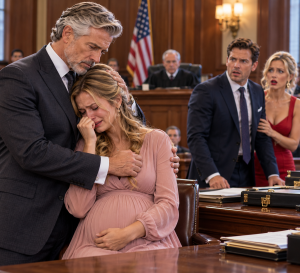
“Excuse me. I believe you’re speaking about my daughter.”
Everyone turned.
An older man stood in the doorway wearing a charcoal suit and carrying a polished wooden cane.
Silver hair framed a stern face, and several attorneys followed him into the courtroom.
I had never seen him before.
Yet the moment his eyes found mine, something changed in his expression.
His jaw tightened.
His eyes filled with tears.
He walked toward me slowly, as if he were afraid I might disappear if he moved too quickly.
Then he stopped beside my chair.
“Tessa Morgan?” he asked.
I nodded, frightened and confused.
He reached into his jacket and removed a small, faded photograph.
It showed a young woman holding a newborn baby outside a hospital.
The woman had my eyes.
And the baby had a tiny crescent-shaped birthmark near her left ear, exactly where mine had been since birth.
The man looked at me and whispered, “I’ve searched for you for twenty-four years.”
Preston’s smile disappeared.
The stranger turned toward him.
“My name is Gregory Sterling,” he announced. “And I am Tessa’s biological father.”
A murmur swept through the courtroom.
Gregory Sterling was the billionaire founder of Meridian Global, a business empire whose name appeared on skyscrapers, hospitals, and international investment firms.
Preston stared at him in disbelief.
“That isn’t possible,” he stammered. “Tessa was raised in foster care. She has no family.”
Gregory’s expression hardened.
“That’s exactly what someone wanted you to believe.”
He placed a thick gold-embossed dossier on the table in front of Preston.
Then he looked at the judge.
“Your Honor, before anyone makes another decision concerning my daughter or her unborn child, I respectfully request permission for my legal counsel to present evidence that has remained hidden for more than two decades.”
He opened the dossier.
The first page contained a hospital record.
The second contained an adoption investigation.
The third contained a photograph of a woman whose face looked almost identical to mine.
But it was the name written at the bottom of that page that made Gregory’s hand tremble.
Because it belonged to the person who had arranged for me to disappear.
And Preston knew that name.
I saw it in his eyes before he said a single word.
Part 2 — The Billionaire’s Secret and the Name That Terrified My Husband
The name on the document was Evelyn Cross.
Preston’s mother.
For several seconds, I couldn’t understand why her name appeared in a file concerning my childhood.
Gregory noticed my confusion.
“Evelyn was a close friend of your biological mother,” he explained. “She was also the person who helped arrange your disappearance from our family.”
Preston suddenly stood.
“This is ridiculous! You can’t walk into a courtroom and make accusations like that!”
Gregory didn’t raise his voice.
“Sit down, Mr. Hale.”
Something about his calmness made Preston hesitate.
One of Gregory’s attorneys stepped forward and introduced himself to the judge.
He explained that his team had spent nearly two years investigating inconsistencies in the records surrounding my birth and childhood placement.
The investigation had uncovered documents suggesting that my original identity had been altered shortly after I was born.
There were missing hospital records, conflicting signatures, and an unexplained transfer between institutions.
The evidence did not establish every detail of what had happened, but it raised serious questions about whether my separation from my biological family had been handled lawfully.
I listened, gripping my stomach.
“Why would anyone do that to me?” I whispered.
Gregory sat beside me.
“Because your mother was going to inherit a controlling interest in my company, and certain people believed your existence threatened their plans.”
He explained that he had been a young businessman when he met my mother, Amelia.
She was a brilliant architect who had designed several of the earliest buildings that helped establish Meridian Global.
They fell in love despite the objections of Gregory’s wealthy family, who believed Amelia was unsuitable for their world.
When Amelia became pregnant, Gregory promised to marry her.
But before he could make that promise official, she disappeared.
He was told that she had left the country and wanted nothing more to do with him.
He searched for her for years.
Eventually, he was shown documents claiming that she had died in an accident shortly after giving birth.
He had never been able to verify the records.
“I should have questioned them more carefully,” he said, his voice breaking. “I should have kept searching.”
I looked at the photograph of the woman who might have been my mother.
“Did she know you were looking for her?”
Gregory lowered his eyes.
“I don’t know.”
For the first time, I saw something more complicated than wealth and power in the billionaire sitting beside me.
I saw a father who had spent twenty-four years wondering whether his daughter was alive.
Then Gregory’s attorney placed another document before the judge.
It was a financial record connected to a trust established shortly before my birth.
According to the preliminary findings, the trust had been created to protect my interests.
Its records showed that money intended for my care had been redirected through several accounts over the years.
Some transfers were associated with companies connected to Evelyn Cross.
The attorney emphasized that the transactions required further investigation and that no final conclusion could be drawn about who had authorized every transfer.
But one thing was clear.
Someone had benefited from my disappearance.
Preston stared at the documents.
His face had lost its color.
Gregory turned toward him.
“Your mother knew about the trust.”
Preston shook his head.
“I don’t know anything about a trust.”
“Then perhaps you can explain why your family office requested financial information about Tessa’s childhood records six months before you filed for divorce.”
The courtroom became silent.
I looked at my husband.
“What?”
Preston avoided my eyes.
Gregory’s attorney produced a copy of an email chain obtained during the investigation.
It showed that someone associated with Preston’s family had requested a review of my background and possible inheritance rights.
The requests had begun shortly before Preston started insisting that I sign additional financial documents.
I remembered those evenings.
The papers he had placed before me.
His insistence that I trust him.
His sudden interest in whether I had ever received money from relatives I supposedly didn’t have.
I had thought he was simply being cautious about our finances.
Now I wondered whether he had discovered something about my identity before I did.
“Preston,” I whispered, “did you know who my father was?”
He finally looked at me.
“No.”
But his answer came too quickly.
Bianca stood up behind him.
“Preston, you told me her family was dead.”
He spun toward her.
“Sit down!”
She stared at him in shock.
Gregory watched the exchange without interrupting.
Then he addressed the judge.
“Your Honor, I am not asking this court to accept every allegation as proven today. I am asking that the evidence be preserved and reviewed through the appropriate legal process.”
The judge agreed to receive the materials for consideration, subject to the applicable rules of evidence and further proceedings.
The divorce ruling was not automatically erased by Gregory’s arrival.
But the situation had changed dramatically.
My identity was now the subject of a formal investigation, and the financial history surrounding my marriage required closer scrutiny.
Preston had entered the courtroom believing that my lack of family made me powerless.
Now he was facing questions he could no longer dismiss with a smug smile.
Gregory turned to me.
“Tessa, there is something else you need to know.”
He took another envelope from his briefcase.
Inside was a letter written in my mother’s handwriting.
It was dated three weeks before my birth.
I read the first few lines, and tears blurred the page.
Amelia had written that she was afraid.
She said that people close to Gregory were pressuring her to leave him, claiming that she would destroy his future if she remained in his life.
She also wrote that she had begun receiving anonymous threats concerning her unborn child.
The letter ended with a sentence that made my chest ache.
If anything happens to me, please make sure our daughter knows she was wanted, she was loved, and she was never a mistake.
I pressed the letter against my heart.
For twenty-four years, I had wondered why nobody had chosen to keep me.
Now, for the first time, I had evidence that my mother had wanted me desperately.
Gregory covered my hand with his.
“You were never unwanted, sweetheart.”
I began to cry.
And for the first time in my life, someone held me without asking me to stop.
But as the judge called for a recess, Preston’s attorney leaned toward him and whispered something.
Preston looked at the dossier again.
Then he glanced toward Gregory.
His expression changed from fear to anger.
Because he had just realized that the investigation might expose a secret his own family had spent decades protecting.
And that secret involved the one person Preston had never expected to see standing beside me.
His mother.
Part 3 — The Truth That Changed My Future Forever
The hearing resumed two hours later.
By then, word had spread through the courthouse that Gregory Sterling had arrived to support a pregnant woman whose identity was connected to an extraordinary family dispute.
Reporters gathered outside the building.
Inside, I sat beside Gregory with one hand resting on my belly and my mother’s letter tucked safely inside my handbag.
I was still frightened.
I still didn’t know where I would live after the divorce.
And I still had no idea whether the man beside me could truly be the father I had spent my entire life wishing for.
But I no longer felt completely alone.
Judge Whitmore called the attorneys forward.
Gregory’s legal team submitted a request to preserve relevant financial records and investigate the apparent discrepancies in my childhood documentation.
Preston’s attorney objected to several portions of the submission, arguing that the investigation did not establish that Preston himself had participated in any wrongdoing.
The judge agreed that those questions would need to be resolved through further proceedings.
Then the courtroom doors opened again.
An elderly woman entered slowly, supported by a cane.
Preston’s mother.
Evelyn Cross.
Her face was pale, and she clutched a handbag against her chest.
Preston stood immediately.
“Mother? What are you doing here?”
Evelyn didn’t answer him.
She looked directly at Gregory.
Then she looked at me.
For a long moment, nobody spoke.
Finally, she approached the table.
“I can’t let you continue blaming the wrong people,” she said.
Preston’s expression tightened.
“Mother, stop talking.”
She ignored him.
“I knew Amelia,” Evelyn continued. “She was a wonderful woman, and I envied her.”
Gregory’s jaw clenched.
“What did you do?”
Evelyn looked down at her hands.
“I believed Amelia would take you away from the family and change everything. I convinced myself that separating you would protect our business interests.”
She admitted that she had helped arrange for Amelia to be pressured into leaving town.
She also acknowledged that she had signed statements about Amelia’s whereabouts that she had never personally verified.
Those actions, she said, had helped create the false impression that Amelia had voluntarily abandoned Gregory.
But she denied arranging my disappearance or personally directing the alteration of my records.
“I told myself that I was protecting my son,” she whispered. “Then one lie required another, and another. Eventually, I was too ashamed to admit what I had done.”
Gregory looked devastated.
“You let me believe my daughter was gone.”
Evelyn began to cry.
“Yes.”
“You let me spend twenty-four years searching for answers.”
“Yes.”
“And you allowed a child to grow up believing nobody wanted her.”
She covered her face.
“I know.”
I listened, feeling as though the ground beneath me had shifted.
I wanted to scream at her.
I wanted to ask how someone could make decisions that changed another person’s entire childhood.
But I also knew that her confession didn’t answer every question.
The investigation still needed to establish who had altered the records, where my mother had gone, and what had happened to the trust.
The judge instructed the attorneys to preserve the evidence and refer any potentially unlawful conduct to the appropriate authorities.
Evelyn agreed to cooperate with the investigation.
Then she turned toward me.
“Tessa, I don’t expect you to forgive me.”
I looked at the elderly woman who had helped create the circumstances that left me without a family.
“No,” I said quietly. “You shouldn’t expect that.”
She nodded, tears streaming down her face.
I wasn’t ready to forgive her.
I wasn’t sure I ever would be.
But I knew that I didn’t need to decide my entire future in that courtroom.
I could allow the truth to come out one piece at a time.
When the hearing finally ended, Preston approached me.
His confidence was gone.
“Tessa, we need to talk.”
I looked at him.
“About what?”
“About us.”
I almost laughed.
“Us?”
He lowered his voice.
“I know things have been difficult. Maybe we moved too quickly with the divorce.”
I stared at him in disbelief.
“You called my child a burden.”
He looked away.
“I was angry.”
“You told me I would end up homeless.”
“I didn’t mean it.”
“You stood beside another woman while the judge ruled on our future, and you smiled when I thought I had nowhere to go.”
He had no answer.
Then he tried something else.
“Your father has money. You don’t need to fight me over everything.”
That was when I finally understood.
Preston wasn’t sorry for how he had treated me.
He was frightened of what I might become now that I had support.
I took a step back.
“My relationship with my father has nothing to do with the promises you broke.”
I told him that any further communication about the divorce would go through our attorneys.
Then I walked away.
Gregory was waiting near the courthouse entrance.
Outside, the afternoon sunlight fell across the pavement, and a gentle breeze moved through the trees.
He offered me his arm.
“Would you like to come home with me?”
I hesitated.
I had spent my entire life learning not to trust promises too quickly.
“I don’t know how to be your daughter,” I admitted.
His eyes filled with tears.
“Neither do I know how to be your father after missing twenty-four years.”
He paused.
“But we can learn together, if you’ll give me the chance.”
I looked at the photograph of my mother in my hand.
Then I looked at Gregory.
For the first time, the future didn’t seem like an empty room I would have to furnish alone.
It seemed like a door I might finally be allowed to open.
“Yes,” I whispered.
“I’d like that.”
Gregory embraced me carefully, mindful of my pregnancy.
He didn’t promise to solve every problem overnight.
He didn’t tell me that money could erase the years I had spent feeling unwanted.
He simply held me and said, “You’re not alone anymore.”
Three weeks later, my daughter was born.
I named her Amelia, after the mother I had never known.
Gregory stood beside me at the hospital, holding his granddaughter with tears running down his face.
“She has your mother’s eyes,” he whispered.
I smiled through my own tears.
For the first time, I could imagine telling my child about her grandmother without having to begin with a story of abandonment.
I could tell her that her grandmother had loved her before she was born.
I could tell her that our family had been separated by fear, greed, and secrets—but that the truth had finally begun to bring us together.
The investigation continued for months.
Some questions received answers.
Others remained unresolved.
The court reviewed the financial claims connected to my marriage, and my attorneys pursued the remedies available under the law.
Gregory provided financial support for my daughter’s care through arrangements reviewed by his legal team, ensuring that I had a safe place to live while the proceedings continued.
I eventually returned to work in a role that allowed me to rebuild my career at my own pace.
I didn’t want to spend the rest of my life defined by Preston, by the divorce, or by the wealth of a father I had only recently discovered.
I wanted to become someone my daughter could look up to.
Someone who understood that security was more than a bank balance.
It was the freedom to make decisions without fear.
It was knowing that love should never require you to surrender your dignity.
And it was understanding that being abandoned did not mean you were unworthy of being loved.
Months after the hearing, Gregory gave me one final gift.
It wasn’t a mansion or an expensive piece of jewelry.
It was a small wooden box containing every photograph, letter, and record he had managed to recover about my mother.
At the bottom lay a photograph of Amelia holding me as a newborn.
On the back, she had written a message.
To my little girl: Whatever happens, never believe that you are alone in this world. You are loved more than you can imagine.
I held that photograph against my chest and cried.
For twenty-four years, I had believed that my story began with people leaving me behind.
Now I understood that it had also begun with a mother who wanted me, a father who searched for me, and a truth that had survived even when the people around me tried to bury it.
Preston had believed that taking away my money would take away my future.
He had been wrong.
My future had never belonged to him.
And the day a billionaire walked into my divorce hearing, I didn’t simply discover that I had a father.
I discovered that my past had never been the proof that I was unwanted—and that my daughter would grow up knowing something I had spent twenty-four years longing to hear.
She would know exactly where she came from, and she would never have to wonder whether she was loved.