PART 1 — The Day My Family Crossed the Line
My name is Evelyn Carter, and for twelve years, my family believed I was nothing more than a struggling single mother who worked an ordinary office job. They had no idea that I had built a successful career in law, owned several properties, and quietly become one of the most respected legal professionals in the city. I had kept my achievements private because I wanted to know whether my family could love me without knowing what I was worth. Unfortunately, the answer came on a Sunday afternoon when my older sister, Vanessa, humiliated my eight-year-old son in front of everyone.
The incident happened at my parents’ enormous mansion during a family gathering celebrating Vanessa’s engagement to a wealthy businessman named Richard. Crystal chandeliers sparkled above the dining table, servants carried silver trays between the rooms, and expensive flowers decorated every corner of the house. My parents had invited nearly forty relatives and business associates, but nobody had thought to ask whether my son, Noah, and I would be comfortable attending.
I almost stayed home. Noah had been looking forward to spending the afternoon with his grandparents, however, and he had spent the entire previous evening making a handmade card for Vanessa. He had carefully drawn a beautiful white wedding cake, decorated it with tiny red hearts, and written, “Congratulations, Aunt Vanessa. I hope your wedding is the happiest day ever.”
When he handed her the card, she barely glanced at it.
“Put that somewhere else, Noah,” she said, passing it to a nearby servant as if it were an unwanted advertisement.
My son lowered his head, but he didn’t complain. He had learned to hide his disappointment whenever his aunt treated him as though he didn’t belong in the family.
I knelt beside him and whispered, “You made something beautiful, sweetheart. You should be proud of yourself.”
He gave me a small smile and followed me toward the dining room.
At first, everything seemed peaceful. My father, William, was discussing property investments with Richard, while my mother, Margaret, proudly introduced Vanessa as the daughter who had finally brought the family the kind of success they deserved. I sat near the end of the table with Noah, hoping we could eat dinner and leave before the usual comparisons began.
Then Vanessa noticed my son’s sketchbook.
“What is that?” she asked, pointing toward the drawings he had placed beside his chair.
“My pictures,” Noah answered politely. “I’m drawing houses because I want to become an architect.”
A few relatives smiled, but Vanessa laughed.
“An architect? With what money? Your mother can barely afford to buy you decent clothes.”
The table fell quiet.
I looked at her. “Vanessa, he’s a child. There’s no reason to speak to him that way.”
She rolled her eyes. “I’m only teaching him to be realistic. Someone needs to explain how the world works before he grows up expecting everything to be handed to him.”
My father chuckled into his glass.
“Your sister has a point, Evelyn. Children need to understand their place.”
Those words hurt more than I wanted to admit. I had spent years listening to my parents praise Vanessa’s achievements while treating mine as unimportant. I had worked through university, survived difficult years as a young mother, and built my career without asking them for a single dollar. Yet they still spoke as though I were a failure.
I reached for Noah’s hand beneath the table.
“We’re going home soon,” I whispered.
But before I could stand, Vanessa walked over to him and picked up his sketchbook.
“Let’s see what our little genius has drawn.”
“Please give it back,” Noah said.
She flipped through the pages, laughing at his colorful drawings. Then she stopped at a picture of a large modern house surrounded by trees.
“Look at this! He’s drawing mansions now. Perhaps he thinks someone will buy him one.”
A few guests laughed nervously.
Noah reached for the sketchbook. “That’s the house I want to design someday.”
Vanessa pulled it away.
“Dreams don’t pay bills, sweetheart.”
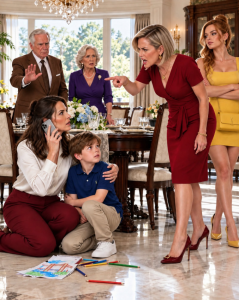
She dropped the sketchbook onto the floor and deliberately stepped on it with her high heel.
The sound of tearing paper made Noah gasp.
“Stop!” he cried, bending down to rescue his drawings.
As he reached for the pages, Vanessa shoved his shoulder aside impatiently. He stumbled backward, struck the edge of a dining chair, and fell hard onto the polished marble floor.
His elbow hit the ground first.
Then came the sound of his frightened scream.
“Mommy! It hurts!”
I was out of my chair before anyone else moved. I dropped to my knees beside him and gently checked where he was holding his arm.
“Noah, sweetheart, don’t try to get up. I’m right here.”
His face had turned pale, and tears streamed down his cheeks.
“I didn’t do anything wrong, Mommy. I only wanted my pictures.”
Those words broke something inside me.
I looked around the table, expecting someone to help. Instead, my mother hurried toward Vanessa.
“Are you all right, darling? Did he scratch your dress?”
My father pointed at Noah.
“Why was he crawling around under the table in the first place?”
I stared at him in disbelief.
“He’s hurt!”
Vanessa crossed her arms. “He tripped. I barely touched him. If you hadn’t raised such a sensitive child, we wouldn’t have this ridiculous scene.”
I pulled out my phone and called for emergency medical assistance.
Vanessa’s expression changed immediately.
“Are you seriously calling an ambulance over a little fall?”
“My son is in pain, and I’m not taking chances with his arm.”
“You’re trying to ruin my engagement party!” she shouted.
Richard, her wealthy fiancé, finally approached. I thought he might ask whether Noah was okay, but instead he looked toward the guests.
“Can we please keep this quiet? There are important people here.”
I slowly lifted my eyes to him.
“An injured child is not a public relations problem.”
His face hardened.
My father stepped closer and lowered his voice.
“Evelyn, hang up the phone. We can handle this privately. You don’t want to create trouble for your sister on the most important day of her life.”
I refused.
For the first time in my life, I didn’t care whether my parents were disappointed in me.
While I stayed beside Noah, I heard Vanessa whisper to our mother, “Tell everyone he fell by himself. Nobody needs to mention that I touched him.”
My mother hesitated before nodding.
Then my father added, “And nobody should exaggerate anything if someone asks questions. We are a respectable family.”
I looked at them, one by one.
Not one of them had asked Noah how much pain he was experiencing. Not one had apologized. Their only concern was protecting Vanessa from embarrassment.
The ambulance arrived several minutes later, and the paramedics carefully assessed Noah before taking him for further medical evaluation. I accompanied him, holding his uninjured hand while he tried to stop crying.
“Mommy,” he whispered during the journey, “does Aunt Vanessa hate me?”
I swallowed the lump in my throat.
“No, sweetheart. But sometimes grown-ups make terrible choices, and that is never your fault.”
He looked toward the window.
“Grandma didn’t even help me.”
I had no answer that could make that pain disappear.
At the hospital, the doctors examined his arm and arranged the necessary tests. I stayed beside him, speaking softly and reassuring him until he finally relaxed enough to rest.
While waiting for the results, I received a message from my father.
You need to think carefully about what you’re doing. Vanessa has a wedding to plan, and we will not allow you to destroy her future over a misunderstanding.
A second message followed from my mother.
Please don’t make this public. Family matters should stay within the family.
Then Vanessa sent one of her own.
If you turn this into a legal problem, don’t expect us to ever forgive you.
I read the messages twice before locking my phone.
They believed I was threatening them because I wanted revenge. They didn’t understand that I was simply protecting my child.
There was another secret they had never bothered to discover.
For twelve years, they had assumed I worked as a low-level legal assistant in a downtown office. In reality, I had spent years studying law, practicing in demanding legal roles, and building a respected career. I had recently been appointed to a senior position overseeing major legal cases, and I had also become the majority owner of a legal consulting firm.
I had never hidden my achievements out of shame. I had hidden them because I wanted a life that belonged to me, not a life in which every family conversation became a calculation of money, influence, and status.
I had never used my position to get special treatment, and I would not start now.
Any matter involving Vanessa would have to be handled by the proper authorities, independently of my career. My responsibility as Noah’s mother was to make sure the truth was documented and that he received the care he needed.
Later that evening, the doctor returned with the results. Noah had sustained a fracture in his arm and would need a cast and follow-up appointments.
I sat beside his bed, gently brushing his hair away from his forehead.
“You’ll be all right,” I told him.
He nodded, but his eyes filled with tears again.
“Can we stop visiting Grandma and Grandpa?”
I took his hand.
“Yes, sweetheart. We don’t have to keep going somewhere you feel unwanted.”
That night, I made three phone calls. The first was to arrange Noah’s follow-up care. The second was to my attorney, asking for guidance on preserving relevant records and handling the incident appropriately. The third was to a trusted family friend who had attended the gathering and might have witnessed what happened.
I didn’t ask anyone to change their story. I didn’t demand that anyone punish Vanessa. I simply wanted the facts preserved before my relatives could pressure everyone into silence.
What I didn’t yet know was that Vanessa had already begun contacting guests, telling them that Noah had caused the accident himself.
By the following morning, my family had transformed a frightened little boy into the supposed villain of their story.
And then my father made his biggest mistake.
He called me and said, “If you insist on making accusations, we’ll make sure everyone knows exactly what kind of mother you are.”
I looked at Noah sleeping beside me, his small arm resting carefully on a pillow.
For twelve years, I had stayed silent to preserve the peace.
But this time, the peace they wanted required my son to carry the blame for someone else’s actions.
I took a deep breath.
“Do whatever you think you need to do, Dad,” I replied. “But from now on, you will not decide what my son deserves.”
Then I ended the call.
I had no intention of using my career, my money, or my connections to frighten my relatives. I was going to let the facts speak for themselves.
And when my father learned that one of the guests had recorded the confrontation on a phone, the entire family’s carefully rehearsed story began to unravel.
PART 2 — The Video That Destroyed Their Perfect Story
Three days after the incident, Noah returned home wearing a blue cast on his arm. He was quieter than usual, and every time the doorbell rang, he looked toward me with nervous eyes, as though he expected someone from my family to appear and blame him again.
I hated seeing him afraid in his own home.
I had spent years trying to maintain a relationship with my parents because I believed children deserved to know their grandparents. I had swallowed countless insults, excused Vanessa’s selfishness, and pretended that my mother’s constant comparisons were harmless. I had even allowed my family to believe I was struggling financially because I didn’t want another argument about my life choices.
But watching Noah struggle to understand why his own relatives had treated him so cruelly made me question every sacrifice I had made for them.
On Wednesday morning, I received a call from my father’s attorney.
He introduced himself as Mr. Harrison and spoke with the confidence of someone accustomed to getting his way.
“Ms. Carter, your father has asked me to contact you regarding Sunday’s unfortunate incident.”
“Is Noah’s condition the reason for your call?” I asked.
There was a brief silence.
“Well, your father would prefer to settle this family misunderstanding without unnecessary complications.”
I looked at the medical paperwork on my desk.
“What exactly does he want to settle?”
“He believes your sister has been unfairly accused of injuring your son. Several guests have confirmed that the boy fell accidentally. Your family hopes you will agree to put this matter behind you.”
I closed my eyes for a moment.
“My son suffered a fracture. I reported what I witnessed. If your client has information to provide, he can submit it through the appropriate channels.”
Mr. Harrison’s tone became less friendly.
“Perhaps you should consider the consequences of making allegations against a prominent family.”
I almost laughed.
For years, my family had used those exact words whenever they wanted me to surrender.
“Thank you for calling,” I replied. “Please direct any further legal communications through the appropriate process.”
I ended the conversation.
Less than an hour later, my sister called.
“How dare you speak to Dad’s lawyer like that?” Vanessa shouted.
“I spoke to him respectfully.”
“You made him look foolish!”
“Vanessa, I have no interest in arguing with you.”
“Then withdraw your accusations.”
“I reported what happened to my son. I’m not going to change the facts to protect you.”
She let out a bitter laugh.
“You think you’re so much better than everyone. You always have. You hide behind your little office job, pretend you’re important, and now you’re trying to destroy my wedding.”
I remained silent.
She had no idea how wrong she was about my career, but I wasn’t going to reveal it during an argument.
“You’re making a mistake, Evelyn,” she continued. “Richard knows important people. My future in-laws know judges, politicians, and business leaders. You have no idea who you’re going up against.”
“Then you should have nothing to worry about if the facts support your story.”
I hung up.
That afternoon, my attorney contacted me with an important update. A guest from the engagement party had come forward with a video recorded shortly before Noah fell.
The guest was Richard’s younger cousin, Daniel.
He had been standing near the dining room entrance, recording a short video of the decorations because he wanted to show his fiancée the beautiful arrangement later. He hadn’t intended to capture an argument, but his phone had recorded much more than he realized.
The video showed Vanessa taking Noah’s sketchbook, laughing at his drawings, and stepping on the pages. It also captured her grabbing his shoulder and pushing him aside just before he fell.
The audio was clear enough to hear Noah asking her to stop.
Most importantly, it showed that several adults had been standing nearby when the incident happened.
They had seen what occurred.
And they had done nothing to help him.
Daniel had initially hesitated to share the recording because he feared upsetting his relatives. But after hearing that Noah had suffered a fracture, he decided he couldn’t remain silent.
My attorney explained that the video should be preserved in its original form and provided through the appropriate process. I agreed.
I didn’t want to post it online or turn my son’s pain into entertainment. I wanted the truth handled responsibly.
Unfortunately, my family had other plans.
That evening, my mother published a long message on social media about the importance of protecting children from overprotective parents. She never mentioned Noah by name, but everyone who knew us understood exactly whom she meant.
She wrote that some parents taught their children to exaggerate minor accidents and use emotional manipulation to get attention.
Vanessa shared the post with a caption.
Some people would rather destroy a family than admit their children can make mistakes.
Within hours, relatives began sending me messages.
One aunt accused me of being vindictive. A cousin told me to apologize to Vanessa before the situation became worse. Another relative warned me that my father was considering taking action against me for damaging the family’s reputation.
I didn’t respond to any of them.
Instead, I sat beside Noah while he worked on a new drawing with his good hand.
He was drawing a small house with a garden, two trees, and a little boy standing beside a woman.
“Who’s that?” I asked gently.
“That’s me and you.”
“And where is the house?”
He smiled faintly.
“It’s our new house. The one where nobody shouts at us.”
My chest tightened.
We already lived in a comfortable home, but hearing my son describe safety as a place without shouting made me realize how much the incident had affected him.
I hugged him carefully.
“Then that’s exactly the kind of home we’ll have, sweetheart.”
The following Friday, my father organized an emergency family meeting at his mansion.
He called every close relative and several of the guests who had attended the engagement party. His stated purpose was to clear up the misunderstanding before Vanessa’s wedding invitations were sent out.
My mother called me personally.
“Your father wants you to attend,” she said. “You need to apologize to your sister and stop this nonsense.”
“Will Vanessa apologize to Noah?”
“Why must you make everything about that child?”
I went completely still.
“Because he’s the child who was hurt, Mom.”
She sighed impatiently.
“Your sister has a future to protect. She is marrying into a respected family. You should be happy for her instead of creating problems.”
I looked at the calendar on my wall.
“Noah has a follow-up appointment that afternoon. I won’t be attending.”
My mother lowered her voice.
“Then don’t complain when the family stops inviting you to anything.”
For the first time, I felt relief rather than fear.
“All right, Mom.”
I ended the call.
But the family meeting went ahead without me, and Daniel attended with the original recording on his phone.
According to what I learned later, my father began by describing the incident as a minor accident caused by Noah’s carelessness.
Vanessa cried at precisely the right moments.
My mother insisted that I had always been jealous of my sister.
Several relatives nodded along.
Then Daniel stood up.
“I think everyone should see what actually happened.”
He played the video.
The room became silent.
My father watched Vanessa step on Noah’s drawing. He watched her shove the boy away. He watched Noah fall and cry while the adults rushed to protect Vanessa’s reputation.
When the recording ended, nobody spoke for several seconds.
Daniel turned toward my sister.
“Why did you tell everyone he fell by himself?”
Vanessa’s face turned red.
“That video doesn’t show everything!”
“It shows you pushing him.”
“I was trying to move him out of the way!”
“He was picking up his drawing!”
Richard, who had been sitting beside Vanessa, slowly stood up.
“Vanessa, you told me you never touched him.”
She looked at him desperately.
“Richard, please. It was an accident.”
“Then why did you tell everyone something different?”
She had no answer.
My father quickly intervened.
“We don’t need to turn this into a courtroom. Families have disagreements. We can resolve this privately.”
Daniel shook his head.
“An eight-year-old child was injured, and you all tried to blame him. That isn’t a misunderstanding.”
My mother began crying.
Not because Noah had been hurt, but because the family secret she had helped protect was now known to everyone in the room.
The meeting ended in chaos.
Richard left the mansion without telling Vanessa when he would return. Several guests demanded that the family stop spreading false claims about the incident. Two relatives who had initially supported Vanessa admitted they had not actually witnessed the fall.
But the greatest shock came the following Monday.
My father received formal notice that the conflicting accounts of the incident were being reviewed. He had assumed that his social influence would make the matter disappear. Now he was being asked to clarify statements he had encouraged others to give.
He called me repeatedly.
I didn’t answer until the sixth attempt.
“Did you arrange this?” he demanded as soon as I picked up.
“Arrange what?”
“The review. The questions. The people suddenly changing their stories!”
“I haven’t asked anyone to do anything, Dad. I told the truth about what I witnessed, and other people are responsible for their own statements.”
“You know people in the legal system!”
I paused.
“How would you know who I know? You’ve never asked what I actually do for a living.”
He went quiet.
Then he said something that revealed just how little he understood me.
“Whatever your job is, it isn’t important enough to challenge this family.”
I looked out the window at the trees moving gently in the wind.
For twelve years, I had wanted my father to recognize my worth.
Now I understood that his approval had never been a reliable measure of it.
“Goodbye, Dad,” I said.
I ended the call.
That night, I made a decision. I would no longer hide my life to make my family feel comfortable, and I would no longer accept mistreatment in exchange for invitations to their gatherings.
However, I would also not use my professional position to influence the matter involving Vanessa. I would let the appropriate officials evaluate the evidence independently.
My family had spent years believing that my silence meant weakness.
They were about to discover that silence could also mean patience.
And patience, once exhausted, did not require revenge.
It required boundaries.
PART 3 — The Secret Behind My Ordinary Life
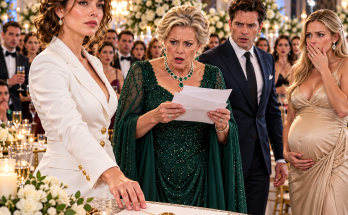
Two weeks later, my father sent me a formal invitation to a charity gala celebrating the opening of a new community legal center.
The event was being held at one of the city’s most prestigious hotels. Business leaders, public officials, attorneys, and charitable organizations would be attending.
At first, I thought the invitation had been sent by mistake.
Then I noticed the handwritten message at the bottom.
Evelyn, please attend. We need to discuss the future of this family.
I almost declined.
But I knew why my father wanted to see me. After the video surfaced, several people had begun questioning his version of events. Vanessa’s wedding plans were on hold, and Richard had asked for time to reconsider their relationship.
My father was desperate to restore the family’s reputation.
He still believed that if he could control the conversation, he could control the outcome.
What he didn’t know was that I had been invited to the gala months earlier as one of the featured legal professionals supporting the community center.
My name appeared on the official program.
My photograph was included in the event brochure.
And I was scheduled to give a short address about equal access to justice and the importance of protecting vulnerable people.
I had not told my family because the invitation had nothing to do with them.
But this time, I decided I would attend.
Not to embarrass anyone.
Not to threaten Vanessa.
And certainly not to make the incident involving Noah about my career.
I was going because I had spent years allowing my family to define me, and I was finally ready to stop living according to their assumptions.
On the evening of the gala, I wore a simple, elegant navy-blue dress and a pair of understated earrings. I left Noah at home with a trusted caregiver, explaining that I would return before his bedtime.
When I arrived at the hotel, the entrance was filled with photographers and guests dressed in formal clothing.
I checked in at the reception desk, where an event coordinator greeted me warmly.
“Good evening, Judge Carter. We’re delighted you could join us.”
I thanked her and proceeded toward the ballroom.
Across the room, my father was speaking with two business associates. My mother stood beside him in a silver gown, while Vanessa wore an expensive champagne-colored dress.
Richard was nowhere to be seen.
My father noticed me first.
He looked surprised that I had come, then motioned impatiently for me to approach.
“There you are,” he said. “We need to talk before this evening gets out of hand.”
I glanced around.
“What exactly are you worried about?”
He lowered his voice.
“People have been asking questions about the incident. I want you to tell them it was a misunderstanding. You can say that you overreacted because you’re protective of Noah.”
I stared at him.
“You want me to lie?”
“I want you to stop making this family look terrible.”
“Then stop asking me to lie.”
His jaw tightened.
Vanessa stepped between us.
“You have no idea how much damage you’ve caused me.”
I looked at her calmly.
“I didn’t make the video, Vanessa. I didn’t tell you to push Noah. And I didn’t tell you to deny what happened.”
She scoffed.
“You’ve always been jealous of me. You couldn’t stand seeing me happy.”
For a moment, I remembered being eighteen years old, standing in our childhood kitchen while my parents handed Vanessa the keys to her first car. I remembered working late shifts to pay my tuition. I remembered my mother asking me to stop talking about my scholarship because it made Vanessa feel uncomfortable.
I had spent years wondering what I needed to do to earn the same respect my sister received automatically.
Now I realized I had been asking the wrong question.
I didn’t need to become more impressive to deserve respect.
I needed to stop accepting disrespect as the price of belonging.
Before I could answer, a woman in a formal black suit approached us.
“Judge Carter, they’re ready for you backstage.”
My father frowned.
“Judge Carter?”
The woman smiled politely.
“Yes. The opening remarks begin in five minutes.”
Vanessa looked from the woman to me.
“What is she talking about?”
I didn’t answer immediately.
The coordinator continued, “Your introduction is printed in the program, Your Honor. The committee is very proud to have you as our guest speaker.”
My mother went pale.
My father stared at me as though he were seeing a stranger.
“Your Honor?” he repeated.
I took a breath.
“My name is Evelyn Carter. I serve as a federal district judge.”
For several seconds, nobody moved.
Vanessa let out a short, disbelieving laugh.
“That’s impossible. You work in an office!”
“I have worked in the legal profession for many years. I was appointed to the bench recently.”
My father shook his head.
“Why didn’t you tell us?”
I looked directly at him.
“When I earned my law degree, you barely asked about it. When I began building my career, Mom told me to stop talking about my achievements because they made Vanessa uncomfortable. Eventually, I realized that you were interested in my life only when it could be compared with hers.”
My mother looked down.
Vanessa’s voice trembled.
“So you deliberately hid this from us?”
“I didn’t hide it to punish you. I kept my professional life private because I wanted it to be mine.”
My father glanced around the ballroom, suddenly aware that several guests were watching us.
“Well, this changes everything,” he said quickly. “We should have a proper family photograph. People need to know about your achievement.”
I almost smiled at the predictability of his reaction.
A few minutes earlier, he had wanted me to apologize for protecting my injured child. Now that he knew my title, he wanted to stand beside me.
“Dad, my appointment doesn’t change what happened to Noah.”
His expression hardened.
“You cannot seriously expect your own sister to face consequences after a single mistake.”
“I’m not deciding what consequences she faces. That’s not my role in this matter. The relevant facts must be considered by the appropriate people.”
“Then you can at least speak to someone and explain that we’re a good family.”
I shook my head.
“I will not use my position to influence a matter involving my relatives.”
For the first time, my father seemed unable to find an argument.
I excused myself and walked toward the stage.
The room gradually quieted as the event host introduced the evening’s speakers. When my name was announced, I stepped into the light and looked out at the audience.
My parents and sister sat near the front.
I could see their expressions, but I did not allow them to distract me.
I spoke about the importance of fairness, the responsibility of public institutions, and the need to protect people who might otherwise be ignored because they lacked wealth or influence.
I did not mention my family.
I did not mention Vanessa.
And I did not use the occasion to defend myself.
I simply spoke about the principles that had guided my career.
When I finished, the audience applauded.
Several people approached me afterward to discuss the community center’s work. Others thanked me for my remarks.
My father waited until the crowd had thinned before approaching.
“Evelyn, we should celebrate this properly,” he said. “Your mother can organize a dinner. Invite everyone. We can tell the family about your appointment.”
I looked at him.
“Why now?”
He blinked.
“What do you mean?”
“You didn’t ask about my career when you believed I was an ordinary employee. You didn’t ask about my work when I spent years studying and building my life. You only became interested when you discovered my title.”
“That’s not fair.”
“Neither was what happened to Noah.”
He looked away.
For once, he had no ready response.
Then he asked the question I had been waiting years to hear, although not in the way I had imagined.
“Do you really think we’re terrible parents?”
I took a moment before answering.
“I think you’ve made choices that hurt me. And I think you made choices that hurt my son. What happens next depends on whether you’re willing to acknowledge those choices instead of blaming everyone else.”
My mother approached, her eyes filled with tears.
“We didn’t know you were so successful.”
I nodded.
“That’s exactly the problem, Mom. You didn’t know because you never asked.”
She began to cry harder.
“We’re still your parents.”
“Yes,” I replied. “And I’m still your daughter. But being family doesn’t mean you can treat me or my child however you want.”
Vanessa stood a few feet away, listening.
For a moment, I thought she might apologize.
Instead, she whispered, “I never thought you’d become someone this important.”
I looked at her sadly.
“I was always someone important, Vanessa. You just never thought to look.”
Then I left the conversation and returned to the reception.
The following weeks were difficult for my family. The incident involving Noah continued to be handled through the appropriate channels, and the conflicting statements were reviewed independently. I did not participate in any decisions about my relatives, nor did I ask anyone to give them special treatment.
Vanessa eventually sent me a message admitting that she had treated Noah cruelly and had been wrong to deny her actions.
Her apology was brief.
I shouldn’t have pushed him. I was angry, and I took it out on a child. I’m sorry.
I read it carefully before responding.
Thank you for acknowledging what happened. Noah needs time, and any relationship with him must begin with genuine accountability and respect for his boundaries.
I did not promise to restore our old relationship.
Forgiveness, I had learned, was not the same as pretending nothing had happened.
Richard later ended his engagement to Vanessa. I never asked him why, and I never celebrated her disappointment. Their relationship was theirs to resolve.
My parents, however, continued to struggle with the consequences of their decisions. Some relatives stopped attending family gatherings, while others began questioning the stories they had accepted without evidence.
For the first time, my father could no longer rely on his reputation to make everyone agree with him.
Several months passed before my mother asked whether she could visit Noah.
I discussed it with him first.
“Do you want Grandma to come over?” I asked.
He considered the question for a long time.
“Will she be nice to me?”
“She must be respectful. And if you feel uncomfortable, we can end the visit.”
He nodded slowly.
“Okay. But I don’t want Aunt Vanessa to come yet.”
I respected his decision.
When my mother arrived, she brought a small box of colored pencils and a sketchbook. She sat beside Noah at the kitchen table and apologized for failing to help him when he was hurt.
It wasn’t a perfect apology, and it didn’t erase what had happened.
But it was the first time she had acknowledged his feelings without blaming me.
Noah accepted the sketchbook but remained cautious.
Trust would have to be rebuilt through actions, not expensive gifts or emotional speeches.
As for me, I returned to my work and continued raising my son in the peaceful home we had promised each other.
One evening, I found Noah sitting at the dining table, drawing another house.
This time, it had enormous windows, a garden filled with flowers, and a wide front door.
“Is this our house again?” I asked.
He smiled.
“No. It’s a house for children who don’t have anywhere safe to go.”
I sat beside him.
“That’s a wonderful idea. What will you put inside?”
“A library. And a big room where kids can draw pictures without anyone ruining them.”
I felt tears gathering in my eyes.
“Then I hope you build it someday.”
He leaned against me carefully.
“Will you help me?”
“Every step of the way.”
That night, after he went to bed, I stood by the window and thought about everything that had changed.
For years, I had believed that keeping my family together meant tolerating their behavior. I had confused silence with loyalty and endurance with love.
But the truth was much simpler.
Family should never require a child to accept humiliation. Success should never be necessary to earn basic respect. And a person’s title should never determine whether their pain matters.
My family had finally discovered that I was a judge, but that was not the secret that changed our lives.
The real secret was that I had never needed their approval to become the woman I was.
And the greatest victory wasn’t watching my father lose his confidence or seeing my sister face the consequences of her actions.
It was watching my son begin to smile again.
Because in the end, I didn’t need to prove that I was more powerful than my family.
I only needed to prove to my child that no matter how wealthy, influential, or important someone appears, nobody has the right to make him feel that he is worth less than anyone else.