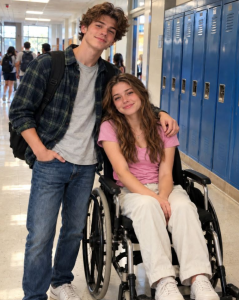
PART 1: The Empty Guitar Stand and the Secret My Son Kept
My thirteen-year-old son sold his favorite guitar, his beloved gaming console, and nearly all his savings to buy a wheelchair for a classmate who struggled to move around school. I thought his sacrifice was the most extraordinary thing I would ever discover about him. Then, at seven o’clock the next morning, two police officers knocked on our front door, asked for my son by name, and told me, “Mrs. Vance, your son has become part of something much bigger than he realizes.” I looked at Julian, whose face had suddenly turned white, and wondered what else my child had done without telling me.
My name is Sarah Vance, and until that morning, I believed I knew almost everything about my son. Julian was quiet around strangers but endlessly talkative at home. He loved music, especially classic rock, and spent hours in his bedroom learning difficult guitar solos. He wasn’t the kind of boy who demanded expensive clothes or begged for the newest gadgets. When he wanted something, he saved his allowance and waited patiently until he could afford it.
His electric guitar was different from every other possession he owned.
It was a blue Fender Stratocaster with a glossy finish that reflected the light from his bedroom window. His father, Daniel, and I had saved for months to buy it for his twelfth birthday. We had given up weekend takeout, postponed replacing our aging television, and tucked away every spare dollar until we finally had enough.
When Julian opened the case, he stared at the guitar for several seconds before throwing his arms around us.
“You actually got it for me?” he whispered.
His father laughed. “No, we got it for the neighbor’s cat. Of course it’s yours.”
Julian laughed so hard that tears filled his eyes.
From that day forward, the guitar became his greatest treasure. He polished it carefully, changed its strings himself, and even made a handwritten list of songs he hoped to learn before turning fifteen.
I sometimes stood outside his bedroom and listened to him practice. His playing wasn’t perfect, but I loved hearing him improve. Every missed note was followed by another attempt, and every small success brought a quiet, satisfied smile.
I never imagined that one day he would willingly sell that guitar.
The first sign that something was wrong came on a Thursday afternoon.
I was folding laundry when I noticed Julian’s bedroom door standing open. His schoolbag lay beside his desk, his sneakers were scattered near the closet, and his music notebook was open on the bed.
But the guitar stand beside his desk was empty.
At first, I thought he had taken the instrument to school for a music club rehearsal. Then I noticed that his gaming console was missing, too.
I walked downstairs and checked the living room, then the storage closet. Nothing.
When Julian arrived home, I was waiting in the kitchen.
“Sweetheart, where’s your guitar?”
He stopped halfway through removing his backpack.
For a moment, he looked as though he hadn’t heard me.
“Julian?”
He lowered his eyes.
“I sold it, Mom.”
The words seemed to hang in the air between us.
“You did what?”
“I sold my guitar.”
I placed the dish towel on the counter.
“Why would you do that? You love that instrument. You saved for years to buy your first amplifier, and you wouldn’t even let your cousins touch it without asking.”
His shoulders slumped.
“I know.”
“Then tell me what happened.”
He took a long breath before answering.
“It’s because of Maya.”
Maya Bennett was a girl in Julian’s eighth-grade class. She was thirteen, had long brown hair, and possessed the kind of smile that could brighten a gloomy room. She loved science, drew little cartoons in the margins of her notebooks, and wanted to become a veterinarian someday.
Maya had used a wheelchair since she was little.
I had seen her at school events, usually surrounded by friends who helped carry her books or held doors open when the hallways became crowded. She rarely complained, even when something clearly made her uncomfortable.
I knew she had a difficult time getting around the older school building, but I hadn’t realized how serious the problem had become.
Julian pulled out a chair and sat down.
“Her wheelchair keeps breaking,” he explained. “The front wheel gets stuck when she tries to turn, and the brakes don’t always hold properly. The cushion is worn out, too.”
“Doesn’t the school know?”
“They know. The teachers help when they can, but they can’t replace her chair.”
He rubbed his palms against his jeans.
“Maya’s dad has been working extra shifts, and her mom has missed work taking her to appointments. They have a lot of medical bills. She told me they were trying to save for a replacement, but the one her therapist recommended costs more than they can afford right now.”
I felt a knot form in my stomach.
“Did Maya ask you for money?”
“No.” Julian answered so quickly that I knew the question had embarrassed him. “She never asked anyone for anything.”
He explained that the decision had started the previous Monday.
Maya’s wheelchair had jammed outside the school library. Several students had walked past while she struggled to free the front wheel. One boy had imitated the squeaking noise, and a few others had laughed.
Julian had been standing nearby.
He told me that Maya had smiled and pretended the joke didn’t bother her. Then she had asked him to help push her to class because she was already late.
That afternoon, Julian had walked home thinking about the incident.
“I kept remembering her face,” he said. “She was trying so hard not to cry.”
He paused before continuing.
“I asked her if she was okay the next day, and she said she was fine. But then she told me she sometimes stayed home when her chair wasn’t working properly because she didn’t want everyone watching her struggle.”
My heart ached for that little girl.
“What happened after that?”
“I searched online for wheelchairs like the one her therapist recommended. I found a place that had one available. It was fourteen hundred dollars, including the delivery and adjustments.”
I stared at him.
“Julian, that’s an enormous amount of money.”
“I know.”
“And you thought selling your guitar would cover it?”
He nodded.
“I called a music shop and asked how much they’d pay for it. They offered me enough to get started. Then I sold my gaming console and some games to another student.”
I closed my eyes briefly.
“You sold your PlayStation, too?”
“And my birthday savings.”
“How much did you have saved?”
“Three hundred and twenty dollars.”
I sat down opposite him.
The guitar had been worth several hundred dollars. His console and games had cost another considerable amount. Together with his savings, he had sacrificed almost everything he owned that could be sold.
“Why didn’t you come to us?” I asked gently. “Your father and I could have helped.”
Julian’s eyes filled with tears.
“Because I didn’t want to wait, Mom. I know you would have tried to help, but I thought we’d have to ask the school, organize a fundraiser, and wait for everyone to decide what to do.”
He looked at his hands.
“Maya can’t wait forever for people to notice that she needs help.”
I didn’t know whether to feel proud, worried, or heartbroken.
Part of me was upset that he had sold valuable belongings without asking permission. He was thirteen, and we had always taught him that major decisions required a conversation with his parents.
But another part of me understood that he had acted out of compassion rather than selfishness.
I moved closer and hugged him.
“You should have talked to us,” I whispered. “But I want you to know something. I’m incredibly proud of the person you’re becoming.”
He held me tightly.
“I can buy another guitar someday.”
I brushed his hair away from his forehead.
“Yes, you can.”
“But Maya needs this now.”
That evening, Julian told me that the wheelchair had been ordered through a local medical equipment provider. He had worked with Maya’s parents to confirm the model and measurements, making sure he wasn’t buying something unsuitable for her needs.
The delivery was scheduled for the following morning.
He wanted the entire thing to be a surprise.
I agreed to keep the secret, although I insisted that we would discuss his decision to sell his belongings properly after Maya received the chair.
At dinner, his father listened to the story in silence.
When Julian finished, Daniel set down his fork and looked at our son.
“Do you know what bothers me most?” he asked.
Julian’s face fell.
“What?”
“That you thought you had to carry this burden alone.”
My husband reached across the table and squeezed his hand.
“You don’t have to sell everything you love to prove that you care about somebody. Your mother and I are here. Next time, bring us into the problem, and we’ll find a way to help.”
Julian nodded.
Then Daniel smiled.
“But for what it’s worth, son, that’s a mighty good reason to give something up.”
For the first time all evening, Julian smiled back.
I thought that was the end of the story.
I thought the next morning would bring a happy surprise, a new wheelchair, and a little girl who could finally move around her school more comfortably.
I had no idea that someone had already discovered what Julian had done.
And I certainly didn’t know that two police officers would arrive before breakfast.
At exactly seven o’clock the next morning, three firm knocks shook our front door.
I hurried downstairs, still wearing my dressing gown.
When I opened it, two uniformed police officers stood on the porch.
“Good morning,” the taller officer said. “Are you Sarah Vance?”
“Yes. Is something wrong?”
“My name is Officer Daniels, and this is Officer Cooper. We need to speak with you about your son, Julian.”
My stomach dropped.
Behind me, I heard footsteps on the stairs.
Julian appeared in the hallway wearing his gray sweatshirt and pajama trousers. The moment he saw the uniforms, all the color drained from his face.
“Mom,” he whispered, “what’s happening?”
I immediately took his hand.
“Officers, please tell me what this is about.”
Officer Cooper glanced at Julian, then back at me.
“Your son isn’t under arrest, and he’s not accused of a crime. But something happened yesterday involving a wheelchair purchase, and we received a call last night that we need to follow up on.”
I felt my knees weaken with relief, but confusion quickly replaced it.
“A wheelchair? You mean the one he bought for his classmate?”
Officer Daniels nodded.
“That’s correct. But there’s something about that purchase that your son may not have told you.”
I turned toward Julian.
He looked genuinely confused.
“Sweetheart, what else happened?”
He shook his head.
“I don’t know.”
Officer Daniels took a small envelope from his jacket.
“Mrs. Vance, we’d like you and Julian to accompany us to the community center near Westbrook Middle School. Maya’s father is waiting there, along with someone who specifically requested to meet your son.”
“Who?” I asked.
The officer looked at Julian with an expression I couldn’t quite understand.
“Someone who heard what he did and believes there’s something important he needs to know.”
Julian squeezed my hand.
And as I followed the officers toward their patrol car, I realized that the kindness my son had shown Maya might have set something much larger in motion.
Something none of us had expected.
PART 2: The Secret Maya’s Father Had Been Keeping
The drive to the community center took less than fifteen minutes, but it felt much longer.
I sat in the back seat beside Julian, holding his hand while the morning traffic moved slowly through our neighborhood. Officer Daniels drove, and Officer Cooper sat in the passenger seat, occasionally glancing at a folder resting on his knees.
Neither officer seemed angry.
That somehow made me even more nervous.
If Julian had done something wrong, I could at least have asked what had happened. Instead, I was trapped in a maze of unanswered questions.
“Officer Daniels,” I finally said, “you told me my son isn’t in trouble. Can you please explain why we’re being brought here?”
He glanced at me through the rearview mirror.
“Mrs. Vance, I understand your concern. We received a call from a family who wanted to make sure a young person received proper recognition for an act of kindness. There was also a misunderstanding involving the purchase that needed to be clarified.”
“A misunderstanding?”
“Yes. That’s all I can tell you before we speak with everyone involved.”
Julian looked at me.
“I swear, Mom, I didn’t steal anything.”
“I know, sweetheart.”
“And I didn’t lie to Maya’s parents.”
“I know.”
But even as I reassured him, I wondered what the officers meant by a misunderstanding.
Had the shop reported the guitar sale? Had someone accused him of taking money? Had Maya’s parents become upset because he had spent so much on their daughter?
When the patrol car finally pulled into the community center parking lot, I saw Maya’s father standing near the entrance.
His name was Thomas Bennett.
He was a tall man in his early forties with tired eyes and work boots that looked as though they had seen years of long shifts. I remembered meeting him briefly at a school event, where he had thanked volunteers for helping with a science fair.
That morning, he looked as if he hadn’t slept.
The moment Julian stepped out of the car, Thomas walked toward him.
“Julian,” he said, his voice breaking slightly.
Julian stopped.
“Mr. Bennett?”
Thomas placed both hands on my son’s shoulders.
“Son, I don’t even know how to thank you.”
Julian looked uncomfortable.
“You don’t have to thank me, sir. I just wanted Maya to have a better wheelchair.”
Thomas closed his eyes for a moment.
Then he pulled Julian into a hug.
My son stood stiffly at first, surprised by the gesture. A second later, he hugged Thomas back.
When they separated, Thomas wiped his eyes.
“Your mother needs to hear the whole story,” he said. “And so do you.”
He led us inside.
The community room was brighter than I expected, with sunlight pouring through large windows and folding chairs arranged in a semicircle. A few people stood near a table covered with coffee, fruit, and pastries.
Maya was there.
She sat in a brand-new wheelchair, its dark blue frame gleaming beneath the overhead lights. The seat was properly fitted, the wheels moved smoothly, and a small backpack hung from the back.
She looked happier than I had ever seen her.
When she noticed Julian, her face lit up.
“Julian!”
He hurried toward her.
“Hey! How does it feel?”
“It’s amazing!” she exclaimed. “Look!”
She maneuvered the chair forward, turned smoothly, and came to a stop beside him.
“Look how easily it turns! And the brakes actually work properly!”
She laughed, and the sound filled the room.
Then her expression softened.
“Thank you.”
Julian rubbed the back of his neck.
“You’re welcome.”
“I mean it,” she continued. “I can get through the school doors without asking someone to pull me. I can move around the library by myself again.”
Her eyes grew watery.
“I don’t feel like everyone has to rescue me anymore.”
Julian’s smile faded into something gentler.
“You never needed rescuing, Maya. You just needed a chair that worked.”
Maya stared at him for a moment before reaching for his hand.
“I’m really glad you’re my friend.”
I pressed my fingers against my lips.
I had expected gratitude, perhaps a few tears. I hadn’t expected those words to reveal just how much independence Maya had lost because of a piece of equipment that no longer worked properly.
Then I noticed the older man standing beside Thomas.
He wore a dark gray suit, carried a leather briefcase, and looked to be in his late sixties. His silver hair was neatly combed, and he held a folded piece of paper in his hands.
Thomas turned toward us.
“Sarah, Julian, this is Mr. Robert Hayes. He runs the Hayes Community Foundation.”
I recognized the name.
The foundation funded scholarships, supported local charities, and occasionally paid for medical equipment for families who couldn’t afford it.
But I still didn’t understand why its director was standing in a community center with two police officers.
Mr. Hayes stepped forward and offered his hand.
“Mrs. Vance, it’s a pleasure to meet you. Julian, I’ve heard quite a bit about you.”
Julian shook his hand nervously.
“Sir, did I do something wrong?”
Mr. Hayes smiled.
“No, young man. In fact, you did something so remarkable that several people spent last night trying to find a way to thank you properly.”
He invited us to sit.
Then Thomas began explaining what had happened after the wheelchair arrived.
The delivery had taken place the previous afternoon. Maya’s parents had been stunned when they discovered that the chair was already paid for.
At first, they assumed there had been a mistake.
When Maya explained that Julian had used the money from selling his guitar, gaming console, and savings, Thomas had become overwhelmed.
He had wanted to return the money immediately.
But Julian had explained that the purchase had been made voluntarily and that he only wanted Maya to have a chair that allowed her to participate fully in school.
Thomas had then called the medical equipment provider to confirm the payment and ensure everything had been handled correctly.
That call had led to an unexpected discovery.
The provider was connected to a local charitable program that worked with the Hayes Community Foundation. When an employee learned that a thirteen-year-old boy had sold his treasured possessions to purchase the wheelchair, she mentioned the story to her supervisor.
The supervisor contacted the foundation.
And the foundation director, after hearing the details, asked Thomas if he could meet Julian.
“Why?” I asked.
Mr. Hayes opened his briefcase.
“Because this wasn’t the first time Maya’s family had needed help, and it wasn’t the first time someone had tried to make sure she received it.”
He took out a photograph.
It showed a small classroom from several years earlier. Children sat around a table, working on colorful projects. Near the window was a little girl with brown hair, smiling at the camera.
Maya.
Beside her stood a young boy wearing a blue school uniform.
I looked closer.
“Who’s that?”
Mr. Hayes studied the photograph.
“That is my grandson, Daniel.”
He paused.
“Daniel died four years ago.”
The room became quiet.
Julian looked at him with wide eyes.
“I’m sorry, sir.”
“Thank you,” Mr. Hayes replied. “He was twelve when we lost him after a long illness. He spent much of his final year in and out of hospitals, and he learned something that most adults take a lifetime to understand.”
Mr. Hayes turned the photograph toward Julian.
“He learned how easily people can overlook someone who needs help, especially when they’re embarrassed, different, or struggling.”
He explained that Daniel had been Maya’s closest friend during elementary school.
When Maya’s family first struggled to pay for specialized equipment, Daniel had asked his grandfather to help establish a small fund for children with disabilities in their community.
The foundation had continued that work after Daniel died.
But there was something Mr. Hayes had discovered only the previous evening.
Maya’s family had recently applied for assistance through the foundation. Their application was still being reviewed because the program had limited funding and several families were waiting.
The application included a note from Maya describing how much she missed moving around school without difficulty.
She had written about wanting to join the science club, visit the library independently, and attend school without worrying that her wheelchair might break in the hallway.
Her words had stayed with Mr. Hayes.
Then he learned that another child had acted before the foundation could make its decision.
“Your son didn’t know about our program,” Mr. Hayes said to me. “He didn’t know that Maya had applied for assistance. He simply saw someone struggling and decided that he couldn’t stand by and do nothing.”
He looked at Julian.
“That is exactly the kind of compassion my grandson believed in.”
Julian lowered his eyes, clearly embarrassed by all the attention.
“I didn’t do anything special.”
Mr. Hayes shook his head.
“You gave up something important to you because you believed someone else needed it more. That is special, even if you don’t think it is.”
Then he reached into his briefcase again.
“I also discovered something else. The music shop that purchased your guitar is one of our community partners. The owner told us you explained why you were selling it. He was so moved that he offered to help.”
Julian looked up.
“What kind of help?”
Mr. Hayes smiled.
“The shop owner has agreed to return your guitar to you at the same price he paid. He has also offered to provide music lessons and equipment maintenance for you for the next year.”
Julian’s mouth fell open.
“But I spent that money on Maya’s wheelchair.”
“You won’t need to repay him,” Mr. Hayes said. “He considers it a gift to a young person who reminded him why his business matters.”
I covered my mouth as Julian stared at the man in disbelief.
“And that’s not all,” Thomas added.
He reached into a folder and removed a printed document.
“The foundation has approved a grant for Maya’s family. It will cover the additional equipment and accessibility expenses we’ve been struggling with.”
Maya’s mother, who had been sitting quietly nearby, began to cry.
Thomas took her hand.
“For months, we kept telling ourselves we’d find a way. We just didn’t know how.”
Maya reached for her mother’s arm.
“Mom, it’s okay.”
Her mother leaned down and hugged her.
For several minutes, the room was filled with quiet tears, relieved laughter, and whispered thank-yous.
I watched my son sitting beside Maya.
He had gone to bed the previous night believing he had lost his favorite possessions forever. Now he was discovering that kindness had a way of reaching places he could never have imagined.
Then Officer Daniels cleared his throat.
“There is one more thing we need to explain,” he said.
I turned toward him.
“Another thing?”
He nodded.
“Last night, Mr. Hayes contacted our department because he wanted to arrange this meeting safely and transparently. When the wheelchair purchase was reported to us, we also wanted to confirm that it had been made legitimately and that no one had pressured Julian into giving up his belongings.”
I understood then why the officers had come to our house.
They hadn’t arrived to punish my son.
They had arrived to make sure a child’s generous act hadn’t concealed coercion, theft, or some other problem.
Once everything had been verified, they had agreed to accompany us so the meeting could happen with everyone’s knowledge.
Officer Cooper smiled at Julian.
“You’re not in trouble, son. Your parents should be proud of you.”
Julian glanced at me.
I pulled him into my arms.
“Oh, sweetheart,” I whispered. “I am.”
But as we prepared to leave, Mr. Hayes asked Julian to stay for one final conversation.
He said there was a letter he wanted to show him.
A letter written by his grandson before he died.
And when Mr. Hayes unfolded that fragile piece of paper, I realized the most important part of the morning had not yet begun.
PART 3: The Letter That Changed My Son’s Future
Mr. Hayes waited until the room had grown quiet before unfolding the letter.
The paper was old and slightly yellow around the edges. Several creases ran across its surface, as though someone had opened and closed it many times over the years.
At the top, written in uneven handwriting, were five words:
For the person who helps.
Mr. Hayes ran his thumb gently over the writing.
“My grandson wrote this during his final months,” he explained. “He knew he wouldn’t be able to return to school, and he worried about the friends he was leaving behind. One afternoon, he asked me what would happen to the little fund he had started helping me organize.”
He looked at Julian.
“I told him that I would keep it going as long as I could. Then he asked me to promise something else. He wanted me to keep looking for people who helped others without expecting a reward.”
Mr. Hayes unfolded the rest of the page.
“I promised him I would.”
He began to read.
Dear Grandpa,
If you are reading this, I hope you are still helping the kids we talked about. I know you can’t fix everything, but you can help someone have one better day.
Sometimes people think being a hero means being strong or famous or having lots of money. I don’t think that’s true.
I think a hero is someone who notices when another person is hurting and doesn’t pretend not to see.
If I can’t be there to help my friends, please find someone who will.
And if you ever meet a kid who gives up something important because someone else needs help, tell them they don’t have to be rich to make a difference.
Tell them they made me proud, too.
Love, Daniel.
No one spoke when Mr. Hayes finished reading.
I looked at Julian.
Tears had gathered in his eyes, but he was trying desperately not to let them fall. Maya was crying openly, while her mother held her hand.
Mr. Hayes carefully folded the letter.
“When I heard about what you did, Julian, I thought about Daniel immediately. I never met a child quite like my grandson until I heard your story.”
Julian shook his head.
“I’m not like him. I don’t even know him.”
Mr. Hayes smiled sadly.
“You don’t have to know someone to share something important with them.”
He placed the letter back inside its envelope.
“Daniel’s dream was to build a community where people helped each other without worrying about recognition. You reminded us that his dream is still alive.”
Then Mr. Hayes stood and walked toward a table near the windows.
On it rested a long rectangular case.
Julian noticed it immediately.
“What’s that?”
Mr. Hayes motioned for him to come closer.
“I believe this belongs to you.”
Julian opened the case.
Inside lay his blue Fender Stratocaster.
The same guitar he had sold the previous afternoon.
For several seconds, he simply stared.
Then he lifted it carefully, checking the body, the strings, and the familiar scratches near the lower edge.
“It’s mine,” he whispered.
“The music shop owner agreed to sell it back for the exact amount he paid,” Mr. Hayes explained. “A local donor has covered that cost, and the shop has offered to keep it safe until today.”
Julian looked from the guitar to Mr. Hayes.
“Who paid for it?”
“A person who heard what you did and wanted to help you keep doing what you love.”
Julian’s eyes filled with tears.
“But I sold it because Maya needed the money.”
“And Maya has her wheelchair,” Mr. Hayes replied. “No one is taking that away from her. Your sacrifice helped solve a real problem. Returning your guitar doesn’t undo your kindness.”
He paused.
“Sometimes people think that if they give something away, they must suffer forever to prove that the gift was meaningful. That’s not true. You can help another person and still be allowed to receive help yourself.”
Those words seemed to reach Julian more deeply than anything else that morning.
He held the guitar against his chest.
“I thought I’d never play it again.”
“You can play it again,” Mr. Hayes said. “And perhaps someday you’ll use your music to help someone else.”
Then he revealed the final part of the surprise.
The Hayes Community Foundation was launching a new youth initiative inspired by Daniel’s original idea. It would help students identify problems in their schools and communities, then provide small grants for practical solutions.
They planned to call it the Daniel Hayes Kindness Project.
Mr. Hayes wanted Julian and Maya to serve as the first student representatives.
They wouldn’t be expected to raise money or make public speeches unless they wanted to. Instead, they would help the foundation understand what students actually needed and suggest projects that could make school more accessible and welcoming.
Julian looked uncertain.
“I’m not sure I know how to do that.”
“You already know how to begin,” Mr. Hayes replied. “You noticed a problem. You listened to someone who needed help. Then you took action.”
He smiled.
“We can teach you the rest.”
Maya’s face brightened.
“Does that mean we can help other kids, too?”
“Absolutely,” Mr. Hayes said.
She looked at Julian.
“We could ask the school to check the ramps and doors. And maybe we could make sure students know where to get help if their equipment breaks.”
Julian nodded.
“And we could ask people what they actually need instead of just guessing.”
Mr. Hayes beamed.
“That’s exactly the kind of thinking we’re looking for.”
I stood a few feet away, watching the two children begin planning a project that had been only an idea minutes earlier.
I had always hoped Julian would grow into a kind, responsible adult.
But I hadn’t realized how much he could teach me while he was still a child.
When the meeting ended, Maya rolled toward him.
“Thank you for everything,” she said. “But I want you to promise me something.”
Julian raised an eyebrow.
“What?”
“When your band becomes famous, you have to let me sit in the front row.”
He laughed.
“Deal. But only if you promise not to complain about the music.”
“No promises.”
They both laughed, and for a moment, the room felt lighter.
Before we left, Thomas pulled me aside.
“Sarah, I need to tell you something,” he said.
I turned toward him.
“When I first learned what Julian had done, I felt ashamed. I’d been working so hard to provide for Maya that I hadn’t realized how much she was struggling at school. I kept telling her to be patient because we were saving money.”
He looked toward his daughter.
“Then a thirteen-year-old boy showed us that waiting wasn’t the only option.”
I reached for his hand.
“You don’t need to feel ashamed. You were doing your best with what you had.”
“I know,” he said. “But your son reminded me that accepting help isn’t failure, either.”
He took a shaky breath.
“I hope Maya grows up with the same kind of courage.”
I smiled.
“I hope both our children do.”
That afternoon, when Julian and I returned home, his father was waiting in the kitchen.
He had spent the morning worrying after hearing that two police officers had taken us away.
The moment he saw the guitar case in Julian’s hands, he stood up.
“Is that what I think it is?”
Julian opened the case.
Daniel stared at the guitar, then at his son.
“What happened?”
Julian told him everything.
He explained the police officers, the meeting, the foundation, Maya’s new wheelchair, and the letter written by Mr. Hayes’s grandson.
When he finished, his father pulled him into a hug so tight that Julian laughed.
“I knew you had a good heart,” Daniel whispered. “But you keep finding ways to surprise me.”
Then he stepped back and looked at the guitar.
“However, young man, we’re still going to discuss selling your gaming console without asking us.”
Julian groaned.
“Dad!”
Daniel smiled.
“Being kind doesn’t mean you get to skip the family rules.”
Even Julian laughed at that.
Over the following weeks, things began to change at Westbrook Middle School.
Maya arrived every morning in her new wheelchair, moving through the hallways with a confidence she hadn’t felt in months. She joined the science club, visited the library during lunch, and began working on a project about accessible school design.
Julian helped her gather feedback from students who used wheelchairs, crutches, and other mobility aids.
They discovered that some classroom doors were difficult to open, a ramp near the gym needed repairs, and several students were unsure whom to contact when equipment failed.
Their findings helped the school prioritize improvements.
The foundation funded several of the projects, while local volunteers contributed materials and labor.
The changes weren’t dramatic enough to make national headlines.
But for the students who could now enter a classroom without struggling, they made an enormous difference.
Julian also returned to his music.
The first evening he took his guitar out of its case, I stood in the hallway and listened.
He played the same song he had been practicing before selling it.
Only this time, something about the melody sounded different.
When he finished, I knocked gently on his door.
“Can I come in?”
He smiled.
“Of course.”
I sat beside him.
“Do you regret selling it?”
Julian thought for a moment.
“No,” he said. “Not really.”
He ran his fingers across the strings.
“I missed it a lot. But when I saw Maya move around in her new chair, I knew I’d made the right choice.”
He looked at me.
“I also learned something, Mom.”
“What?”
“Next time, I’ll tell you first.”
I laughed and hugged him.
“That would be an excellent place to start.”
Months later, the foundation held a small community celebration to recognize the students who had helped launch the Daniel Hayes Kindness Project.
Julian and Maya stood beside Mr. Hayes while parents, teachers, and volunteers applauded.
Neither child gave a long speech.
Maya simply explained how much independence her new wheelchair had restored. Julian talked about how easy it was to overlook someone’s struggles when you were too busy thinking about your own life.
Then he said something that made the entire room fall silent.
“I didn’t sell my guitar because I wanted people to think I was a good person. I sold it because I didn’t want Maya to keep struggling when I knew there was something I could do.”
He looked toward his classmate.
“I’m glad I could help her. But I also learned that we shouldn’t have to wait until someone gives up something they love before we pay attention to a problem.”
Mr. Hayes stood behind them, his eyes shining.
After the celebration, he gave Julian a framed copy of Daniel’s letter.
The original would remain with the foundation, but the copy was Julian’s to keep.
That night, I placed it on the shelf beside his guitar.
For a long time, I stood in the doorway looking at those two things together.
A letter from a boy who had wanted kindness to continue after he was gone.
And a guitar that had been sold, returned, and transformed into a reminder that generosity doesn’t have to be the end of something precious.
Sometimes, it can be the beginning of something even more meaningful.
I still think about the morning two police officers knocked on our door.
I remember the fear that rushed through me when they asked for my son. I remember how pale Julian looked, how tightly he held my hand, and how little any of us understood about what was waiting at the community center.
I had expected trouble.
Instead, I discovered that my son had touched the lives of people he barely knew.
He had reminded a grieving grandfather of a promise made to a dying child. He had helped a struggling family regain some of its peace. He had encouraged a school to recognize problems it had overlooked for too long.
And he had learned that kindness is not about becoming a hero.
It is about noticing another person’s pain and refusing to pretend it doesn’t matter.
Julian is still thirteen. He still leaves his socks on the living room floor, forgets to put his dishes in the sink, and occasionally argues with his father about screen time.
He is not perfect.
But whenever I hear his guitar playing from upstairs, I remember the empty stand that once frightened me.
I remember thinking that he had lost something irreplaceable.
Now I understand that he hadn’t lost his favorite guitar.
He had discovered something more important about himself.
And if someone asked me today what happened when two police officers arrived at my door that morning, I would tell them this:
They came looking for a boy who had sold almost everything he owned to help a classmate.
But they left having witnessed something money could never buy.
A thirteen-year-old boy had reminded an entire community that the smallest act of kindness can become the beginning of a much bigger change.