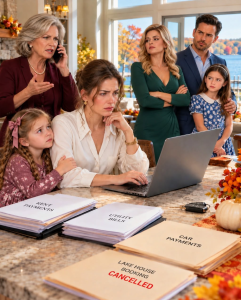
PART 1 — The Phone Call That Changed Our Family Forever
“Clara, I need you to be mature about this. Your daughter cannot come to Thanksgiving this year.”
My mother said those words so casually that, for a moment, I wondered whether I had misunderstood her.
I was standing in my kitchen on a chilly November morning, holding a cup of coffee in one hand while my seven-year-old daughter, Ivy, sat at the dining table drawing colorful pictures for her grandparents.
Outside, the trees had turned gold and orange, and the smell of cinnamon rolls filled our house.
Thanksgiving was only five days away.
“What did you just say, Mom?” I asked quietly.
My mother sighed as if I were already exhausting her.
“I said Briana wants a peaceful holiday. Travis is bringing his daughter, and she needs to make a good impression. Your little girl can be distracting sometimes, and we don’t want anything to spoil the weekend.”
I looked at Ivy.
She was carefully drawing a turkey with a crooked orange beak and seven enormous feathers, each painted a different color. Every few seconds, she glanced toward me, smiling because she believed we were about to have a wonderful holiday together.
My throat tightened.
“Mom, Ivy is seven years old. She’s not a problem you can simply remove because my sister wants to impress a man.”
“Please don’t start, Clara.”
“I’m not starting anything. I’m asking why Travis’s daughter is welcome, but mine isn’t.”
There was a long pause.
Then my mother answered with a sentence I would never forget.
“Because Briana’s future matters right now, and you already have your life figured out.”
I couldn’t speak.
For years, I had been the daughter who fixed everything.
When my father lost his job, I covered their mortgage payments until he found another position. When my mother needed expensive dental treatment, I paid the bill without asking for repayment. When Briana’s car broke down, I bought her a replacement because she claimed she couldn’t keep her job without one.
And when my parents fell behind on their utility bills, I quietly paid them before the notices turned into something worse.
Over three years, I had provided more than $60,000 in financial support.
I had never kept a running total because I didn’t consider helping my family an investment.
I considered it love.
But apparently, love was something my family expected from me while refusing to extend the same courtesy to my daughter.
“Mom,” I said, trying to keep my voice steady, “I rented the lake house for Thanksgiving. I paid the deposit, the remaining balance, the groceries, and the decorations. I arranged everything because you told me you wanted all of us together.”
“Yes, and we’re grateful.”
“Then how can you tell me that the child I’ve been raising alone isn’t welcome at an event I paid for?”
My mother lowered her voice.
“Don’t make this about money. Family isn’t supposed to keep score.”
I almost laughed at the irony.
Family wasn’t supposed to keep score, yet she had just decided that my seven-year-old daughter was less important than my sister’s new relationship.
“Is Ivy’s name still on the invitation?” I asked.
“Clara, there isn’t an invitation. It’s a family gathering.”
“Then why are you telling me she can’t come?”
“Because Briana asked me to handle it.”
That hurt more than I expected.
My younger sister hadn’t even called me herself.
She had sent our mother to deliver the message, hoping I would accept the humiliation without making a scene.
I looked at the picture Ivy was drawing.
At the top, in uneven letters, she had written GRANDMA AND GRANDPA.
Below it, she had drawn herself holding hands with me.
“Can I ask you something, Mom?” I said.
“What?”
“If Ivy weren’t my daughter, would you treat another seven-year-old this way?”
My mother didn’t answer.
Instead, she said, “I knew you would turn this into a personal attack. Briana has finally found someone serious. Travis comes from a respectable family, and this relationship could change her future.”
“And my daughter?”
“She’s just a child. She won’t understand.”
Those words settled inside me like a stone.
She was right about one thing.
Ivy might not understand the complicated cruelty of adults.
But she would understand being the only child left behind.
She would understand watching photographs of a holiday she had been excited about while everyone else ate dinner together.
And she would probably blame herself.
I wasn’t going to let that happen.
“Okay, Mom,” I said.
Her voice immediately softened.
“Thank you. I knew you would understand. You’re always the reasonable one.”
I ended the call without another word.
Then I sat beside Ivy.
She held up her drawing.
“Mommy, do you think Grandma will put this on the refrigerator?”
I swallowed the lump in my throat.
“Sweetheart, can I ask you something?”
She nodded.
“Would you be okay if we did something different for Thanksgiving this year? Just the two of us?”
Her smile faded slightly.
“But what about Grandma and Grandpa? And Aunt Briana?”
I brushed a strand of hair away from her face.
“We can still have a wonderful Thanksgiving together, even if we celebrate somewhere else.”
She studied my expression with the seriousness only a child can manage.
“Did I do something wrong?”
That question broke something inside me.
“No, baby. Absolutely not. You haven’t done anything wrong.”
“Then why doesn’t Grandma want me there?”
I pulled her into my arms.
“Sometimes grown-ups make selfish decisions, sweetheart. That doesn’t mean there’s anything wrong with you.”
I held her until she stopped asking questions.
After she went to her room to finish her drawing, I returned to the kitchen, opened my laptop, and logged into the rental account.
The lake house reservation was under my name.
The payments came from my bank account.
The rental agreement allowed cancellation before the final deadline, with a clearly stated refund policy.
I read every line carefully before clicking anything.
Then I called the property manager.
“Good morning, Clara,” she said. “Are you calling about your Thanksgiving reservation?”
“Yes. I need to cancel it.”
There was a pause.
“Are you sure? Your family requested an early check-in, and we’ve already confirmed the arrangements.”
“I’m sure.”
“I can process the cancellation according to the terms of your agreement. You’ll receive the applicable refund after the cancellation fee.”
“That’s fine. Please send me the confirmation in writing.”
When I ended the call, the house suddenly felt quieter.
I wasn’t angry anymore.
I was clear.
Next, I opened my banking app and reviewed the recurring transfers I had arranged for my parents.
The rent assistance.
The monthly utility payments.
The money I sent whenever Briana claimed she was struggling.
I didn’t cancel essential services irresponsibly or touch money that belonged to anyone else. I simply began arranging to end the voluntary support I had been providing, giving notice where necessary and checking which obligations were legally mine.
Then I opened the folder containing Briana’s car documents.
Two years earlier, she had begged me to help her purchase a nearly new SUV.
Her credit was poor, and she had insisted she would never qualify for reliable transportation on her own.
I had paid the down payment and taken responsibility for the financing. The vehicle was registered in my name, with an agreement that she would use it while covering the agreed expenses.
For months, I had even helped with insurance and unexpected repairs.
I reviewed the documents before making any decision.
If I wanted the vehicle returned, I needed to follow the contract and applicable law. I wasn’t going to make threats or take it unlawfully.
I contacted the lender and my attorney to understand my options.
By late afternoon, I had taken the first steps toward ending the arrangements that had made my family’s lifestyle so comfortable.
Then my phone buzzed.
It was a message from Briana.
Mom said you understand why Ivy shouldn’t come. Thank you for not making this difficult. Travis has been talking about how important family traditions are to him, and I really need this weekend to go perfectly.
I read it twice.
Not once did she ask whether Ivy was hurt.
Not once did she apologize.
She simply thanked me for cooperating with her plan to exclude my child.
I put my phone facedown.
Ten minutes later, another message appeared.
This one came from my mother.
By the way, can you transfer the money for the lake house groceries today? Briana has already invited Travis’s parents to dinner on Friday.
I stared at the screen.
They were still planning to spend my money.
They had already excluded my daughter and were now expecting me to finance the event as though nothing had happened.
I typed a response, deleted it, and typed another.
Finally, I sent four words.
The reservation is canceled.
My phone began ringing almost immediately.
I watched my mother’s name flash across the screen.
For the first time in years, I didn’t feel obligated to answer.
I placed the phone in a drawer, walked into Ivy’s room, and found her sitting on the floor surrounded by crayons.
“Mommy, I made another picture.”
She showed me a drawing of a little house beside a blue lake.
There were two people standing in front of it, holding hands.
“This is our Thanksgiving house,” she explained. “It’s where we can go if Grandma doesn’t want us.”
I knelt beside her.
“That’s a beautiful house, sweetheart.”
She smiled.
“Can we go somewhere with a lake anyway?”
I kissed her forehead.
“Yes. We’ll make our own memories.”
I didn’t yet know how furious my family would become.
But by the time the sun disappeared behind the trees that evening, the lake house was no longer available to them, the financial arrangements were being wound down, and my family had begun discovering that the dependable daughter they had taken for granted had finally reached her limit.
And the next morning, my mother arrived at my front door with a suitcase in her hand and a demand that would change everything again.
PART 2 — My Family Arrived Expecting a Holiday I Had Already Taken Away
The pounding on my front door began at 8:15 on Wednesday morning.
I was helping Ivy choose between two sweaters for her school celebration when the doorbell rang repeatedly.
I opened the door and found my mother standing on the porch.
She wasn’t alone.
My father stood behind her, looking irritated, while Briana sat in her car at the curb, talking on her phone.
My mother held a printed document in one hand.
“Clara, what on earth have you done?”
I glanced at the paper.
It was the cancellation confirmation from the rental company.
“I canceled the reservation,” I said.
“You can’t just cancel Thanksgiving!”
“I can cancel a reservation that I paid for.”
My father stepped forward.
“Your mother says you canceled it because of some misunderstanding about Ivy.”
“It wasn’t a misunderstanding. Mom told me Ivy wasn’t welcome.”
“She said your sister needed a quieter gathering,” he replied. “There’s a difference.”
I looked directly at him.
“Would you have told Briana to leave her daughter behind if I had one?”
He frowned.
“That’s not the point.”
“It is exactly the point.”
My mother pushed past him and stepped into the entryway.
“Do you realize how embarrassing this is? Travis’s parents have already been told about the lake house. Briana has spent weeks talking about this weekend.”
“Then Briana should have considered that before asking you to exclude my daughter.”
“She didn’t mean it the way you’re making it sound.”
I folded my arms.
“How did she mean it, Mom? Did she mean that Ivy could come after dinner? Or only if she promised not to speak? Perhaps she could sit in the car until everyone had finished taking pictures?”
My mother looked offended.
“Stop being ridiculous.”
“No. I’m done pretending that cruelty becomes acceptable just because our family calls it a misunderstanding.”
At that moment, Briana entered the house without knocking.
“Clara, seriously? You canceled the whole weekend over one little issue?”
I turned toward her.
“One little issue?”
“It’s Thanksgiving. We can celebrate anywhere.”
“Wonderful. Then you can rent another house.”
She stared at me as if I had started speaking another language.
“But you already booked this one!”
“And I canceled it.”
“Why would you do that when you knew how important this was to me?”
I couldn’t believe what I was hearing.
“You told Mom that my daughter shouldn’t be allowed to attend a family holiday because your boyfriend might be impressed by a child-free gathering. Why would you expect me to keep paying for it?”
Briana’s cheeks flushed.
“I never said it like that!”
“Then tell me what you said.”
She glanced at our mother.
For a moment, neither of them spoke.
Finally, Briana muttered, “I said Ivy gets excited and talks a lot. Travis’s daughter is shy, and I didn’t want her to feel uncomfortable.”
I took a breath.
“Then why not invite both children and plan activities that help them get along?”
“Because Travis’s daughter doesn’t know Ivy!”
“Children meet new people all the time, Briana. That’s how they make friends.”
“You don’t understand what this relationship means to me!”
Her voice cracked.
For the first time, I saw the fear underneath her anger.
Briana had spent years watching me build a stable life while she struggled to maintain hers. Now she had met a man she considered successful, and she desperately wanted him to believe she belonged in his world.
But instead of becoming more thoughtful, she had become more concerned with appearances.
“Travis owns a successful construction company,” she continued. “His family is wealthy, and they’ve invited me to meet everyone next month. If this weekend goes well, he might ask me to move in with him.”
“So you decided my daughter was a threat to your future?”
“That’s not what I said!”
“It’s what you did.”
My father rubbed his forehead.
“Clara, family members make compromises. You could have let Ivy stay with a babysitter for one weekend.”
I stared at him.
“You want me to pay for a holiday where my daughter isn’t allowed, then leave her with a stranger so Briana can impress her boyfriend?”
“Don’t twist my words.”
“I’m repeating them.”
My mother placed the cancellation paper on the counter.
“Fine. If you’re going to behave this way, at least transfer the money you promised us for next month. Your father has bills due, and Briana needs the car payment covered.”
I felt something inside me settle.
There it was.
Even now, after learning that I had canceled the house, they were more concerned about the money than about why I had canceled it.
“I haven’t promised you another payment,” I said.
My mother blinked.
“What?”
“The support I’ve been providing is ending. I’ll honor any legitimate obligations that are legally mine, and I’ll give appropriate notice where needed. But I will no longer pay your household expenses or Briana’s personal bills.”
My father stepped closer.
“You can’t do that to us!”
“Why not?”
“Because we’ve counted on you!”
I nodded slowly.
“Yes. You have.”
The admission seemed to surprise him.
For three years, they had treated my generosity as a permanent arrangement. They had planned their monthly expenses around money I sent them, and they had begun to believe that I would always rescue them, regardless of how they treated me.
But helping someone had never meant surrendering the right to say no.
My mother shook her head.
“You’re punishing innocent people because you’re angry with your sister.”
“No, Mom. I’m choosing not to fund arrangements that I no longer feel comfortable supporting.”
“What are we supposed to do?”
“Make a budget based on your own income and expenses. I’ll give you the information you need to plan the transition.”
Briana let out a bitter laugh.
“And what about my car?”
I looked at her.
“We need to review the agreement and work out a lawful solution. The financing and registration are in my name, so I can’t simply pretend the situation doesn’t exist anymore.”
Her face went pale.
“You’re taking my car away?”
“I’m addressing a financial arrangement that has become unsustainable. I’ll follow the proper process and give you time to make other plans.”
“But I need that car!”
“I understand. That’s why I’m not going to handle this carelessly. We can discuss a reasonable transition.”
“You bought it for me!”
“I helped you get it because you told me you needed reliable transportation. I didn’t buy it so you could use it to hurt my daughter.”
My mother raised both hands.
“This is unbelievable. You are destroying your own family over one holiday.”
I looked toward the staircase.
Ivy was standing at the top, clutching her little stuffed rabbit.
She had heard everything.
“Mommy?” she whispered.
I immediately walked over and lifted her into my arms.
“It’s okay, sweetheart.”
She looked over my shoulder at her grandmother.
“Grandma, I made you a picture.”
My mother went silent.
Ivy reached into her pocket and pulled out the folded drawing she had worked on the day before.
It showed a house beside a lake, with a large table, colorful leaves, and a row of smiling people.
She had written everyone’s names beneath the figures.
Grandma.
Grandpa.
Aunt Briana.
Mommy.
Ivy.
My daughter held the drawing out with both hands.
“I made enough room for everybody.”
For a moment, the entire room was silent.
My mother looked at the picture but didn’t take it.
Briana turned her face away.
My father stared at the floor.
Ivy slowly lowered her hands.
“It’s okay,” she whispered. “I can keep it.”
She tucked the paper against her chest and buried her face in my shoulder.
That was the moment I knew I had made the right decision.
I wasn’t going to teach my daughter that love meant begging for a place at a table where people didn’t want her.
I wasn’t going to show her that financial generosity required accepting humiliation.
And I wasn’t going to let her believe that the adults who hurt her were automatically entitled to another chance simply because they were related to us.
“It’s time for you to leave,” I told my family.
My mother stared at me.
“Are you throwing us out?”
“Yes. Ivy needs some peace.”
For once, no one argued.
They walked out, and I closed the door behind them.
That afternoon, I contacted a local charity that organized holiday meals for families and offered to sponsor a Thanksgiving dinner. I didn’t announce it online or tell anyone in my family. I simply wanted to turn a painful situation into something kind.
I also booked a small lakeside cabin for Ivy and me, choosing a place I could comfortably afford without compromising our financial security.
We would cook together, take walks, make paper turkeys, and watch the sunset.
There would be no expensive guest list.
No pressure to impress strangers.
And no one would be asked to leave.
But my family’s reaction was only beginning.
By Thursday morning, Briana had posted a long message on social media accusing me of being controlling and vindictive.
She didn’t mention the phone call.
She didn’t mention Ivy’s drawing.
She didn’t mention that I had been paying many of the expenses that kept their lives running.
Instead, she wrote that I had sabotaged her chance at happiness because I couldn’t stand seeing her succeed.
Within an hour, relatives began messaging me.
Some called me selfish.
Others said I should apologize.
One aunt wrote, Your mother raised you. The least you can do is help her.
I read the messages without responding.
Then my phone rang.
It was Travis.
I had met him only twice, and our conversations had been polite but brief.
“Clara,” he said, “I hope you don’t mind me calling.”
“Not at all. What’s going on?”
“Briana told me there was a disagreement about Thanksgiving. She said you canceled the lake house because she asked for one quiet evening.”
I closed my eyes.
“That’s not what happened.”
“I thought so. There’s something else I need to tell you.”
His voice became hesitant.
“Briana told my parents that she was organizing and paying for the entire Thanksgiving weekend. She said the lake house was a gift from her.”
I sat down.
“She told them that?”
“Yes. She also said she was helping your parents financially because they couldn’t afford the holiday themselves.”
For several seconds, I couldn’t find my voice.
Then Travis asked a question that changed everything.
“Clara, why was your name on every single reservation document and payment confirmation I saw?”
I looked at the folder on my desk.
For the first time, I realized my sister hadn’t simply tried to exclude my daughter.
She had been building an entire version of her life for a man she wanted to impress.
And the truth was beginning to catch up with her.
PART 3 — The Truth Came Out at Thanksgiving, and My Daughter Finally Understood Her Worth
I didn’t tell Travis everything during that first phone call.
I didn’t need to.
I simply explained that I had arranged the Thanksgiving celebration and paid for the reservation, and that I had canceled it after learning my daughter wasn’t welcome.
I also told him that I wanted to keep the disagreement private rather than turn it into a public battle.
He listened carefully.
When I finished, he said, “I’m sorry. You shouldn’t have been put in that position, and neither should Ivy.”
His response surprised me.
I had expected him to defend Briana.
Instead, he asked whether Ivy was okay.
That simple question reminded me that the situation had never needed to become complicated.
People who genuinely cared about a child would have started by asking whether she was hurt.
“She’s doing better,” I told him. “We’re making new Thanksgiving plans.”
“Good. I hope you both have a wonderful holiday.”
Before ending the call, Travis added something else.
“I need to be honest with you. Briana has told me several things about her family that don’t seem to match what I’m learning. I’m going to speak with her directly.”
I thanked him and hung up.
Then I returned to preparing our own holiday.
Ivy and I drove to the grocery store, where she chose apples, sweet potatoes, and a bag of tiny marshmallows for a casserole she wanted to help make.
She also insisted on buying a small pumpkin.
“We need a centerpiece,” she explained.
We brought everything home and spent the afternoon cooking.
I let her stir the batter for our apple cake, even though she got flour on the counter and a little on her nose.
She laughed when I pretended to inspect her face like a serious chef.
For the first time all week, I saw her relax.
That evening, we packed our bags for the cabin.
Ivy carried her stuffed rabbit, three coloring books, and the picture she had made for Grandma.
I noticed she had folded it carefully and placed it inside her backpack.
“Do you still want to give that to Grandma?” I asked.
She nodded.
“Maybe someday.”
I kissed her forehead.
“That’s okay, sweetheart. You can decide when you’re ready.”
We arrived at the cabin on Thanksgiving morning.
It wasn’t as large as the lake house I had originally rented. There was no grand dining room, no expensive chandelier, and no long table designed to impress anyone.
But it had a fireplace, a little wooden porch, and a beautiful view of the water.
Ivy ran from window to window, delighted by the ducks swimming near the shore.
“Mommy, look! They came to have Thanksgiving with us!”
I laughed.
“Apparently, we have guests already.”
We cooked our meal together.
Ivy arranged the napkins, placed little paper leaves beside our plates, and wrote two name cards.
One said MOMMY.
The other said IVY.
Then she added a third card.
It read EVERYONE IS WELCOME.
I looked at it for a long time.
“That’s a lovely message,” I told her.
She shrugged.
“I don’t want anyone to feel sad like I did.”
I pulled her into a hug.
“That’s a very kind thing to wish for other people.”
For the rest of the morning, we kept our phones on silent.
I didn’t want social media arguments to take away the peaceful day I had promised my daughter.
But by early afternoon, several messages had arrived.
The first came from my father.
Your mother is very upset. Please call her.
The second came from Briana.
Travis knows about the car and the money now. What exactly did you tell him?
I stared at the screen.
I hadn’t told Travis about the car.
I hadn’t needed to.
He had discovered enough inconsistencies on his own.
Another message arrived.
You have no right to ruin my relationship because you’re jealous of me.
I put the phone away.
I wasn’t going to argue with someone who had confused consequences with cruelty.
A few minutes later, Travis called again.
This time, he sounded troubled.
“Clara, I’m sorry to bother you on Thanksgiving.”
“It’s okay. Is everything all right?”
“Not really. Briana admitted that you paid for the lake house. She also admitted that she asked your mother to tell you not to bring Ivy.”
I closed my eyes.
He continued.
“She says she thought you’d agree because you always help the family.”
Those words hurt, but they didn’t surprise me.
For years, my willingness to help had become something my family counted on rather than appreciated.
Travis took a breath.
“I also learned that Briana told my daughter that she would be spending Thanksgiving with a new cousin. My daughter was excited about meeting Ivy. She didn’t even know there was a disagreement.”
I looked through the window at Ivy, who was arranging paper leaves around the dessert plates.
“I’m sorry the children were caught in the middle,” I said.
“So am I. My daughter has been asking why the plans changed. I’ve explained that adults sometimes make mistakes, and it’s never the children’s fault.”
I appreciated that more than I could express.
Then Travis said, “I’m not going to attend Briana’s planned family dinner tomorrow. I need time to think about our relationship.”
I didn’t celebrate.
I didn’t tell him what to do.
“That’s your decision,” I replied. “I hope you make it based on what you believe is right.”
After the call ended, I stepped outside.
The air was cold, and the lake reflected the soft afternoon sunlight.
I thought about the previous three years.
The rent payments.
The emergency transfers.
The late-night calls.
The promises that this would be the last time anyone needed help.
I thought about how often I had ignored my own needs because I believed being a good daughter meant being endlessly available.
But I had a daughter of my own now.
I needed to show her something different.
Love could be generous without being blind.
Kindness could coexist with boundaries.
And family relationships did not give anyone permission to treat another person as disposable.
Inside the cabin, Ivy called out, “Mommy! Dinner is ready!”
I turned toward the door.
“I’m coming!”
We sat together at our little table.
Before eating, Ivy closed her eyes.
“I’m thankful for Mommy,” she said. “And for our house by the lake. And for the ducks.”
I smiled.
“What about the pumpkin?”
She opened one eye.
“Oh, yes. And the pumpkin.”
We burst into laughter.
For the first time in days, I felt completely at peace.
The following morning, I woke to twenty-three missed calls.
My mother had called repeatedly.
My father had left several voicemails.
Briana had sent a string of angry messages, followed by one that simply said, Please answer me.
I listened to my father’s latest voicemail.
His voice sounded tired.
“Clara, we need to talk. Your mother is frightened because she doesn’t know how we’re going to manage next month. Briana says the car situation is becoming serious, and we need to figure out what happens now.”
I sat at the kitchen table and considered my response.
I wasn’t going to abandon my parents without warning if they depended on support I had voluntarily provided.
But I wasn’t going to resume unlimited payments simply because they were uncomfortable with the consequences of their choices.
I called my father.
“I’ll help you make a transition plan,” I told him. “We’ll review your actual expenses, identify what you can afford, and discuss any support I can reasonably provide during the transition. But the old arrangement is ending.”
He sighed.
“Your mother says you’re trying to teach us a lesson.”
“I’m trying to protect my daughter and my household. Those are not the same thing.”
“What do you want us to do?”
“I want you to acknowledge what happened. I want you to understand that Ivy should never have been treated as though she were an inconvenience. And I want us to stop pretending that my money is more important than the way we treat one another.”
He remained silent for a long time.
Finally, he said, “I didn’t realize how much this would hurt her.”
“You didn’t ask.”
His voice became quieter.
“No. I didn’t.”
It wasn’t a complete apology, but it was the first time he had acknowledged the harm without blaming me for reacting to it.
I told him I would send a written summary of the financial arrangements and a reasonable timeline for ending them.
Then I ended the call.
Later that afternoon, my mother sent me a message.
I want to see Ivy.
I stared at the words.
There was no apology.
No acknowledgment of the phone call.
No mention of the drawing my daughter had tried to give her.
I didn’t respond immediately.
Instead, I asked myself what I would want Ivy to learn from whatever happened next.
I didn’t want her to grow up believing she had to reject everyone who disappointed her.
But I also didn’t want her to believe that an apology was unnecessary when someone had hurt her.
So I replied:
If you want to rebuild your relationship with Ivy, we need to start with an honest apology. She deserves to hear that excluding her was wrong and that she was never responsible for what happened. After that, we can take things slowly and see what feels comfortable for her.
My mother didn’t answer that day.
Briana called me two days later.
Her voice was unlike anything I had heard from her before.
She sounded frightened.
“Clara, can we talk?”
“About what?”
“Everything.”
I waited.
She let out a shaky breath.
“Travis is reconsidering our relationship. He said he doesn’t know whether he can trust me.”
I didn’t respond.
“I told him I paid for the lake house because I wanted him to think I was independent,” she continued. “I know that was wrong.”
“Yes, it was.”
“And I shouldn’t have asked Mom to exclude Ivy.”
“No, you shouldn’t have.”
There was a long silence.
Then Briana began to cry.
“I didn’t think you’d actually cancel everything. I thought you’d get upset, maybe argue with Mom, and then you’d do what you always do.”
I closed my eyes.
At least she was finally being honest.
“You thought I would accept hurting my daughter because I had always accepted being taken for granted.”
“I guess I did.”
“Briana, I love you. But I can’t keep making your life easier at the expense of my own family.”
“I know.”
“No, I don’t think you did know. Not until now.”
She cried quietly for another moment.
Then she said, “I’m sorry I hurt Ivy.”
It was the first direct apology I had heard from her.
I didn’t immediately forgive her.
I didn’t promise to pay for anything.
I didn’t tell her that everything would return to normal.
Instead, I said, “If you mean that, you need to show it through your actions. Ivy is a child. She doesn’t need expensive presents or dramatic speeches. She needs to know that the people who say they love her actually want her around.”
“I understand.”
“Then start there.”
We ended the call without making any promises about the future.
Over the following weeks, I completed the financial changes I had begun. I followed the relevant agreements, coordinated with the lender about the vehicle, and gave Briana the time and information she needed to make alternative transportation arrangements.
I also helped my parents create a realistic budget so they could manage their expenses without depending on automatic transfers from me.
Some relatives remained angry.
Others eventually admitted they hadn’t known the whole story.
I stopped trying to convince everyone to take my side.
I no longer needed a unanimous vote to justify protecting my daughter.
A month later, my mother asked whether she could visit us.
Before answering, I spoke to Ivy.
“Grandma wants to see you. How do you feel about that?”
Ivy thought carefully.
“Will she be mad if I talk too much?”
My heart ached.
“No, sweetheart. You don’t have to make yourself smaller to deserve someone’s love.”
She looked down at her hands.
“Can she come for cookies?”
“If that’s what you want.”
After another moment, Ivy nodded.
“Okay. But I want to make the cookies myself.”
When my mother arrived, she brought no expensive gifts.
She carried a small box of art supplies and a handwritten letter.
She sat at our kitchen table and asked Ivy whether she could read the letter aloud.
Ivy agreed.
My mother unfolded the paper.
“Ivy, I owe you an apology. I told your mother you shouldn’t come to Thanksgiving because I wanted everything to be easy for your aunt. That was unfair and hurtful. You didn’t do anything wrong, and you should never have been made to feel unwanted. I’m sorry.”
Her voice trembled.
She looked at Ivy.
“I can’t undo what I did, but I hope I can earn back your trust.”
Ivy studied her for a long moment.
Then she asked, “Can I show you my drawings?”
My mother began to cry.
“Yes, sweetheart. I’d love that.”
Ivy ran to her bedroom and returned with a folder full of pictures.
She spread them across the table, explaining the colors, the characters, and the little stories behind each one.
My mother listened.
Really listened.
It wasn’t a magical ending.
Trust takes time, and one apology cannot erase the memory of being rejected by someone you love.
But it was a beginning.
Briana’s relationship with Travis continued to change, and I left them to work through their own choices. I didn’t use his opinion as a weapon against her, and I didn’t allow his involvement to determine whether I would forgive my sister.
That decision belonged to me.
Several months later, Ivy and I hosted a small Thanksgiving dinner at our own home.
There were no expensive reservations.
No attempts to impress anyone.
Just roasted vegetables, homemade pie, paper leaves, and a table surrounded by people who had been invited because we wanted them there.
Ivy placed a handmade card beside every plate.
Mine read:
Thank you for always making room for me.
I hugged her tightly.
“I will always make room for you, sweetheart.”
She smiled.
“I know, Mommy.”
As our guests gathered around the table, I looked at my daughter and understood something I wished I had learned years earlier.
Being a good daughter had never required me to become an endless source of money.
Being a loving sister had never required me to tolerate cruelty.
And being generous had never meant surrendering my right to protect the little girl who depended on me most.
My family had assumed that because I could afford to help them, I would always do so.
They had mistaken my generosity for an obligation and my patience for permission.
But the greatest thing I took back that Thanksgiving wasn’t a car, a reservation, or a single dollar.
It was the belief that I had to earn my place in my own family by paying for everyone else’s comfort.
Ivy didn’t need a luxurious lake house to feel loved.
She needed a mother who would stand beside her when the people around her failed to do the right thing.
And that was something I could give her every single day.
Because the moment I stopped paying for everyone else’s happiness, I finally had the freedom to build a happier life for my daughter and me.