The 79-Year-Old Woman in Muddy Boots Asked the Bank Manager to Check Account No. 0001—His Face Turned White When He Saw Who Owned It
PART 1 — “We Have to Be Careful With People Like You.”
The young bank manager refused to cash my $40 check because I was wearing muddy boots and an old straw hat, but the moment I asked him to look up account number 0001, he stared at his computer as if he had just seen a ghost.
My name is Dorothy Miller, although most people in our little town of Millbrook simply call me Dot.
I was seventy-nine years old that summer, and I had been banking at Farmers & Merchants Bank for fifty-eight years.
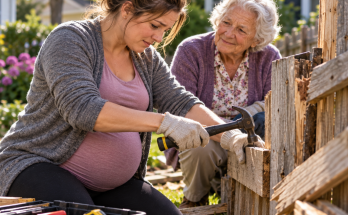
That Tuesday in June, I had spent the entire morning in my garden, pulling weeds around my tomato plants and gathering rhubarb for the pies I had promised to bake for our church fundraiser.
My knees were dirty.
My rubber boots were muddy.
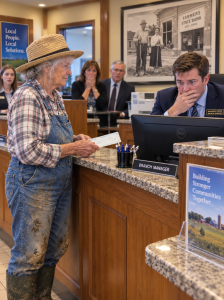
And I was wearing my late husband George’s old straw hat because it kept the sun out of my eyes.
The $40 check in my purse was payment for four rhubarb pies.
It wasn’t much money, but I planned to use it to buy fresh flowers for George’s grave.
He had been gone for six years, and I still brought him flowers every Tuesday.
I parked my old pickup truck outside the bank, walked through the glass doors, and headed toward the teller counter.
Usually, Shelly was there to greet me.
She had worked at the bank for nearly twenty years, and she always asked whether my roses were blooming.
But that morning, a young man in a perfectly pressed blue suit stood behind the counter.
His name tag read BRANDON PIERCE — BRANCH MANAGER.
I had heard about Brandon.
He had transferred from a big-city branch a few months earlier, and people around town said he was ambitious, efficient, and determined to bring the bank into the modern age.
I smiled politely and slid my check beneath the glass.
“Good morning, young man.”
“I’d like to cash this, please.”
He glanced at the check.
Then he looked at my boots.
Then he looked at my hat.
“Do you have an account here, ma’am?”
“I certainly do.”
“Identification?”
I handed him my driver’s license.
He examined it beneath the overhead light before placing it on his side of the counter.
“I’ll need two additional forms of identification.”
I thought I had misunderstood him.
“Two more?”
“For a $40 check?” I asked.
“That’s correct.”
I chuckled softly, thinking he was joking.
He didn’t smile.
“A utility bill, passport, or another document showing your current address,” he said.
“Young man, I live four blocks away.”
He folded his arms.
“Ma’am, we have to be careful with people like you.”
The words landed harder than I expected.
Behind me, a woman holding a toddler stopped moving.
An elderly gentleman near the deposit slips slowly raised his head.
Even the security guard seemed to find something fascinating about the floor.
I looked at Brandon.
“People like me?”
He sighed as though I were deliberately wasting his time.
“People who arrive without the proper documentation.”
I glanced down at my muddy boots.
Then I looked back at him.
“I’ve been a customer here since before you were born.”
“That doesn’t change our procedures.”
He still hadn’t returned my driver’s license.
I could have argued.
I could have demanded his supervisor.
Instead, I remembered something George used to tell me whenever someone tried to provoke him.
“Dot, never let another person’s bad manners decide what kind of day you’re going to have.”
So I took a slow breath.
“I appreciate careful,” I told Brandon.
He looked surprised.
I think he had expected me to shout.
Then I turned toward the entrance.
An old black-and-white photograph hung on the wall near the lobby.
It showed a young man and woman standing on an empty piece of land, both holding shovels.
The woman wore a simple cotton dress, and the man had rolled his shirtsleeves to his elbows.
Most customers probably walked past that photograph without giving it a second glance.
But I never did.
The young woman in the photograph was me.
The man beside me was George.
The year was 1968, and the empty land behind us was where the original Farmers & Merchants Bank building would eventually stand.
George and I hadn’t been rich.
We had started with a small farm, a borrowed truck, and a dream of helping our neighbors keep their farms when the local lenders refused them.
We had spent years working with farmers who needed emergency loans to buy seed, repair equipment, or survive a terrible harvest.
Sometimes George came home after midnight, exhausted from helping someone prepare paperwork.
Sometimes we used our own savings to keep a struggling family from losing everything.
We weren’t saints.
We made mistakes, lost money, and argued more than once about whether we could afford to keep helping people.
But we believed a bank should remember that the people behind every account were human beings.
And when the bank nearly collapsed during the agricultural crisis of the late 1980s, George and I had made a decision that changed our lives forever.
I turned back toward Brandon.
“Would you do one small thing for me before I go home and fetch those documents?”
He looked impatient.
“What?”
“Please look up account number 0001.”
He frowned.
“Ma’am, I can’t access an account just because you ask me to.”
“It’s my account.”
I nodded toward my driver’s license, which was still lying beside his keyboard.
“You already have my identification.”
He glanced toward the security guard, rolled his eyes, and turned back to his computer.
“Fine.”
He typed four digits.
Zero.
Zero.
Zero.
One.
Then he pressed Enter.
For several seconds, nothing happened.
Then Brandon stopped moving.
He leaned closer to the screen.
He scrolled down.
Then he scrolled back up.
His eyebrows rose, and the color began draining from his face.
He looked at the monitor again.
Then he slowly turned toward the photograph of George and me hanging beside the entrance.
Finally, he looked back at me.
“Ma’am,” he whispered, “where did you get this account number?”
I smiled gently.
“My husband gave it to me.”
Brandon reached for the telephone on his desk.
His hand was shaking.
And when he spoke to the person on the other end, I heard him say five words that made everyone in the bank turn around.
“I think she’s the owner.”
PART 2 — The Account Nobody Was Allowed to Touch
Brandon didn’t put the phone down for nearly two minutes.
He kept looking at me, then at the screen, as though he expected me to disappear.
Finally, he covered the receiver with his hand.
“Ma’am, I’m going to need you to wait here.”
“I wasn’t planning on running away.”
The elderly gentleman behind me chuckled.
Brandon didn’t.
He returned to the phone.
“Yes, I understand.”
“No, she hasn’t presented the additional documents yet.”
“I know what the account says.”
His voice dropped.
“I’m asking you to come down here personally.”
Then he hung up.
I leaned against the counter.
“Would you mind returning my driver’s license?”
He immediately handed it back.
“Of course, Mrs. Miller.”
It was the first time he had called me anything other than ma’am.
A few minutes later, the bank’s regional director hurried through the entrance.
His name was Robert Hayes, and I had met him years earlier at a community fundraiser.
He was older than Brandon, with silver hair and the kind of calm expression people develop after spending decades solving other people’s problems.
The moment he saw me, he stopped.
“Mrs. Miller?”
“Hello, Robert.”
He walked around the counter and shook my hand.
Then he turned toward Brandon.
“Did you verify her identity?”
Brandon nodded.
“I checked her license.”
“And did you examine the account history?”
“Yes.”
Robert looked at the computer screen.
His expression grew serious.
“Then why is she standing here without her check being processed?”
Brandon swallowed.
“I was following the branch’s identification policy.”
Robert nodded slowly.
“Policies are important, Brandon.”
“But so is knowing when to ask for help instead of making assumptions.”
He turned to me.
“Mrs. Miller, I’m sorry you’ve been treated this way.”
I appreciated his apology, but I wasn’t interested in humiliating a young man in front of an audience.
“Let’s start again,” I said.
“I’d simply like to cash my $40 check.”
Robert smiled.
“Of course.”
He asked a teller to verify the check and complete the transaction according to the bank’s procedures.
Within minutes, I had my forty dollars.
I thanked the teller and placed the bills in my purse.
I could have left then.
But Brandon was still staring at the screen.
“Mrs. Miller,” he said quietly, “I don’t understand.”
“Which part?”
“Account 0001.”
He hesitated.
“It’s listed as the original founding account of this institution.”
I nodded.
“That’s right.”
“But it isn’t an ordinary checking account.”
“No,” I replied.
“It isn’t.”
Robert pulled a chair toward the small office beside the counter.
“Would you be comfortable explaining the history to us?”
I looked at the old photograph on the wall.
Then I sat down.
In 1968, George and I had helped establish a lending cooperative for farmers who couldn’t obtain affordable credit elsewhere.
We started with our own savings, a few local investors, and a simple promise that nobody would be turned away merely because they looked poor.
The cooperative eventually became Farmers & Merchants Bank.
As the institution grew, George and I transferred our original capital into a special founding account.
Over the decades, the account became part of a carefully structured ownership arrangement.
Some of the money supported local agricultural lending.
Some funded scholarships for children from farming families.
And some was held to protect the bank during difficult economic periods.
George had insisted that the account should never be treated as personal spending money.
It existed to protect the institution and the community that had built it.
After he died, the account remained under the same governance arrangements, with me as its surviving principal beneficiary and authorized representative.
I had rarely needed to visit the bank personally because the arrangements were handled through the institution’s senior officers.
But I had kept the original account number.
And I had never forgotten what it represented.
Brandon looked stunned.
“So you’re saying you helped establish this bank?”
“George and I did.”
Robert corrected him gently.
“Mrs. Miller is also the surviving representative named in the founding documents.”
Brandon looked down at his hands.
“I didn’t know.”
“That much was obvious,” I said.
He flinched.
I softened my voice.
“You’re young. You can’t know every person who has ever walked through these doors.”
“But you can choose how you treat them while you’re learning.”
He nodded slowly.
Robert asked me whether I would review the bank’s current community lending practices.
I told him I would consider it, but I had one condition.
“Before I agree to anything, I’d like to understand why this branch has become so concerned with appearances that a woman in muddy boots can’t cash a small check without being treated like a criminal.”
Robert’s expression changed.
He glanced toward Brandon.
Then he admitted something that surprised me.
The bank had recently introduced a new performance system that rewarded branches for reducing financial risk and identifying potentially suspicious transactions.
Managers were under pressure to meet strict targets.
Some had responded by becoming overly rigid with customers who didn’t fit their expectations.
“That’s not an excuse,” Robert said.
“No,” I agreed.
“It isn’t.”
I stood up and collected my purse.
“Then perhaps we should discuss how to fix it.”
Brandon walked around the counter.
“Mrs. Miller, I owe you an apology.”
I looked at him.
“Yes, you do.”
He took a breath.
“I judged you by your appearance. I was disrespectful, and I made an assumption about you before I understood who you were.”
I nodded.
“That’s a good start.”
Then I added something I hoped he would remember.
“But I want you to understand something, Brandon.”
He waited.
“If account number 0001 had belonged to someone else, a poor farmer, a cleaner, or a widow who had never owned anything more valuable than her old pickup truck, you still would have owed her respect.”
His face reddened.
“You’re right.”
I left the bank that afternoon with my $40, but I couldn’t stop thinking about the conversation.
The account had surprised Brandon because of the money and history attached to it.
But the real problem was that he had believed my appearance told him everything he needed to know.
And I wondered how many other people had walked through those doors and been treated the same way.
The next morning, Robert called me.
He had reviewed the branch’s customer complaint records and discovered something troubling.
Several elderly customers had complained about being spoken to disrespectfully.
A small business owner had moved his accounts elsewhere after being publicly questioned about a routine transaction.
And a farmer who had banked with the institution for decades had stopped coming in because he felt ashamed of his worn clothes.
Robert wanted to know whether I would attend a meeting with the board.
I agreed.
But before I arrived, I received an email from Brandon.
The subject line read:
A request I hope you’ll consider.
And the first sentence said:
Mrs. Miller, I would like to ask your permission to help make this bank worthy of the people who built it.
PART 3 — The Lesson That Changed the Bank Forever
I arrived at the board meeting wearing a clean pair of jeans, a simple blouse, and George’s old straw hat.
I hadn’t planned the outfit as a statement.
It was simply the hat I loved.
But when I entered the conference room, I noticed Brandon glance at it.
This time, he smiled.
“Good morning, Mrs. Miller.”
“Good morning, Brandon.”
The board members introduced themselves, and Robert explained why he had requested the meeting.
They wanted to review the bank’s customer service policies, staff training, and community lending commitments.
I listened carefully.
Then I placed an old photograph on the table.
It was the same picture hanging in the lobby, but this copy was older and had been taken before the frame was added.
George and I stood on the empty lot with shovels in our hands.
Behind us, several local farmers were gathered around a folding table.
I pointed to one man standing near the edge.
“His name was Samuel Harris,” I said.
“He lost nearly everything during a drought in 1974.”
The board members listened as I explained how George had helped Samuel restructure his debt instead of forcing him to sell his farm.
Samuel eventually recovered.
His children inherited the farm, and one of his grandchildren now ran a successful agricultural supply business.
“That’s why we started this bank,” I told them.
“Not because we wanted people to admire us.”
“Because we wanted ordinary people to have a fair chance when life became difficult.”
I placed another photograph beside the first.
It showed George standing outside a small farmhouse with a family of six.
“They weren’t wealthy,” I continued.
“They wore old clothes, drove a truck that barely started, and had no impressive paperwork beyond their land records and a history of working hard.”
“But George believed they deserved to be heard.”
I looked around the table.
“I am not asking you to abandon identification rules or ignore legitimate financial risks.”
“I’m asking you to make sure your employees understand the difference between protecting a bank and humiliating a customer.”
Robert nodded.
One of the board members asked what changes I would recommend.
I suggested practical improvements.
Staff should explain identification requirements respectfully.
Customers should have a clear way to speak with a supervisor when a transaction was delayed.
Employees should receive training on recognizing bias and communicating with people from different backgrounds.
And the bank should review complaints to identify patterns rather than dismissing each incident as an isolated misunderstanding.
The board agreed to examine the proposals.
Brandon volunteered to help lead the customer service review.
Over the following weeks, the bank introduced new training sessions and reviewed its branch procedures.
Robert also arranged for a community advisory group that included farmers, small business owners, retirees, and local residents who rarely had a voice in financial decisions.
I attended the first meeting.
Brandon sat beside me.
He listened while a retired mechanic described feeling embarrassed when a teller questioned him about a routine deposit.
He listened when a young mother explained how difficult it was to navigate banking paperwork after leaving an abusive relationship.
And he listened when a farmer admitted he had stopped asking the bank for help because he assumed nobody would take him seriously.
Afterward, Brandon approached me.
“I thought being a good manager meant knowing the rules better than everyone else,” he said.
“I didn’t realize it also meant understanding how those rules affect people.”
I smiled.
“Rules matter.”
“People matter, too.”
He nodded.
Then he asked me something I hadn’t expected.
“Do you think you could tell the story about account 0001 to the new employees?”
I considered it.
“Only if you tell them your part of it, too.”
He looked surprised.
“You want me to?”
“Yes.”
“Because they need to understand that the lesson wasn’t that they should treat someone well because she might be wealthy or powerful.”
I paused.
“The lesson is that they should treat people well before they know anything about them.”
Brandon agreed.
A month later, I stood in the bank’s meeting room in front of a group of new employees.
I told them about George, the farm, the founding account, and the difficult years when we had nearly lost everything.
I told them how much it meant when someone behind a counter took the time to listen.
Then I told them about the Tuesday I walked in wearing muddy boots and an old straw hat.
I didn’t leave out Brandon’s words.
“We have to be careful with people like you.”
The room became quiet.
Brandon stood beside me and acknowledged what he had done.
He didn’t make excuses.
He didn’t blame the policies.
He explained that he had judged a customer by her appearance and failed to treat her with dignity.
Then he told the employees what he had learned.
After the session, an older teller approached me.
She had worked at the bank for twenty-seven years.
“Mrs. Miller,” she said, “I’m glad you spoke up.”
I smiled.
“So am I.”
That evening, I drove home along the familiar road past the church and the old hardware store.
I stopped at the cemetery and placed the four rhubarb pies’ worth of flowers beside George’s grave.
I told him about the meeting.
I told him about Brandon.
And I told him that the bank he had helped build was finally talking about the things we had cared about from the beginning.
The next morning, I returned to my garden.
The tomatoes needed watering.
The rhubarb had begun growing again.
And George’s straw hat still fit perfectly.
I was still seventy-nine.
I still wore muddy boots.
I still drove the same old pickup truck.
And I was still the same woman who had walked into that bank with a $40 check.
The only difference was that a young manager had learned a lesson he would hopefully carry for the rest of his career.
Never mistake worn clothes for a small life, an old face for a weak mind, or a quiet voice for someone who has nothing to say.
Because the woman standing in front of you might have helped build the very place where you work.
And even if she didn’t, she still deserves to be treated with dignity.
That is what George believed.
And after fifty-eight years of banking with Farmers & Merchants, it is what I believe, too.