Part 1: The Goodbye That Hid a Secret
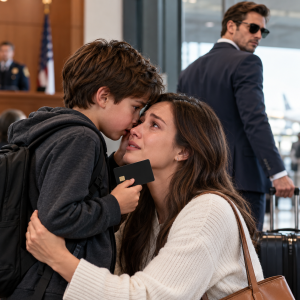
My eight-year-old son stood in the middle of an airport terminal, wearing a navy-blue blazer that made him look older than he was. His small fingers clutched the sleeve of my cream-colored coat, and his eyes were filled with tears he was desperately trying to hide.
Behind him stood his father, a wealthy businessman who had spent months convincing a judge that our son deserved a better life than I could provide.
I had already lost custody.
I had already watched my little boy tell a judge that his mother could not give him the future he deserved.
And now, seven days after that devastating hearing, I was watching him prepare to board a private international flight with the man who had taken him away from me.
I thought the worst moment of my life had arrived.
Then Owen leaned close to my ear.
“Mom, I need you to trust me. Whatever Dad tells you, don’t give him this.”
He pressed something into my palm.
A black bank card.
Before I could ask what it meant, he kissed my cheek, turned around, and walked toward his father.
I stood frozen as the two of them disappeared into the crowd.
Three minutes later, my phone vibrated.
It was a message from an unfamiliar number.
“Mom, the card contains the only proof that Grandpa left us. Dad doesn’t know I’ve found it yet. Whatever happens, never let him get that card.”
My knees nearly gave way.
Because my father-in-law, the man who had supposedly died without leaving anything behind for his grandson, had been dead for nearly two years.
And according to every document I had ever seen, he had left his entire fortune to his eldest son.
My ex-husband.
My name is Rachel Mercer. I was thirty-nine years old when my eight-year-old son chose his father’s wealth over the ordinary life I had worked so hard to give him.
At least, that was what I believed at the time.
I lived in a small rented townhouse outside Fairfax, Virginia. The kitchen was narrow, the upstairs bathroom had a stubborn faucet, and the living room furniture had been purchased secondhand.
But Owen’s height marks were drawn on the pantry door, his school drawings covered the refrigerator, and his favorite stuffed dinosaur slept beside him every night.
I worked as an administrative coordinator for a medical supply company. My salary paid the rent, groceries, electricity, and Owen’s school expenses. There wasn’t much left over at the end of the month, but we had never gone without the things that mattered most.
I knew which pancakes he liked.
I knew he hated the crust on sandwiches.
I knew that when he was frightened, he rubbed the small scar on his left thumb.
And I knew that he sometimes pretended to be asleep when he was worried because he didn’t want me to ask questions he couldn’t answer.
His father, Grant Whitaker, lived in a world I had never been able to afford.
Grant was forty-three and came from one of Virginia’s wealthiest families. The Whitakers owned luxury hotels, commercial properties, and investment companies. Their name appeared in business magazines, charity galas, and photographs of expensive houses overlooking private lakes.
When I married Grant, I was twenty-seven and working at a hotel reception desk. He had been charming, generous, and attentive. He sent flowers to my workplace, remembered my favorite coffee, and once drove two hours through a snowstorm because I had mentioned feeling lonely.
I thought I had found a man who would always protect me.
I didn’t understand that some people were generous only when generosity gave them control.
After Owen was born, Grant became increasingly absent. Business dinners turned into overnight trips. Overnight trips became weeks away. Every disagreement became an argument about my lack of ambition, my modest background, or my inability to understand the responsibilities of his family’s position.
When I finally discovered that he had been hiding substantial financial dealings from me, our marriage was already falling apart.
We divorced five years later.
Grant kept the mansion, the cars, and the businesses he claimed had nothing to do with our marriage. I left with my clothes, my savings, and the one thing I had fought hardest to protect.
Owen.
For years, our custody arrangement worked reasonably well. Owen lived primarily with me and spent scheduled weekends with his father.
Grant sent expensive presents. He took Owen to amusement parks, bought him a tablet, and occasionally flew him to resorts where the swimming pools were larger than our entire townhouse.
I never told Owen to reject those things.
A child shouldn’t have to feel guilty because one parent has more money than the other.
But I worried when Owen began returning from visits unusually quiet.
Sometimes he would ask questions that didn’t sound like his own.
“Mom, why don’t we have a house with a swimming pool?”
“Mom, why can’t you buy me the newest phone?”
“Mom, Dad says children who work hard should have opportunities, and he says he can give me all of them.”
I answered honestly.
“Your father can afford things I can’t, sweetheart. But money isn’t the only thing that makes a home.”
He would nod, then stare at the floor.
I didn’t realize that someone was teaching him to measure love in dollars.
The custody battle began six months before the airport goodbye.
Grant’s attorneys filed a petition claiming that I couldn’t provide Owen with the educational opportunities, security, and international exposure he needed.
They presented photographs of Grant’s mansion, a private school acceptance letter, a list of overseas travel opportunities, and a detailed financial plan.
Grant promised Owen a private bedroom overlooking a garden, a personal tutor, and summer holidays in Europe.
I brought school reports, medical records, attendance sheets, and statements from teachers who described Owen as a happy, well-adjusted child.
I brought photographs of birthday cakes we had baked together, camping trips to nearby parks, and evenings spent reading books beneath a blanket when thunderstorms frightened him.
I believed the court would see what I saw.
A little boy who needed stability.
A little boy who had never asked for a mansion.
A little boy who still called me into his room when he had a bad dream.
But Grant had something I could not explain away.
Owen’s own words.
During a private meeting with the judge, my son sat beside his father wearing a navy blazer I had never seen before.
The judge spoke gently.
“Owen, you know you can tell me how you really feel. Nobody is going to punish you for your answer.”
My son looked at his hands.
Then he glanced at Grant.
It lasted less than a second, but I saw it.
Fear.
Or perhaps I only understood what I had seen much later.
“I want to live with Dad,” Owen whispered.
My heart tightened.
The judge asked why.
Owen swallowed.
“Because he can give me a better future.”
Then he raised his eyes and looked directly at me.
“Mom can’t give me the future I deserve.”
I remember the sound of the courtroom clock.
Tick.
Tick.
Tick.
It was as though every second was taking something away from me.
I wanted to stand up and tell him about the nights I had stayed awake beside his bed when he was sick. I wanted to remind him of the day I walked three miles in the rain because my car had broken down and I didn’t want him waiting alone at school.
But what could I say?
That I had loved him more consistently than his father?
That I had sacrificed more?
Love wasn’t a competition, and I refused to turn my son into the prize in an argument between adults.
I sat silently while the judge considered the evidence.
Two weeks later, the court approved a temporary arrangement allowing Grant to take Owen overseas for an extended educational placement, subject to reporting requirements and a scheduled review.
Grant’s attorney called it an extraordinary opportunity.
I called it the beginning of losing my son.
During the following week, Owen barely spoke to me about the move.
He packed his clothes, arranged his books, and carefully placed his stuffed dinosaur in his carry-on bag.
Every time I entered his room, he quickly closed whatever he had been looking at.
I assumed he was angry with me.
On the sixth night, I found him sitting on the floor beside his bed, holding a photograph of his grandfather, Arthur Whitaker.
Arthur had been the only member of Grant’s family who had ever treated me as an equal.
He was a stern but kind man who preferred old books to expensive watches and believed that a person’s character mattered more than a bank balance.
When Owen was younger, Arthur taught him how to play chess.
He also told him a peculiar story.
“Sometimes,” Arthur had said, “the most important thing you will ever own won’t look valuable at all.”
I had assumed he was talking about a family photograph or an old book.
Arthur died two years earlier, leaving Grant in control of the family’s public estate.
Grant told everyone that his father had left behind a complicated financial situation and that almost everything had been absorbed by debts, taxes, and business obligations.
I never questioned it.
I had no reason to.
That evening, Owen looked up at me.
“Mom, do you think Grandpa was a good man?”
I sat beside him.
“I do.”
“Even when people said bad things about him?”
“Good people can make mistakes. But a good person tries to make things right.”
He stared at the photograph for a long time.
Then he asked, “If Grandpa left something for someone, would it still belong to them if another person took it?”
I turned toward him.
“Why are you asking me that?”
He shook his head.
“Just wondering.”
Before I could ask anything else, Grant called to remind him about the airport arrangements.
Owen immediately put the photograph away.
That should have warned me.
The next morning, we drove to Dulles International Airport.
Grant arrived in a charcoal suit, carrying a leather briefcase. His driver unloaded the luggage while he answered calls and issued instructions to his assistant.
Owen stayed close to me.
When we reached the security checkpoint, Grant checked his watch.
“It’s time, Owen.”
My son walked toward me.
For one terrible moment, I thought he might offer a quick hug and turn away.
Instead, he wrapped his arms around my waist and held on so tightly that I could barely breathe.
“Don’t cry, Mom,” he whispered.
“I’ll try, sweetheart.”
“Just wait for me.”
I pulled back to look at him.
“What do you mean?”
He slipped the black bank card into my hand and folded my fingers around it.
“Please trust me.”
Then he walked away.
I watched Grant place a hand on Owen’s shoulder as they entered the security line.
Grant never looked back.
Owen did.
Just once.
His face was pale, and his eyes were filled with a fear no eight-year-old should have to carry.
Then they disappeared.
I stood near the glass windows, watching the aircraft outside while strangers hurried past me.
My phone vibrated.
The message about the card appeared.
I read it three times.
Then a second message arrived.
“Mom, don’t call Dad. Don’t tell anyone about the card until you find Grandpa’s lawyer. Ask for Mr. Daniel Brooks. He knows the truth.”
I had never heard of Daniel Brooks.
But I remembered Arthur Whitaker mentioning a lawyer by that name during a family dinner years earlier.
My hands trembled as I searched the inside of my coat pocket.
The card was black, with no bank logo, no printed name, and no visible account number.
Only a small silver symbol appeared near one corner.
Three interlocking circles.
On the back, someone had written six digits in tiny white lettering.
I was still staring at it when my phone rang.
Grant’s name appeared on the screen.
I answered.
“Rachel,” he said pleasantly, “Owen has just gone through security. I hope you understand that this is for his own good.”
“Where are you taking him?”
“To London first. Then we’ll decide whether he should continue to Switzerland for school.”
“You didn’t tell me about Switzerland.”
“I didn’t think every detail required a discussion.”
I gripped the phone.
“Grant, Owen looked frightened.”
He laughed softly.
“He’s eight. Children get emotional. He’ll settle down once he sees what his new life has to offer.”
I looked at the black card in my palm.
“Did your father leave anything for Owen?”
The silence on the other end lasted only a second.
But it was enough.
“What are you talking about?” Grant asked.
“Arthur. Did he leave Owen anything?”
Grant’s voice changed.
“Rachel, I suggest you stop filling your head with nonsense. My father left a will, and the estate was handled legally.”
“Then you won’t mind if I speak to his attorney.”
A long silence followed.
Finally, Grant said, “You have no idea what you’re getting involved in.”
The call ended.
I stood in the airport with my son’s card in one hand and my phone in the other.
For the first time since the custody hearing, I no longer believed that Owen had chosen his father because of money.
I believed he had chosen him because he was trying to protect something.
And whatever that something was, Grant Whitaker was terrified of it.
Part 2: The Secret Behind the Black Card
I drove home without turning on the radio.
Every few minutes, I checked my phone, hoping Owen would send another message.
Nothing came.
By the time I reached my townhouse, the airport goodbye had replayed in my mind so many times that I could barely remember the journey.
I locked the front door, pulled the curtains, and placed the black card on the kitchen table.
Under the light, I noticed a tiny inscription along its lower edge.
A number.
Not an account number, but a sequence that looked more like a reference code.
I searched the internet for the three interlocking circles, but the results were meaningless. I tried the six digits on several financial websites, then stopped when I realized I was guessing blindly.
I needed someone who knew Arthur’s affairs.
The following morning, I called the law firm that had handled his estate.
The receptionist informed me that Daniel Brooks had retired from active practice.
When I explained that I was Arthur Whitaker’s former daughter-in-law and that the matter concerned his grandson, she placed me on hold.
Ten minutes later, an older man’s voice came through the phone.
“This is Daniel Brooks.”
I told him about the card.
I told him about Owen’s messages.
I told him what Grant had said at the airport.
For a long time, Mr. Brooks said nothing.
Then he asked a question that made my stomach drop.
“Rachel, did Grant see the card?”
“No.”
“Does he know Owen gave it to you?”
“I don’t think so.”
“Good. Do not attempt to use it. Do not hand it to any bank employee, and do not send me a photograph of it by email. Can you come to my office this afternoon?”
“Why? What is it?”
“I can’t explain everything over the telephone. But I can tell you one thing.”
His voice lowered.
“Arthur spent the last year of his life preparing for the possibility that his son would try to take something that did not belong to him.”
I felt a chill travel down my back.
“Are you saying Grant stole money?”
“I’m saying that you need to hear the entire story before you make any accusations.”
His office was located in an old brick building in Alexandria.
When I arrived, Mr. Brooks was waiting beside a conference table covered with folders.
He was in his seventies, with silver hair, a dark suit, and the tired eyes of a man who had spent decades watching families destroy themselves over money.
He examined the card without touching its magnetic strip.
Then he opened a locked cabinet and removed a thick envelope bearing Arthur’s signature.
“I prepared this envelope two years ago,” he explained. “Your father-in-law instructed me to release it only if his grandson came forward with specific information or if certain irregularities in the estate were discovered.”
“What information?”
Mr. Brooks looked at me.
“Did Owen mention a recording?”
I shook my head.
He opened the envelope.
Inside were copies of bank statements, trust documents, and a letter written in Arthur’s unmistakable handwriting.
The first page contained a sentence that made me sit down.
To my grandson, Owen Whitaker, who may one day need to understand why the truth was hidden from him.
Arthur explained that he had established a private trust for Owen shortly after the boy’s birth.
The trust had originally contained $3.8 million in investments, shares, and cash reserves.
Its purpose was simple.
When Owen turned twenty-five, he would receive control of the funds, provided the money had been preserved and managed according to the trust’s terms.
Until then, an independent trustee would oversee the assets.
Grant was not supposed to control the trust.
He was not supposed to borrow against it.
And he was not supposed to use the money to finance his businesses.
Yet the documents Mr. Brooks placed before me suggested that someone had attempted to transfer portions of the trust into accounts associated with Grant’s investment company.
“How much?” I whispered.
“The original trust was worth approximately $3.8 million,” he replied. “The amount that remains must be independently verified. Some transactions appear legitimate. Others require investigation.”
I stared at the documents.
“Why didn’t Arthur tell me?”
“He wanted to protect Owen from becoming a target in a dispute over money. He also believed that if Grant knew the trust existed in its full form, he might try to gain control of it.”
“Then why give Owen the card?”
“Because the card is not simply a payment card.”
Mr. Brooks leaned forward.
“It is a secure access credential associated with a private custodial account and a digital archive. The archive contains records that may establish what happened to the trust.”
My mouth went dry.
“What kind of records?”
“Transfer instructions. Correspondence. Authorization logs. And a recording.”
I remembered Owen asking whether something left to a person could still belong to them if someone else took it.
“What does the recording contain?”
“Arthur believed it would be essential if the trust was ever challenged. But I cannot tell you its full contents until we verify the archive and establish that it has not been compromised.”
I thought about my son standing in the airport.
He had been carrying a secret that involved millions of dollars, yet he was only eight years old.
“How did Owen find out?”
Mr. Brooks folded his hands.
“That is the part I don’t understand. Arthur left instructions that the card should be kept in a sealed compartment within a particular family document box. I was told the box had been placed in storage after his death.”
“Who had access to it?”
“Grant.”
I felt suddenly cold.
If Grant had known about the card, why hadn’t he taken it?
And if he hadn’t known, how had Owen found it?
Mr. Brooks asked me to describe the final week before the flight.
I told him about the strange questions, the photograph of Arthur, and the way Owen had watched his father before speaking to the judge.
When I finished, the lawyer closed his eyes briefly.
“Arthur may have anticipated exactly this situation,” he said.
“What situation?”
“A custody dispute in which money, rather than the child’s welfare, became the real objective.”
I wanted to believe him.
But there was still a problem.
Owen was thousands of miles away with a father who might be hiding financial misconduct, and I had no legal authority to simply bring him home.
Mr. Brooks explained that the custody order remained in effect. We could not violate it or attempt to retrieve Owen without following the proper legal process.
Instead, he recommended that we contact my family-law attorney, arrange an independent examination of the trust records, and document every communication with Grant.
That afternoon, we met with a forensic accountant.
By evening, the accountant had identified several transfers that deserved closer scrutiny.
One transfer had been made three months before Arthur died.
Another had occurred shortly after his death.
A third had been initiated under a digital authorization supposedly approved by an independent trustee.
But the trustee’s signature did not match the records.
Someone had attempted to move more than $1.2 million out of the trust.
The money had not disappeared entirely. Some of it had passed through companies connected to Grant’s business network, and several transfers remained unexplained.
The black card was the key to determining whether the transactions had been authorized.
At 8:43 p.m., my phone rang.
It was an international number.
I answered immediately.
“Mom?”
Owen’s voice was so quiet I could barely hear him.
“Sweetheart, are you okay?”
“Yes.”
“Where are you?”
“Dad’s hotel. He says we’re leaving for Switzerland tomorrow.”
“Can you talk safely?”
He hesitated.
“I don’t know.”
I closed my eyes.
“Listen to me, Owen. You haven’t done anything wrong. You don’t have to solve any grown-up problems. Your job is to stay safe and tell a trusted adult if you’re frightened.”
“I know.”
“Then why did you give me the card?”
He was silent for several seconds.
“Because Dad found Grandpa’s box.”
My fingers tightened around the phone.
“When?”
“Before the court hearing. He was looking for papers in Grandpa’s old study. I was there because he told me to find my school things.”
“What happened?”
“I heard him talking to someone on the phone. He said the money wasn’t supposed to be there, and he needed to find the last key before the lawyer checked everything.”
I felt sick.
“Did he see you?”
“I don’t think so. I went into the closet. Then I found Grandpa’s little wooden box behind some books.”
Owen’s breathing became uneven.
“There was a card inside and a letter with my name. Grandpa wrote that if Dad ever asked me to say something I didn’t believe, I should remember that the truth mattered more than making him happy.”
I pressed a hand against my mouth.
“Did your father tell you what to say to the judge?”
Owen began to cry.
“He said if I wanted to stay with him, I had to explain that you couldn’t give me the life I deserved. He said it was just a sentence, and nobody would be hurt.”
“Oh, Owen.”
“I didn’t want to say it, Mom. But he told me if I didn’t help him, he would send me away to boarding school and I wouldn’t see you for a long time.”
I could barely breathe.
My little boy had not chosen his father because he wanted a bigger house.
He had been frightened into saying the words that broke my heart.
“I’m sorry,” he whispered.
“No, sweetheart. You never have to apologize for being scared.”
“Grandpa said you would understand.”
I wiped my eyes.
“Where is the letter now?”
“In my backpack. I hid it under my books.”
“Does Dad know?”
“I don’t think so. But he keeps asking where the black card is.”
The line went silent for a moment.
Then Owen whispered, “Mom, he thinks I gave it to someone at the airport. He doesn’t know I gave it to you.”
A door slammed somewhere near him.
I heard Grant’s voice in the background.
“Owen? Who are you talking to?”
My son gasped.
“Mom, I have to go.”
“Wait—”
The call ended.
I immediately contacted Mr. Brooks and my attorney.
We documented the conversation as accurately as possible, including the time of the call and Owen’s statements. My attorney explained that the information could be relevant to the custody proceedings, but it would need to be presented properly and supported by evidence.
We also discussed requesting an urgent review of the international travel arrangements if credible evidence indicated that Owen was being pressured or that the existing order might be at risk.
I barely slept that night.
At 6:12 the next morning, an email arrived from an address I didn’t recognize.
It contained one attachment.
A scanned letter.
The handwriting was Arthur’s.
At the top, he had written:
For Rachel Mercer, if Owen is ever forced to leave her care before he understands what happened to my family.
The letter began with an apology.
Arthur admitted that he had made a terrible mistake by trusting Grant with responsibilities he should never have given him.
He described a dispute over the family trust and revealed that he had discovered evidence suggesting Grant had used company funds and trust assets to cover losses from a failing investment.
Arthur had confronted his son.
Grant had promised to repay the money.
But the repayments never came.
Arthur then made a decision that changed everything.
He transferred control of Owen’s trust to an independent structure and arranged for the relevant records to be preserved outside the family’s ordinary financial systems.
The black card was one part of that arrangement.
The letter ended with a warning.
If Grant learns that Owen has the card, he may try to make the child believe that the secret is his responsibility. It is not. Owen must never be made to carry the burden of his father’s choices.
I read that sentence until the words blurred.
Then I reached the final paragraph.
Rachel, if you are reading this, do not fight Grant with anger. Fight him with the truth. He has spent his life believing that everything can be controlled if he owns enough of it. There is one thing he cannot buy: a record of what he has done.
I folded the letter carefully.
For the first time, I understood why Owen had asked me to wait.
He wasn’t asking me to rescue him through some dramatic act.
He was asking me to discover the truth before his father could destroy the evidence.
But Grant was already moving faster than we were.
At noon, my attorney received notice that Grant intended to enroll Owen in a residential school overseas and would not return to Virginia until the following summer.
The proposed arrangement appeared inconsistent with the temporary custody order’s review provisions.
My attorney immediately began preparing an emergency application.
Then, at 2:17 p.m., my phone rang again.
This time, it was Grant.
His voice was no longer calm.
“Rachel, I know you have something that belongs to my family.”
I looked at the black card on the table.
“What makes you think that?”
“Because my father’s lawyer has suddenly started asking questions.”
“Perhaps you should answer them.”
He laughed, but there was no humor in it.
“Listen carefully. That card is worthless to you. It contains no money you can claim, and if you interfere with my business, I’ll make sure you never see Owen again.”
I felt the old fear rising.
Then I remembered Arthur’s letter.
“Grant,” I said quietly, “if the card is worthless, why are you so desperate to get it back?”
He said nothing.
I heard a door close on his end of the call.
When he spoke again, his voice was low.
“You don’t understand what you’re doing.”
“Then explain it to me.”
“You have until tomorrow morning to return the card.”
“And if I don’t?”
His answer chilled me.
“Then you may discover that your son isn’t the only person who can be taken away from you.”
He hung up.
For several seconds, I sat motionless.
Then another message arrived from Owen.
It contained only seven words.
“Mom, Dad found out about Grandpa’s recording.”
A second message appeared almost immediately.
“He’s coming back to Virginia tonight.”
Part 3: The Recording That Changed Everything
By sunrise, my life had become a race against a man who believed that money could erase any mistake.
Grant’s private flight was scheduled to arrive at Dulles that afternoon.
My attorney had already filed an emergency request for a custody review, supported by the messages, the documents from Arthur’s estate, and the preliminary findings of the forensic accountant.
We did not accuse Grant of crimes we could not yet prove.
Instead, we asked the court to consider the new evidence, Owen’s reported statements about pressure surrounding the hearing, and the possibility that the child’s welfare required immediate attention.
Mr. Brooks arranged for the black card to be examined by an independent digital security specialist.
The process took hours.
The card did not contain money in the ordinary sense. It provided access to an encrypted archive linked to Arthur’s private trust arrangements.
The archive required two separate verification steps.
The first was the card itself.
The second was a short sequence of numbers Arthur had hidden in a handwritten letter intended for Owen.
Fortunately, Owen had photographed the letter before leaving Virginia and sent the image to a secure email account he had created for schoolwork.
He had never intended to become involved in a financial investigation.
He had simply followed his grandfather’s instructions because he feared something bad would happen if he didn’t.
By late afternoon, the specialist had recovered part of the archive.
There were transaction records, correspondence, and a video file dated four days before Arthur’s death.
The file had been recorded in Arthur’s study.
Mr. Brooks asked whether I wanted to watch it.
I nodded.
On the screen, Arthur appeared in his usual armchair, wearing a white shirt and a dark cardigan. He looked tired, but his voice was clear.
“If this recording is being viewed,” he began, “then I have reason to believe that the arrangements I made for Owen are being challenged.”
He paused to adjust his glasses.
“Grant, if you are watching this, I want you to understand that I am not trying to destroy you. I am trying to prevent you from destroying yourself.”
My hands were shaking.
Arthur continued.
“I trusted you with the family businesses because I believed you understood that wealth comes with responsibility. Instead, I discovered that you had used funds that did not belong to you to conceal losses you were unwilling to admit.”
He lifted a folder into view.
“These records show transfers from accounts associated with Owen’s trust. You told me they were temporary loans. You promised to repay them. But the money was moved again, and the documentation provided to the trustee did not accurately reflect what had occurred.”
The video showed Arthur placing the folder on his desk.
“I have arranged for an independent review. The trust will remain separate from the businesses, and Owen’s inheritance will be protected until he is old enough to manage it himself.”
Then Arthur leaned toward the camera.
“Grant, I know you believe that giving Owen expensive things makes you a good father. But a child does not need a fortune to feel loved. He needs to know that the adults in his life will tell him the truth.”
Arthur’s expression softened.
“And if you have convinced my grandson that he must choose between his mother and his future, then you have misunderstood both.”
The recording ended.
Nobody in the room spoke.
Mr. Brooks eventually explained that the video alone would not establish every allegation. The financial records needed authentication, and any suspected misconduct would have to be investigated by the appropriate authorities.
But the archive gave us something we had not possessed before.
A clear starting point.
A record of Arthur’s intentions.
And evidence that the family trust might have been improperly used.
The following morning, Grant arrived at my attorney’s office with two lawyers.
He looked immaculate, but the confidence he had displayed at the custody hearing was gone.
He sat across from me and placed a folder on the table.
“Let’s make this simple,” he said. “You give me the card, and I’ll agree to a generous visitation schedule.”
I stared at him.
“You mean the schedule you should have agreed to before taking Owen overseas?”
His jaw tightened.
“You’re making this personal.”
“You made it personal when you taught our son to believe he had to insult his own mother to get what he wanted.”
Grant glanced at his lawyers.
“That is a ridiculous accusation.”
“Then explain why Owen said you threatened to send him away if he didn’t tell the judge he wanted to live with you.”
Grant’s expression changed.
For the first time, I saw genuine uncertainty in his eyes.
“He’s eight,” he said. “He misunderstands things.”
“Then the court can hear his account with appropriate safeguards.”
Grant leaned forward.
“You have no idea how complicated this is.”
“I know my son was frightened. I know your father’s trust records show transactions that require investigation. And I know you are asking me to hand over evidence before anyone has established what happened.”
He stared at me.
“You think you’re going to win because my father left you a recording?”
“No,” I replied. “I think the truth should be examined, regardless of who wins.”
For a moment, the room was silent.
Then Grant stood.
“You’ll regret this.”
One of his attorneys quietly asked him to sit down.
He ignored her.
“You have no idea what will happen to your life if you continue.”
My own attorney rose.
“Mr. Whitaker, this meeting is over.”
Grant left without another word.
That afternoon, the court scheduled an urgent hearing to review the international custody arrangement.
The judge ordered both parents to preserve relevant communications and financial documents. Grant was also directed to provide updated information about Owen’s location, schooling, and return arrangements.
The court did not decide the financial allegations at that hearing, and it did not automatically reverse the existing custody order.
But it did something that mattered.
It required Grant to explain why the original plan had changed and why Owen had been told that he might not see his mother for months.
Three days later, Owen returned to Virginia under an interim arrangement agreed upon by both parties and approved by the court.
I waited outside the arrivals area at Dulles, standing near the same glass windows where I had watched him leave.
When he finally appeared, he was carrying his small backpack.
He looked exhausted.
For one second, he stood still.
Then he ran toward me.
I dropped to my knees and opened my arms.
He crashed into me, wrapped his arms around my neck, and began sobbing.
“I thought you wouldn’t get me back,” he cried.
I held him as tightly as I could.
“I’m here, sweetheart. I’m right here.”
“I didn’t want to say those things in court.”
“I know.”
“Dad said he would make you disappear from my life.”
I closed my eyes.
“No one should ever have made you feel that you had to choose.”
He pulled away and searched my face.
“Are you angry with me?”
The question broke my heart more than anything that had happened.
“Never for being scared,” I told him. “You are my son. You don’t have to earn my love by saying the right words.”
He pressed his face against my shoulder.
For a long time, neither of us moved.
The legal investigation continued for months.
The forensic accountant traced a series of transfers between companies associated with Grant’s investment network. Some transactions had legitimate explanations, while others lacked the documentation required by the trust agreement.
Investigators obtained additional records from the financial institutions involved.
The independent trustee confirmed that the trust had not been managed according to all of its original requirements.
Grant denied intentionally misappropriating funds and argued that the transactions were part of complicated business arrangements he had expected to reconcile.
His attorneys challenged portions of the evidence.
But the documents, correspondence, and Arthur’s recorded statements gradually established a clearer picture of what had happened.
The final accounting showed that approximately $1.2 million had been transferred out of the trust through transactions that had not been properly authorized. A portion was recovered during the review, while the remaining disputed amounts became the subject of formal recovery proceedings.
The full $3.8 million had never been sitting untouched in a single account, as I had initially imagined. The trust had contained a mixture of investments and cash, and its value had changed over time.
Still, the central point was undeniable.
The money had been set aside for Owen.
And it had never been Grant’s personal fortune to use as he pleased.
The financial dispute was ultimately resolved through a court-supervised settlement. The trust was restored and restructured under independent oversight, with strict controls preventing Grant from accessing the assets without authorization.
As part of the separate custody proceedings, the court considered the evidence concerning pressure on Owen, the changes to the travel arrangements, and the need for a stable relationship with both parents where safe and appropriate.
The resulting parenting order gave Owen a primary home with me, established a structured visitation schedule with his father, and required future international travel to follow specific safeguards.
It was not a victory that erased everything we had endured.
Owen still had nightmares sometimes.
He sometimes asked whether money could make people do terrible things.
And every time he heard a phone ring late at night, he would look toward me to make sure I was still there.
We found a family counselor who specialized in helping children navigate difficult separations. Slowly, Owen began to understand that the problems between his parents were not his responsibility.
I never asked him to hate Grant.
I never asked him to repeat the details of the case to prove that he loved me.
I wanted him to grow up knowing that he could love his father and still recognize when an adult had behaved wrongly.
Six months after the airport goodbye, I received a package from Mr. Brooks.
Inside was a small wooden box that had belonged to Arthur.
It contained the original letter, a photograph of Arthur holding Owen as a baby, and a handwritten note addressed to me.
Rachel,
If this box has reached you, I hope the truth has finally been given the chance to speak. I am sorry that you and Owen were placed in a position where you had to fight for what should never have been taken from you.
Do not let this money become the measure of your son’s life. The trust is meant to give him choices, not to tell him who he must become.
Teach him to be kind when he has power, honest when he is afraid, and brave enough to admit when he is wrong. If he learns those things, he will be wealthier than most people who spend their entire lives collecting fortunes.
With gratitude,
Arthur.
I sat at the kitchen table for a long time, holding the letter.
That evening, Owen came downstairs wearing his pajamas.
He climbed into the chair beside me and noticed the black card resting near the wooden box.
“Is it all over, Mom?”
I considered the question.
“The court case is mostly settled. The money is protected. And you don’t have to keep secrets for grown-ups anymore.”
He looked relieved.
“Can we put the card away?”
“Yes.”
“Somewhere nobody needs it?”
I smiled sadly.
“That’s probably the best place for it.”
We placed the card, the letter, and Arthur’s photograph inside the wooden box. Mr. Brooks arranged for the original financial records to remain securely preserved through the proper legal process.
Then Owen carried the photograph upstairs and placed it on his bedside table.
Before he went to sleep, he asked me one final question.
“Mom, if I hadn’t given you the card, would Dad have won?”
I sat beside him and brushed the hair away from his forehead.
“I don’t know, sweetheart. But I do know that you were never supposed to solve this problem. You were supposed to be a child.”
He thought about that.
Then he whispered, “I just wanted you to know I didn’t choose money over you.”
My eyes filled with tears.
I kissed his forehead.
“You never had to prove that to me.”
He reached for my hand.
“Can you stay until I fall asleep?”
“Of course.”
I remained beside his bed until his breathing became slow and steady.
The black card had helped uncover a financial secret worth millions of dollars. Arthur’s recording had exposed questions that wealth and influence could not simply make disappear. And the legal process had given my son a safer path forward.
But the most important thing the card had revealed was something much simpler.
An eight-year-old boy had been placed in the middle of a battle between adults, frightened into saying words he didn’t believe, and forced to carry a secret he should never have been responsible for.
He had not needed a richer mother.
He had needed someone to listen.
Someone to believe him.
Someone who would remind him that love was not a prize he had to win by choosing sides.
I had spent months fearing that my son would grow up believing his future depended on how much money I could give him.
Instead, he began learning that his future belonged to him.
And every morning, when he came downstairs in his school uniform and asked what we were having for breakfast, I remembered something Arthur had written in his final letter.
The greatest inheritance a child can receive is not a fortune.
It is the freedom to grow up without being afraid that love will be taken away.
And the black card?
We never used it to buy a single thing.
We kept it in the wooden box, beside Arthur’s photograph, as a reminder of the day my little boy walked away from me at an airport—not because he loved me any less, but because he was brave enough to trust me with the truth.
And that truth gave us both something money could never purchase.
A chance to begin again.