PART 1 — THE GROOM WHO NEVER CAME
I was standing at the entrance of the reception hall in my wedding dress when my fiancé’s mother called to tell me that her son would not be coming.
Then she asked whether I had the $12,000 her family had spent on our wedding.
I thought I had misheard her.
My name is Claire Bennett, and I was twenty-nine years old when I discovered that the man I planned to marry could disappear without having the courage to look me in the eyes.
His name was Matthew Collins.
We had been together for four years, and I had spent the previous six months planning what I believed would be the happiest day of our lives.
My father, Robert, had paid $7,500 for the reception.
He had also covered the flowers, the band, and the beautiful three-course dinner waiting for our 120 guests.
He was a retired mechanic who had worked twelve-hour shifts for most of his life.
After my mother died, he took extra jobs repairing neighbors’ cars because he wanted me to have the wedding she had always dreamed of helping me plan.
Every time I thanked him, he gave me the same answer.
“Your mother would have wanted you to have one beautiful day, sweetheart.”
I believed Matthew wanted that day, too.
Until he failed to show up.
The ceremony was scheduled for two o’clock.
At 2:15, his best man told me Matthew had gone out to make a phone call.
At 2:40, nobody had heard from him.
At three o’clock, his father stopped answering questions.
By 3:20, Matthew’s younger sister, Emily, came into the bridal suite with tears in her eyes.
She looked at my wedding dress, then quickly looked away.
“Claire, I’m sorry.”
My stomach tightened.
“Where is Matthew?”
She pressed her lips together.
“He told Mom he couldn’t go through with it.”
I stared at her.
“What does that mean?”
“He left town this morning.”
For several seconds, I couldn’t speak.
“He left town?”
Emily nodded.
“He said he needed to think about his future.”
I looked down at the bouquet in my hands.
Our future had been the reason I had spent months saving money, choosing invitations, and making room in my life for his dreams.
And now he had decided to think about it somewhere else.
“Did he say why?”
Emily hesitated.
Then she whispered something that hurt more than his disappearance.
“He said he didn’t want to spend the rest of his life being responsible for someone else’s happiness.”
I slowly sat down.
I had supported Matthew when he lost his job.
I had helped him prepare for interviews.
I had paid our rent for three months when his savings ran out.
I had never asked him to repay a single dollar.
And apparently, loving me had made him feel trapped.
My father entered the room a moment later.
He had changed into his navy wedding suit and was holding two cups of coffee.
When he saw my face, he put them down.
“Claire?”
I tried to explain, but the words came out in pieces.
Daddy listened without interrupting.
Then he pulled a chair beside mine and sat down.
For a moment, he looked older than I had ever seen him.
“I am so sorry, sweetheart.”
I began crying.
Not because I wanted Matthew to come back.
But because I was embarrassed that I had believed someone who could leave me like this.
Daddy wrapped his arms around me.
“You have nothing to be ashamed of.”
Then he stood up, wiped his eyes, and glanced toward the reception hall.
“What happens to all that food?”
I almost laughed through my tears.
“Daddy, I think the food is the least of our problems.”
“Maybe,” he replied. “But I paid for it, and I’m not throwing it away.”
That was when Grandma Rose entered the room.
She was seventy-nine, wore a silver brooch on her blue cardigan, and had been married to my grandfather for fifty-six years before he passed away.
She listened to the whole story without saying a word.
Then she asked a question nobody else had thought to ask.
“Has anyone told the guests?”
“No,” I answered.
“Good.”
She picked up her handbag.
“Then we still have time to do something decent.”
Within fifteen minutes, my father had spoken to the pastor, the caterer, and the band.
I walked into the church wearing my wedding dress and announced that the ceremony would not take place.
I expected sympathy.
Instead, I saw 120 people looking at me with the kind of sadness usually reserved for a funeral.
So I took a deep breath.
“The wedding is canceled,” I said. “But the dinner isn’t.”
A few guests exchanged surprised looks.
“My father worked too hard for this meal to go to waste. Anyone who wants to join us is welcome.”
Grandma Rose raised her hand.
“And the band is playing tonight. We didn’t pay those musicians to sit around looking miserable.”
For the first time that afternoon, someone laughed.
The guests began moving toward the reception hall.
I changed nothing about my appearance except my shoes.
I kept my wedding dress on.
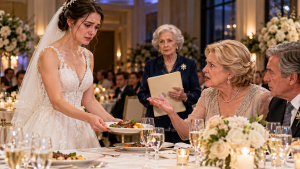
Then I stood beside the buffet and helped serve the people who had come to celebrate a marriage that would never happen.
For a little while, the room began to feel warm again.
My cousin told a ridiculous story about Matthew getting lost on the way to his own birthday party.
The band played old songs.
Daddy even danced with Grandma Rose.
And I started to believe that perhaps the day had not taken everything from me.
Then, at 6:10, the reception hall doors opened.
Matthew’s mother, Patricia Collins, walked in.
She wore an expensive cream-colored dress and carried a structured leather handbag.
She didn’t look at the guests.
She didn’t ask whether I was all right.
She walked directly toward the buffet, where I was cutting a piece of roast beef for an elderly neighbor.
“Claire,” she said coldly. “We need to settle something.”
I put down the knife.
“What is it, Patricia?”
She opened her handbag and pulled out a folded sheet of paper.
“My family contributed twelve thousand dollars toward this wedding and the engagement arrangements.”
I looked at the paper.
It was a handwritten list of expenses.
Then she held out her hand.
“I want the money returned, and I want Matthew’s grandmother’s engagement ring back.”
I looked at the ring on my finger.
It had been given to Matthew by his grandmother before she died.
He had told me it was a symbol of the family’s trust.
Now his mother was standing in front of 120 witnesses, demanding it back as if I had stolen it.
“Matthew left me at the altar,” I said quietly. “And you came here to collect money?”
Her expression hardened.
“My son has made his decision. You need to accept it.”
She glanced at my wedding dress.
“And frankly, the least you can do is return what belongs to us.”
The band stopped playing.
Conversations faded one by one.
My father began rising from his chair.
But Grandma Rose reached over and touched his arm.
“Wait, Robert,” she said.
Then she turned toward Patricia.
“Before Claire gives you anything, I believe we should discuss the agreement your family signed.”
Patricia went completely still.
Grandma Rose opened her handbag and removed a thick manila envelope.
And when she placed it on the buffet beside the roast beef, Patricia’s face lost its color.
Because whatever was inside that envelope, Patricia clearly knew exactly what it was.
PART 2 — THE ENVELOPE GRANDMA KEPT
Patricia stared at the manila envelope as though it were something dangerous.
“Rose,” she said, forcing a smile, “I don’t think this is the appropriate place for that conversation.”
Grandma Rose adjusted her glasses.
“You had no trouble discussing money in front of everybody.”
A few guests quietly set down their forks.
My father came to stand beside me.
I had never seen Grandma Rose speak to anyone in that tone.
She was usually the woman who sent birthday cards, baked cinnamon rolls, and remembered every person’s favorite dessert.
But that evening, she looked like someone who had finally run out of patience.
“What’s in the envelope?” I asked.
Grandma turned toward me.
“Something your father and I asked Matthew’s family to sign six weeks ago.”
I frowned.
“What did they sign?”
She removed three pages from the envelope.
“The contribution agreement.”
Patricia immediately shook her head.
“That was only a formality.”
“Then you won’t mind if everyone hears what it says.”
Patricia reached for the papers.
Grandma moved them out of her reach.
My hands began to tremble.
I had never known there was an agreement.
Six weeks earlier, Matthew had told me his parents wanted to help us start our marriage with less financial pressure.
He said they were contributing $12,000 toward the wedding and our first year together.
I had thanked them.
I had even sent Patricia a handwritten note.
I never imagined she would later use the money to humiliate me.
Grandma Rose unfolded the first page.
“The agreement states that the contribution was a gift toward the couple’s wedding and the beginning of their married life. It was not a loan.”
Patricia folded her arms.
“That doesn’t change anything.”
Grandma continued.
“There’s another section.”
She placed her finger on a paragraph near the bottom.
“If either party voluntarily abandons the marriage ceremony without a mutually agreed postponement, the contributing family cannot demand repayment from the other party.”
A murmur passed through the room.
I looked at my father.
He nodded slowly.
“You and your mother signed that agreement, Claire,” he explained. “We wanted everyone to understand the arrangements before the wedding. Nobody should begin a marriage with a financial argument hanging over their heads.”
“But why didn’t you tell me?”
“Because it wasn’t supposed to become an issue.”
Grandma looked directly at Patricia.
“Matthew’s family agreed to those terms.”
Patricia’s cheeks turned red.
“Matthew didn’t sign anything saying he was forced to marry her.”
“No one said he was,” Grandma replied. “He was free to leave. But being free to leave doesn’t give you the right to send his mother to collect money from a woman he abandoned.”
Patricia glanced around the room.
Several members of her own family were looking at the floor.
Then she said something that made my heart pound.
“You’re all making this sound much worse than it is. Matthew has been under tremendous pressure. Claire wanted a house, a wedding, children. He wasn’t ready for all those expectations.”
I felt something inside me settle.
For months, I had wondered whether I had asked too much of him.
I had wondered whether I had pushed him toward a life he didn’t want.
But I had never demanded a mansion.
I had never insisted on expensive vacations.
I had only wanted honesty.
“I never asked Matthew to marry me if he didn’t want to,” I said.
Patricia looked at me impatiently.
“Then you should be grateful he made the decision before the marriage.”
I took a slow breath.
“I’m grateful he showed me who he was before I legally tied my life to his.”
Someone near the back whispered, “Good for her.”
Patricia ignored the comment.
She pointed at my left hand.
“The ring still belongs to our family.”
I looked at it.
The diamond had been in Matthew’s family for three generations.
When he proposed, he told me his grandmother had worn it for fifty years.
He said she had wanted it to go to someone who would protect the family.
Now I understood why Grandma Rose had asked me to wait.
She took another document from the envelope.
“This ring was loaned to Matthew for the engagement,” she explained. “The written agreement states that it must be returned if the engagement ends.”
My shoulders dropped.
“So I have to give it back?”
Grandma nodded gently.
“The agreement says it should be returned to the family. But it doesn’t say you have to surrender it to Patricia in the middle of a dinner.”
Patricia stepped forward.
“Give it to me.”
I began turning the ring around my finger.
Then Emily, Matthew’s younger sister, came rushing into the reception hall.
Her face was pale.
“Mom, stop.”
Patricia turned sharply.
“Emily, not now.”
“No. You need to stop this.”
Emily looked at me.
“Claire, I need to tell you something.”
Patricia grabbed her arm.
“You are not going to embarrass your brother.”
Emily pulled away.
“He embarrassed himself.”
The room fell silent again.
Emily reached into her handbag and took out her phone.
“Matthew didn’t leave because he suddenly realized he wasn’t ready for marriage.”
I stared at her.
“What are you talking about?”
Emily swallowed.
“Three days ago, he told me he had been planning to leave for months. He didn’t know how to tell you, so he kept pretending everything was fine.”
My throat tightened.
“Why didn’t you tell me?”
“Because he made me promise not to. He said he would speak to you after the honeymoon.”
She wiped her eyes.
“But that wasn’t the worst part.”
Patricia’s voice rose.
“Emily, enough!”
Emily shook her head.
“Mom knew.”
I looked at Patricia.
She said nothing.
Emily continued.
“She knew Matthew wasn’t going to marry you. She knew before the invitations went out. She told him to wait until after the wedding because she didn’t want the family to look bad.”
My knees felt weak.
For a moment, all I could hear was the hum of the refrigerator behind the buffet.
Patricia finally spoke.
“That’s not what happened.”
Emily’s eyes filled with tears.
“You told him that canceling the wedding would embarrass the family. You told him to let the guests arrive first, then decide what to do.”
I looked at the woman standing across from me.
She had known her son might abandon me.
She had watched me choose flowers.
She had attended the dress fitting.
She had smiled when my father told her how proud he was to give his daughter a beautiful wedding.
And she had said nothing.
“Why?” I whispered.
Patricia’s jaw tightened.
“Because I believed Matthew would change his mind.”
“And when he didn’t?”
She looked at the floor.
“I thought it would be easier to settle everything afterward.”
“Easier for whom?”
She had no answer.
Emily took a breath.
“There’s something else, Claire. Matthew didn’t leave town.”
I stared at her.
“What?”
“He’s staying at the lake house your father helped him repair last summer.”
My father slowly turned toward Emily.
“The lake house belongs to my friend George.”
“I know,” Emily said. “Matthew called me from there this afternoon.”
She hesitated.
“He told me he was going to stay there for a few days and then move to another state.”
I closed my eyes.
He had been sitting somewhere comfortable while 120 people waited for him.
He had known I was standing alone in a church.
And his mother had come to demand money from me.
I took a long breath and slipped the engagement ring off my finger.
Then I placed it on a clean white plate.
Patricia reached for it.
I moved the plate toward Grandma Rose instead.
“Please make sure it goes back to the proper person.”
Grandma nodded.
Then I turned to Patricia.
“You can leave now.”
Her mouth opened.
“You can’t speak to me like that.”
I looked around at the people eating the dinner my father had paid for.
“I can. This is my father’s reception, my wedding dress, and my life. You came here to demand money from someone your son abandoned. I think we’ve given you enough time.”
Patricia’s face tightened.
She picked up her handbag and turned toward the exit.
But before she reached the door, Emily spoke again.
“Mom, you forgot to tell Claire about the other money.”
Patricia stopped walking.
Emily looked at me.
“Matthew borrowed money from Dad six months ago. Twelve thousand dollars. He said he needed it to start a business.”
My father looked stunned.
“He told me he was paying it back after the wedding.”
Emily nodded.
“He never started the business.”
Patricia slowly turned around.
“Emily, don’t.”
But Emily continued.
“Matthew used that money to pay off his own debts.”
The room erupted in whispers.
My father stared at Patricia.
“Did you know about this?”
She didn’t answer.
And in that moment, I understood that the $12,000 she wanted returned was not the only financial secret in the Collins family.
Grandma Rose quietly collected the documents.
Then she looked at Emily.
“There’s one question we need answered.”
Emily wiped her face.
“What?”
Grandma glanced at the engagement ring resting on the plate.
“Did Matthew ever intend to return the money he borrowed from Claire’s father?”
Emily lowered her eyes.
“No.”
Then she lifted her head and added five words that changed everything.
“He planned to leave before Christmas.”
PART 3 — THE WEDDING GIFT THAT CHANGED EVERYTHING
Nobody moved.
The band stood silently beside the stage.
My father remained beside me, his hands clenched at his sides.
And Patricia Collins looked as though she had suddenly realized that leaving the reception hall would not make the truth disappear.
“That’s enough,” she announced.
But Emily didn’t stop.
“Matthew told me he was going to take a job out of state. He said he wanted a fresh start and didn’t want to deal with anyone here.”
I felt strangely calm.
For months, I had imagined a hundred possible reasons for Matthew’s behavior.
Maybe he was afraid.
Maybe he was overwhelmed.
Maybe he had fallen out of love and didn’t know how to say it.
The truth was simpler.
He had made a decision, then allowed everyone else to pay for his cowardice.
My father finally spoke.
“Where is the money I lent him?”
Patricia looked at him.
“I don’t know.”
“Did you know he was planning to leave Claire?”
She hesitated.
“I knew they were having problems.”
“That isn’t what I asked.”
Patricia’s eyes moved toward the door.
“I don’t think we need to discuss this in front of everyone.”
My father nodded slowly.
“You’re right. We don’t.”
He took his phone from his pocket.
“I’ll contact Matthew directly about the money he borrowed from me. If necessary, I’ll handle it through the proper legal channels.”
Patricia’s face changed.
“You wouldn’t take legal action against my son.”
“I didn’t raise him,” Daddy replied. “I raised my daughter. And I’m done watching her be punished for someone else’s choices.”
I reached for his hand.
He squeezed mine.
Then Grandma Rose stood up from her chair.
“Patricia, the agreement is clear. The $12,000 contribution was a gift, and the ring will be returned to the family through the proper arrangements. Claire owes you nothing.”
Patricia looked around the room, searching for someone who might support her.
Nobody did.
Even her own brother shook his head.
Finally, she walked out.
The door closed behind her.
For several seconds, the reception hall remained silent.
Then Harold, the elderly neighbor who had been first in line for dinner, raised his glass.
“To Claire.”
A few people lifted their glasses.
He continued.
“To the woman who kept her dignity when the man she loved forgot how to behave like a man.”
Applause broke out across the room.
I tried to smile, but tears rolled down my cheeks.
Daddy wrapped an arm around my shoulders.
“Want me to take you home?”
I looked at the buffet.
At the flowers my mother would have loved.
At the guests who had stayed because they cared about me, not because they had come to watch a wedding.
“No,” I said.
“I want to finish dinner.”
Daddy smiled.
“That’s my girl.”
The band began playing again.
At first, people returned to their tables cautiously.
Then Grandma Rose marched onto the dance floor and demanded that the musicians play her favorite song.
Harold offered her his arm.
Within minutes, half the room was laughing.
I spent the rest of the evening helping the caterers pack leftover food into containers for a local shelter.
My dress became stained with gravy.
One of the straps came loose.
My white sneakers were covered in flour from the dessert table.
And somehow, I felt more like myself than I had in months.
At nine o’clock, Emily approached me near the kitchen.
She had been helping wash serving spoons.
“I owe you an apology,” she said.
I looked at her.
“You didn’t leave me at the altar.”
“No, but I knew something was wrong, and I stayed quiet.”
She looked ashamed.
“I was scared of Mom. She has always controlled everything in our family.”
I put down the container I was holding.
“Emily, you don’t have to fix what your brother did.”
“I know.”
She hesitated.
“But I want you to know that I never thought you were the problem.”
I reached for her hand.
“Thank you for telling the truth.”
She began to cry.
I hugged her.
It wasn’t her fault that she had been raised in a family where honesty was treated like betrayal.
Before she left, she handed me a small envelope.
“Matthew asked me to give you this if the wedding didn’t happen.”
I stared at it.
“He wrote me a letter?”
Emily nodded.
“He gave it to me last week.”
I looked at the envelope for a long moment.
Then I put it in my handbag without opening it.
I wasn’t ready to hear another explanation from a man who had already said everything through his actions.
Three days later, my father called me into his kitchen.
He had been speaking with his attorney about the money Matthew owed him.
The loan had been documented in bank transfers and messages.
There was no confusion about the amount.
My father wasn’t interested in revenge.
He wanted the money repaid because he had worked too hard for it to become an undeserved gift to a man who had deceived his daughter.
The attorney sent Matthew a formal repayment request.
Matthew responded that evening.
He claimed he had intended to repay the loan eventually.
He also said he had been emotionally overwhelmed and that everyone was treating him unfairly.
Then he sent me a message.
Claire, I know you’re angry. I never wanted to hurt you. I just couldn’t see myself getting married anymore. I hope someday you’ll understand.
I read it twice.
Then I typed a reply.
I understand that you didn’t want to marry me. What I don’t understand is why you let me plan a wedding you knew you wouldn’t attend.
I deleted the message before sending it.
There was nothing left to explain.
Instead, I blocked his number.
Over the following weeks, I returned the engagement ring through a family attorney.
Matthew’s grandmother’s ring deserved to be handled respectfully, even if the family had failed to treat me with respect.
My father’s loan was addressed separately through the proper legal process.
I didn’t ask for money from Matthew’s family.
I didn’t demand an apology.
And I didn’t try to convince anyone that I had been a good fiancée.
The people who mattered already knew.
Six months later, I started volunteering at a community center that provided meals for families going through difficult times.
I discovered that I enjoyed cooking for large groups.
I liked watching people sit together without worrying about who had more money or whose family name mattered.
Eventually, I began helping organize community dinners every month.
Daddy built extra tables for the center.
Grandma Rose donated her collection of serving dishes.
And Harold became the unofficial head of the dessert committee, despite the fact that he couldn’t bake anything without burning it.
One Saturday morning, I was arranging flowers on a table when Grandma Rose walked through the door.
She carried a small wooden box.
“I think this belongs with you,” she said.
I opened it.
Inside was the silver brooch she had worn to my wedding.
I looked up in surprise.
“Grandma, I can’t take this.”
“You can,” she replied. “It belonged to my mother. I wore it when I married your grandfather, and I wore it when I watched you walk into that church.”
She gently closed my fingers around the box.
“I want you to have it because I want you to remember something.”
“What?”
“That the wedding wasn’t the most important day of your life.”
I smiled faintly.
“It certainly didn’t feel like it at the time.”
Grandma shook her head.
“The important day was the one when you discovered you could stand on your own, even when the person who promised to stand beside you walked away.”
I held her close.
For the first time, I understood what she had been trying to teach me that afternoon.
A wedding could be canceled.
A ring could be returned.
Money could be repaid.
But the life I built afterward would belong entirely to me.
A year after Matthew left me at the altar, my father and I organized a special dinner at the community center.
We invited the volunteers, the elderly neighbors, and the families who had become part of our lives.
There was roast beef, mashed potatoes, fresh bread, and a three-tier cake decorated with white flowers.
Grandma Rose insisted on wearing her blue cardigan.
Harold wore his brown suit.
And Daddy stood beside me as the guests began arriving.
He looked around the room and smiled.
“Your mother would have loved this.”
I felt tears gather in my eyes.
“I think she would have.”
Then he handed me a serving spoon.
“Ready?”
I looked at the long tables, the steaming food, and the people laughing together.
I thought about the wedding day I had once believed would define my future.
Then I smiled.
“I’m ready.”
That evening, nobody asked for an engagement ring.
Nobody demanded $12,000.
Nobody measured love by what someone could afford or what a family name could buy.
They simply came to eat, to laugh, and to make sure nobody had to sit alone.
And that was when I finally understood something I wished I had known before I walked down the aisle.
The man who abandoned me thought he had taken my future away.
But the day he failed to show up was the day I stopped building my life around someone else’s promises.
And the greatest gift my father gave me wasn’t the wedding he paid for.
It was the reminder that I deserved a life in which I never had to beg someone to choose me.
Because sometimes, the most important thing you can do when someone walks away is stop waiting for them to come back.
And start serving dinner to the people who stayed.