My Daughter-in-Law Never Let Anyone Change My Grandson’s Clothes for Nine Months—Until Halloween Revealed the Secret She Had Been Hiding
PART 1 — The Note on the Pumpkin Costume
For nine months, my daughter-in-law refused to let anyone undress my grandson.
Not me.
Not my son.
Not even the babysitter she hired when she needed to run errands.
Every time I offered to help change little Noah’s clothes, she would pull him closer and say the same thing.
“Please don’t take anything off him, Linda.”
“He gets cold very easily.”
At first, I thought she was simply an anxious first-time mother.
But as the months passed, her behavior became increasingly strange.
Noah wore long-sleeved onesies even during the hottest days of summer.
His clothes always covered his arms and legs.
Whenever I held him, my daughter-in-law, Vanessa, watched me as though she expected me to do something wrong.
I had raised two children of my own.
I knew how to change a diaper, prepare a bottle, and soothe a crying baby.
Yet I could barely hold my grandson without Vanessa finding a reason to take him back.
My son, Michael, always defended her.
“She worries about him, Mom,” he would say.
“Please don’t make this harder for her.”
So I stayed quiet.
I didn’t want to become the mother-in-law who interfered with her son’s marriage.
I didn’t want to lose what little time I had with Noah.
But something about Vanessa’s fear bothered me.
It wasn’t ordinary worry.
It was panic.
Whenever Noah’s sleeve slipped up his arm, she immediately pulled it down.
Whenever I reached for his little feet, she tucked them beneath a blanket.
And whenever I asked why, she gave me a different explanation.
“He has sensitive skin.”
“He gets cold.”
“The pediatrician said we need to be careful.”
I never saw any medical instructions.
I never heard the pediatrician explain anything.
Still, I told myself that Vanessa was his mother and that I needed to respect her decisions.
Then Halloween arrived.
That afternoon, Michael called me.
“Mom, could you watch Noah for a few hours tonight?”
“Of course,” I replied happily.
“Vanessa and I have been invited to a Halloween party, and we can’t take him with us.”
For the first time in months, I thought I might finally get some uninterrupted time with my grandson.
I baked a little pumpkin-shaped cake, prepared his bottle, and spread a soft blanket across the living room floor.
At six o’clock, my phone buzzed.
Michael had sent a message.
We’re outside. Can you come get him? We’re running late.
I hurried to the front door.
Their car was already pulling away from the curb.
Noah sat strapped into his infant car seat, wearing a thick orange pumpkin costume with a green hood.
A folded piece of paper rested across his little legs.
I carried him inside, placed the car seat on the floor, and unfolded the note.
It was written in Vanessa’s handwriting.
“Linda, please do not remove his costume. He gets cold. If he cries, give him his bottle and keep him covered.”
I read it twice.
Then I looked at Noah.
His cheeks were flushed, and tiny beads of sweat glistened near his hairline.
The house was warm.
I loosened the blanket around his legs and offered him his bottle.
He took a few sips, then began crying.
Not the little whimpering sound I had heard before.
He screamed.
His tiny hands clenched, and he twisted his body away whenever I tried to settle him against my chest.
I walked around the living room.
I rocked him gently.
I checked his bottle.
Nothing seemed to comfort him.
“Sweetheart, what’s wrong?” I whispered.
I touched the back of his neck.
It was damp and unusually warm.
I looked at the note again.
Then I remembered how Vanessa had reacted every single time I offered to change his clothes.
I had spent nine months respecting her request.
But now my grandson was clearly uncomfortable, and I couldn’t ignore it simply because his mother had written a note.
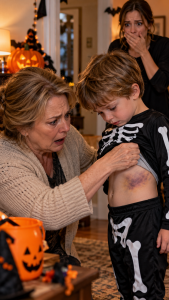
I laid him on his changing mat and carefully opened the outer zipper of his pumpkin costume.
Beneath it was another layer of clothing.
A thick, long-sleeved bodysuit.
I paused.
Why would a baby need so many layers inside a warm house?
Noah cried harder, so I gently loosened the bodysuit around his neck, checking that nothing was irritating his skin.
That was when I noticed something I had never seen before.
A small medical identification bracelet was fastened around his ankle beneath the fabric.
My hands went cold.
I had never known Noah wore one.
I carefully read the tiny printed information.
Then I noticed a folded hospital card tucked into the inside pocket of his bodysuit.
It had his name on it.
And beneath his name was a medical department I had never expected to see.
Pediatric Cardiology.
I sat down beside him, suddenly frightened.
Why did my grandson have a medical identification bracelet?
Why had nobody told me about a cardiology appointment?
And why had Vanessa insisted that nobody ever see what was underneath his clothes?
Before I could examine the card further, my phone rang.
It was Vanessa.
“Linda,” she said breathlessly, “is Noah still wearing his pumpkin costume?”
I looked at my grandson.
Then I looked at the hospital card.
“Yes,” I answered carefully.
There was a long silence.
Then she whispered something that made my heart pound.
“Please tell me you haven’t seen the scar.”
I couldn’t speak.
Because I had just noticed a small, healed surgical scar beneath his collar.
And suddenly, I understood that Vanessa hadn’t merely been afraid of someone changing his clothes.
She had been afraid of someone discovering what had happened to her baby.
PART 2 — The Secret Behind His Clothes
“Vanessa,” I said quietly, “what happened to Noah?”
She didn’t answer.
I could hear her breathing through the phone.
Then she said, “Put his clothes back on, Linda.”
“I’m worried about him.”
“He’s fine!”
Her voice cracked on the last word.
“Then explain the hospital bracelet.”
Silence.
“And explain why there’s a cardiology card in his clothing.”
She began crying.
“Please don’t tell Michael.”
That sentence frightened me more than anything else she could have said.
“Why wouldn’t I tell my own son something about his child’s health?”
“Because he doesn’t know the whole story.”
I stared at Noah, who had finally stopped screaming but was still restless on his changing mat.
“Vanessa, listen to me. He’s uncomfortable, and I’m worried about him. I’m not going to ignore that because you’re afraid of what I’ll discover.”
She sobbed.
Then the connection went dead.
I immediately called Michael.
He answered over the noise of traffic.
“Hey, Mom. Everything okay?”
“Noah has a medical bracelet, and I found a hospital card for pediatric cardiology.”
The noise in the background stopped.
“What did you say?”
I repeated myself.
For several seconds, he didn’t speak.
Then he whispered, “Mom, please don’t let Vanessa hear you say that.”
My heart sank.
“Michael, what is going on?”
He told me that Noah had been born with a congenital heart defect.
When he was only a few weeks old, doctors discovered that he needed surgery to correct a problem with the structure of his heart.
The operation had been successful, but his recovery required regular appointments and careful monitoring.
I pressed my hand against my mouth.
“My grandson had heart surgery, and nobody told me?”
“Vanessa asked me not to tell anyone.”
“Why?”
Michael struggled to find the words.
“She was terrified that people would treat Noah differently. She kept imagining everyone looking at him as if he were fragile or sick. She said she wanted him to have a normal childhood.”
“And you agreed to hide this from your own mother?”
“I thought we would tell you eventually.”
I felt tears burning behind my eyes.
“Michael, I don’t need every detail of your medical decisions. But I should never have had to discover that my grandson had undergone surgery by finding a hospital card inside his clothes.”
“I know, Mom.”
His voice broke.
“I know.”
Then he told me something else.
Vanessa had become intensely anxious after the operation.
Every cough frightened her.
Every change in Noah’s breathing made her panic.
She had started covering his body because she was terrified someone would notice the scar and ask questions she wasn’t ready to answer.
The clothing had become a kind of shield.
She told herself that if nobody saw the scar, nobody would judge Noah, pity him, or remind her of the terrifying weeks she had spent beside his hospital bed.
But her fear had grown until she could barely allow anyone else to care for him.
I looked at the little pumpkin costume on the floor.
For the first time, I understood that Vanessa’s behavior might not have come from a desire to deceive me.
It might have come from a fear she didn’t know how to manage.
But understanding her fear didn’t make the secrecy harmless.
“Michael,” I said, “your wife needs help, and your son needs parents who can talk honestly about his health.”
“I agree.”
“Then come home.”
He arrived twenty minutes later.
Vanessa came with him.
The moment she entered my living room, she rushed toward Noah and lifted him into her arms.
“You shouldn’t have taken his clothes off!”
“Vanessa, he was crying and sweating.”
“You promised you wouldn’t!”
“I promised to take care of him.”
She clutched him against her chest.
“I knew this would happen.”
Michael stepped between us.
“Vanessa, stop.”
She looked at him in disbelief.
“You’re taking her side?”
“No,” he said. “I’m asking you to listen.”
He explained that I had discovered the medical bracelet and hospital card.
Vanessa began shaking.
Then she sat on the sofa and covered her face.
“I didn’t want anyone to look at him differently,” she whispered.
I sat beside her.
“Look at him differently how?”
“Like he’s broken.”
Her voice was barely audible.
“When he came home after surgery, I couldn’t sleep. I kept checking whether he was breathing. Every time someone asked to hold him, I imagined something going wrong. I thought that if I kept him covered and never let anyone touch his clothes, I could keep him safe.”
Tears rolled down her cheeks.
“Then it became easier to tell people he was cold than to explain what had happened.”
I reached for her hand.
“Vanessa, a scar doesn’t make Noah broken.”
She shook her head.
“You don’t understand.”
“Perhaps I don’t understand everything you’ve been feeling,” I replied. “But I know what it means to be afraid of losing someone you love.”
I told her about the nights I had spent beside my own children’s beds when they were sick.
I told her that being a mother never meant being free from fear.
It meant learning when fear was helping us protect our children and when it was preventing us from allowing them to live.
Vanessa cried harder.
Then Michael took the hospital card from the table.
“Mom, there’s something else we haven’t told you.”
He looked at his wife.
She nodded reluctantly.
“The doctors recently scheduled another appointment,” he continued. “They want to check his progress and make sure his heart is developing as expected.”
“Is something wrong?”
“Not necessarily. It’s a routine follow-up, but Vanessa has been terrified about it.”
I looked at her.
“Is that why you wouldn’t let anyone change his clothes?”
She nodded.
“I was afraid someone would see the scar and ask whether he was going to be okay. I don’t know how to answer that question.”
I pulled her into a gentle embrace.
“Then we can be afraid together.”
For a moment, she leaned against me.
Then she suddenly pulled away and looked at Noah.
“His breathing sounds strange.”
Michael immediately picked him up and checked whether he was comfortable.
I reminded them that if Noah appeared to have difficulty breathing or showed other concerning symptoms, they needed urgent medical help rather than trying to manage it themselves.
Fortunately, his breathing settled, but the experience made something painfully clear.
They needed to follow his medical team’s guidance instead of allowing fear to dictate every decision.
That evening, we agreed that Michael and Vanessa would speak honestly with Noah’s pediatric cardiology team about their worries.
We also agreed that I would respect their medical instructions while being allowed to help with ordinary caregiving when it was appropriate.
For the first time, Vanessa let me hold Noah without watching every movement of my hands.
I rocked him gently.
He curled his little fingers around mine.
And I thought the worst of the secret was finally behind us.
Then Vanessa opened her handbag and pulled out a second envelope.
“Linda,” she whispered, “there’s something else I need to tell you.”
She handed it to me.
Inside was a letter from the hospital.
I read the first paragraph.
Then I looked up at her, unable to believe what I was seeing.
Because the letter wasn’t about Noah’s surgery.
It was about a genetic condition that might affect other members of the family.
And the person the doctors wanted to speak with first was my son.
PART 3 — The Truth That Brought Our Family Together
For a moment, I couldn’t make sense of the letter.
I read it again, more slowly.
The doctors had discovered that Noah’s heart condition might have a genetic component.
They had recommended that Michael receive genetic counseling to determine whether further testing would be appropriate for him or other relatives.
The letter did not say that Michael had the condition.
It did not say that anyone else in the family was affected.
It simply explained that more information might help the doctors understand Noah’s diagnosis and plan his care.
I looked at my son.
“Have you spoken to the doctor about this?”
He shook his head.
“Not yet.”
Vanessa wiped her cheeks.
“I was afraid that if people knew, they’d start thinking about everything that could go wrong.”
I placed the letter on the table.
“Sweetheart, knowing more doesn’t mean something terrible will happen.”
She stared at the floor.
“But what if it does?”
“Then you’ll have information to help you make decisions.”
I paused.
“And you won’t have to face it alone.”
The next morning, Michael and Vanessa contacted Noah’s medical team.
They arranged the recommended appointments and asked questions they had been too frightened to ask before.
I accompanied them when they invited me, sitting quietly in the waiting room while the doctors explained what was known, what remained uncertain, and which follow-up steps were appropriate.
The doctor reassured them that Noah’s surgery had addressed the defect that prompted it, but that continued monitoring was important.
The doctor also explained that genetic counseling could help the family understand whether further testing was useful.
Nothing was promised.
There were no magical guarantees that every future appointment would be easy.
But for the first time, Vanessa had a plan based on medical guidance rather than fear.
Over the following weeks, she gradually began to relax.
She stopped insisting that Noah wear thick layers inside a warm house.
She learned to distinguish between following his care instructions and trying to protect him from every imaginable danger.
She also began speaking with a counselor about the anxiety she had experienced after his surgery.
One afternoon, she called me.
“Linda, could you come over?”
“Of course.”
When I arrived, she was sitting on the living room floor beside Noah’s play mat.
He was wearing a short-sleeved blue romper, kicking his feet and reaching for a soft toy.
I stopped in the doorway.
Vanessa looked up.
“I wanted to show you something.”
She gently lifted Noah’s sleeve.
There, on his upper chest, was the small, healed surgical scar.
It was much less dramatic than I had imagined.
Vanessa touched it carefully.
“This is where they helped him.”
I sat beside her.
“Yes.”
She swallowed.
“I used to look at it and remember the worst days of my life.”
I listened without interrupting.
“Every time I saw it, I remembered the machines, the hospital rooms, and the doctors telling us what might happen. I couldn’t stop thinking that if I let my guard down, something would go wrong again.”
She looked at Noah.
“But now, when I see it, I want to remember something else.”
“What is that?”
“That he made it through.”
My eyes filled with tears.
I reached for her hand.
“He did.”
She looked at me.
“And I’m sorry I kept him from you.”
I squeezed her fingers.
“I missed those months, and that hurt. But I’m glad we’re talking now.”
“I was afraid you’d think I was a terrible mother.”
“No,” I said gently. “I think you were a frightened mother who needed support.”
She began crying again.
This time, I held her while she cried.
Not because everything she had done was acceptable.
Not because secrecy could erase the pain it had caused.
But because I wanted our family to move forward without pretending that fear was something we had to hide from one another.
A few weeks later, Noah celebrated his first birthday.
We gathered in my backyard beneath strings of warm lights.
There were balloons, sandwiches, a homemade cake, and far too many photographs.
Michael held Noah while Vanessa helped him touch the frosting with one tiny finger.
Everyone laughed when he smeared cake across his nose.
At one point, Vanessa approached me with Noah in her arms.
“Would you like to change him into his pajamas after his bath?”
I stared at her.
“Are you sure?”
She smiled.
“I’m sure.”
She handed me a clean set of clothes and showed me where she had packed his supplies.
She also explained the ordinary care instructions she wanted me to follow, including how to protect his skin and when to contact them if I noticed anything concerning.
It was a small moment.
But to me, it felt enormous.
For nine months, I had been kept at a distance from my grandson.
Now his mother was trusting me to help care for him.
I carried him upstairs, changed him carefully, and kissed his forehead before bringing him back to the party.
He rested his head against my shoulder.
His little hand caught the collar of my shirt.
And I realized that the secret had never really been the scar.
The scar was visible.
It was the fear surrounding it that had remained hidden.
Vanessa had believed that concealing the evidence of Noah’s illness would protect him.
Instead, it had isolated her, frightened her family, and made it harder for the people who loved Noah to support him.
She had not needed to protect him from our love.
She had needed help learning how to live with uncertainty.
That evening, after everyone had gone home, I sat beside the window with Noah asleep in my arms.
Vanessa came downstairs and sat beside me.
“Linda?”
“Yes, sweetheart?”
“Thank you for not giving up on me.”
I looked at her.
“I wasn’t going to give up on you.”
She rested her head against my shoulder.
For a while, neither of us spoke.
Then she whispered, “I wish I had told you the truth sooner.”
“So do I.”
She nodded.
“I thought keeping everything hidden would make me feel safe.”
I kissed the top of her head.
“Sometimes, the things we hide because we’re frightened are the very things we need help carrying.”
She began to cry softly.
And I held her hand while Noah slept peacefully between us.
From that day forward, I never again assumed that I understood every struggle happening inside another person’s heart.
I learned that a mother can love her child desperately and still become overwhelmed by fear.
I learned that a grandmother can be hurt by being excluded and still choose compassion.
And I learned that families don’t become stronger by pretending nothing is wrong.
They become stronger when they can finally tell one another the truth.
The secret beneath my grandson’s clothes wasn’t something shameful. It was the scar of a battle he had survived.
And the greatest gift that Halloween gave our family wasn’t the discovery of that scar. It was the chance to stop hiding our fears and start helping one another heal.