PART 1 — The Boy My Mother Chose Over Her Own Daughter
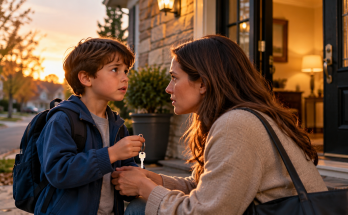
I was nine years old when my mother began feeding a homeless boy who slept in an abandoned shed behind our house.
His name was Daniel, and he looked barely eighteen.
He owned two shirts, a battered backpack, and a pair of shoes with holes in the soles.
Every morning, my mother prepared an extra portion of breakfast and carried it to him.
At first, I thought she was simply being kind.
Then my father died, our bills piled up, and kindness began to feel like a luxury we couldn’t afford.
There were nights when Mom and I ate plain rice because she claimed she wasn’t hungry.
Yet the following morning, Daniel would receive eggs, fresh bread, and sometimes even the last piece of chicken from our refrigerator.
I couldn’t understand it.
One Sunday, Mom baked a chocolate cake for my birthday.
I had been looking forward to that cake for weeks because we rarely had money for anything special.
But before I could even take my first slice, someone knocked on the back door.
It was Daniel.
His jacket was soaked from the rain, and he stood there shivering.
Mom immediately wrapped the cake in foil, placed it inside a container, and handed it to him.
I stared at her in disbelief.
“That’s my birthday cake!”
She froze.
For a moment, I thought she would apologize and bring it back.
Instead, she looked at me with an expression I had never seen before.
“Daniel needs it more than we do today.”
I burst into tears.
“Then why don’t you adopt him? Why don’t you make him your son and let me go live somewhere else?”
The words escaped before I could stop them.
Mom’s face turned pale.
She grabbed my shoulders and spoke in a trembling voice.
“Never say that again. You have no idea what this boy has been through.”
I pulled away from her.
“And you have no idea what I’m going through!”
That night, I cried myself to sleep.
I decided that Daniel was the reason my mother had stopped noticing how lonely I was.
Whenever he tried to talk to me, I ignored him.
Whenever he smiled at me, I looked away.
And whenever Mom asked me to bring him a meal, I left it on the ground without saying a word.
Daniel never complained.
He simply nodded, picked up the food, and whispered, “Thank you.”
Years passed.
I grew older, graduated from college, and moved to another city.
My calls to Mom became shorter.
My visits became less frequent.
And eventually, I stopped asking about Daniel altogether.
Whenever I returned home, I noticed small things that seemed strange.
Mom sometimes disappeared for hours without explaining where she had gone.
Occasionally, an envelope arrived with no return address.
Whenever I asked about it, she would quickly put it away.
Once, I caught her crying in the kitchen while holding a small wooden box.
When she noticed me, she locked it inside her bedroom drawer.
“What are you hiding?” I asked.
“Nothing you need to worry about,” she replied.
I was furious.
After everything she had sacrificed for a stranger, she still refused to explain herself to her own daughter.
Then, twenty years after Daniel first appeared behind our house, my mother suffered a sudden medical emergency.
I rushed to the hospital.
She was conscious, but her voice was weak, and the doctors told me that her condition was critical.
I held her hand and begged her to keep fighting.
She looked at me with tears in her eyes.
“There’s something I should have told you a long time ago.”
“What is it, Mom?”
Her lips trembled.
“Daniel isn’t the person you think he is.”
Before she could explain, her breathing became difficult, and the medical team rushed into the room.
I was escorted into the hallway.
Hours later, the doctor came out and quietly told me that my mother had passed away.
I collapsed against the wall.
Despite all our arguments, all the years of distance, and all the things I had never said, she was still my mother.
And I had run out of time to ask her the questions that mattered.
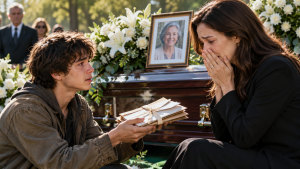
At her funeral, I looked for Daniel.
He wasn’t there.
I felt a bitter wave of anger.
Even at the end, my mother had worried about him more than anyone else.
But as I was leaving the cemetery, an unfamiliar man in an expensive black suit approached me.
He appeared to be in his late thirties.
His hair was neatly styled, his shoes were polished, and a chauffeur waited beside a black luxury SUV.
He looked at me as if he had been searching for me his entire life.
Then he asked a question that made my blood run cold.
“You’re Margaret’s daughter, aren’t you?”
I nodded cautiously.
He swallowed hard.
“My name is Daniel.”
I stared at him.
The homeless boy I remembered had been thin, frightened, and dressed in clothes that barely protected him from the weather.
This man looked like he belonged in a boardroom.
“Where have you been?” I demanded. “My mother is gone. You couldn’t even come to her funeral?”
His eyes filled with tears.
“I wanted to come,” he whispered. “But I couldn’t face you until I was ready to tell you the truth.”
“What truth?”
He reached into his coat and pulled out a sealed envelope bearing my mother’s handwriting.
Then he said six words that made my knees weak.
“Your mother saved my life twice.”
I looked down at the envelope.
On the front, Mom had written my name.
And beneath it were four words.
OPEN ONLY WHEN HE RETURNS.
PART 2 — The Secret Hidden Behind Our House
My hands shook as I opened the envelope.
Inside was a letter written in my mother’s familiar handwriting.
The first sentence made me stop breathing for a moment.
My darling girl, if Daniel has finally come to you, it means I am no longer here to explain what happened all those years ago.
I looked up at him.
“What does this mean?”
Daniel lowered his head.
“Please let me explain everything.”
I wanted to scream at him.
I wanted to demand why my mother had spent twenty years protecting him while allowing her own daughter to believe she was second best.
But something in his expression stopped me.
He wasn’t arrogant.
He wasn’t proud of his expensive clothes.
He looked like a man carrying a burden he had been afraid to put down for decades.
So I listened.
Daniel explained that when he was eighteen, he had been living with his stepfather, a man who controlled every part of his life.
After his mother died, the situation at home became unbearable.
Daniel worked odd jobs to help pay the bills, but his stepfather took most of his earnings.
One night, after a terrible argument, Daniel was thrown out with nothing but the clothes he was wearing.
He spent several nights sleeping behind shops and abandoned buildings.
Eventually, he found the old shed behind our property.
He had intended to stay for only one night.
But the weather turned cold, and he became seriously ill.
That was when my mother found him.
“She didn’t just bring me food,” Daniel said. “She found me a doctor when I could barely stand. She paid for medicine with money she had been saving for your school expenses.”
I felt my stomach tighten.
“Why would she do that?”
“Because she believed I deserved a chance to rebuild my life.”
He paused.
“But that wasn’t the only reason.”
I looked at the letter again.
The next paragraph explained that shortly before my father died, he had been involved in a small charitable organization that helped young people who had nowhere safe to go.
One of the teenagers the organization had tried to help was Daniel.
My father had met him once and promised to find him a stable place to live.
But before he could fulfill that promise, he died unexpectedly.
My mother discovered Daniel behind our home months later.
When she learned his name and heard his story, she recognized him from the notes my father had left behind.
She believed that helping Daniel was one way to honor my father’s final promise.
I wiped my eyes.
“Then why didn’t she tell me?”
Daniel looked away.
“Because she was afraid you’d think your father had chosen me over you.”
I couldn’t speak.
He continued.
“Your mother told me that your father loved you more than anything. She didn’t want his unfinished promise to become another reason for you to feel abandoned.”
For the first time, I began to understand why Mom had reacted so strongly when I called Daniel a burden.
But I still didn’t understand how a homeless teenager had become a wealthy businessman.
Daniel explained that my mother had helped him find a temporary job at a local repair shop.
She also helped him apply for a vocational training program.
He studied at night, worked during the day, and slowly began rebuilding his life.
When he received his first real paycheck, he tried to repay my mother.
She refused.
When he offered to buy her a new refrigerator, she refused again.
“She told me to save the money and build a future,” he said. “She made me promise that if I ever became successful, I would help someone else the way she had helped me.”
Over the years, Daniel started a small maintenance business.
Then he hired employees.
Eventually, the business grew into a successful property restoration company.
He became financially secure, but he never forgot the woman who had fed him when he had nothing.
“So why did you disappear?” I asked.
Daniel’s face tightened.
“Because I made a terrible mistake.”
He explained that about five years earlier, he had offered to pay off our mother’s remaining debts and renovate her house.
She refused to accept the money as a gift.
She didn’t want me to feel that a stranger had rescued our family.
Instead, she asked Daniel to establish a charitable fund that would support struggling families anonymously.
He agreed.
But he also began visiting her less frequently because he believed his success might make me feel ashamed of how I had treated him.
“She kept telling me that you were a good person,” he said. “She believed that one day, you would understand why she helped me.”
I lowered my head.
I had spent twenty years believing Daniel had stolen my mother’s love.
Yet he had spent those same twenty years trying not to become another source of pain between us.
Still, there was something missing.
I turned to the final page of the letter.
My mother’s handwriting became uneven toward the bottom.
There is one more thing I must tell you, sweetheart.
The day your father died, he left something behind that I never had the courage to show you.
It concerns the house you grew up in, the promise he made to Daniel, and the reason I insisted that you never abandon him.
My heart began to pound.
I looked at Daniel.
“What did my father leave behind?”
He closed his eyes.
Then he reached into his briefcase and removed a small wooden box.
The same kind of box I had seen my mother hiding years ago.
He placed it on the table between us.
“I think it’s time you knew,” he said.
“Your father didn’t just ask your mother to help me.”
He paused, struggling to speak.
“He made a decision about your future that could have changed your entire life.”
PART 3 — The Promise My Father Left Behind
I stared at the wooden box.
For twenty years, I had believed my father had left us with nothing but grief and unpaid bills.
Now Daniel was telling me that my father had made a decision that my mother had kept secret.
“What was it?” I asked.
Daniel carefully opened the box.
Inside were several legal documents, a small savings book, and a handwritten letter signed by my father.
I recognized his handwriting immediately.
My throat tightened.
Daniel slid the letter toward me.
It began with a message addressed to my mother.
If anything happens to me, please make sure our daughter has a chance to build a life without carrying the burden of our struggles.
I covered my mouth.
The letter explained that my father had been working on a plan to turn a small piece of inherited land behind our house into a community workshop.
He wanted to teach young people practical skills and help them find employment.
Daniel had been one of the first young people he hoped to help.
But the plan had never been completed.
After my father’s death, my mother discovered that the land could eventually become valuable.
She could have sold it to pay our debts.
Instead, she kept it, worked extra hours, and struggled to maintain the property while raising me.
I looked at the documents.
The land had been placed in a trust intended to support the family and fund the charitable project my father had envisioned.
My mother had managed it carefully for years.
And Daniel had helped her turn that forgotten dream into something real.
“The business I built eventually gave me enough money to fund the workshop,” Daniel explained. “Your mother helped me establish it quietly. We started by training a few young people who had nowhere else to turn.”
I thought about all the times Mom had told me she was visiting friends or attending appointments.
I remembered the mysterious envelopes, the locked drawer, and the evenings when she returned home exhausted but smiling.
She hadn’t been secretly giving everything away to a stranger.
She had been keeping a promise to my father while building something that could help people like Daniel.
But there was another document in the box.
It was a letter addressed directly to me.
My hands trembled as I unfolded it.
My precious daughter,
I know you were angry when I helped Daniel. I know you sometimes wondered why I gave him food when we had so little ourselves.
I wish I had explained everything sooner.
But I was afraid that if I told you about your father’s unfinished promise, you would feel that you had to carry it too.
You were my child. Your happiness was never less important than his future.
I fed Daniel because he was hungry. I helped him because he needed a chance. And I kept helping him because I watched him turn that chance into a life of his own.
I never expected you to love him.
I only hoped that one day, you would understand that kindness does not mean there is less love left for you.
I could no longer hold back my tears.
All those years, I had mistaken my mother’s compassion for rejection.
I had been so focused on what she gave Daniel that I had forgotten everything she had given me.
She had worked long hours to pay my school fees.
She had stayed awake beside my bed whenever I was sick.
She had quietly sent me money during my first difficult months in the city, even when I was too proud to admit I needed help.
And I had spent years treating her as though she had failed me.
Daniel waited until I finished reading.
Then he spoke softly.
“There’s one final part.”
He took another document from the box.
It was a proposal for a new community center, designed to provide meals, temporary accommodation, and job training for young people experiencing homelessness.
The building would stand on the land behind our old house.
My mother had spent the final years of her life preparing for it.
She had asked Daniel to help finance the project, but she had made one condition.
He could not reveal the plan until after her death.
She wanted me to have the choice to become involved without feeling pressured by her wishes.
Daniel looked directly at me.
“She wanted you to decide what happens next.”
I glanced toward the window.
Outside, the afternoon light fell across the table, illuminating the letter I had read so many times in my mind already.
For the first time, I understood the truth.
My mother hadn’t chosen Daniel instead of me.
She had seen a young man who had been abandoned by the world, and she had refused to let him believe that he was worthless.
And in doing so, she had given him the chance to become the person standing before me.
“Why are you telling me this now?” I whispered.
“Because your mother asked me to give you something she could never give you herself.”
“What?”
Daniel reached across the table and placed a small brass key in my palm.
“An opportunity to finish what your parents started.”
I looked at the key, then at the documents.
For years, I had thought the house behind which Daniel once slept represented everything my family had lost.
Now it represented something else.
A beginning.
I agreed to help establish the community center.
We kept my mother’s name on the entrance, not because we wanted people to praise her, but because I wanted every young person who walked through those doors to know that one small act of kindness could change a life.
The first time the center opened, dozens of people arrived for a hot meal.
Some were young.
Some were older.
Some had jobs but nowhere safe to sleep.
Others had lost everything and didn’t know where to begin.
I stood near the entrance, watching Daniel greet them one by one.
Then a teenage boy appeared in the doorway.
His jacket was torn, and he kept his eyes on the floor.
He looked at the serving table and asked quietly, “Is there enough food for me?”
My eyes filled with tears.
I walked over, placed a warm plate in his hands, and smiled.
“There’s always enough for one more.”
For a moment, I could almost hear my mother’s voice.
And I finally understood the lesson she had spent twenty years trying to teach me.
Love doesn’t become smaller when we share it.
Sometimes, the person we resent for receiving our kindness is the very person who teaches us how to give it.
That evening, after everyone had gone home, Daniel and I stood together outside the center.
I turned to him.
“I’m sorry I hated you for so long.”
He shook his head gently.
“You were a child who missed her father and was afraid of losing her mother. I understood more than you think.”
I cried then, not because I was angry, but because I wished I had understood sooner.
My mother had spent twenty years feeding a homeless boy.
But the greatest thing she left behind wasn’t the building, the money, or the unfinished promise.
It was the truth that a family isn’t always defined by who shares your blood.
Sometimes, it’s defined by who refuses to let you face the world alone.
And from that day forward, whenever someone asked me why we kept the community kitchen open even when donations were low, I told them about my mother.
I told them about the boy behind our house.
And I told them that the smallest act of kindness can become the beginning of a story no one could have imagined.
Because twenty years earlier, my mother had given a hungry stranger a meal.
And after her death, he helped me discover the heart of the woman I thought I had lost long before she was gone.