I Repaired a Widow’s Fence Before the Storm — The Next Morning, Her Son Arrived With Police and Accused Me of Stealing Something I’d Never Seen
PART 1 — The Woman Behind the Broken Fence
The morning I discovered that I might lose my home, I received a letter that made my hands go numb.
My name is Hannah Brooks. I was thirty-one years old, seven months pregnant, and living alone in a little white house on the edge of a quiet town in Ohio.
My husband, Michael, had left four months earlier after telling me he wasn’t ready to become a father. He packed two suitcases, took most of the money from our joint account, and promised he would send help when he could.
He never did.
I worked remotely as a customer service representative, but my hours had been reduced, and the medical bills were piling up. The letter on my kitchen table informed me that I was behind on my mortgage payments and needed to make arrangements immediately.
I read it three times, hoping the words would somehow change.
They didn’t.
I folded the letter and slipped it into a drawer because I couldn’t bear to look at it anymore.
That afternoon, I went outside to clear my head. The sky was dark, and the weather forecast warned that a powerful storm was approaching.
That’s when I heard the sound of wood cracking.
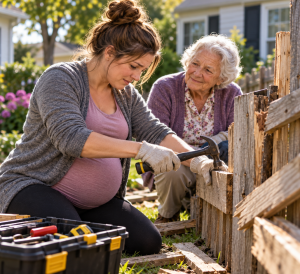
Next door, an elderly woman named Mrs. Eleanor Whitaker was standing beside a fallen fence, struggling to lift a heavy wooden panel.
She was seventy-eight years old, small and thin, with silver hair usually tucked beneath a knitted cap. Her husband had died two years earlier, and her only son, Peter, reportedly lived several states away.
The fence separating our properties had stood for decades. A section had collapsed during the previous night’s wind, leaving broken boards scattered across her garden.
Eleanor tried to lift one of the panels, but it slipped from her hands.
“Please be careful!” I called.
She looked up, embarrassed.
“Oh, don’t mind me, dear. I thought I could manage it myself.”
I walked over.
“That piece is too heavy for you.”
“And you’re pregnant,” she replied, glancing at my stomach. “You certainly shouldn’t be helping an old woman with a fence.”
I smiled despite everything weighing on my mind.
“Then we’ll have to be sensible. I’ll handle the tools, and you can tell me what needs fixing.”
She hesitated before nodding.
I fetched my toolbox and a pair of work gloves. We spent the next two hours salvaging the unbroken boards, replacing the damaged posts, and securing the loose panels.
I wasn’t a carpenter, but my father had taught me how to repair things when I was young.
Eleanor sat on a garden chair, handing me screws and telling me where the old posts had stood.
As we worked, she began talking about her late husband, Arthur.
“He built this fence the summer we got married,” she said. “He wasn’t much of a carpenter, but he was determined.”
“Did it last?”
She laughed.
“Forty-six years. I’d say he did pretty well.”
For the first time in weeks, I found myself laughing too.
When the fence was finally standing again, Eleanor walked along it slowly, touching the repaired boards as if they were precious.
“You’ve done more than fix a fence, Hannah.”
“I just didn’t want you to get hurt.”
She looked at me for a long moment.
“Sometimes, the people who need help the most are the ones who keep giving it.”
Her words struck closer to home than she could have known.
Before I left, she insisted that I come inside for tea.
Her house smelled of cinnamon and freshly baked bread. Family photographs covered the walls, and a grandfather clock ticked in the corner of the living room.
Eleanor poured two cups of tea and placed a slice of apple cake on a plate in front of me.
“You look worried,” she said.
I tried to smile.
“I’m fine.”
“No, you’re not.”
Something about her gentle voice broke through the wall I’d built around myself.
I told her about my husband leaving, the baby coming, and the mortgage letter sitting in my kitchen drawer.
I expected sympathy.
Instead, she listened without interrupting.
When I finished, she reached across the table and squeezed my hand.
“You don’t have to solve your entire life tonight, dear. Just get through today.”
I blinked back tears.
Before I left, Eleanor packed a container of soup and bread for me to take home.
At the door, she handed me a small brass key.
“What’s this for?” I asked.
She looked toward the garden.
“An old storage shed. Arthur kept his tools there. If you ever need a hammer or something similar, help yourself.”
“I’ll bring it back.”
“No rush.”
I tucked the key into my coat pocket and thanked her.
That evening, the storm arrived.
Wind rattled the windows, rain hammered the roof, and tree branches scraped against the house. I spent most of the night awake, worrying about the baby and wondering how I would keep my home.
Shortly after midnight, the electricity went out.
I lit a candle and sat on the sofa with a blanket wrapped around my shoulders.
Then I heard a loud crash from next door.
I looked through the window.
A large tree branch had fallen into Eleanor’s yard, narrowly missing her back porch.
I wanted to check on her, but the wind was too dangerous, and my phone showed no signal.
I waited anxiously until morning.
At seven o’clock, I finally stepped outside.
The repaired fence was still standing.
But Eleanor’s house was silent.
I knocked on her door.
No answer.
I called her name and tried again.
Nothing.
Then I noticed a dark sedan pulling into her driveway.
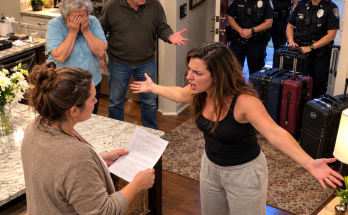
Two uniformed police officers stepped out.
A tall man in an expensive gray coat followed them, carrying a leather briefcase.
He looked at the house, then turned toward me.
“Are you Hannah Brooks?” he asked.
I nodded cautiously.
“Yes. Can I help you?”
He glanced at the officers.
Then he pointed toward the fence I’d repaired the previous afternoon.
“Did you work on my mother’s property yesterday?”
My stomach tightened.
“Yes. Eleanor and I repaired the damaged fence. Is something wrong?”
His expression hardened.
“Something is very wrong.”
One of the officers approached me.
“Ma’am, we need to ask you a few questions about what happened here last night.”
My heart began pounding.
“Is Eleanor all right?”
The man in the gray coat looked away.
“My mother passed away sometime during the night.”
I covered my mouth.
“No. I just saw her yesterday.”
He didn’t respond to my grief. Instead, he opened his briefcase and removed a photograph.
It showed the inside of Eleanor’s house.
A wooden cabinet stood against the living room wall.
The cabinet door was open.
“Something valuable disappeared from my mother’s home,” he said. “And according to her neighbors, you were the last person known to have spent time with her.”
I stared at him in disbelief.
“I didn’t take anything.”
He studied my face.
“Then perhaps you can explain why my mother left your name in her private notebook.”
Before I could answer, one officer walked toward the side gate.
He stopped beside the fence.
Then he crouched and examined the ground near the final post I had repaired.
“Sir,” he called. “You need to see this.”
The man in the gray coat hurried over.
A small metal box was partially buried beneath the loose soil.
I recognized the area immediately.
It was the spot where Eleanor had asked me to straighten the last fence post.
The officer carefully lifted the box.
The man’s expression changed the moment he saw it.
“That’s impossible,” he whispered.
Then he turned toward me.
“Where is the key my mother gave you?”
My hand instinctively moved to my coat pocket.
The little brass key.
Suddenly, I understood that the fence had led me into something far more complicated than I had imagined.
And the secret Eleanor had kept for years was about to change both our lives.
PART 2 — The Secret Beneath the Fence
I slowly removed the brass key from my pocket.
The man in the gray coat stared at it as though he had just seen a ghost.
“Give it to me,” he demanded.
One of the officers raised a hand.
“Sir, please let us handle this.”
I held the key tightly.
“Eleanor gave this to me yesterday. She said it belonged to her storage shed.”
The man shook his head.
“My mother wouldn’t have given you that key unless she had a reason.”
“Then perhaps you should tell me what it opens.”
He looked furious, but before he could answer, the officer carrying the metal box called us over.
Inside the box lay several envelopes, an old photograph, and a small notebook wrapped in plastic.
There was also a second key, much larger than the one Eleanor had given me.
The officer examined the envelopes without removing anything.
One had the name Peter Whitaker written across it.
Another bore my name.
Hannah Brooks.
My knees nearly buckled.
“Why would she leave something for me?” I whispered.
The officer explained that Eleanor had been found in her bedroom early that morning. The preliminary assessment suggested that she had died peacefully, but her death would be reviewed because of the missing property and the circumstances surrounding the discovery.
Peter immediately objected.
“My mother was perfectly healthy. Somebody must have entered the house.”
The officer remained calm.
“We aren’t accusing anyone. We’re establishing what happened.”
Peter turned toward me.
“Did she tell you about the documents?”
“No.”
“Did she show you the cabinet?”
“No.”
“Did she mention a safe?”
I shook my head.
He laughed bitterly.
“Of course she didn’t.”
Then he pointed toward my house.
“You know what I think? I think my mother trusted you because she felt sorry for you. She probably told you more than you realize.”
His words stung.
I had helped Eleanor because she was struggling with a broken fence. I hadn’t expected anything in return.
Now I was standing in her garden being treated like a criminal.
One of the officers asked Peter to step aside while they documented the discovery.
The second officer opened the notebook to a page marked with a paper clip.
He read a short passage aloud.
“November fourteenth. Peter came again asking about Arthur’s papers. I told him the same thing I told him last year. The property is mine, and the decision is mine.”
Peter went pale.
“That’s out of context.”
The officer continued reading.
“November twenty-second. The young woman next door helped me repair the fence today. She asked for nothing. I wish my own family understood that kindness cannot be purchased.”
I felt my throat tighten.
The officer turned another page.
There was a date from three days earlier.
And beneath it, Eleanor had written a sentence that made everyone fall silent.
“If anything happens to me, the truth is hidden where Arthur’s fence meets the old stone wall.”
We all looked toward the repaired fence.
The officer examined the metal box again.
Inside the notebook’s plastic wrapping was a folded map of the property. A red circle marked the corner where the fence met an old stone wall at the far end of the garden.
Peter stared at the map.
“My father demolished that wall years ago.”
“Apparently, part of it remains,” the officer replied.
Peter began pacing.
“This is ridiculous. My mother was confused. She was almost eighty.”
I remembered Eleanor’s clear eyes, her steady hands pouring tea, and the way she had recalled the exact date her husband built the fence.
She hadn’t seemed confused.
She had seemed determined.
The officers asked me to accompany them to the marked location.
Peter protested, but they explained that the property owner was deceased and they needed to document anything found.
We walked along the fence until we reached a section hidden behind overgrown ivy.
Beneath the vines, several old stones formed a narrow boundary wall.
The final fence post stood directly beside it.
One officer carefully moved the loose soil with a small tool.
After several minutes, he uncovered a flat metal panel.
Beneath it was a narrow compartment containing a sealed document pouch.
Peter took a step forward.
“That’s my father’s property!”
The officer stopped him.
“Please remain where you are.”
Inside the pouch were property deeds, bank records, a handwritten letter, and a photograph of Eleanor and Arthur standing beside a young boy.
The photograph had been taken decades earlier.
I noticed that the boy wore a small silver pendant shaped like a star.
Peter leaned forward.
“My brother.”
I looked at him.
“You have a brother?”
He hesitated.
“Had.”
The officers exchanged glances.
Peter’s voice grew sharper.
“He left home when he was nineteen. We haven’t spoken in years.”
The officer carefully unfolded the letter.
It was addressed to Peter.
But Eleanor had written another name beneath his.
Daniel Whitaker.
The brother Peter claimed was gone.
The letter began:
Peter, if you’re reading this, then I’ve run out of time to explain what I should have told you years ago.
Peter reached for the paper.
The officer moved it out of reach.
“This needs to be preserved as evidence.”
Peter’s face turned red.
“You’re letting a stranger stand here while you read my family’s private letters?”
The officer replied evenly.
“We’re investigating a possible dispute involving missing documents. Your cooperation would help.”
Then he examined the property deed.
His expression changed.
“Mr. Whitaker, this document appears to concern a parcel of land that was transferred out of your father’s estate more than twenty years ago.”
Peter stared at him.
“What does that mean?”
The officer looked toward the old stone wall.
“It means your mother may have been protecting property that someone else has been trying to claim.”
My heart began pounding again.
Eleanor’s kindness had drawn me into a mystery involving a family secret, a disputed inheritance, and a missing brother.
But I still didn’t understand why she had chosen me.
Then the officer removed the envelope bearing my name.
He examined the seal before handing it to me.
“You may want to read this privately,” he said.
I opened it with trembling fingers.
Inside was a short letter.
Dear Hannah,
If you are reading this, then I wasn’t able to thank you properly.
You repaired my fence when you had every reason to worry about your own life. You listened when I needed someone to listen. And you treated me like a person, not a burden.
I have watched you struggle these past months. I know about your husband leaving, and I know you are afraid of losing your home.
There is something you must understand about the house you live in.
I stopped reading.
My breath caught in my throat.
Eleanor had written the exact address of my property.
Then came the final sentence on the first page.
“Your home and my husband’s old workshop are connected by a piece of land that was never legally transferred, and I believe someone has been hiding the truth from you.”
I looked up at the officers.
Peter was staring at the letter in my hands.
For the first time that morning, he looked genuinely frightened.
Because whatever Eleanor had left behind, it wasn’t merely a sentimental keepsake.
It could change who owned the land beneath my home.
And it might explain why someone had been so desperate to get inside her house.
PART 3 — The Truth That Changed Everything
The officers allowed me to take the letter home after recording it as evidence.
Peter refused to speak to me again.
Before leaving, he made one final accusation.
“Whatever my mother promised you, you have no right to any of it.”
I wanted to tell him I hadn’t asked for anything.
But I could see that he wasn’t interested in the truth.
He was interested in control.
That afternoon, I sat at my kitchen table with Eleanor’s letter spread in front of me.
The mortgage warning remained in the drawer beside it.
For months, I had believed my biggest problem was finding enough money to keep my home.
Now I was beginning to suspect that the history of the property itself had been misunderstood.
I called the attorney whose name appeared on the old deed.
The receptionist told me he had retired, but his former partner still handled estate matters.
I explained the situation as clearly as I could.
After reviewing the details, the attorney agreed to meet me the following morning.
I barely slept that night.
At nine o’clock, I arrived at his office carrying Eleanor’s letter, the property records I had, and the mortgage notice.
The attorney, Mr. Bennett, listened without interrupting.
Then he spread several maps across his desk.
One showed my house and the neighboring property as they existed today.
Another showed the same area nearly fifty years earlier.
He placed the maps side by side.
“There,” he said, pointing to a narrow strip of land between the two properties.
“This boundary was never properly recorded when the original lots were divided.”
I leaned closer.
“What does that mean for me?”
“It means the legal description attached to your deed may not match the boundaries that were actually intended when the properties were sold.”
He reviewed additional records.
Then he found a document that had been filed years before I purchased my house.
It was a boundary agreement signed by Eleanor and her late husband.
According to the agreement, the small strip of land containing my driveway access and an old workshop had been intended to remain with the property now occupied by me.
However, a later survey had incorrectly included part of it in Eleanor’s parcel.
The mistake had never been corrected.
I stared at the document.
“Could this affect my mortgage?”
“Potentially. But we need to verify the title, establish the correct boundary, and determine whether the discrepancy has any financial implications.”
Then he found something else.
A separate document indicated that Eleanor had placed her remaining property into a trust several years earlier.
The beneficiary wasn’t Peter.
It was Daniel, the son Peter had claimed was gone.
I remembered the old photograph.
The boy with the silver star pendant.
“Why would she leave everything to a son who hasn’t been around?”
Mr. Bennett shook his head.
“We can’t assume we know the reason. But her letter suggests she wanted the truth established before the property changed hands.”
He recommended that I avoid making any claims until the documents had been verified.
So I waited.
Over the next two weeks, the attorney worked with the county records office to review the deeds and survey history.
The police continued investigating the missing documents from Eleanor’s home. They found no evidence that I had taken anything, and I was no longer considered a person of interest.
Then, one Thursday afternoon, Mr. Bennett called.
“We found Daniel.”
I gripped the phone.
“He’s alive?”
“Yes. He lives in another state. He left home decades ago after a serious disagreement with his father. Eleanor had been trying to reconnect with him for years.”
“Did he know about the trust?”
“No. He had no idea.”
The attorney explained that Eleanor had recently located Daniel and arranged for him to receive a letter. She had also asked him to come home if anything happened to her.
But she died before they could meet.
Daniel agreed to travel to Ohio.
When we finally met in Mr. Bennett’s office, he looked older than the boy in the photograph, but the silver star pendant still hung around his neck.
He held the old picture in both hands.
“She kept this all these years,” he whispered.
I nodded.
“She wanted you to come home.”
His eyes filled with tears.
For several minutes, neither of us spoke.
Then Daniel turned toward me.
“Why did she leave you a letter?”
I explained how I had helped Eleanor repair the fence and how she had given me the brass key.
Daniel listened carefully.
When I finished, he smiled sadly.
“That sounds like my mother. She always believed a person’s character showed in the small things they did when nobody was watching.”
He told us that he had left home at nineteen after his father demanded that he abandon his plans to become a teacher and take over the family business.
Peter had stayed behind and eventually taken responsibility for their father’s affairs.
Daniel had spent years building a quiet life elsewhere, but he had never stopped loving his mother.
He simply hadn’t known how to return.
The trust documents revealed Eleanor’s intentions: Daniel would inherit her remaining estate, while the disputed boundary and workshop would be handled according to the verified property records.
My own home was not automatically transferred to me, as the documents made no such promise.
But the corrected survey established that the narrow strip of land I needed for access belonged with my parcel, and the county records supported the boundary correction.
That mattered more than I could explain.
With the title discrepancy resolved, my attorney helped me negotiate with the mortgage company. I arranged a repayment plan and qualified for temporary assistance that gave me time to get back on my feet.
I still had bills to pay.
I still had a baby coming.
And I still had to rebuild my life after my husband’s abandonment.
But I was no longer fighting a property dispute I hadn’t even known existed.
As for Peter, the investigation revealed that he had been attempting to obtain documents related to the old property boundary. The police handled the matter through the appropriate legal process, and I never learned every detail of what happened afterward.
I didn’t need to.
Several months later, I gave birth to a healthy little girl.
I named her Grace.
Daniel came to visit us after the birth. He brought a small wooden box containing the silver star pendant’s matching chain, which he had found among his mother’s belongings.
Inside was a note Eleanor had written years earlier.
Family isn’t always the people who stand beside you from the beginning. Sometimes it’s the people who show up when life becomes difficult.
I read it twice before placing it in Grace’s keepsake box.
A year after Eleanor’s death, Daniel and I repaired the old fence again.
This time, we replaced the weathered boards with sturdy cedar and planted climbing roses along the stone wall.
When we finished, Daniel stood back and looked at the fence.
“She would have liked this,” he said.
“I think so too.”
He handed me a small envelope.
Inside was a photograph of Eleanor smiling in her garden, taken only a few weeks before I met her.
On the back, she had written a final message.
To Hannah, who helped mend a fence when her own world felt broken: never underestimate what kindness can set in motion.
I stood there for a long time, holding the photograph.
I had repaired that fence because an elderly woman needed help.
I hadn’t expected a reward.
I hadn’t expected a mystery.
And I certainly hadn’t expected that one afternoon of kindness would help uncover a hidden family history, resolve a property dispute, and give a lonely son the chance to reconnect with his mother’s memory.
But Eleanor had taught me something I would never forget.
Sometimes, the smallest thing you do for another person becomes the thing that helps you survive your own darkest season.
And sometimes, when you help someone repair what has fallen apart, you discover that your own life can still be rebuilt, one piece at a time.