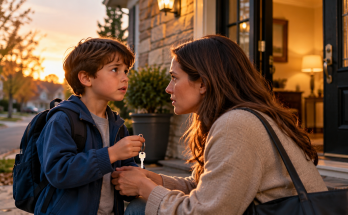
PART 1 — THE DAUGHTER THEY ERASED
For eight years, my parents forced me to leave home whenever my older brother brought his wealthy fiancée to visit.
“People like her don’t need to know about our family problems,” my mother would say.
My father was even more direct.
“Pack your things, Lily. And don’t come back until Sunday night.”
I obeyed them for eight years.
Until the night I discovered that the room they had locked me out of contained a secret that could destroy everything they had spent years pretending was perfect.
My name is Lily Bennett, and I was eighteen when my family decided I was too embarrassing to be seen.
It started after a terrible winter that changed my life.
I had been recovering at home, trying to finish school and rebuild the future I thought I would have.
My older brother, Daniel, had just become engaged to Victoria Hayes, a woman whose family owned several successful businesses in our town.
My mother treated Victoria as if she were royalty.
She bought new curtains, polished the silverware, replaced the furniture in the living room, and even hired someone to maintain the garden.
Then, three days before Victoria’s first visit, she walked into my bedroom and dropped a suitcase onto my bed.
“You’re going to stay with your aunt this weekend.”
I stared at her.
“Why?”
She looked at me as if I had asked the stupidest question imaginable.
“Victoria comes from a respectable family. We want her to have a good impression of us.”
“And what does that have to do with me?”
Her expression hardened.
“Don’t start, Lily.”
That evening, my father sat me down at the kitchen table.
“Your brother has worked hard for this relationship,” he said. “We’re not going to let anything interfere with his future.”
“I’m his sister.”
“And you need to understand your place.”
I waited for Daniel to defend me.
He didn’t.
He merely stood beside the refrigerator, staring at his phone.
The following Saturday, I left before Victoria arrived.
I watched from the end of the street as Daniel’s car pulled into our driveway.
Victoria stepped out wearing a cream-colored dress, smiling as my mother hurried forward to welcome her.
Nobody looked for me.
Nobody called to ask whether I had somewhere comfortable to sleep.
That night, I cried in the spare room at my aunt’s house until I fell asleep.
On Sunday evening, I returned home and found my bedroom door locked.
My father told me the lock had been changed because I had supposedly left the house in a mess.
It wasn’t true.
But I had learned that arguing only made things worse.
The next weekend, the same thing happened.
Then the weekend after that.
Eventually, my parents stopped pretending it was temporary.
Every Thursday, my mother sent me a message telling me when I had to leave.
Sometimes I stayed with my aunt.
Sometimes I slept in my old car.
And sometimes I went to a small family-run farm outside town, where an elderly woman named Margaret allowed me to help with her plants in exchange for a bed and dinner.
Margaret never asked me to explain my family.
She simply handed me a pair of gardening gloves and said, “A living thing doesn’t become worthless because someone refuses to make room for it.”
I remembered those words.
At home, however, I became almost invisible.
My family removed my name from the household calendar.
My mother told neighbors I was working in another city.
My father instructed relatives not to mention me when Victoria was around.
Even my graduation celebration was quietly canceled because Daniel and Victoria had scheduled an engagement dinner that weekend.
When I confronted my mother, she sighed.
“Must everything always be about you?”
I looked at her for a long moment.
Then I picked up my coat and walked away.
I stopped asking them to love me.
Instead, I began building a life they knew nothing about.
Margaret taught me how to grow plants, repair damaged roots, and recognize when a seemingly dead branch still had life inside it.
I found a job at a local nursery.
I saved every dollar I could.
And I started keeping a notebook.
Inside it, I recorded every weekend I was forced to leave, every lie my parents told, and every promise Daniel made before abandoning me again.
By my twenty-first birthday, the notebook was nearly full.
Then, one afternoon, I overheard my mother speaking on the telephone.
“No, Victoria doesn’t know,” she whispered. “And Daniel promised he would never tell her.”
I stopped outside the kitchen.
My mother lowered her voice.
“If she ever learns what happened that night, our entire family will be finished.”
My hands began to tremble.
What night?
What had happened that my family was so desperate to hide?
Before I could hear another word, my mother turned around and saw me.
Her face drained of color.
“Lily,” she said slowly, “how much did you hear?”
I looked directly at her.
“Enough to know you’ve been lying to me.”
She grabbed my wrist.
“You will not repeat this conversation to anyone.”
For the first time in my life, I pulled away from her.
“You don’t get to tell me what to do anymore.”
Then I walked out.
I thought that was the beginning of my freedom.
I had no idea that four years later, one unexpected discovery would reveal why my family had spent so long making me disappear.
And why Victoria’s own mother had once stood outside my locked bedroom door, praying for someone she believed was gone forever.
PART 2 — THE SECRET BEHIND THE LOCKED DOOR
By the time I turned twenty-four, I had built a modest but peaceful life.
I rented a little cottage near Margaret’s farm and worked as a supervisor at the nursery.
My boyfriend, Ethan, was a carpenter who believed that a quiet dinner and an honest conversation were worth more than an expensive house.
For the first time, I felt like I belonged somewhere.
My family, meanwhile, seemed to be living the perfect life.
Daniel and Victoria married in a beautiful ceremony.
My parents appeared in photographs from the wedding, smiling beside the bride’s wealthy relatives.
I wasn’t invited.
When I called Daniel to ask why, he gave me the same answer he had given for years.
“It’s complicated, Lily.”
“No,” I said. “It’s convenient.”
He hung up.
I didn’t call him again.
Then, in the spring of my twenty-fifth year, Victoria came into the nursery.
She was looking for flowering trees to plant beside a small community garden her family had funded.
I recognized her immediately.
She didn’t recognize me.
“I’m sorry,” she said, examining the plants. “Have we met before?”
I could have told her everything.
Instead, I showed her a beautiful dogwood tree and explained how to care for it.
Before leaving, she turned toward me.
“Can I ask you something strange?”
“Of course.”
“Do you know a woman named Lily Bennett?”
My heart seemed to stop.
I kept my face still.
“Why do you ask?”
“Daniel says his sister moved away years ago. But whenever I ask about her, everyone gets uncomfortable.”
She hesitated.
“His mother once told me Lily was too ill to attend our wedding. Yet another time, she said Lily had left the country.”
Victoria frowned.
“The stories don’t match.”
I placed the plant tag on the counter.
“Maybe you should ask your husband.”
“I have,” she replied. “He gets angry every time.”
Then she left.
That evening, I told Ethan what had happened.
He listened without interrupting.
When I finished, he asked a question nobody in my family had ever asked me.
“What do you want, Lily?”
I looked around the little cottage we had made into our home.
“I want the truth.”
Two days later, I returned to my parents’ house while they were away.
I still had a spare key, although I hadn’t used it in years.
The house smelled exactly as I remembered: furniture polish, expensive candles, and the faint scent of my mother’s perfume.
My old bedroom remained locked.
But the door was different.
The original wooden door had been replaced with a heavier one, and a new lock had been installed.
I tried my key.
It wouldn’t turn.
I was about to leave when I noticed a narrow envelope tucked beneath the door.
My name was written across the front in handwriting I recognized immediately.
It belonged to my grandmother.
She had died four years earlier.
My hands shook as I opened it.
Inside was a short note.
My darling Lily,
If you’re reading this, I wasn’t brave enough to tell you while I was alive.
Your parents have made a terrible mistake, but it isn’t the mistake they want you to believe.
Look behind the loose panel beneath the hallway stairs.
You deserve to know what happened before you decide whether you can ever forgive them.
Love, Grandma.
I read it three times.
Then I went to the stairs.
The panel was hidden behind a narrow cabinet.
When I moved it aside, I discovered a small metal box.
Inside were bank statements, legal papers, a hospital bracelet, and a sealed envelope bearing my full name.
The first document showed a bank account opened when I was eighteen.
My name appeared as the beneficiary.
The account contained far more money than I had ever earned.
The second document was a letter from a lawyer.
It stated that my grandmother had established a trust for me after an incident that had occurred eight years earlier.
But there was something else.
A handwritten statement, signed by my father.
It said that I had voluntarily agreed to leave the family home and had no intention of returning.
I had never signed anything like it.
The signature looked like mine, but something was wrong with the date.
It was dated two days before my parents first ordered me to leave.
My stomach tightened.
Why would my father need to create a document claiming I had left voluntarily if I had done nothing wrong?
I opened the final envelope.
Inside was a letter from my grandmother’s attorney.
It explained that the trust could not be released until I personally contacted the firm.
My parents had no authority to claim the money.
Yet someone had repeatedly attempted to access information about it.
I took photographs of the documents and called the attorney.
The next morning, I met him in his office.
He listened carefully as I explained the years of forced absences, the locked bedroom, and the contradictory stories my family had told.
Then he opened a file.
“Your grandmother came to see me shortly after the original incident,” he said. “She was deeply concerned about your safety and your future.”
“What incident?”
He looked at me for several seconds.
“Lily, you were told that your grandmother’s money was the only reason your family kept you at home.”
I shook my head.
“Nobody ever told me that.”
He turned the file toward me.
“The truth is that your grandmother had discovered that someone in your household had been hiding a serious financial problem.”
My mouth went dry.
“Who?”
He pointed to a name on the page.
It was Daniel’s.
According to the records, my brother had used money from a family account to cover debts he had concealed from our parents.
When my grandmother discovered what he had done, she threatened to tell the family.
The confrontation happened on the night I was taken to the hospital.
I remembered fragments of that night: raised voices, a slammed door, my mother’s trembling hands, and my father insisting that nobody speak to the neighbors.
But I couldn’t remember everything.
The attorney closed the file.
“Your grandmother believed you had been made the scapegoat for what happened.”
I stared at him.
“What happened to me?”
He hesitated.
“I’m not a doctor, and I won’t speculate about your medical history. But your parents gave us a written account of that night, and it differs significantly from the records your grandmother preserved.”
I left his office feeling as though the ground beneath my feet had shifted.
For eight years, I had believed my family wanted me hidden because I embarrassed them.
Now I wondered whether they had been hiding me because my presence reminded them of something they had done.
That evening, I called Victoria.
She answered on the third ring.
“Lily?”
I had never told her my real identity.
“It’s me,” I said. “The woman from the nursery.”
Silence.
Then a sharp intake of breath.
“You’re Daniel’s sister?”
“Yes.”
She didn’t speak for several seconds.
Finally, she whispered, “There’s something you need to know.”
My fingers tightened around the phone.
“What?”
“Your mother-in-law has been visiting your old bedroom for years.”
I closed my eyes.
“Why?”
Victoria’s voice began to shake.
“Because every Easter, she says a prayer for the daughter she believes she failed to protect.”
I felt cold all over.
“Failed to protect me from what?”
Victoria paused.
Then she said the words that changed everything.
“Lily, I think your parents have been lying about what happened the night you went to the hospital.”
PART 3 — THE NIGHT I FINALLY CAME HOME
Victoria agreed to meet me the following morning.
We sat in a small café away from our neighborhood, and for the first time in eight years, someone from my family listened to me without asking me to disappear.
She told me that shortly before our wedding, her mother, Suzanne, had overheard my parents arguing.
My father had been demanding that Daniel confess something.
Daniel insisted that revealing the truth would destroy his marriage before it began.
My mother kept repeating one sentence.
“She doesn’t remember everything. We need to leave it alone.”
Suzanne had asked what they meant.
My mother immediately changed the subject.
Afterward, Suzanne began asking questions about me.
She received different answers every time.
Sometimes I was living in Atlanta.
Sometimes I was studying abroad.
Sometimes I was too unwell to see anyone.
Eventually, she discovered that none of those explanations made sense.
She had driven to my parents’ house one Easter evening, hoping to speak with me.
My bedroom door was locked.
My mother told her I wasn’t home.
Suzanne didn’t believe her.
She stood outside my door and prayed because she thought I might be inside, frightened and alone.
That was the woman I had seen through the hallway window years earlier.
She wasn’t praying for someone who was dead.
She was praying for someone her own family had deliberately shut away.
Victoria reached across the table and held my hand.
“I’m sorry,” she whispered. “I should have asked more questions.”
“You didn’t know.”
“But I knew something was wrong.”
I couldn’t blame her for that.
For years, everyone had chosen comfort over the truth.
I was simply the person who paid for it.
That afternoon, Victoria and I went to my parents’ house together.
My mother opened the door.
The moment she saw me standing beside her daughter-in-law, she stopped breathing for a second.
“Lily?”
My father appeared behind her.
Daniel came down the stairs.
Nobody invited us inside.
I held up the copies of the legal documents.
“I want an explanation.”
My father stared at the papers.
Then he looked at Daniel.
That single glance told me more than any confession could have.
Daniel stepped forward.
“Lily, this isn’t the place.”
“Then where is the place? The room you locked? The farm where I slept? The weekends you made me vanish? Or the life you built while telling everyone I had abandoned you?”
My mother began crying.
“Please. You don’t understand.”
“Then explain it to me.”
For the first time, I refused to leave.
We sat in the living room where my parents had spent years entertaining Victoria’s family.
I placed the documents on the coffee table.
My father finally spoke.
Eight years earlier, Daniel had accumulated serious debts after secretly borrowing money to support a business venture.
When my grandmother discovered the missing funds, she confronted him.
The argument escalated.
I had tried to intervene.
During the confusion, I suffered a serious medical emergency and was taken to the hospital.
My parents were terrified.
Not just because of my condition, but because the financial records and the events surrounding that night threatened to expose Daniel’s deception.
They told relatives that I had been unstable.
They told neighbors that I needed privacy.
And when Victoria entered Daniel’s life, they decided that keeping me out of sight was easier than explaining what had happened.
But the most painful revelation came next.
My grandmother had created the trust to ensure that I would have money and independence if I ever needed to leave.
My parents knew about it.
They also knew that if I understood my rights and spoke to the lawyer, their version of events could be challenged.
The forged statement claiming I had voluntarily left home was part of their attempt to make the separation look like my choice.
My mother covered her face.
“We thought we were protecting the family.”
I looked at her.
“No. You were protecting the story you wanted people to believe.”
Daniel stared at the floor.
For years, I had imagined that one day he would explain everything and apologize.
Now that he was finally standing in front of me, I realized that an apology couldn’t return the birthdays I had spent alone or the years I had wasted believing I was the problem.
I turned to him.
“Did you ever ask where I slept?”
He said nothing.
“Did you ever wonder whether I had enough money for food?”
His eyes filled with tears.
“Lily, I was ashamed.”
“So you let me carry your shame for eight years.”
He began to cry.
My father attempted to interrupt, but Victoria stood up.
“Enough,” she said.
Everyone looked at her.
“You told me Lily abandoned this family. You told me she was living a wonderful life somewhere else. You let me believe that while she was sleeping in a car and working for everything she had.”
She removed her wedding ring and held it in her palm.
“I married Daniel because I believed he was an honest man. I need time to decide what this truth means for our future.”
Daniel looked as if the room had collapsed around him.
But I felt no satisfaction.
I had not come to destroy their marriage or take revenge on my parents.
I had come because I was tired of being erased.
My father pushed the papers toward me.
“What do you want from us?”
I looked at the house where I had grown up.
For years, I had imagined this moment would make me feel powerful.
Instead, I felt exhausted.
“I want my name back,” I said. “I want the truth corrected. I want the money Grandma left me transferred according to her wishes. And I want you to stop telling people that I abandoned you.”
My mother reached for my hand.
“Can you ever forgive us?”
I stepped back.
“I don’t know.”
That was the honest answer.
I left with Victoria, carrying the documents that would finally allow the attorney to resolve the trust and investigate the false statement.
Over the following months, the truth spread through the family.
Some relatives apologized.
Others insisted I should forgive my parents because they had been under pressure.
I stopped explaining myself to people who preferred the old story.
Victoria eventually began counseling with Daniel, but their marriage was no longer the effortless fairytale my parents had tried to sell.
Daniel wrote me a letter.
For the first time, he acknowledged what he had done without blaming our parents, our circumstances, or me.
I kept the letter.
I didn’t immediately answer it.
Forgiveness, I learned, is not a door someone else gets to unlock with a few sentences.
It is a choice you make when you are ready.
A year later, I used part of the money my grandmother had left me to open a small plant nursery of my own.
Above the entrance, I placed a wooden sign with a simple message:
EVERY LIVING THING DESERVES ROOM TO GROW.
Margaret stood beside me on opening day, smiling through her tears.
I thought about the eighteen-year-old girl who had packed a duffel bag every weekend because her parents believed she was an embarrassment.
I wished I could tell her that she didn’t need to earn her place in the world.
She had always deserved one.
Four years after I first began keeping records of my family’s lies, I finally understood why my parents had spent so long trying to make me disappear.
It wasn’t because I was worthless.
It was because the truth about what they had done was worth more to them than their own daughter’s peace.
And the night I returned home, I stopped helping them hide it.
I never moved back into that bedroom.
I built a home of my own instead.
And for the first time in my life, nobody could order me to leave.
Because sometimes the strongest thing a daughter can do is stop begging a family to make room for her—and start building a life where she never has to ask again.