PART 1 — THE PILOT WHO NEVER CAME HOME
At 76, I Was Still Visiting the Memorial of the Man I Loved in 1971—Until a Pilot Announced My Name Over the Plane’s Speakers and Revealed That My First Love Had Never Told Me the Truth…
I was twenty-one when I fell in love with Daniel Hayes.
He was the kind of man who made ordinary moments feel unforgettable.
We met in a university library during the winter of 1970, when he accidentally knocked an entire stack of books out of my arms.
Instead of laughing, he spent the next hour helping me collect every book and carrying them back to my dormitory.
Before he left, he asked me to have coffee with him.
I told him I couldn’t afford to buy him a cup.
He smiled and said, “Then we’ll share one.”
That was how our story began.
Daniel was studying aeronautical engineering, but his real dream was to fly.
He could spend hours talking about airplanes, describing the feeling of lifting off the runway as though he were explaining what it meant to be free.
I wanted to become a teacher.
We had almost no money, no important connections, and no idea what our future would look like.
But we had each other.
By the spring of 1971, Daniel had enlisted as a military pilot and received orders to deploy to Southeast Asia.
The night before he left, we sat on a wooden bench outside my parents’ house.
He held my hands and promised that he would return.
“When I come home, Eleanor, I’m going to marry you,” he said.
I tried to smile, but tears kept falling down my cheeks.
“Don’t promise me forever,” I whispered.
“Just promise me you’ll try to come back.”
He pressed his forehead against mine.
“I promise.”
Those were the last words he ever said to me in person.
Six months later, two military officers arrived at my parents’ door.
Daniel’s aircraft had disappeared during a mission.
There had been no confirmed wreckage, no recovered body, and no reliable explanation for what had happened.
His status was listed as missing in action.
I remember staring at the officers, waiting for one of them to admit there had been a mistake.
One of them gently told me that I should prepare myself for the possibility that Daniel would never return.
I refused to believe him.
For months, I left the porch light on every night.
Whenever the telephone rang, I ran to answer it.
Whenever a car stopped outside our house, I rushed to the window.
But Daniel never came home.
Years passed.
My friends married, raised children, and eventually welcomed grandchildren.
I received proposals from kind men, but I could never bring myself to say yes.
People called me foolish.
Some said I had turned a memory into an excuse to avoid living.
Perhaps they were right.
But how could I build a life with someone else when the man I loved had never been given the chance to say goodbye?
Every year, on Daniel’s birthday, I flew to the memorial where his name was engraved among those of other missing servicemen.
I left a single white rose.
I sat quietly for an hour.
Then I returned home.
I repeated that ritual for fifty-five years.
By 2026, I was seventy-six years old, my hair had turned white, and my hands trembled whenever the weather changed.
Still, I made the journey.
That morning, I boarded a commercial flight bound for the city closest to the memorial.
I took seat 12A beside the window.
As the plane climbed above the clouds, I closed my eyes and whispered Daniel’s name.
I had no idea that someone aboard that aircraft already knew exactly who I was.
Twenty minutes before landing, the captain’s voice came over the speakers.
“Good afternoon, ladies and gentlemen. We will be beginning our descent shortly.”
I barely paid attention.
Then the speakers crackled again.
“Before we land, I need to speak with a passenger named Eleanor Whitmore.”
My eyes opened.
That was my name.
The captain continued, his voice strangely unsteady.
“If you are seated in 12A, please remain in your seat after the other passengers have left the aircraft.”
A nervous laugh escaped me.
Perhaps there was another Eleanor.
Perhaps it was a mistake.
Then he said something that made my blood turn cold.
“I understand you’re traveling to visit the memorial of Captain Daniel Hayes.”
My fingers tightened around the armrests.
Nobody outside my family knew I still made that journey every year.
The captain paused.
Then he added, “Ma’am, I know what happened to Daniel Hayes in 1971.”
My water cup slipped from my hand.
It struck the floor, spilling across my shoes.
For fifty-five years, I had imagined hearing those words.
But I had never imagined hearing them from the cockpit of a commercial airplane.
When we landed, the other passengers gathered their belongings and walked toward the exit.
I remained frozen in my seat.
A flight attendant approached me.
“Mrs. Whitmore, the captain has asked if you would be willing to wait a few minutes.”
My heart pounded so hard that I could barely hear her.
“Why?” I whispered.
She looked toward the closed cockpit door.
“Because he says he has something that belongs to you.”
The cabin emptied.
Then I heard a lock click.
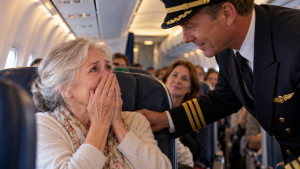
The cockpit door opened.
A tall man in his late fifties stepped into the aisle.
He had silver at his temples, tired eyes, and a small scar near his left eyebrow.
He looked at me as though he had rehearsed this moment a thousand times and still had no idea what to say.
I struggled to stand.
“Do I know you?”
He swallowed hard.
“No, Mrs. Whitmore. But my father knew you.”
I stared at him.
“Who was your father?”
The man reached into the pocket of his uniform and withdrew a small, sealed envelope.
My name was written across the front in handwriting I recognized immediately.
The same slanted letters.
The same unusual way of crossing the letter T.
Daniel’s handwriting.
I covered my mouth.
The pilot placed the envelope in my trembling hands.
Then he looked directly into my eyes and spoke two sentences that shattered everything I had believed for fifty-five years.
“My father didn’t disappear over Vietnam, Eleanor. He came home—but the man who sent you that missing-in-action notice knew exactly where he was.”
PART 2 — THE LETTER THAT CHANGED EVERYTHING
I couldn’t open the envelope.
I simply stared at Daniel’s handwriting, feeling as though the world had stopped moving around me.
“Who are you?” I finally asked.
“My name is Michael Hayes,” the pilot replied. “Daniel Hayes was my father.”
I shook my head.
“No. That’s impossible.”
Michael lowered his eyes.
“My father died three weeks ago.”
The words struck me harder than I expected.
Daniel had supposedly vanished in 1971.
For fifty-five years, I had mourned a man whose final moments I had never known.
Now a stranger was telling me that Daniel had lived long enough to raise a family, grow old, and die without ever coming back to me.
“Why didn’t he find me?” I whispered.
Michael pulled a chair from the row behind him.
“Because he believed you had moved on.”
I almost laughed.
Moved on.
I had spent more than half a century visiting his memorial, refusing to marry, and wondering whether he had suffered in his final moments.
“Who told him that?”
Michael took a slow breath.
“My grandmother.”
I looked at him in confusion.
“Your grandmother?”
“My father’s mother.”
He explained that after Daniel’s aircraft disappeared, a military rescue team had eventually located him alive in a remote area.
He had been seriously injured and was transported to a medical facility before being moved to another location for treatment and debriefing.
His return was complicated by a series of military investigations and administrative decisions.
But the explanation did not end there.
According to the documents Michael had discovered, Daniel had repeatedly asked for permission to contact his family and send a message to me.
For months, his requests went unanswered.
When he was finally able to write, he sent letters to my parents’ address.
None reached me.
Then, in early 1973, Daniel received a letter supposedly written by me.
Michael said his father had kept it locked away for decades.
The letter claimed that I had married another man, that I wanted Daniel to forget me, and that any attempt to contact me would only cause pain.
I felt my knees weaken.
“I never wrote such a letter.”
“I know,” Michael said quietly.
He opened his briefcase and removed a folder.
Inside were copies of military records, old correspondence, and a document bearing my parents’ address.
He showed me a letter from Daniel requesting permission to return home and locate me.
Beneath it was a response indicating that the request had been delayed.
There were more letters.
Some had been returned.
Others had no record of delivery.
Then I saw a copy of the letter supposedly written in my name.
The signature looked similar to mine.
But the words were cold and unfamiliar.
I would never have written them.
“Who did this?” I asked.
Michael looked away.
“My father spent most of his life believing it was his mother.”
I felt a wave of anger rise inside me.
“Your grandmother separated us?”
“He believed she had,” Michael answered. “But shortly before he died, he found something that made him question everything.”
He reached into the folder and handed me a second envelope.
This one contained a handwritten note from Daniel, dated only weeks before his death.
Michael explained that his father had spent years trying to reconstruct what had happened after his rescue.
He had believed that the woman he loved had chosen another life.
But he had never completely accepted the explanation.
In his final months, while sorting through old belongings, he discovered a sealed packet that had been hidden inside a metal box.
It contained letters from me.
Not copies.
My original letters.
The ones I had written after his disappearance, begging him to come home.
There were seventeen of them.
I remembered every single one.
I had written to the military offices, to the authorities handling missing personnel, and to every address I could find.
I had even sent letters to the home of Daniel’s parents, hoping they might somehow reach him.
But they had never been delivered.
I began to cry.
“Where is he buried?” I asked.
Michael gently answered.
“My father was buried beside my mother.”
I lowered my head.
Daniel had married.
He had built a life.
He had become a father.
And while I had preserved our love as though it were a promise waiting to be fulfilled, he had spent decades believing I had abandoned him.
For the first time, I understood that we had both been victims of the same terrible lie.
But one question remained.
“Why are you telling me this now?”
Michael looked at the envelope in my hands.
“Because my father left instructions that I wasn’t allowed to contact you until I found the original letters.”
“Why?”
“Because he wanted to know whether you had ever truly stopped loving him.”
I stared at the seventeen letters.
Then Michael gave me a final document.
It was a page from his father’s journal.
The handwriting was weaker than it had been in the earlier letters, but the words were clear.
If Eleanor is still alive, tell her I searched for her.
Tell her I was angry for many years.
Tell her I married because I believed she had chosen another man, not because I ever forgot the girl who shared one cup of coffee with me.
I pressed the page against my chest.
For fifty-five years, I had wondered why Daniel had never come home.
Now I knew he had returned to the world.
He had simply never found his way back to me.
Michael sat beside me while I cried.
He did not try to comfort me with promises.
He did not tell me that everything happened for a reason.
He simply waited.
When I could finally speak, I asked him to take me to his father’s grave.
He nodded.
“There’s something else you should know, Eleanor.”
I looked at him.
“My father didn’t leave you only those letters.”
He opened the final pocket of his briefcase.
Inside was a small, tarnished brass key.
And attached to it was a note with an address I had not seen in fifty-five years.
The address belonged to the little house where Daniel and I had once dreamed of living together.
Michael’s voice broke as he explained.
“My father bought that house after the war. He kept it for the rest of his life.”
Then he handed me another envelope.
On it were five words.
For Eleanor, if she returns.
I stared at the envelope, afraid of what it might contain.
Because for the first time since 1971, I understood that the past was not finished with me.
And whatever Daniel had left behind, he had meant for me to find it.
PART 3 — THE PROMISE HE KEPT IN SECRET
The house stood at the end of a quiet street lined with old oak trees.
I recognized it before Michael even parked the car.
The white paint had faded.
The porch steps had been replaced.
A climbing rose bush covered one side of the front window.
But the little brass mailbox was still there.
I remembered standing beside Daniel in front of that house in 1971, looking through the windows and imagining the life we would build together.
We had never owned it.
We had never even rented it.
It had simply been a place we passed on our walks, a small house with a garden and a porch where we imagined drinking coffee on Sunday mornings.
“How did your father find it?” I asked.
Michael smiled sadly.
“He bought it decades later, when the previous owner decided to sell.”
I turned toward him.
“Why would he buy a house he had only dreamed about with me?”
“Because he never forgot the dream.”
He unlocked the front door.
Inside, the house was clean but modest.
The furniture was old.
The curtains were pale and faded.
A small wooden table stood near the kitchen window, and beside it were two chairs.
On the wall hung a simple clock.
I stepped inside slowly, feeling as though I had entered a memory that had been waiting for me.
Then I noticed something on the mantel.
A small metal airplane.
It was the same model Daniel had once kept on his dormitory desk.
I picked it up with trembling hands.
Michael stood behind me.
“My father used to tell me about a girl who believed every promise should be kept.”
I couldn’t speak.
“He told me that if I ever found you, I should bring you here before taking you to his grave.”
I looked around the room.
“Why?”
Michael pointed toward a narrow wooden door at the back of the house.
“Because he wanted you to see what he had been doing all those years.”
I opened the door.
Behind it was a small study.
There were shelves filled with books, neatly labeled boxes, and a desk beneath a window overlooking the garden.
On the desk sat a locked wooden drawer.
Michael handed me the brass key.
I slid it into the lock.
The drawer opened with a soft click.
Inside lay dozens of envelopes.
Every one of them bore my name.
Some were dated from the 1970s.
Others came from the 1980s, the 1990s, and even the early 2000s.
I picked up the oldest envelope.
It had never been sealed.
Inside was a letter Daniel had written shortly after returning home.
My dearest Eleanor,
I don’t know whether you will ever read this.
I have spent months trying to understand why you stopped writing.
I keep telling myself that perhaps your letters were lost, that perhaps the world simply carried us in different directions.
But every time I close my eyes, I remember your face at the airport.
You asked me to come back.
I did.
I just couldn’t find you.
I lowered the letter.
The room blurred through my tears.
There were more letters.
Some were filled with anger.
Some were full of questions.
Others contained small details about Daniel’s life.
He wrote about learning to walk again after his injuries.
He wrote about returning to civilian work.
He wrote about becoming a father.
And he wrote about the first time his son asked him why he had never married the woman he called his greatest love.
Daniel had answered that he had believed I was happy without him.
But in the final years of his life, his letters changed.
They became gentler.
Less concerned with finding explanations.
More concerned with leaving the truth behind.
I found one dated three months before his death.
Eleanor,
I am old now.
My hands shake when I write, and sometimes I forget where I put my glasses.
But I still remember the way you laughed when I spilled coffee on my engineering notes.
I remember the little things because the little things were our life before the world became so complicated.
I don’t blame you anymore.
I don’t know what happened to us, and perhaps I never will.
If you are alive, I hope you found kindness.
If you are gone, I hope you knew that someone loved you with everything he had.
I promised I would come back.
I am sorry it took me so long to find the way.
I pressed the letter against my heart.
For decades, I had imagined Daniel as a young man frozen in time, forever twenty-two years old.
Now I understood that he had grown old without me.
He had experienced ordinary mornings, difficult years, family celebrations, and quiet evenings.
He had loved his children.
He had watched his hair turn gray.
And somewhere inside that long life, he had carried the memory of a girl who had never known he survived.
I sat at the desk and wept until I had no strength left.
Michael brought me a glass of water.
Then he sat across from me.
“My father wanted you to know something else,” he said.
I looked up.
“He didn’t want you to spend the rest of your life feeling that you had failed him.”
I shook my head.
“How can I stop wondering what would have happened if we had found each other?”
“You can’t change what happened,” Michael replied. “But you can decide what happens next.”
I looked at the letters scattered across the desk.
For the first time in fifty-five years, I didn’t feel as though I were standing outside a closed door, waiting for someone who might never return.
Daniel had returned.
He had lived.
He had loved.
And now, at last, I knew the truth.
A week later, Michael accompanied me to the cemetery where his father was buried.
The sky was clear, and the wind moved softly through the trees.
I carried a single white rose.
For fifty-five years, I had left that rose at a memorial bearing Daniel’s name.
This time, I placed it beside his grave.
I knelt carefully and brushed a little dirt from the edge of the headstone.
“Hello, Daniel,” I whispered.
My voice trembled.
“I’m sorry we lost so much time.”
I waited for the old pain to return.
It did, but something else came with it.
Peace.
I finally understood that loving someone did not mean I had to spend the rest of my life trapped in the moment they disappeared.
I could remember him without waiting for him.
I could grieve him without believing I had abandoned him.
And I could honor the life we never shared by finally allowing myself to live the one I still had.
Before I left, Michael handed me one last envelope.
“This was found in his bedside drawer,” he said. “He wrote it the night before he died.”
I opened it.
Inside was a single page.
Eleanor,
If my son has found you, then the truth has finally reached the person who deserved it.
I wish I could have stood in front of you and explained everything myself.
I wish I could have seen your face one more time.
But if there is one thing I want you to understand, it is this.
You did not waste your life by loving me.
And I did not waste mine by remembering you.
We were young, and we made a promise.
The world took away our chance to keep it together.
But it never took away what we meant to each other.
Please, Eleanor, do not spend another year waiting at a memorial for me.
I have been gone for a long time.
You are still here.
Go live.
That is the last promise I need you to keep.
I folded the letter carefully and held it against my chest.
For the first time in fifty-five years, I did not leave the cemetery feeling as though I were saying goodbye to the future I had lost.
I left feeling grateful for the love that had once changed my life.
And the following spring, when my seventy-seventh birthday arrived, I boarded a plane again.
Not to visit a memorial.
Not to search for answers.
I was traveling to see Michael and his family.
His young granddaughter had asked me to teach her how to make the old-fashioned coffee Daniel and I used to share.
When the plane lifted into the sky, I looked out the window and smiled.
Then, quietly, I pressed my palm against my heart.
“I came back, Daniel,” I whispered.
“But this time, I’m going home.”
THE END