My Family Arrived at My Beach House Uninvited and Ordered Me to Serve Them Breakfast—By Sunrise, My Father Was Begging Me to Explain the Documents in the Deputy’s Hands
PART 1 — They Mistook My Kindness for Permission
At 5:02 on a Saturday morning, I watched my older sister walk into my kitchen wearing a robe she had no permission to touch, demanding that I cook breakfast for six people who had invited themselves into my home.
“Scrambled eggs, bacon, toast, and coffee,” Vanessa announced, opening my refrigerator. “And please don’t make your usual tiny portions. The kids are hungry.”
I stood beside the kitchen island holding my coffee mug.
She looked at me as if I were the hired help.
Then she added, “Honestly, Olivia, you have a six-bedroom house and enough money to buy anything you want. The least you can do is make your family comfortable.”
I didn’t argue.
I simply looked at the clock.
5:02 a.m.
By six o’clock, my family would discover that being related to someone didn’t give them ownership of that person’s life.
My name is Olivia Bennett. I’m thirty-six years old, and I own a beachfront property on the coast of North Carolina.
I bought it three years ago after selling my share in a technology company I’d spent nearly a decade building. The house had six bedrooms, a wide ocean-facing deck, a private swimming pool, and a long driveway lined with palm trees.
Every dollar I spent on it came from my own work.
There was no family inheritance, no secret benefactor, and no money from my parents.
I had earned it.
And after years of working late nights, negotiating contracts, and watching friendships disappear whenever business became difficult, I wanted one thing from my new life.
Peace.
Unfortunately, my family had always mistaken my independence for an invitation to take advantage of me.
My older sister, Vanessa, had perfected that habit long before I could afford the beach house.
When we were children, she could break something and somehow convince our parents that I was responsible.
When we became adults, the pattern continued.
If Vanessa needed rent money, I was expected to help.
If her husband lost another job, I was expected to cover the bills.
If my mother wanted an expensive birthday celebration, I was expected to organize it because I was supposedly the only person in the family who knew how to manage things properly.
Whenever I protested, my father delivered the same sentence.
“Family helps family, Olivia.”
I used to believe him.
Then, six months before that Saturday morning, I discovered that my parents had been telling relatives I was selfish because I refused to give Vanessa money for a luxury car.
They had conveniently forgotten that I had already paid several months of her rent.
I stopped making automatic transfers after that.
I also stopped explaining my decisions.
My family called it arrogance.
I called it learning.
For a while, the distance between us gave me the peace I needed.
Then, at 10:18 on Friday night, two vehicles pulled into my driveway.
I was sitting on the deck watching the waves when my phone buzzed.
A message from my mother appeared.
Surprise! We’re spending the next week with you. Everyone is excited!
Before I could reply, I heard car doors slamming.
My mother, Patricia, emerged from the first vehicle wearing a bright smile. My father, Robert, followed her with a cooler. Vanessa climbed out of the second car with her husband, Mark, and their two children.
They began unloading suitcases, grocery bags, beach toys, and enough luggage for a small expedition.
I walked toward them.
“What are you doing?”
Mom laughed as if I’d made a joke.
“We’re here for vacation!”
“You didn’t ask me.”
Dad lifted a suitcase from the trunk.
“Do we need an invitation to visit our own daughter?”
I stared at him.
“This isn’t your house.”
His smile disappeared.
“There’s that attitude again.”
Vanessa walked past me carrying a bag.
“Which room has the best ocean view?”
“None of the rooms are available.”
She stopped.
“What?”
“I didn’t agree to host anyone.”
Mom stepped between us.
“Olivia, don’t embarrass us. We’ve driven for hours, and the children are exhausted.”
I looked at my niece and nephew. They were half asleep, leaning against their father.
I didn’t want them caught in the middle of another argument between adults.
So I stepped aside and said, “We’ll talk in the morning.”
That was all Vanessa needed.
Within thirty minutes, she had claimed the master guest suite, spread her belongings across my bathroom counter, and connected her phone to my television.
Mark opened a bottle of wine from my kitchen.
Dad settled onto my sofa and announced that the house needed a larger television.
Mom wandered through the bedrooms, commenting on the furniture.
Then I heard Vanessa laughing on the deck.
“Can you imagine living here all the time? Olivia barely even works now, and she has all this space.”
Her husband chuckled.
“Maybe we should stay longer than a week.”
I stood behind the glass door, listening.
Vanessa continued.
“She won’t throw us out. She never does anything when Dad gets angry.”
That was when I realized they hadn’t come because they missed me.
They had come because they believed I couldn’t say no.
At midnight, I went upstairs and locked my bedroom door.
I didn’t cry.
Instead, I opened my laptop and reviewed the property documents stored in my secure account.
The house was legally mine. My parents had no ownership interest, and Vanessa had no right to stay simply because she was my sister.
I called my property manager first.
Then I contacted my attorney.
Finally, I arranged accommodation at a nearby family resort with connecting rooms, a children’s waterpark, and an early breakfast service.
I paid for the first two nights because I didn’t want my niece and nephew caught in a roadside argument.
I also arranged transportation and asked my attorney to prepare a written notice making it clear that my relatives had no permission to remain in the property.
I wasn’t going to scream.
I wasn’t going to threaten anyone.
I was going to set a boundary and follow through.
At 4:58 a.m., Vanessa began hammering on my bedroom door.
“Olivia! Get up! We need breakfast!”
Four minutes later, she appeared in my kitchen wearing my expensive silk robe.
“Where’s the food?”
I took another sip of coffee.
“There isn’t any.”
Her mouth fell open.
“You cannot be serious.”
“I am.”
Mom appeared in the doorway.
“What’s gotten into you?”
Before I could answer, headlights swept across the kitchen windows.
A shuttle pulled into the driveway, followed by a dark SUV.
Vanessa hurried to the glass.
“Who are those people?”
“Your transportation.”
Dad came rushing down the stairs.
“What transportation?”
I placed a printed reservation on the kitchen island.
“I booked you two connecting suites at a family resort. The shuttle will take you there. I’ve paid for two nights, and you can decide what you want to do afterward.”
Vanessa stared at the paper.
Then she looked at me.
“You’re throwing us out?”
“No. I’m ending an uninvited stay in my home.”
Dad slammed his hand against the counter.
“This is outrageous! You don’t treat your own family like strangers!”
“I treat people according to whether they respect me.”
He stepped closer.
“I’m your father. You will not order me out of your house!”
I remained still.
“It’s my house, Dad. And you’re leaving.”
A knock sounded at the front door.
The visitors had arrived.
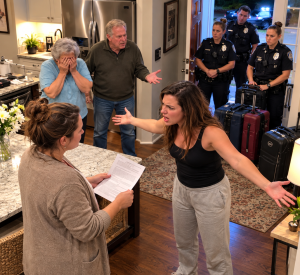
Two resort employees stood outside with the shuttle driver. Beside them was a uniformed deputy who had agreed to be present to help keep the situation calm while my attorney’s written notice was delivered.
Dad opened the door before I could reach it.
“What is this supposed to be?”
The deputy introduced himself and explained that he was there to keep the situation peaceful, not to take sides in a family disagreement.
Dad scoffed.
Then the deputy handed him a folder.
The top page carried my name, the property’s address, and a copy of the recorded deed.
Dad glanced at it.
His expression changed.
He turned the page.
Then another.
And suddenly, the man who had spent my entire childhood telling me that nobody could challenge him in his own home was standing in my kitchen without saying a word.
Because the last document in that folder wasn’t about the house.
It was about something my father had done three months earlier.
Something he had apparently assumed I would never discover.
And when my mother saw the heading, she grabbed the edge of the counter to steady herself.
“Robert,” she whispered. “Tell me that isn’t what I think it is.”
He didn’t answer.
For the first time that morning, my father looked afraid.
PART 2 — The Document My Father Never Expected Me to Find
Dad closed the folder.
“That’s private family business,” he said sharply.
The deputy calmly explained that he wasn’t there to investigate the contents of the documents. His role was simply to prevent the disagreement from escalating.
I stepped forward and held out my hand.
“Dad, give me the folder.”
He hesitated.
Then he handed it to me.
I had already seen the document the previous evening, but I wanted my parents to understand that I knew exactly what it contained.
Three months earlier, my father had contacted a local lender claiming he had a financial interest in my beach property.
He had used an old address and outdated family information to make it appear that he was authorized to discuss the house as a potential source of collateral.
He had not successfully borrowed against the property.
But the lender had contacted me to verify the information before proceeding.
At first, I thought it was a clerical error.
Then I discovered that my father had told several relatives he was helping me manage my investments.
He had even claimed that I had promised to use the beach house to support a family business he wanted to start.
I had made no such promise.
My attorney had reviewed the paperwork and sent a formal notice disputing any suggestion that Dad had authority over the property.
The lender had halted the application while it reviewed the matter.
I hadn’t told my parents what I knew because I wanted the facts documented before confronting them.
Now, standing in my own kitchen, I finally understood why they had arrived without warning.
They weren’t simply looking for a free vacation.
My father had been trying to make himself appear financially connected to a property he didn’t own.
Vanessa folded her arms.
“Dad was only trying to help the family.”
I turned toward her.
“By telling a lender he had an interest in my house?”
Her face tightened.
“He said you were going to help him.”
“Did he show you anything proving that?”
She looked at Mark.
He suddenly became fascinated by the floor.
Mom began crying.
“Your father made a mistake. We don’t need to destroy the family over it.”
I felt a familiar ache in my chest.
That sentence had followed me for years.
Whenever someone hurt me, I was told to protect the family.
Whenever I refused to pay for someone else’s decisions, I was accused of being cruel.
Whenever I asked for honesty, I was reminded that forgiveness was more important than accountability.
But forgiveness without change had become another way for my family to demand that I accept the same treatment over and over.
“I haven’t destroyed anything,” I said quietly. “I’m simply refusing to pretend this is acceptable.”
Dad’s face darkened.
“You think you’re better than us because you made some money?”
“No.”
“Then why are you treating us like this?”
“Because you came into my home without permission, demanded that I serve you, and tried to involve my property in a financial arrangement I never approved.”
Vanessa shook her head.
“This is unbelievable.”
I looked at her silk robe.
“Please take that off and leave it in the bedroom. It belongs to me.”
She glanced down as though she’d forgotten what she was wearing.
Then she turned red.
“You’re humiliating me!”
“No, Vanessa. I’m asking you to return something you took without permission.”
For several seconds, nobody spoke.
Finally, Mark took his wife’s arm.
“Let’s get the kids ready.”
Mom moved toward me.
“Olivia, please. We can discuss all this after the vacation.”
I shook my head.
“The vacation is over here.”
The resort employees waited outside while my relatives gathered their belongings.
My niece came downstairs holding a stuffed rabbit.
“Are we going to the beach?” she asked.
I knelt beside her.
“You’re going somewhere with a swimming pool and a waterpark. You’ll have a lovely time.”
“Are you coming?”
I smiled gently.
“Not this morning, sweetheart.”
She hugged me before following her father outside.
That small gesture nearly broke my heart.
The children hadn’t done anything wrong. They had simply watched the adults around them behave as if my boundaries didn’t matter.
I wanted them to grow up knowing that love didn’t require someone to surrender their dignity.
By 6:15 a.m., the last suitcase had been loaded into the shuttle.
Dad remained beside the front door.
He looked at me with the same expression he had worn when I was sixteen and refused to let Vanessa borrow my car.
“You’ll regret this,” he said.
I met his gaze.
“Perhaps. But I won’t regret protecting my home.”
He walked out without another word.
When the vehicles disappeared down the driveway, I closed the door and leaned against it.
For the first time since they had arrived, the house was quiet.
I walked into the kitchen, removed the coffee cup from the counter, and looked out at the ocean.
Sunlight was beginning to appear over the water.
I should have felt victorious.
Instead, I felt exhausted.
Because the truth was that I still loved my family.
I simply couldn’t keep allowing that love to become an excuse for mistreatment.
At 8:30, my attorney called.
He had received an update from the lender.
The application involving my property had been formally stopped, and the lender had requested written clarification from my father about the information he had submitted.
My attorney also explained that I should preserve every document and avoid making accusations beyond what the records supported.
I agreed.
Then he said something that made me pause.
“Olivia, there’s another issue. Your father mentioned a family company in his correspondence. Do you know what he was referring to?”
I didn’t.
My father had operated a small construction supply business for years, but I had never invested in it.
My attorney explained that the lender’s file included a financial statement suggesting that my property would support a proposed business expansion.
My name appeared in a section describing potential family backing.
I had never authorized that statement.
I asked my attorney to send me the relevant records.
When I opened them, I discovered that my father had been telling people for months that I intended to invest in his company.
He had apparently used my success to reassure potential business partners that the family had substantial financial resources.
The beach house was part of that story.
I sat at my kitchen table for a long time.
This was no longer just about an unwanted vacation.
My father had built a financial story around my name without my consent.
I would need to correct the record, protect my assets, and allow the proper professionals to determine whether any further action was necessary.
I forwarded everything to my attorney.
Then I turned off my laptop.
I had done what I could for that morning.
But at 11:42, my phone rang again.
It was Vanessa.
I almost ignored it.
Then I answered.
Her voice sounded different.
“Olivia, Dad is furious.”
“I assumed he would be.”
“His business partners have started asking questions about the paperwork.”
I remained silent.
She continued.
“They want to know why he said your house was backing the company.”
“Then he needs to explain why he said it.”
“Can’t you just call them and tell them everything is fine?”
I closed my eyes.
There it was again.
Another request for me to clean up a problem I hadn’t created.
“No, Vanessa. I won’t tell people something is fine when it isn’t.”
She began crying.
“You’re making our lives impossible.”
I looked toward the ocean.
“No. I’m refusing to pretend my life belongs to all of you.”
Then I ended the call.
For the rest of the afternoon, I stayed home, walked along the beach, and let myself think.
I didn’t know whether my relationships with my parents or sister could ever recover.
But I knew I couldn’t return to the old arrangement.
Not after this.
That evening, my mother sent a message.
Your father says you have always wanted to punish him for everything he’s done for you.
I read it twice.
Then I typed a response.
I don’t want to punish anyone. I want my property, my finances, and my decisions to be respected. If we can start there, perhaps we can have a relationship again.
I sent it.
For the first time in my life, I didn’t add an apology afterward.
PART 3 — The Morning My Family Finally Understood
Three weeks passed before I saw my family again.
During that time, my attorney worked with the lender to correct the information connected to my property.
The application was withdrawn, and my father was required to clarify his claims about my financial involvement.
I didn’t speculate about what that meant for his business. I simply made sure my name and assets were no longer being presented as support for arrangements I hadn’t approved.
I also changed the access codes to my house, updated the guest policies with my property manager, and made it clear that nobody could stay without my prior consent.
Those changes were small, practical, and necessary.
They weren’t revenge.
They were boundaries.
Then, one Sunday afternoon, my mother called and asked if she could visit me alone.
I hesitated before agreeing to meet her at a café in town.
When she arrived, she looked tired.
She sat across from me and wrapped both hands around her tea.
“Your father hasn’t been sleeping,” she said.
I listened.
“He says you’ve embarrassed him in front of everyone.”
“I didn’t contact his business partners to embarrass him. I corrected information involving my property.”
Mom lowered her eyes.
“I know.”
For a moment, I wasn’t sure I’d heard her correctly.
She continued.
“I should have asked before we came to your house. I should never have expected you to serve us. And I shouldn’t have acted as if being your mother gave me the right to decide how you used your home.”
My throat tightened.
It was the first time she had acknowledged what happened without immediately defending herself.
“Why did you come without asking?” I asked.
She sighed.
“Your father said you would agree once we arrived. He thought you wouldn’t want to upset the children.”
I looked out the window.
That answer hurt because it was true.
They had relied on my love for the children to pressure me into accepting something I didn’t want.
Mom reached across the table.
“I don’t expect you to forgive us today.”
I looked at her hand.
“I don’t need you to be perfect, Mom. I need you to ask before making decisions that affect my life.”
She nodded.
We sat quietly for a while.
When we parted, I didn’t promise that everything would return to normal.
Because I no longer wanted the old normal.
I wanted something better.
A few days later, Vanessa called.
She didn’t begin with an accusation or a demand.
Instead, she said, “I owe you an apology.”
I waited.
“I shouldn’t have taken your robe. I shouldn’t have ordered you to make breakfast. And I shouldn’t have assumed I could stay in your house just because you’re my sister.”
Her voice trembled.
“I was embarrassed when you made us leave, but I understand why you did it.”
I appreciated the apology.
But I also knew that words mattered only when behavior changed.
“Thank you for saying that,” I replied. “I love you, Vanessa. But if we’re going to have a relationship, I need you to respect my decisions even when you don’t like them.”
“I understand.”
We didn’t become best friends overnight.
We didn’t suddenly agree about everything.
But the conversation was different from the arguments we’d had for years.
For the first time, Vanessa wasn’t asking me to solve her problems.
She was acknowledging one she had helped create.
My father was the last to contact me.
Nearly two months after the morning at the beach house, I received an email from him.
It was short.
He said he regretted allowing the situation to escalate. He admitted that he should never have represented my property as financial backing without my permission.
He also wrote that he had been so focused on keeping his business alive that he had convinced himself my success meant the entire family could depend on it.
I read the message carefully.
He didn’t explain everything.
He didn’t suddenly become the father I’d always wanted.
But he acknowledged what he had done.
I replied that I was willing to meet him when we could discuss the future honestly and calmly.
That meeting happened several weeks later.
We sat on the deck of my beach house, listening to the waves.
Dad looked out at the water for a long time before speaking.
“I thought being your father meant I would always have a say in your life.”
I took a breath.
“You’ll always be my father. But that doesn’t mean you own my decisions.”
He nodded slowly.
“I understand that now.”
I hoped he did.
But I also understood that rebuilding trust would take time.
I wasn’t going to hand him control of my life again simply because he had apologized.
Some things would have to be demonstrated, not promised.
That summer, I hosted my niece and nephew for an afternoon at the beach.
Their parents came too, but this time they called first.
They arrived at the agreed time, brought their own food, and asked before using anything.
It was such a small change that an outsider might not have noticed.
To me, it meant everything.
At the end of the visit, my niece hugged me and said, “Aunt Olivia, your house is my favorite place.”
I smiled.
“I’m glad you like it.”
Then she added, “Mom said we have to ask before coming again.”
I laughed softly.
“Yes, that’s a very good rule.”
After everyone left, I stood on the deck watching the sun sink below the horizon.
For years, I had believed that being a good daughter and sister meant always making room for everyone else.
I had confused generosity with obligation and peace with silence.
But my family had taught me something I wished I’d learned much earlier.
You can love people without giving them unlimited access to your life.
You can forgive someone without pretending their behavior was acceptable.
And you can say no without becoming a bad daughter, a selfish sister, or an unkind person.
My beach house had never been a test of how much money I had.
It was a reminder of what I had worked for: independence, security, and the freedom to choose how I wanted to live.
The next time my family visited, I welcomed them because I wanted them there.
Not because they had announced themselves.
Not because my father expected it.
And certainly not because my sister believed I owed her breakfast.
That was the difference.
My family didn’t lose access to my home because I stopped loving them. They lost the privilege of taking my love for granted.