PART 1: THE WOMAN THEY REFUSED TO RESPECT
Admiral Mason Crowe asked for my call sign in front of three hundred military officers because he wanted everyone to laugh at me.
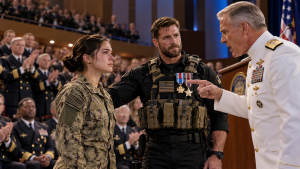
I was thirty-four years old, a lieutenant commander in the United States Navy, and the only woman standing among twenty elite operators at a graduation ceremony in Coronado, California.
Every officer in that auditorium wore a name, a rank, and a history of accomplishments.
I had all three.
But according to Admiral Crowe, I lacked the one thing that mattered most.
Respect.
“Thirty days of training,” he announced, raising his ceremonial glass, “and Lieutenant Commander Aurora Whitaker still hasn’t earned a call sign.”
A few nervous chuckles drifted through the room.
I stood motionless in my white dress uniform, my hands resting naturally at my sides.
Crowe studied me with the satisfied expression of a man who believed he had already won.
“Perhaps our young commander is waiting for someone to invent a name that matches her abilities.”
More laughter followed.
I could have reminded him that I had graduated at the top of my class.
I could have listed the classified operations I had participated in, the lives I had helped save, or the commendations locked inside a file that most officers would never be permitted to read.
Instead, I looked him directly in the eyes.
“Sir, I haven’t been assigned an official call sign.”
“Exactly,” he replied.
Then he turned toward the graduating operators.
“Gentlemen, surely one of you can help her out. What should we call our mysterious commander?”
Nobody answered.
I noticed something unusual.
The men who had endured thirty days of exhausting training beside me weren’t smiling.
They weren’t even looking at me.
Every single one of them was watching Admiral Crowe.
Their expressions carried something I couldn’t quite explain.
Not anger.
Not embarrassment.
Something closer to disbelief.
Crowe mistook their silence for submission.
“Fine,” he said, lowering his glass. “Let’s hear it from someone who actually knows her.”
A tall operator with a scar above his right eyebrow pushed his chair backward.
His name was Chief Petty Officer Daniel Mercer.
Among the graduating class, he was the man everyone trusted when a situation became impossible.
He had served in dangerous environments across multiple continents and had earned enough decorations to make even senior officers pause before questioning his judgment.
Mercer stepped into the aisle.
“Permission to speak, Admiral?”
Crowe nodded impatiently.
“Granted.”
Mercer glanced at me.
Then he turned back toward the podium.
“Sir, we did come up with a call sign for Commander Whitaker.”
The admiral’s smile returned.
“Wonderful. Let’s hear this masterpiece.”
Mercer didn’t smile.
“But we refused to put it on paper.”
The auditorium became completely silent.
Crowe lowered his glass.
“Why?”
Mercer took a slow breath.
“Because, sir, we didn’t believe a name like hers should be handed out during training.”
Crowe’s expression hardened.
“Then where did she earn it?”
Mercer looked directly at the admiral.
“During the operation you told everyone never to discuss.”
For the first time that evening, Admiral Crowe had nothing to say.
And I knew exactly which operation Mercer meant.
Because three years earlier, I had been the only person who knew where his missing team was.
And I had been ordered to leave them behind.
PART 2: THE MISSION THAT CHANGED EVERYTHING
Three years before that ceremony, I wasn’t training elite operators.
I was serving as an intelligence officer attached to a joint special operations task force.
My job wasn’t to kick down doors or lead a team through enemy territory.
My job was to find the information that brought those people home alive.
Most days, nobody noticed my work.
That was how I preferred it.
Then came Operation Black Harbor.
A team of seven American operators had been sent into a remote region to extract a source carrying intelligence about an imminent attack.
Their mission was supposed to last less than six hours.
Instead, a sudden change in local security conditions cut off their planned route, communications became unreliable, and the team disappeared from the network.
At headquarters, the situation deteriorated by the minute.
Satellite imagery was incomplete.
Reports contradicted one another.
And every attempt to establish contact ended in silence.
Chief Mercer was leading the team.
Among the missing operators was a young medic named Elias Bennett, who had barely celebrated his twenty-fifth birthday.
His mother had sent him a letter before deployment.
He had told me about it during a briefing because he wanted to make sure it reached him if anything went wrong.
I remembered that conversation.
I remembered his nervous smile.
And I remembered the way Mercer had looked at the map when the final transmission came through.
He knew his team was running out of time.
I spent hours comparing old intelligence reports with updated terrain information, searching for an explanation nobody else had considered.
Then I found it.
A forgotten service route, omitted from the current operational briefing, connected two locations that everyone else believed were inaccessible to one another.
It wasn’t proof that the team was there.
But it was enough to give us a chance.
I brought the information to the operations center.
The senior commander examined my findings and rejected them.
“The route is unreliable,” he said.
“Sir, the latest imagery is consistent with the historical records.”
“It’s still an assumption.”
“Every option we have is an assumption right now.”
He stared at me.
Then he delivered the order that would follow me for years.
“No additional resources. We are preparing to close the operation.”
I looked at the screen displaying the team’s last known position.
Seven people.
Seven families waiting for news.
And seven lives that might still be saved.
I had a choice.
I could obey without another word and allow the operation to end.
Or I could use the emergency communications channel available to me to relay the information to the authorized recovery coordinator, risking an investigation into why I had challenged a direct decision.
I chose the second option.
I sent the intelligence.
I documented my reasoning.
And I waited.
The next transmission arrived forty-seven minutes later.
It was brief, distorted, and almost impossible to hear.
But the voice was unmistakable.
Mercer.
“Control, this is Mercer. We have the route. Confirming all seven personnel accounted for.”
I closed my eyes.
For the first time in hours, I could breathe.
The recovery team reached them before the situation deteriorated further.
All seven operators returned alive.
The young medic, Elias Bennett, was among them.
When Mercer finally reached the secure operations center, he asked to speak with the intelligence officer who had sent the information.
I expected a routine debrief.
Instead, he stood in front of me and said something I never forgot.
“You didn’t know us personally.”
“No, Chief.”
“You didn’t have to take that risk.”
“I was doing my job.”
He shook his head.
“No. You did more than your job.”
He paused, searching for the right words.
“You gave seven families another chance to see their sons come home.”
I didn’t know what to say.
So I simply nodded.
The official report later credited a successful recovery process and coordinated intelligence support.
My involvement was classified.
The details were restricted.
And the seven operators were instructed not to discuss the mission outside authorized channels.
I returned to work.
They returned to their units.
I assumed that would be the end of it.
I was wrong.
Three years later, when I was assigned to support the elite training program at Coronado, I discovered that Chief Mercer and six members of that same team were among the instructors and graduating operators.
They recognized me immediately.
They never mentioned Black Harbor.
They never explained why they watched my every move with such unusual attention.
And when the graduating class began discussing call signs, they agreed on one name.
A name that belonged to someone who had found them when everyone else had stopped looking.
They called me Beacon.
But they kept it unofficial because they believed the name belonged to a moment of sacrifice, not a line on a form.
They wanted me to hear it from them only when they could tell the story properly.
Then Admiral Crowe decided to turn my silence into a public humiliation.
And Chief Mercer finally decided he had heard enough.
PART 3: THE NAME THAT SILENCED THE ADMIRAL
Chief Mercer stood in the center aisle, facing Admiral Crowe.
“Sir,” he said, “three years ago, my team was stranded during Operation Black Harbor.”
The admiral’s face changed.
Only slightly.
But I saw it.
So did Mercer.
“Seven of us were missing. Our communications had failed, our planned route was no longer viable, and headquarters was preparing to terminate the recovery effort.”
Nobody moved.
Mercer continued.
“One intelligence officer identified an alternative route using records that had been overlooked. She challenged the prevailing assessment, sent her findings through the authorized emergency channel, and gave the recovery team the information it needed to reach us.”
Crowe’s fingers tightened around the ceremonial glass.
“Those details are classified.”
“Yes, sir,” Mercer replied. “I’m not revealing operational specifics.”
He paused.
“But I am telling you that every member of my team came home alive.”
A murmur spread through the auditorium.
The admiral looked toward the senior officers seated near the stage, apparently expecting someone to interrupt.
Nobody did.
Mercer turned toward me.
“When I returned, I asked who had found that route. I wanted to thank her.”
His voice softened.
“She told me she had only done her job.”
He looked back at Crowe.
“So when we learned she would be joining this training program, we knew exactly what we wanted to call her.”
The first operator in the front row stood.
Then another.
One by one, all twenty graduating operators rose from their seats.
Mercer raised his chin.
“Commander Whitaker is our Beacon, sir.”
The word traveled through the auditorium.
“Beacon.”
“Beacon.”
“Beacon.”
They weren’t shouting.
They didn’t need to.
The name carried across the room with a weight no official introduction could have given it.
I felt my throat tighten, but I kept my composure.
For three years, I had believed the most meaningful thing I had done would remain buried in a classified report.
I had never expected recognition.
I had certainly never expected it from the people whose lives had been changed by a decision I had made alone.
Admiral Crowe set his glass on the podium.
“Commander Whitaker,” he said carefully, “is this account accurate?”
“Yes, sir.”
“Why wasn’t this included in your training record?”
“Because the operation remains classified, sir, and because I never requested special treatment for my role.”
Crowe looked toward Mercer.
Then toward the twenty operators standing in front of him.
His expression had lost its earlier confidence.
“I was unaware of these circumstances.”
Mercer answered before I could.
“With respect, Admiral, you were unaware because you never asked.”
The room went still again.
Crowe’s jaw tightened.
For a moment, I thought he would turn the exchange into another confrontation.
Instead, he straightened his uniform and faced me.
“Lieutenant Commander Whitaker, I owe you an apology for the manner in which I addressed you.”
I held his gaze.
“Thank you, sir.”
He hesitated.
“Would you accept the call sign your colleagues have chosen?”
I looked at the twenty operators.
I thought about the seven people who had come home.
I thought about the families who had received phone calls they once feared would never arrive.
And I understood something I had never fully appreciated.
A call sign wasn’t valuable because it sounded impressive.
It was valuable because of what it meant to the people who gave it to you.
“Yes, Admiral,” I answered.
“I accept.”
Chief Mercer smiled for the first time that evening.
Then he delivered the words that made the entire auditorium rise to its feet.
“Welcome to the family, Beacon.”
The operators began applauding.
Soon, officers who had never met me were standing too.
Some of the senior commanders joined them.
Even the foreign attachés rose from their seats.
I remained at attention, fighting to keep my eyes dry.
Admiral Crowe stood beside the podium, watching the room he had expected to control with a single cruel joke.
He had asked for my call sign because he believed the answer would expose my weakness.
Instead, he had forced an entire room to remember what real strength looked like.
That night, my official record remained unchanged.
I received no sudden promotion.
No new medals appeared on my uniform.
And no classified mission was revealed to the public.
But when I walked out of the auditorium, twenty operators followed me into the corridor.
Mercer fell into step beside me.
“Commander,” he said, “we’ve been waiting three years to say that out loud.”
I smiled.
“You could have told me earlier.”
He laughed quietly.
“Maybe. But a Beacon doesn’t need to know everyone is following her.”
I looked back at the auditorium doors.
For the first time in a long while, I didn’t feel like the only woman in the room.
I felt like someone who had finally found her place in it.
And from that day forward, whenever someone asked what the call sign Beacon meant, Chief Mercer gave the same answer.
“She was the person who found us when we thought nobody was coming.”
And that was worth more than any title an admiral could ever give me.