PART 1 — They Left Her Behind
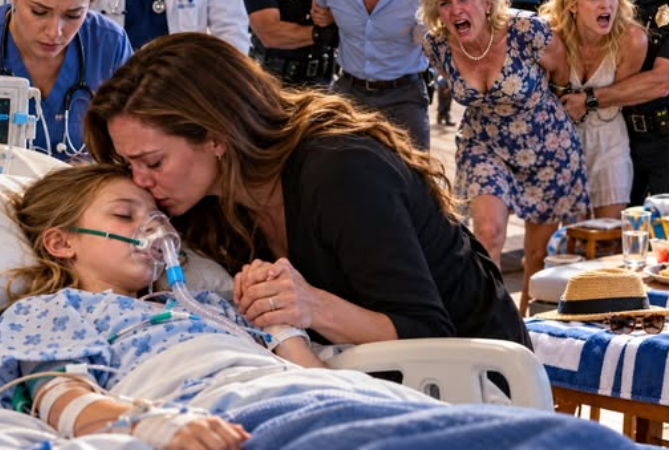
By the time I reached St. Agnes Children’s Hospital, my ten-year-old daughter, Lily, was lying beneath a thin hospital blanket with an oxygen mask covering her face.
Two IV lines were attached to her tiny hands.
A monitor beeped steadily beside her.
I stood outside the emergency room for several seconds, unable to move.
Not because I was afraid of what I might see.
Because I already knew.
My daughter had suffered a severe allergic reaction.
And the people who were supposed to protect her had walked away.
Three hours earlier, I had been sitting in a business meeting when I finally checked my phone.
Twelve missed calls.
One voicemail from Lily’s school nurse.
And a text message from my sister-in-law, Claire.
Lily got into something with peanuts. We handled it. Don’t make a scene.
My hands immediately went cold.
Lily had a severe peanut allergy.
Her doctor had given us strict instructions.
If she was exposed, she needed her emergency medication immediately and an ambulance if symptoms became severe.
I called the school nurse.
She answered almost immediately.
“Your daughter had an allergic reaction during lunch.”
My heart dropped.
“Where is she?”
The nurse hesitated.
“Your mother-in-law picked her up.”
“What?”
“I told her Lily needed emergency treatment. I specifically told her to use the prescribed medication and call 911.”
“Did she?”
Another pause.
“No.”
I stood so quickly that my chair nearly fell backward.
“Where is my daughter now?”
The nurse’s voice became quieter.
“She was taken to a neighbor’s house.”
I couldn’t believe what I was hearing.
“Why?”
“They said they had family plans.”
My hands began shaking.
I called Patricia, my mother-in-law.
No answer.
I called my husband, Daniel.
No answer.
Then I called Claire.
She finally picked up.
Behind her voice, I could hear children laughing.
Water splashing.
Music.
“Where is Lily?”
Claire sighed.
“She’s fine.”
“Where is she?”
“We had reservations at the lake club. Everyone was already there.”
My heart stopped.
“You left my daughter during an allergic reaction?”
“She wasn’t that bad when we left.”
“Did you give her the medication?”
Silence.
“Claire?”
“She seemed calmer.”
“Did you call an ambulance?”
“No.”
I closed my eyes.
“Where is she?”
Claire finally gave me the neighbor’s address.
I called 911 immediately.
Then I drove.
The traffic seemed endless.
Every red light felt like an insult.
When paramedics arrived at the neighbor’s house, Lily was barely responsive.
She was struggling to breathe.
Her lips had begun turning blue.
The prescribed emergency medication was still inside her backpack.
Unused.
The paramedics treated her immediately and rushed her to the hospital.
I followed behind them.
Now, hours later, I stood beside her hospital bed.
When I touched her hand, her fingers moved slightly.
“Mom?”
Her voice was barely audible.
I leaned closer.
“I’m here.”
Her eyes opened for only a second.
“I’m sorry.”
I felt something inside me break.
“You have nothing to be sorry for.”
She closed her eyes again.
I kissed her forehead.
Then I walked into the hallway.
My fear had changed into something else.
Something much colder.
I called my attorney.
Then I called the police.
I gave them everything.
The school nurse’s voicemail.
The allergy action plan.
Claire’s text message.
The hospital records.
The paramedics’ report.
The neighbor’s statement.
I wasn’t interested in revenge.
I wanted one thing.
Accountability.
The officer listened carefully.
Then he asked:
“Where are the people who left her?”
I looked down at my phone.
Claire had just posted a photograph.
She was smiling beside the lake.
Patricia was holding a champagne glass.
Daniel stood behind them.
The caption read:
Family day. Best weekend ever.
I handed the phone to the officer.
He stared at the photograph.
Then he reached for his radio.
“They’re still at the lake club?”
“Yes.”
He nodded.
“Then let’s go talk to them.”
PART 2 — The Lake Club
At 5:41 p.m., Daniel was laughing beside the swimming pool when two police officers approached him.
His smile disappeared.
Patricia immediately stood.
“What is this about?”
One officer calmly asked:
“Are you Patricia Carter?”
“Yes.”
“We need to speak with you regarding a child.”
Claire’s face turned pale.
Daniel stepped forward.
“My daughter?”
The officer nodded.
“Your daughter is currently hospitalized.”
Nobody spoke.
Then Patricia said something that made the officer’s expression change.
“She wasn’t that sick.”
The officer looked at her.
“You were informed that she had a serious allergic reaction?”
Patricia hesitated.
“Yes.”
“You were told to administer her emergency medication?”
“I thought she was improving.”
“You were told to call emergency services?”
Patricia looked away.
“We didn’t want to overreact.”
The officer opened his notebook.
“Who decided not to call?”
Silence.
Daniel finally spoke.
“My mother.”
Patricia immediately turned toward him.
“Daniel!”
He raised his hands.
“I didn’t know how serious it was.”
The officer looked at him.
“Your wife was contacted?”
“Yes.”
“Did she tell you your daughter was having trouble breathing?”
Daniel’s face went blank.
“She called me.”
“And what did you do?”
“I…”
He couldn’t finish.
Because he knew.
He had ignored my calls.
He had trusted his mother.
And he had continued enjoying his afternoon.
The officer closed his notebook.
“You’re going to need to come with us.”
Claire suddenly started crying.
“I didn’t know she was that sick.”
But the officer replied calmly:
“The school nurse says you were specifically told that she needed emergency care.”
Claire said nothing.
That evening, the family gathering ended very differently than it had begun.
The photographs disappeared from social media.
The champagne was abandoned.
And the people who had spent the afternoon enjoying themselves were suddenly sitting in separate rooms answering questions.
Meanwhile, I stayed beside Lily.
Her condition stabilized slowly.
The doctor told me the next several hours would be important.
At 11:23 p.m., Lily finally opened her eyes.
“Mom?”
“I’m here.”
She looked frightened.
“Are you mad?”
I kissed her forehead.
“No.”
“Grandma said I was making everyone miss their trip.”
My chest tightened.
“She said that?”
Lily nodded.
“She said I was always causing problems.”
I closed my eyes.
My daughter had been fighting to breathe while believing she was the reason everyone was angry.
That was the moment I made a decision.
I would never allow Lily to believe that again.
The next morning, my attorney arrived.
He placed a folder on the table.
“There’s more.”
I looked at him.
“What?”
He opened the folder.
During the investigation, police had obtained messages between Patricia, Claire, and Daniel.
One message from Patricia said:
Don’t let her mother make this into another emergency. She always exaggerates Lily’s allergies.
Another message from Claire read:
If we leave now, everyone will blame us if something happens.
And Daniel had responded:
Just keep her somewhere quiet until tonight. She’ll be fine.
I stared at the screen.
They knew.
They didn’t misunderstand the situation.
They knew there was a risk.
And they chose the lake anyway.
Then my attorney showed me one final message.
It had been sent shortly after I called 911.
Patricia had written:
If she survives, everyone needs to agree that she was fine when we left.
I slowly put the phone down.
The room was silent.
My attorney looked at me.
“This changes the situation significantly.”
I looked through the hospital window at Lily sleeping peacefully.
For the first time since the emergency began, I knew exactly what I had to do.
I wasn’t going to scream.
I wasn’t going to threaten anyone.
I wasn’t going to make a scene.
I was going to let the evidence speak.
And there was plenty of it.
PART 3 — The Consequences
Lily remained in the hospital for several days.
Thankfully, she recovered.
But the investigation continued.
The school provided its records.
The nurse provided her statement.
The neighbor provided photographs showing Lily’s condition when she arrived.
The paramedics documented how severe her reaction had become.
And the messages from my family established something even more important.
They had been warned.
They had chosen not to act.
Eventually, Daniel came to the hospital.
He stood outside Lily’s room for several minutes before knocking.
I stepped into the hallway.
He looked exhausted.
“I want to see her.”
“You can see her when her doctor and attorney agree that it’s appropriate.”
He looked down.
“I made a mistake.”
I stared at him.
“A mistake is forgetting an appointment.”
He swallowed.
“What I did was different.”
“Yes.”
“I should have called you.”
“Yes.”
“I should have called 911.”
“Yes.”
He rubbed his face.
“I thought my mother knew what she was doing.”
“And you chose to believe her instead of your daughter’s doctors.”
He didn’t answer.
Then he whispered:
“I’m sorry.”
I believed that he was sorry.
But being sorry didn’t erase what happened.
It didn’t erase Lily struggling to breathe.
It didn’t erase the hours she spent terrified.
And it didn’t erase the decision he had made when nobody was watching.
The legal consequences unfolded over the following months.
The exact outcome depended on the authorities and the evidence, but my family was forced to answer for their decisions.
My mother-in-law could no longer simply dismiss Lily’s allergy as exaggeration.
Claire couldn’t pretend she hadn’t known.
And Daniel finally had to confront the fact that being a father meant more than providing a roof and paying bills.
It meant protecting your child when protecting her was inconvenient.
Lily eventually returned home.
The first night she slept in her own room, I sat beside her bed.
She opened her eyes.
“Mom?”
“Yes?”
“Am I still a problem?”
My heart broke.
I took her hand.
“No, sweetheart.”
She looked at me.
“Then why did Grandma say that?”
“Because sometimes adults make terrible choices.”
I brushed her hair away from her forehead.
“But none of those choices were your fault.”
She smiled faintly.
“Okay.”
Then she closed her eyes.
I stayed beside her until she fell asleep.
Three months later, Lily returned to school.
Her teacher arranged a meeting with the school nurse to make sure everyone understood her emergency plan.
Her classmates learned how serious food allergies could be.
And Lily became surprisingly confident about speaking up.
One afternoon, she came home and said:
“Mom, I told my teacher exactly what I need if I ever have a reaction again.”
I smiled.
“Good.”
She looked at me proudly.
“I don’t want anyone to think I’m being dramatic.”
I hugged her.
“You’re not dramatic.”
She smiled.
“You’re prepared.”
That became our new family rule.
Prepared.
Not frightened.
Not ashamed.
Prepared.
Because three hours of someone else’s selfishness had nearly cost my daughter her life.
But the silence that followed wasn’t surrender.
It was the moment I stopped protecting people who refused to protect her.
And from that day forward, Lily never had to wonder whether her mother would choose her.
She already knew the answer.