PART 1: MY TWIN BROTHER REFUSED TO TAKE HIS NEWBORN DAUGHTER HOME—THEN HE POINTED AT HER BACK AND SAID, “WE CAN NEVER RAISE THIS CHILD…”
My twin brother had dreamed of becoming a father for as long as I could remember.
So when he and his wife asked me to carry their baby, I agreed without hesitation.
I thought I was giving the two people I loved most in the world the greatest gift imaginable.
I never imagined that, on the day their daughter was born, my brother would look at his own baby and beg me to take her away.
Ryan and I had always been inseparable.
After our parents died, we became each other’s strongest support.
When he married Melissa, I was genuinely happy for him.
But their happiness was overshadowed by years of failed fertility treatments, heartbreaking disappointments, and countless nights when Melissa cried herself to sleep.
One evening, Ryan came to my house and sat across from me at the kitchen table.
His eyes were red.
“We just want to be parents,” he whispered. “We want someone to love, someone to raise, someone to call our daughter.”
I looked at my little boy playing on the living room floor.
Then I looked at my brother.
“I’ll carry your baby,” I told him.
Melissa burst into tears when she heard my answer.
She hugged me so tightly that neither of us could speak.
From that day forward, we went through the pregnancy together.
They attended every appointment, celebrated every ultrasound, and spent hours choosing a name for their little girl.
They painted her nursery a soft pink and filled it with tiny dresses, stuffed animals, and picture books.
Ryan even assembled her crib himself, proudly sending me photographs of every finished corner of the room.
Whenever I felt exhausted, he reminded me that their daughter would one day know how much she was loved before she had even entered the world.
And I believed him.
Until the delivery room.
After hours of labor, a beautiful baby girl finally arrived.
Melissa began crying the instant she heard her daughter’s first cry.
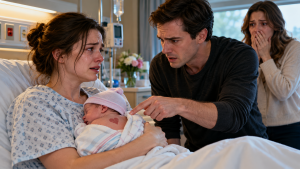
Ryan stood beside her, trembling with happiness.
When the nurse placed the baby in his arms, he smiled through his tears.
For a few precious seconds, everything seemed perfect.
Then he turned the baby slightly to adjust her blanket.
His smile disappeared.
He stared at her back.
His hands began shaking.
“Ryan?” I whispered from the hospital bed. “What’s wrong?”
He didn’t answer.
He simply kept staring.
Then he stepped backward as if he had seen something impossible.
“No,” he murmured. “No, this can’t be happening.”
Melissa reached toward him.
“Let me hold our daughter.”
But Ryan refused to move closer.
Instead, he looked at me with an expression I had never seen before.
“I’m sorry,” he said. “I can’t take her home.”
My heart stopped.
“What are you talking about? She’s your daughter!”
His eyes filled with tears.
Then he pointed toward the baby’s back.
“Look at what’s on her skin!”
I gently turned the newborn toward me.
The moment I saw the unusual mark beneath her shoulder, my entire body went cold.
Melissa covered her mouth.
Then she screamed.
Because that mark wasn’t merely a birthmark.
It was something Ryan recognized.
Something he had spent his entire life trying to forget.
And when he finally explained what it meant, I realized our family had been hiding a secret that could change all our lives forever.
PART 2: THE MARK ON HER BACK REVEALED A SECRET OUR FAMILY HAD BURIED FOR THIRTY YEARS…
“Tell me what you’re talking about!” I demanded.
Ryan stood beside the hospital window, his face drained of color.
Melissa was crying beside me, refusing to take her eyes off the baby.
The nurse gently checked the newborn and reassured us that the mark did not appear to be causing her any immediate distress.
But Ryan seemed unable to hear her.
Finally, he spoke.
“When we were children, our mother told us that our older sister had died before we were born.”
I frowned.
“What older sister?”
Ryan looked at me.
“You remember the old stories Mom used to tell about the little girl she lost? The one nobody was allowed to talk about?”
I nodded slowly.
Our mother had mentioned a baby she had lost long before Ryan and I were born.
Whenever we asked questions, she would become quiet and change the subject.
Ryan continued.
“She told me something else when I was seventeen. She said our sister had a distinctive birthmark on her back. A mark that looked almost exactly like the one on this baby.”
I stared at him in disbelief.
“That doesn’t mean anything! Birthmarks can look alike.”
“I know,” he replied, his voice breaking. “But Mom also told me our sister had been born with a rare congenital condition. She was terrified that the same thing could happen to another child in our family.”
Melissa finally interrupted.
“Ryan, we had genetic testing. The doctors knew our medical history. Why are you suddenly acting as if our daughter is doomed?”
He lowered his head.
“Because I found something after Mom died.”
He reached into his jacket and pulled out a folded envelope.
Inside was a handwritten letter, yellowed with age.
Our mother’s handwriting was unmistakable.
Ryan had discovered it among her belongings years earlier, but he had never shown it to me.
He handed it to Melissa.
She read the first few lines, then looked at him in horror.
The letter explained that our mother had given birth to a little girl many years before us.
The baby had survived, but doctors had discovered a serious medical condition shortly after her birth.
Our mother had been overwhelmed, frightened, and desperately poor.
She had eventually agreed to let another family raise the child, believing they could provide the medical care she could not afford.
She had been told the adoption would be permanent.
But she had never stopped wondering whether her daughter was alive.
At the bottom of the letter was a name.
A name neither Ryan nor I had ever heard before.
Melissa looked from the letter to the baby.
“Are you saying you think this child has the same condition?”
Ryan nodded.
“I don’t know. I only know what Mom wrote.”
I felt anger rising inside me.
“You cannot abandon your daughter because of a mark on her skin and a letter from decades ago!”
“I’m not trying to abandon her!” he shouted, immediately breaking down. “I’m scared!”
His confession silenced the room.
He admitted that he had spent years imagining the perfect moment when he would finally become a father.
He had never prepared himself for the possibility that his child might need lifelong medical care.
He was afraid of failing her.
Afraid of watching her suffer.
And afraid that he would repeat the mistakes he believed our mother had made.
Melissa wiped her tears.
“Then we learn what the mark means,” she said firmly. “We speak to the doctors. We get answers. But we do not reject our daughter before we even know what’s wrong.”
Ryan looked at the newborn.
For the first time since her birth, he stepped closer.
The baby opened her tiny hand and wrapped her fingers around his thumb.
His face crumpled.
“I wanted you so much,” he whispered to her. “I don’t know why I’m so afraid.”
I thought that was the end of the nightmare.
But the following morning, a hospital specialist examined the mark and asked us several questions about our family history.
After reviewing the baby’s initial examination, she explained that a skin mark alone could not establish whether the child had inherited any condition.
She recommended further evaluation before anyone drew conclusions.
Then she asked whether anyone in our family had ever been diagnosed with a rare inherited disorder.
Ryan and I exchanged a glance.
Neither of us knew.
Until Melissa remembered the letter.
She carefully unfolded it again and noticed a sentence hidden beneath the crease at the bottom.
It read:
“If another child is ever born with this mark, please find her sister before making any decisions.”
I felt the room tilt.
“Her sister?” I whispered.
Ryan snatched the letter from Melissa’s hands.
Then he read the sentence again.
His lips parted.
Because our mother had not written those words to warn us about a disease.
She had written them because she believed our lost sister might still be alive.
And the letter contained a name and an address that could lead us directly to her.
PART 3: THE WOMAN WHO ARRIVED AT THE HOSPITAL KNEW WHY THE BABY HAD THAT MARK—AND HER FIRST WORDS LEFT US SPEECHLESS…
By noon, Ryan had made the call.
The woman who answered the phone was named Eleanor.
When he explained who he was, she remained silent for so long that he thought the call had disconnected.
Then she whispered, “I’ve been waiting for this day for thirty years.”
Ryan asked her to come to the hospital.
She arrived less than two hours later.
She was a woman in her early thirties, with dark hair, tired eyes, and a small necklace bearing an old family photograph.
The moment she stepped into the room, she looked at Ryan.
Then at me.
And finally at the newborn sleeping in my arms.
Her eyes filled with tears.
“Is that her?” she asked.
Ryan stood frozen.
“Who are you?”
The woman swallowed.
“My name is Eleanor. I believe I’m your sister.”
Nobody moved.
I stared at her, struggling to understand how the little girl our mother had lost could now be standing in front of us.
Eleanor explained that she had been adopted as a baby.
Her adoptive parents had loved her deeply, but when she became an adult, they gave her the documents they had kept about her birth.
For years, she had searched for her biological family.
She had learned our mother’s name only recently.
Then, a few weeks earlier, she had received a message from someone who had recognized the family connection.
It was Ryan.
He had contacted her after discovering the letter, but he had never told me.
“I didn’t know what to believe,” Ryan admitted. “I was afraid that if I opened this door, everything would change.”
Eleanor looked at the baby.
“And now it has.”
She asked whether she could see the mark on the newborn’s back.
I carefully adjusted the blanket.
Eleanor’s face softened.
Then she began to cry.
“I have the same mark,” she whispered.
She turned slightly and showed us a similar birthmark beneath her shoulder.
Ryan stepped backward.
“But Mom said you had a condition. She said—”
“She was frightened,” Eleanor interrupted gently. “And she didn’t have all the information she needed.”
Eleanor explained that she had been born with a medical condition that required monitoring when she was young.
But her adoptive parents had taken her to specialists, followed their recommendations, and helped her grow up to live a full life.
The birthmark itself had never been proof of the condition.
It was simply one detail in a much larger medical history.
“I’m not saying your daughter has the same condition,” Eleanor continued. “Only a proper medical evaluation can tell you that. But I know what it’s like to grow up wondering whether someone rejected you because of something you couldn’t control.”
Ryan covered his face with his hands.
For thirty years, our mother had carried the pain of losing a daughter.
Ryan had carried the fear of repeating that history.
And now, in the middle of a hospital room, he finally understood that fear could become its own kind of tragedy.
He approached the baby.
“I’m sorry,” he whispered.
The newborn stirred in my arms.
Ryan gently touched her cheek.
“I was supposed to protect you. Instead, I let my fear make me forget that you’re my daughter.”
Melissa reached for his hand.
“We’ll face whatever comes together,” she told him. “But she deserves to know that we wanted her from the beginning.”
Ryan nodded through his tears.
Then he looked at Eleanor.
“Would you help us? I don’t know where to start.”
Eleanor smiled sadly.
“I can tell you what helped me. I can share my medical records with the doctors if they’re useful. And I can be here while you figure things out.”
Over the following weeks, Ryan and Melissa worked with the medical team to arrange the appropriate evaluations.
They asked questions, learned about the possible condition, and followed the specialists’ recommendations.
They also began building a relationship with Eleanor, who had spent years wondering whether she would ever meet her birth family.
The baby’s birthmark turned out not to be the answer Ryan had feared it was.
It was a reason to ask questions, not a reason to turn his back on his child.
Months later, I watched Ryan carry his daughter through the front door of the beautiful nursery he had prepared for her.
The same room he had once feared bringing her into was now filled with laughter, lullabies, and tiny clothes scattered across the floor.
Melissa stood beside him, smiling as their daughter reached for a stuffed rabbit.
Eleanor visited often.
And I finally understood the truth about the day that had nearly destroyed us.
Ryan had not looked at his daughter and discovered that she was unworthy of love.
He had looked at her and confronted a fear he had never learned how to face.
Thankfully, he chose to confront it before it cost him the most precious relationship of his life.
Our mother had once believed that giving up a child was the only way to protect her.
Ryan had nearly made the same mistake.
But this time, our family chose a different ending.
Because a child should never have to prove she is healthy, perfect, or easy to raise before she deserves to be loved.
And sometimes, the most important thing a family can inherit is not a name, a home, or a secret.
It is the courage to break a painful cycle before it passes to another generation.