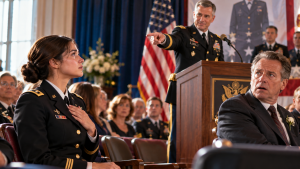
PART 1 — THE DAUGHTER MY FATHER ERASED FROM HIS MILITARY LEGACY
My Father Invited Hundreds of People to Celebrate His 40-Year Military Career, but He Made Sure His Own Daughter Was Left Off the Guest List—When I Arrived in Uniform, My Brother Laughed and Said I Had No Clearance, Until the Commander Walked Onto the Stage, Saw Me Standing at the Back, and Announced a Rank That Made My Entire Family Forget How to Breathe…
“What the hell is she doing here?” my father whispered.
I heard him clearly.
I was standing only a few feet from the entrance to the auditorium, beneath a row of golden lights, while hundreds of military officers, retired commanders, and their families filled the room.
My father, Lieutenant General Harlan Vale, had spent forty years building a reputation for discipline, honor, and service.
Apparently, he had spent just as long convincing everyone that his daughter was nothing worth mentioning.
My name is Sable Rowan Vale.
I was thirty-nine years old, and I had spent twenty years serving my country in military intelligence.
I had worked in secure command centers where mistakes cost lives, traveled through dangerous regions under orders that could never be discussed at family dinners, and helped coordinate operations that were later summarized in official reports without ever including the names of the people who had carried them out.
I had learned to live without applause.
But I had never learned how to stop wanting my father’s approval.
When I was seventeen, he told me that military intelligence was a place for people who preferred hiding behind computers instead of leading real soldiers.
When I received my first overseas assignment, he said I was running away from responsibility.
When I missed my younger brother Penn’s engagement party because I was deployed, my mother told relatives that I had become too important to remember where I came from.
And when I earned my first major promotion, my father barely glanced at the official notification.
“Your brother is building a future,” he said.
“Try not to make your life so complicated.”
Penn was his favorite.
He had followed our father’s path, choosing a visible command career filled with ceremonies, photographs, and carefully cultivated friendships.
He wore his medals proudly and knew precisely which senior officers to greet first at every gathering.
I had no resentment toward his achievements.
What hurt was the way my family treated his accomplishments as proof of his worth while treating my absence as proof of my failure.
Over the years, I stopped explaining myself.
My assignments were classified.
My achievements were rarely discussed outside official channels.
And my family never asked enough questions to discover the truth.
Then came the invitation to my father’s retirement ceremony.
It arrived three weeks before the event, addressed to my childhood home rather than my current residence.
Inside was a formal program announcing the end of Lieutenant General Harlan Vale’s distinguished career.
There were pages celebrating his leadership, photographs of his deployments, and a paragraph about his devoted family.
My mother was named.
Penn was named.
Penn’s fiancée, Liora, was named.
I was nowhere.
I called my mother.
“Oh, Sable,” she said when I asked about the omission. “It must have been an oversight.”
“An oversight that included everyone except me?”
She sighed as if I were making an embarrassing scene.
“Your father doesn’t want tension on his special day.”
“What tension?”
“You know how you are.”
That was the end of the conversation.
I could have stayed home.
Instead, I drove to Fort Halder on the morning of the ceremony, wearing my formal service uniform.
Not because I wanted to embarrass my father.
Not because I wanted anyone to recognize me.
I simply refused to let his version of our family become the only version that existed.
At the security gate, a young corporal examined my identification.
“I’m sorry, ma’am. Your name isn’t on the guest list.”
Behind me, my brother’s black SUV rolled into the adjacent lane.
Penn lowered his window.
“Well, look who decided to show up.”
His eyes traveled over my uniform before he turned to the corporal.
“She probably thinks being related to the guest of honor gives her special access.”
Liora laughed softly beside him.
My mother sat in the passenger seat, staring straight ahead.
“Should I escort her out?” Penn asked the corporal, smiling as though he had delivered a brilliant joke.
The corporal looked uncomfortable.
I remained silent.
Then Penn leaned closer to the window.
“Honestly, Sable, this isn’t one of your little secret assignments. This is Dad’s retirement. Don’t make it about yourself.”
He raised his window.
The SUV moved forward.
For a moment, I stood there watching the vehicle disappear through the gates.
Twenty years of service.
Two decades of sacrifice.
And my own brother still believed I was an embarrassment who had arrived somewhere she didn’t belong.
The corporal looked at me again.
Then he noticed the insignia on my shoulders.
His expression changed.
He straightened so quickly that the movement startled me.
“General, I sincerely apologize.”
He raised his hand in a sharp salute.
I returned it.
“There’s nothing to apologize for, Corporal. You were following the list you were given.”
He lifted the barrier.
I drove into the installation and parked near the auditorium.
Through the glass entrance, I could see my father greeting guests beneath a massive American flag.
He looked happy.
Penn stood beside him, shaking hands with officers and introducing Liora as though she were already part of a military dynasty.
My mother adjusted his collar before they posed for another photograph.
I watched them for several seconds.
Then I straightened my jacket and walked inside.
Nobody stopped me.
A few officers noticed my insignia and immediately stood aside.
Others nodded respectfully as I passed.
I barely registered their reactions.
My attention was fixed on the stage, where the installation commander was preparing to begin the ceremony.
My father spotted me just as the room began filling with applause.
His smile vanished.
He leaned toward Penn.
Penn followed his gaze.
His expression hardened.
Then he whispered something to Liora, who turned and stared at me with open disbelief.
My father began walking toward me.
I knew that expression.
It was the same one he had worn when I announced my first deployment, when I declined a family obligation because of an emergency briefing, and when I refused to apologize for choosing a career he did not understand.
He stopped directly in front of me.
“What are you doing here?”
“I came to attend your retirement ceremony.”
“You weren’t invited.”
“I received the announcement.”
“That isn’t the same thing.”
His voice remained low, but the anger beneath it was unmistakable.
People nearby had begun watching us.
“Do you have any idea how this looks?” he demanded.
I looked at the man who had spent his entire life teaching other people about duty.
“I came to congratulate you, Dad.”
He stared at me.
For a second, something almost human crossed his face.
Then it disappeared.
“Sit in the back,” he said. “And please, for once in your life, don’t make a spectacle of yourself.”
I stepped aside.
“Of course.”
He returned to the front row.
I took my place near the rear entrance, where I could see the entire auditorium without drawing attention to myself.
The lights dimmed.
The audience rose.
The installation commander stepped onto the stage.
And then he looked directly toward me.
“Before we begin,” he announced, “there is one distinguished officer in attendance whose presence deserves special recognition.”
My father settled into his chair.
Penn leaned back with a satisfied smile.
I remained still.
The commander continued.
“An officer whose service has shaped critical national security decisions, whose leadership has saved American lives, and whose achievements have remained outside the public spotlight for many years.”
The applause began slowly.
Then the commander lifted his hand.
“Brigadier General Sable Rowan Vale, would you please join us onstage?”
The entire room fell silent.
My father turned so sharply that his program slipped from his fingers.
Penn’s smile disappeared.
And my mother finally looked at me.
For the first time in years, all three of them were staring at the daughter they had spent so long pretending not to see.
I walked toward the stage.
The applause grew louder with every step.
But the most important moment wasn’t the sound of hundreds of people standing.
It was the look on my father’s face when he realized that the woman he had ordered to sit in the back was about to stand beside the most powerful officers in the room.
And he still had no idea why the commander had personally requested my presence.
PART 2 — THE SECRET PROMOTION MY FAMILY NEVER KNEW ABOUT
The applause continued as I reached the stage.
The installation commander, General Marcus Whitmore, stepped forward and shook my hand.
“It’s an honor to have you here, General Vale.”
“Thank you, sir.”
He turned toward the audience.
“Many of you know Brigadier General Vale’s work through the outcomes of her assignments. Far fewer have had the privilege of working directly with her.”
A presentation appeared on the screen behind us.
It displayed no classified operational details, no sensitive locations, and no names that should not have been made public.
Instead, it showed a carefully approved summary of my service: leadership positions, joint-command responsibilities, and recognition for work that had protected American personnel.
The room remained quiet as the commander described my career.
I saw officers in the front rows exchange surprised glances.
Some knew me by reputation.
Others had worked alongside people whose lives had been changed by decisions I had helped make.
My father stared at the screen.
I wondered whether he was searching for some mistake that would restore the world he understood.
Penn leaned toward him.
“What is this?” he whispered.
My father didn’t answer.
The commander continued.
“General Vale has spent much of her career in assignments where recognition was neither possible nor appropriate. She has consistently placed the mission above personal credit.”
He paused.
“That is why I asked her to join us today.”
I looked toward the front row.
My mother had clasped both hands tightly in her lap.
Liora was no longer smiling.
Penn sat perfectly still.
My father looked as though someone had changed the language of a conversation he had been having for forty years.
When the ceremony resumed, the commander invited me to sit in the reserved section near the stage.
I took my seat beside several senior officers.
For the first time that morning, I could hear my family whispering without being able to hear every word.
I didn’t need to.
The ceremony proceeded with speeches, formal presentations, and a tribute to my father’s decades of service.
He delivered his own remarks with the confidence of a man who had practiced them many times.
He spoke about sacrifice.
He spoke about loyalty.
He spoke about the importance of family.
When he thanked Penn for continuing the Vale military tradition, the audience applauded.
Then he thanked my mother for standing beside him through every difficult year.
More applause followed.
He never mentioned me.
Not once.
The omission might have hurt more if I had still believed he had simply forgotten.
Instead, it confirmed something I had spent years trying not to accept.
My father could recognize my existence when it suited him.
He simply preferred a story in which I didn’t matter.
After the ceremony, guests gathered in the reception hall.
Officers approached me to exchange greetings.
One colonel remembered working with me during a difficult joint assignment.
A retired commander congratulated me on my recent promotion.
Another officer introduced me to his wife and thanked me for the leadership I had provided to his team.
I accepted each greeting with a quiet smile.
Across the room, Penn watched from beside the refreshments table.
Finally, he approached.
“So,” he said, attempting a laugh, “Brigadier General. That’s quite a surprise.”
“It’s been a long career.”
“You never told us.”
“You never asked.”
He frowned.
“Come on, Sable. We all have our own lives.”
“Yes,” I replied. “We do.”
He glanced around to make sure nobody was listening.
“Dad’s upset. You know how important today is to him.”
“I haven’t interrupted his ceremony.”
“You showed up without being invited and somehow ended up onstage.”
“The commander invited me.”
Penn’s jaw tightened.
“You could have warned us.”
I looked at him for a moment.
“Would that have changed anything?”
He said nothing.
Before he could answer, our mother approached.
“Sable, darling.”
She reached for my arm, but stopped when I stepped back slightly.
“We had no idea you had achieved so much.”
“You had my contact information.”
She looked down.
“Your father has always worried about you.”
I almost laughed.
“Has he?”
“He didn’t understand your career.”
“Understanding and respecting someone aren’t the same thing.”
Her eyes filled with tears.
For a moment, I saw the woman who used to sit beside my bed when I was a child, brushing my hair away from my forehead after a nightmare.
I wanted to believe she had come to apologize.
Instead, she whispered, “Please don’t make this harder for him.”
There it was again.
My achievements were unexpected.
My feelings were inconvenient.
And my father’s comfort was still everyone’s responsibility.
“I haven’t done anything to him,” I said.
She pressed her lips together and walked away.
A few minutes later, my father approached.
He waited until the other officers had moved away before speaking.
“Who authorized that announcement?”
“The installation commander.”
“Why would he single you out at my retirement?”
“Because he wanted to recognize my service.”
“Your service?” He gave a short, disbelieving laugh. “You work in intelligence. You sit behind a desk. You have no idea what it takes to command people in the field.”
I studied him.
Twenty years ago, those words would have destroyed my entire day.
Now they sounded like a man arguing with facts he had never bothered to investigate.
“You’re entitled to your opinion,” I said.
“Don’t speak to me like I’m one of your subordinates.”
“I wasn’t.”
His face reddened.
“You’ve always had this problem. You think you’re better than everyone else because you disappear for months and come back with a different title.”
“I don’t think I’m better than anyone.”
“Then why didn’t you tell us?”
I took a slow breath.
“Because the work was confidential. Because I was tired of defending my choices. And because every time I tried to share something about my life, you found a way to tell me it wasn’t important.”
He looked away.
For the first time, he seemed unable to produce an immediate response.
Then Penn appeared beside him.
“Dad, the guests are waiting for the family photographs.”
My father straightened his jacket.
“We’ll discuss this later,” he told me.
He turned and walked away.
I watched him join the others near the stage.
The photographer arranged my parents in the center, with Penn and Liora beside them.
A staff member noticed me standing several feet away.
“General Vale, would you like to join your family?”
Before I could answer, my father said, “We’re ready.”
The photographer hesitated.
My mother looked toward me.
Penn stared at the floor.
I smiled politely at the staff member.
“No, thank you.”
I walked toward the exit.
Behind me, I heard the camera shutter.
Another perfect Vale family photograph.
Another image in which I did not exist.
Outside, the cold air struck my face.
I stood beside my car for a moment, wondering why the old hurt could still reach me even after everything I had accomplished.
Then my phone rang.
It was General Whitmore.
“General Vale, I hope you haven’t left the installation yet.”
“Not yet, sir.”
“Good. I need you back at headquarters tomorrow morning. There’s a matter we need to discuss, and your presence is essential.”
“Understood.”
He paused.
“And Sable?”
“Yes, sir?”
“Your father doesn’t know the full story. I imagine that will change soon.”
I looked back at the auditorium windows.
“What story is that, sir?”
“The one that explains why your name was kept off the retirement program.”
The call ended.
I remained beside my car, holding the phone in my hand.
Until that moment, I had believed my family’s rejection was simply a matter of pride, favoritism, and years of accumulated resentment.
But the commander had sounded certain.
Someone had made a decision.
Someone had ensured my name was missing.
And suddenly, I needed to know whether my father had merely accepted my absence—or had personally arranged it.
PART 3 — THE DOCUMENT THAT EXPOSED THE TRUTH ABOUT MY FAMILY
The following morning, I arrived at headquarters at 7:30.
General Whitmore was waiting in a conference room with two senior officers and a civilian director from the personnel office.
A folder sat in the middle of the table.
“Please sit down, General Vale,” he said.
I took the chair opposite him.
He opened the folder.
Inside were copies of official correspondence concerning the retirement ceremony, including the original guest list and several subsequent revisions.
My name appeared on the first version.
It had been added months earlier, when the event was initially planned.
Beside my name was a note indicating that I would attend as a senior officer and that the installation commander intended to acknowledge my service.
Then came the revisions.
My name had been removed.
A handwritten explanation appeared beside the change: Family seating adjustments.
I read it twice.
“Who requested this?”
General Whitmore folded his hands.
“The request came through your father’s office.”
I felt a strange stillness settle over me.
Not shock.
Not even anger.
Just the quiet recognition of something I had suspected for years.
“Was the request approved?”
“No. The event staff restored your name to the official security list after confirming your credentials. But the printed program had already gone to production.”
I looked at the papers.
“So my father knew I was expected.”
“He knew you had been included in the original arrangements.”
“And he removed me.”
“The correspondence indicates that his office requested the change. I cannot tell you what he intended beyond what the record shows.”
I appreciated that distinction.
Military service had taught me to separate evidence from assumptions.
The documents established what had happened.
They did not establish every reason behind it.
General Whitmore continued.
“There is something else. The retirement committee had planned to recognize several officers with distinguished service records. Your name was among them. Your father requested that the acknowledgment be limited to personnel directly associated with his command.”
I looked up.
“But my career wasn’t under his command.”
“Correct.”
The room fell silent.
For years, my father had criticized me for building a career outside his shadow.
Now I understood that he had not merely failed to acknowledge my achievements.
He had taken an active step to keep them separate from the legacy he wanted to leave behind.
I closed the folder.
“Thank you for showing me this, sir.”
General Whitmore studied my face.
“You have every right to be angry.”
“I am angry.”
“Then what will you do?”
I considered the question.
For years, I had imagined a moment when my family would finally understand what they had done.
I had pictured my father apologizing in front of the same people who had watched him dismiss me.
I had imagined my brother lowering his eyes.
I had even imagined my mother explaining to the relatives why she had allowed me to be treated like a stranger.
But sitting in that room, I realized I no longer wanted to organize my life around their regret.
“I’ll do my job,” I said. “And I’ll stop pretending their approval is something I need to earn.”
The commander nodded.
“That sounds like the right decision.”
By noon, I had returned to my office.
I did not contact my father.
I did not send him copies of the documents.
I did not call Penn to demand an explanation.
I simply went back to work.
Three days later, my mother called.
I almost let it go to voicemail.
Then I answered.
“Your father wants you to come to dinner,” she said.
“Why?”
“He says the family needs to talk.”
“About what?”
She hesitated.
“Everything that happened at the ceremony.”
I looked through my office window at the people moving between buildings.
“Did he ask you to invite me?”
“Yes.”
“Did he apologize for removing my name from the guest list?”
Silence.
“Mom?”
“He doesn’t think it was as serious as you do.”
I closed my eyes briefly.
“Then we have nothing to discuss.”
I ended the call gently.
For the next several weeks, I heard nothing from them.
Then, on a Saturday afternoon, someone knocked on my apartment door.
It was Penn.
He stood in the hallway without his uniform, holding a paper bag from a bakery I remembered from our childhood.
“Can I come in?”
I stepped aside.
He sat on the edge of the sofa, looking around the room as though he had expected to find evidence of a completely different life.
“I didn’t know you were a general,” he said finally.
“You knew I was an officer.”
“I knew you worked in intelligence. I didn’t know what that meant.”
“You never asked.”
He rubbed his hands together.
“Dad says you embarrassed him.”
I waited.
“But I looked into some things after the ceremony,” he continued. “I spoke to people. I read the public material about your career.”
He swallowed.
“You’ve done a lot.”
“Yes.”
“I should have known.”
“Yes,” I repeated.
He looked down at the bakery bag.
“I’m sorry I laughed at you at the gate.”
It was the first honest apology I had heard from him in years.
It wasn’t enough to erase everything that had happened.
But it was a beginning.
“What about the guest list?” I asked.
Penn’s face changed.
“Dad told me he wanted the ceremony to focus on his career. He said you wouldn’t want the attention anyway.”
“Did you believe him?”
“I didn’t question it.”
“Why not?”
He took a long breath.
“Because it was easier to believe what he said than to admit how little I knew about you.”
For the first time, I saw something other than arrogance in my brother’s face.
I saw shame.
We talked for almost an hour.
He told me about the pressure he had felt growing up as the son expected to continue our father’s legacy.
I told him what it had been like to have every accomplishment dismissed because it happened outside our father’s preferred world.
Neither of us tried to pretend that our childhood had been the same.
When Penn finally stood to leave, he paused at the door.
“Will you come to dinner sometime?”
“Maybe.”
He nodded.
“I understand.”
It was a small step.
But for once, it was an honest one.
My father did not come to my apartment.
He did not call to apologize.
For a while, I wondered whether he ever would.
Then, almost two months after the ceremony, an envelope arrived at my office.
It contained a handwritten letter.
My father had written only a few paragraphs.
He admitted that he had asked for my name to be removed from the program.
He said he had convinced himself that my presence would distract from his retirement and create questions he did not know how to answer.
He admitted that he had spent years measuring my success against his own expectations instead of recognizing it for what it was.
The last line read:
I thought I was protecting the legacy I had built. I failed to understand that you had built a life of your own.
I read the letter twice.
Then I placed it in my desk drawer.
I did not immediately forgive him.
An apology could open a door, but it could not erase twenty years of standing outside it.
A week later, I agreed to meet my parents at a quiet restaurant near the installation.
My father looked older than I remembered.
For once, he did not begin the conversation with a lecture.
“I was wrong,” he said.
I waited.
“I wanted people to see me as a successful commander and a successful father. I thought your career would make people ask questions I couldn’t answer. Instead of admitting that I didn’t understand your work, I tried to make it disappear.”
His voice faltered.
“I am sorry, Sable.”
My mother reached across the table and held my hand.
I looked at both of them.
“I don’t need you to understand every operation I’ve worked on,” I said. “I don’t need you to know every detail of my career. But I needed you to believe that my life mattered even when you couldn’t see it.”
My father nodded.
“I know.”
“No,” I said softly. “You’re beginning to understand.”
We sat in silence.
For the first time, it was not the silence of rejection.
It was the silence of people who had finally run out of excuses.
Our relationship did not transform overnight.
There were difficult conversations, uncomfortable memories, and boundaries my parents had to learn to respect.
Some things improved.
Other things took longer.
But I stopped measuring my worth by how warmly my father greeted me or whether my name appeared in his stories.
I had spent twenty years serving a country that had trusted me with difficult responsibilities.
I had led people who judged me by my decisions, not by how well I fit someone else’s expectations.
I had built a life that mattered, even when the people closest to me refused to see it.
And that was enough.
Months later, I received an invitation to speak at a military leadership conference.
My father attended.
He sat quietly in the audience while I spoke about service, leadership, and the importance of recognizing people whose contributions remain unseen.
When the presentation ended, the room rose in applause.
My father stood with them.
This time, he did not look embarrassed.
He looked proud.
Afterward, he approached me and offered his hand.
I took it.
Then he pulled me into an awkward, hesitant embrace.
“I should have done that years ago,” he whispered.
“Yes,” I said. “You should have.”
And for the first time, neither of us pretended otherwise.
Because the greatest victory was never making my father regret underestimating me.
It was finally understanding that I had never needed his permission to become the woman I was meant to be.