PART 1: THE STRANGER WHO NEVER FORGOT MY NAME
My name is Corporal Jake Reynolds, and I was 26 years old when I learned that the smallest act of kindness could lead to the most unexpected day of my military career.
I was stationed near Norfolk, Virginia, and at the time, my life was nothing extraordinary.
I followed orders, completed my duties, and tried to make my father proud, even though he had been gone for nearly eight years.
He was a Marine, too.
Before he died, he gave me one piece of advice that I carried everywhere.
“Jake, never measure a man by the uniform he wears. Measure him by what he does when nobody is watching.”
I never imagined those words would one day change my life.
It happened on a rainy Thursday evening.
After a long day of training, I stopped at a small diner outside the base.
The place was almost empty, with red leather booths, fogged-up windows, and the smell of coffee drifting through the air.
I had barely taken three sips of my coffee when I noticed an elderly man standing at the register.
He wore a faded Vietnam veteran cap and a worn brown jacket.
His shoulders were slightly hunched, and his hands trembled as he searched his wallet for another card.
“I’m sorry, sir,” the waitress said gently. “It’s been declined again.”
The old man stared at the payment terminal.
For a moment, I thought he might become angry.
Instead, he quietly asked, “How much do I owe you?”
“Twenty-three dollars and forty cents.”
He opened his wallet again.
There were a few crumpled bills inside, but not enough to cover the meal.
“I see,” he whispered.
Then he began apologizing.
Not loudly.
Not dramatically.
He simply apologized to the waitress, to the people waiting behind him, and even to the young couple sitting near the window.
Something about that moment bothered me more than I could explain.
I had seen men spend thousands of dollars on things they didn’t need, yet here was an elderly veteran struggling to pay for a simple dinner.
I stood up.
“Ma’am, put his bill on mine.”
The old man immediately turned around.
“No, son. You don’t have to do that.”
“I know, sir.”
“Then why would you?”
I looked at the faded emblem on his cap.
“Because somebody probably helped my father once when he needed it.”
That answer seemed to silence him.
The waitress processed my payment, and I returned to my booth.
The old man approached me a few seconds later.
He stood beside my table, holding his cap between both hands.
“What branch are you in?”
“Marine Corps, sir.”
His eyes moved briefly to my uniform.
“Your name?”
“Corporal Jake Reynolds.”
He repeated it quietly, as if committing every syllable to memory.
“Reynolds,” he said. “Was your father ever stationed at Camp Lejeune?”
My heart skipped.
“Yes, sir. He served for twenty years.”
The old man’s expression changed.
It was subtle, but I noticed it.
His fingers tightened around the brim of his cap.
“What was his name?”
“Daniel Reynolds.”
For several seconds, the old man didn’t move.
Then he pulled out the chair opposite me and sat down without asking.
“Daniel Reynolds,” he repeated.
His eyes had suddenly become glassy.
“You said he passed away?”
“Yes, sir. Eight years ago.”
The man lowered his head.
“I’m sorry, son.”
I didn’t know why, but his apology sounded different from the usual condolences.
It sounded personal.
Before I could ask him anything, he stood.
“Thank you for dinner, Corporal.”
“You’re welcome, sir.”
He paused beside the door.
“One day, Jake, you’ll understand that kindness is never wasted.”
Then he disappeared into the rain.
I watched his silhouette fade beneath the parking lot lights.
I never learned his first name.
I never asked where he lived.
And I certainly never imagined I would see him again.
Two weeks later, my commanding officer summoned me to his office.
I arrived ten minutes early, convinced I had somehow made a mistake during training or paperwork.
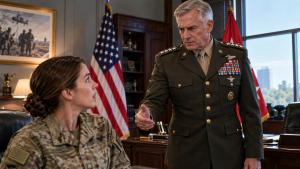
When I entered, my commander stood behind his desk.
But he wasn’t alone.
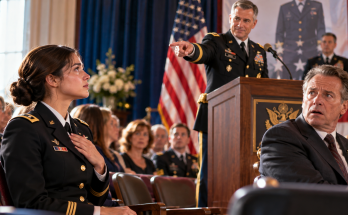
A man sat in the chair beside the window, wearing an immaculate Marine Corps dress uniform.
Four silver stars gleamed on his shoulders.
I recognized his face immediately.
The diner.
The declined card.
The faded veteran cap.
It was the same man.
Except now, he was a four-star general.
My mouth went dry.
I snapped to attention.
“Corporal Jake Reynolds reporting as ordered, sir!”
The general studied me for a long moment.
Then he slowly rose from his chair.
“Relax, Corporal.”
I tried to obey, although my heart was pounding.
He walked around the desk and stopped directly in front of me.
“Your father was Daniel Reynolds,” he said.
“Yes, sir.”
The general glanced toward my commanding officer.
Then he looked back at me.
“Before I tell you why you’re here, I need you to answer one question.”
I swallowed.
“Yes, sir.”
“Did your father ever tell you what happened during his final deployment in 2008?”
My entire body went still.
My father had never discussed that deployment in detail.
Whenever I asked, he would simply say that some memories were better left buried.
“No, sir,” I answered.
The general’s expression hardened.
“Then there’s something your family should have been told a long time ago.”
He opened a black folder on the desk.
Inside was a photograph of my father standing beside three Marines.
One of them was the general himself.
And beneath the photograph was a document bearing my father’s signature.
The general placed his finger on the page.
“Corporal, your father didn’t die believing he had failed his men.”
He paused.
“He died protecting the truth about what happened to them.”
My knees almost buckled.
Because for eight years, I had believed my father had died with an unresolved accusation hanging over his name.
And now the most powerful officer I had ever met was telling me that everything I knew about my father’s final days might have been wrong.
But the general wasn’t finished.
He turned to the last page in the folder.
And when I saw the name written there, I realized this meeting was about to become far more dangerous than I had ever imagined.
It was the name of a senior officer who was still serving in the Marine Corps.
An officer who had personally attended my father’s funeral.
An officer who had stood beside my family and promised that my father had been an honorable man.
And according to the document in front of me, he had been the last person to see my father alive.
PART 2: THE SECRET MY FATHER TOOK TO HIS GRAVE
I stared at the name until the letters began to blur.
Brigadier General Thomas Whitmore.
I knew that name.
Every Marine in my command knew it.
Whitmore had spent decades building a reputation as a decorated officer and respected military strategist.
He had received commendations, led major operations, and appeared in official photographs with some of the most influential people in the military.
Three years earlier, he had even delivered a speech at a ceremony honoring fallen Marines.
My father’s name had been mentioned during that speech.
Whitmore had called him a hero.
Now, according to the document in the general’s folder, Whitmore might have been responsible for the events that destroyed my father’s final deployment.
“Sir,” I said carefully, “are you telling me General Whitmore lied about my father?”
The four-star general didn’t answer immediately.
Instead, he returned to his chair and motioned for me to sit.
“My name is General Richard Hale,” he said. “And I knew your father long before you were born.”
I sat down slowly.
“Daniel Reynolds was one of the finest Marines I ever served with. He wasn’t the loudest man in a room, and he never asked for recognition. But when others became frightened, he remained steady.”
General Hale opened another folder.
“In 2008, your father was assigned to a mission that went terribly wrong. Several Marines were placed in danger after a critical change to their operational instructions.”
He slid a report toward me.
“Your father discovered that the instructions had been altered after the original plan had been approved.”
I looked at the report.
There were dates, signatures, and several paragraphs blacked out for security reasons.
“Why didn’t he report it?”
“He did,” Hale replied. “More than once.”
The general explained that my father had submitted written concerns before the operation.
Those concerns were dismissed.
Afterward, when the mission resulted in the deaths of two Marines and serious injuries to another, the investigation focused heavily on the decisions made by the men on the ground.
My father refused to sign a statement accepting responsibility for orders he claimed he had never received.
He believed the truth would eventually emerge.
Instead, his career was damaged, his reputation was questioned, and he returned home carrying a burden he never fully explained to his family.
“Why didn’t you help him?” I asked.
The question escaped before I could stop it.
General Hale accepted it without flinching.
“Because I was not in the position you think I was, and because I failed to recognize how far the deception had gone until it was too late.”
He lowered his eyes.
“I have spent years trying to correct that failure.”
I didn’t know what to say.
Part of me wanted to believe him.
Another part remembered every time my father had gone silent when someone mentioned his military service.
I remembered the night before his final hospitalization, when he had held my shoulder and said, “Whatever people say about me, Jake, don’t let bitterness decide who you become.”
At the time, I thought he was talking about the arguments he’d had with former colleagues.
Now, I wasn’t so sure.
General Hale continued.
“Recently, a retired communications specialist contacted my office. He had kept copies of records from that deployment. Those records contradict key parts of the original investigation.”
“Why now?”
“Because he is seriously ill, Corporal. He decided he couldn’t take the truth with him.”
The general placed a small envelope on the desk.
Inside was a handwritten letter from a man named Sergeant First Class Michael Turner.
Turner had served alongside my father.
He wrote that he had witnessed the confusion surrounding the mission and had tried to raise concerns afterward.
He also described seeing a senior officer enter the operations room shortly before the revised instructions were distributed.
The officer’s name was omitted from the letter.
But the attached record identified the person who had authorized the change.
Thomas Whitmore.
I read the page twice.
My hands had begun to shake.
“Why are you showing me this, sir?”
“Because your father left something in writing that may help establish what happened. And because your name appeared in the correspondence.”
“My name?”
Hale nodded.
“Your father wanted you to know the truth if the evidence ever came to light. But he also wanted you to make your own decisions about your future.”
He reached into the folder and removed a sealed envelope.
My name was written across the front in my father’s unmistakable handwriting.
I had seen that handwriting on birthday cards, school notes, and the letter he left me before his final deployment.
I couldn’t breathe properly.
“Where did you get that?”
“It was held with a collection of his personal papers. A family representative recently authorized its release to the review team.”
I held the envelope without opening it.
For eight years, I had wished for one more conversation with my father.
Now, suddenly, I had one more message from him.
And I was terrified of what it might contain.
General Hale stood and walked toward the window.
“I want you to understand something, Corporal. This is not an order to accuse anyone. We are conducting a formal review, and every claim must be supported by evidence. You have every right to decline involvement in the process.”
I looked down at the envelope.
My father had spent his final years carrying a truth he couldn’t prove.
I wasn’t going to turn away simply because the truth might be uncomfortable.
“I want to help, sir.”
Hale nodded.
“Then read your father’s letter. Take time to think. Speak with the appropriate investigators, and don’t discuss restricted material outside authorized channels.”
I opened the envelope.
The letter was only two pages long.
The first few lines made my eyes sting.
Jake, if you’re reading this, then someone finally found the courage to look again.
I stopped.
I pressed my lips together and continued.
I need you to know that the men who died were never just names in a report. They were someone’s sons, someone’s brothers, and someone’s best friends.
I tried to make sure their families would know what happened. I failed to get the truth heard while I was alive.
If you ever have the chance to help, do it because those men deserve honesty—not because you want revenge for me.
I had to put the letter down.
The general remained silent.
When I finally looked up, he was watching me with an expression I couldn’t quite read.
“There’s one more thing,” he said.
I wiped my eyes and straightened.
“What is it, sir?”
“The retired specialist who contacted us didn’t just provide records.”
Hale returned to the desk and placed a final document in front of me.
“He provided the original audio recording from the operations room.”
I stared at him.
“An audio recording?”
“Yes.”
“And it still exists?”
“It does.”
The general tapped the page.
“The review team has authenticated the recording’s source and is examining its contents. I cannot discuss every detail with you yet, but it contains a conversation that may explain why your father’s warnings were ignored.”
I looked at the attached transcript.
Most of the text had been redacted pending review.
But one sentence remained visible.
If Reynolds refuses to sign, make sure the investigation ends with him.
I felt cold all over.
The words were attributed to a speaker whose identity had not yet been formally established.
But the timestamp placed the conversation minutes before the first official statement was submitted.
And the record showed that the officer responsible for collecting those statements was Thomas Whitmore.
I raised my eyes to General Hale.
“Sir, if this is real, why hasn’t anyone been held accountable?”
“Because suspicion isn’t proof,” he answered. “And because some of the people involved had the authority to make certain records disappear.”
He closed the folder.
“That’s why we must do this correctly.”
I left his office that afternoon carrying my father’s letter in a sealed document envelope.
For the first time in eight years, I no longer felt ashamed when I thought about my father’s service.
But I also knew that the truth would not come without resistance.
Three days later, General Hale called me back.
This time, he wasn’t alone.
A civilian investigator sat beside the desk, and two officers from the review team stood near the window.
A new report lay open in front of them.
The investigator looked at me and said, “Corporal Reynolds, we’ve confirmed that the original operational instructions were altered after approval.”
My heart began racing.
“Does that prove General Whitmore did it?”
“Not by itself,” she replied. “But we now have corroborating records, testimony, and an authenticated recording that raise serious questions about his role.”
Then she turned to another page.
“We also discovered something that changes the timeline.”
I leaned forward.
“What?”
The investigator took a breath.
“Your father submitted a final report just hours before he died. It was never included in the official case file.”
She slid a copy toward me.
At the bottom of the page was a handwritten note.
It wasn’t addressed to the investigators.
It wasn’t addressed to my father’s commanding officer.
It was addressed to me.
And beneath my name, my father had written seven words that made me realize he had known more than anyone had ever told me.
Jake, the person you trust knows why.
PART 3: THE FOUR-STAR GENERAL’S PROMISE
I read those seven words again.
The person you trust knows why.
For several seconds, I couldn’t hear anything except the sound of my own breathing.
Who had my father trusted?
His fellow Marines?
His commanding officers?
The men who had attended his funeral and promised my mother that he had served honorably?
General Hale watched me carefully.
“Corporal, do you recognize the handwriting beneath the note?”
I examined the page.
The final line was in my father’s hand, but the initials beside it belonged to someone else.
I recognized them immediately.
R.H.
Richard Hale.
I looked up.
“Sir, you knew about this?”
Hale didn’t evade the question.
“I knew your father had concerns about the investigation. I did not know he had written that note until the document was recovered.”
“Then why are your initials here?”
The room fell silent.
The general took a slow breath.
“Because Daniel asked me to promise him something.”
“What?”
“That if evidence ever emerged proving his concerns were justified, I would make sure the case was reviewed independently—even if doing so damaged my own reputation.”
I searched his face.
“Did you keep that promise?”
“Not soon enough.”
His answer was so quiet that it unsettled me more than any denial could have.
Hale explained that he had known my father for years.
They had served together early in their careers, and my father had once taken responsibility for a mistake that could have ended Hale’s career before it truly began.
Years later, when my father’s deployment became the subject of controversy, Hale believed the investigation would uncover the truth.
He was wrong.
He had trusted the system to correct itself.
It didn’t.
By the time he realized how incomplete the investigation had been, my father was gone.
“I cannot undo that,” he said. “But I can ensure that the evidence is examined properly now.”
For the next several weeks, I cooperated with the review team.
I provided copies of my father’s personal letters and answered questions about the conversations we had shared.
I didn’t accuse anyone publicly.
I didn’t spread rumors.
I simply told the truth about what I knew and left the investigators to establish what the evidence proved.
Meanwhile, the review expanded.
Former Marines were interviewed.
Old records were retrieved from storage.
Communications logs were compared with the original operational plans.
The recording was examined by specialists.
And slowly, a picture emerged that was far more complicated than the one contained in the original investigation.
Some officers had acted on incomplete information.
Others had ignored warnings.
At least one senior official had attempted to shift responsibility onto men who had not received the instructions later attributed to them.
The evidence against Whitmore became substantial enough for the appropriate authorities to take formal action.
He was removed from his leadership position pending the investigation.
For the first time since my father’s death, someone was being required to answer questions about the decisions that had haunted our family.
But the most important moment came on a quiet Tuesday morning.
General Hale asked me to attend a private meeting with the review team.
When I entered, a thick report sat on the conference table.
The lead investigator stood and addressed everyone in the room.
“The independent review has established that Corporal Reynolds’s father raised legitimate concerns before the operation. The original inquiry failed to adequately investigate those concerns, and several statements in the final report were inconsistent with the newly recovered evidence.”
I gripped the back of my chair.
She continued.
“The review has also identified serious misconduct in the handling of the investigation. The matter has been referred for further administrative and legal proceedings.”
I looked at General Hale.
He nodded once.
It wasn’t a celebration.
No one clapped.
No one smiled as if years of damage could be erased by a few pages of findings.
But something important had changed.
My father was no longer being remembered solely through an investigation that had failed to tell the whole story.
The record was being corrected.
And that mattered.
After the meeting, Hale asked me to remain behind.
He was no longer wearing his dress uniform.
Instead, he wore a simple service uniform, and the four stars on his shoulders seemed less important than they had the first day I saw him.
“I owe you an explanation about the diner,” he said.
I almost laughed.
“Sir, I thought you were going to court-martial me when I saw you in your office.”
He smiled faintly.
“I imagine you weren’t expecting to meet me again.”
“Not exactly, sir.”
He sat down.
“The truth is, I had been traveling privately that evening. My wallet had been compromised during a trip, and my bank had temporarily blocked the card I normally used. I had enough cash for part of the meal, but not all of it.”
I listened quietly.
“I could have asked the waitress to wait while I contacted someone. I could have explained who I was. But I didn’t want my rank to determine how people treated me.”
He paused.
“Then you stepped forward.”
“Anyone could have done it, sir.”
“Perhaps,” he replied. “But you did.”
He leaned back.
“When you mentioned your father, I recognized his name. I had been reviewing old records for months, but I hadn’t known you were serving at that installation.”
I thought about the way he had repeated my name in the diner.
“You remembered me because of my father?”
“Initially, yes. But I requested this meeting because your father’s case required your cooperation, and because I wanted you to hear the findings from someone who knew him personally.”
He looked directly at me.
“I did not want you to think that helping me buy dinner had earned you special treatment. You deserved to know the truth about your father regardless of what happened in that diner.”
That answer earned my respect more than the four stars ever could.
Then Hale reached into his briefcase and removed a small envelope.
“This was recovered with your father’s personal papers. The review team has authorized its release to your family.”
I recognized the handwriting before I even touched it.
Another letter.
This one had been sealed for years.
I opened it carefully.
Jake,
If you ever become a Marine, remember that the uniform is not what makes you honorable.
Your choices do.
There will be moments when doing the right thing costs you something. You may lose friends. You may lose opportunities. You may even discover that people you admire have made terrible decisions.
Don’t let that make you cruel.
You can demand accountability without becoming hateful. You can stand up for the truth without forgetting that every person deserves a fair hearing.
And if you ever see someone struggling, don’t ask whether helping them will benefit you.
Help because you can.
Love, Dad.
I lowered the letter.
For years, I had imagined my father leaving me some explanation of the events that had ruined his final years.
Instead, he had left me something much more important.
He had reminded me who I wanted to become.
General Hale stood beside the window while I folded the letter.
“I can’t give your father back the years he lost,” he said. “And I can’t promise that every person responsible will receive the punishment they deserve. That is for the proper authorities to determine.”
He turned toward me.
“But I can promise that his concerns will no longer be dismissed without examination.”
I extended my hand.
“Thank you, sir.”
He shook it firmly.
“No, Corporal. Thank you for reminding me of something I should never have forgotten.”
“What’s that, sir?”
“That leadership isn’t measured by the number of stars on your shoulders. It’s measured by whether you’re willing to face the truth when the truth becomes inconvenient.”
Months later, the investigation continued through the proper channels.
Some findings became public.
Others remained restricted.
The legal and administrative consequences took time, and I learned that justice rarely arrives as quickly or as cleanly as people hope.
But my father’s record was formally amended to reflect the findings of the independent review.
Our family received an official letter acknowledging that his concerns had been legitimate and that the original investigation had failed to address important evidence.
My mother cried when she read it.
Not because a document could erase eight years of pain.
But because, at last, she no longer had to wonder whether the man she had loved had been remembered fairly.
I kept both of my father’s letters in a small wooden box beside my bed.
And every time I passed a diner, I thought about the rainy evening when I had paid twenty-three dollars and forty cents for a stranger’s dinner.
I had believed I was helping an old veteran through a difficult night.
I never imagined that the encounter would lead me back to my father’s story.
I never expected to sit across from a four-star general while he explained why the truth had remained buried for so long.
And I never imagined that the greatest lesson of my military career would come from a man whose card had been declined at a diner.
But I learned something I will carry for the rest of my life.
Rank can command attention.
Money can open doors.
Power can influence what people believe.
But none of those things can replace the courage to do what is right when nobody is watching.
That rainy night, I thought I was paying for a stranger’s meal.
In reality, I was honoring the lesson my father had spent his entire life trying to teach me.
And the man with four stars on his shoulders?
He didn’t remember me because I had paid his bill.
He remembered me because, for one brief moment, I had treated him exactly as my father taught me to treat every human being.
Not as a general.
Not as a veteran.
Not as a stranger who might someday be useful.
But as a person who needed a little help.
And sometimes, that is where the most important stories begin.