PART 1 — The Book in the Grave
My grandmother’s funeral ended beneath a gray afternoon sky.
Everyone had already begun walking toward their cars when my father picked up the small blue savings book Grandma had kept for decades.
He looked at it with disgust.
“This thing is worthless.”
Then he tossed it onto the lid of her coffin.
My stepmother laughed quietly.
My half-brother shrugged.
Dad looked at me.
“Go ahead. Take it if you want. Maybe Grandma left you enough money for lunch.”
I said nothing.
But two nights before she died, Grandma had squeezed my hand from her hospital bed.
“Promise me something.”
“What?”
“When your father tells you there is nothing left, don’t believe him.”
She had looked frightened.
“Find the blue book.”
I hadn’t understood.
Now I did.
After everyone left the cemetery, I returned to the grave.
I searched through the wet soil until my fingers found the book.
The cover was torn.
The pages smelled like earth.
I opened it beneath the cemetery lights.
At first, everything looked ordinary.
Small deposits.
$40.
$125.
$300.
Then I reached the final pages.
The numbers suddenly became enormous.
$15,000.
$42,000.
$75,000.
And beside several withdrawals were the initials:
R.H.
My father’s initials.
My hands began shaking.
A folded piece of paper slipped from between the pages.
It was Grandma’s handwriting.
“If Richard tells you this account is empty, he is lying.”
I stopped breathing.
There was another sentence.
“He has been taking from me for years.”
Then came the part that made my stomach twist.
“But the money he took was never really mine.”
At the bottom of the page, Grandma had written:
“Go to the bank. Ask for the account with the red stamp. Do not call your father.”
I barely slept that night.
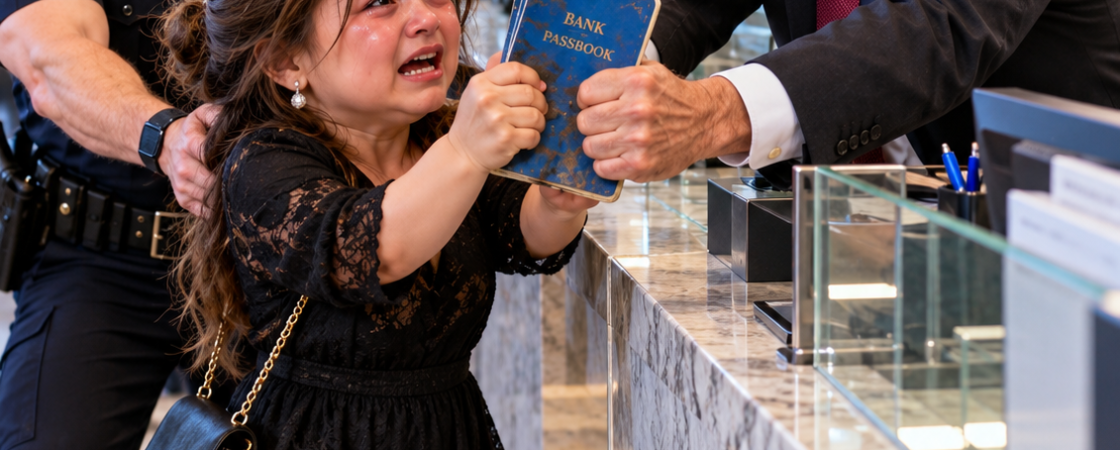
At eight the next morning, I walked into the bank with the blue book inside my purse.
A young teller took it from me.
She typed the account number.
Then stopped.
Her expression changed.
“Where did you get this?”
“It belonged to my grandmother.”
She looked at my identification.
Then back at the computer.
“Please wait here.”
She disappeared through a security door.
Three minutes later, a gray-haired bank manager came rushing toward me.
He didn’t look surprised.
He looked terrified.
He closed the blinds around the service counter.
Then he quietly said:
“Mrs. Henderson…”
“Yes?”
“Where exactly did you get this passbook?”
I told him.
He stared at me.
Then he looked toward the security cameras.
“Please don’t leave the building.”
My heart began pounding.
“Why?”
He leaned closer.
“Because your grandmother left instructions that if you ever came here with this book…”
He paused.
“…we were supposed to contact the police.”
PART 2 — What Grandma Had Hidden
Two police officers arrived less than ten minutes later.
I expected them to ask whether I had stolen the passbook.
Instead, one officer sat beside me and opened a thick file.
“Your grandmother created this file six years ago.”
I stared at him.
“She knew this was going to happen?”
“She apparently expected someone to try to access her accounts after her death.”
The bank manager placed several documents on the table.
There were signatures.
Transfer records.
Copies of checks.
And something else.
A photograph.
It showed my father standing inside the bank years earlier.
He was holding a folder.
The date on the photograph was exactly one day before a $180,000 transfer had been made from Grandma’s account.
I felt sick.
“How much money did he take?”
The manager slowly answered.
“Approximately $640,000.”
I couldn’t speak.
My father had spent years telling everyone Grandma was becoming confused.
He had convinced the family that she couldn’t manage her finances.
He had even told me she had given him permission to handle everything.
But Grandma had apparently been documenting every transaction.
Then the manager showed me the red-stamped account.
It wasn’t a normal savings account.
It was a protected trust account.
And my name was on it.
I stared at the document.
“Why is my name here?”
The police officer looked at me.
“Because your grandmother established it when you were born.”
I shook my head.
“I knew nothing about this.”
“She intended you to know after her death.”
The manager opened another folder.
Inside was an original trust agreement.
The document explained that Grandma had placed a large portion of her inheritance into a protected account for me.
My father had never owned the money.
He had never been authorized to withdraw from it.
And every time he accessed it, the bank had recorded the transaction.
But there was something even worse.
My grandmother had also discovered that my father had attempted to change the beneficiary designation.
He had tried to remove my name.
And the bank had refused.
The manager turned another page.
“This is why your grandmother came here repeatedly.”
He pointed toward a handwritten note.
“She wanted to make sure your father couldn’t touch the account.”
Then my phone began ringing.
Dad.
I didn’t answer.
It rang again.
Then again.
Finally, a message appeared.
Where are you?
Another message followed.
We need to talk about Grandma’s things.
Then:
Don’t go to the bank.
I stared at the screen.
The police officer noticed.
“Does he know you’re here?”
“I don’t think so.”
The bank manager looked uncomfortable.
“He may know.”
“How?”
He pointed toward the blue book.
“Because someone accessed the account yesterday.”
My stomach dropped.
“Yesterday?”
“Yes.”
“Who?”
He pulled up the security record.
Then his expression changed.
“Your father.”
The room became completely silent.
“He knew Grandma was dead,” I whispered.
“And he was looking for this.”
The officer stood.
“Then we need to move quickly.”
But before we could leave, the bank manager opened one final envelope.
It had been sealed by my grandmother.
Written across the front were five words:
OPEN ONLY IF RICHARD COMES BACK.
I looked at the police officer.
Then I opened it.
Inside was a letter.
And the first sentence made my hands go cold.
“My son will come for more than money.”
PART 3 — Grandma’s Final Secret
I read the letter slowly.
Grandma explained that my father had been taking money for years.
But she had discovered something much bigger.
He wasn’t only stealing from her.
He had been using her identity.
Credit applications.
Property documents.
Business loans.
Several accounts had been opened using information that belonged to her.
And one of those accounts had my name attached to it.
I looked up.
“What does this mean?”
The police officer took the document carefully.
“It means your father may have been building a financial operation using your grandmother’s identity—and possibly yours.”
I felt dizzy.
All those years, Dad had told me I was irresponsible with money.
He had criticized my credit.
He had insisted that I let him “handle” certain documents.
Suddenly, every strange request made sense.
The police asked whether I had ever signed documents for him without reading them.
I remembered one.
Then another.
Then another.
My grandmother’s letter continued.
“If you are reading this, I am gone, and Richard believes he has finally won.”
I swallowed hard.
Then I read the final paragraph.
“He will come looking for the blue book because he believes it proves nothing.”
A second envelope was attached to the back.
Inside was a small USB drive.
The bank manager recognized it immediately.
“Your grandmother left this here.”
The police connected it to a secure computer.
There were scanned documents.
Bank statements.
Audio recordings.
Copies of emails.
Photographs.
And a complete timeline of my father’s financial activity.
The evidence wasn’t based on one suspicious transaction.
It covered years.
The officers began making copies.
Then the bank manager made an unexpected announcement.
“The protected account is still intact.”
I looked at him.
“How much is there?”
He gave me a number.
I couldn’t process it.
My grandmother had quietly protected a fortune for me.
And my father had spent years trying to reach it.
Then the front doors of the bank opened.
My father walked inside.
My stepmother followed.
He spotted me immediately.
His face changed.
“You.”
He marched toward the counter.
“What are you doing here?”
I said nothing.
His eyes moved toward the police officers.
Then toward the blue passbook.
Finally, he understood.
“You went through Grandma’s things.”
I looked directly at him.
“No.”
I placed the blue book on the counter.
“I went through Grandma’s truth.”
His face went pale.
He turned toward the police.
“This is a family matter.”
One officer stepped forward.
“Sir, please remain where you are.”
Dad stopped.
For the first time in my life, I saw fear in his eyes.
He looked at me.
“You don’t understand what you’re doing.”
I remembered Grandma’s final words.
Don’t believe him.
So I answered calmly.
“I finally do.”
The officers began questioning him about the withdrawals.
My father tried to explain.
Then deny.
Then blame Grandma.
But the documents were already there.
The bank records.
The photographs.
The signatures.
The recordings.
The protected account.
And the letter my grandmother had written before she died.
Before leaving, one officer handed me the blue passbook.
“You should keep this somewhere safe.”
I held it tightly.
It wasn’t valuable because of the money.
It was valuable because Grandma had trusted me with the truth when everyone else had chosen to believe my father.
That evening, I returned home and placed the passbook inside a small wooden box.
Then I found one final note hidden beneath the lining.
It contained only one sentence.
“Chloe, never let someone convince you that you are powerless simply because they taught you to be afraid.”
I sat there for a long time.
Then I finally smiled.
My father had thrown Grandma’s passbook into her grave because he believed it was worthless.
He was wrong.
It had been the one thing Grandma left behind that could finally tell the truth.