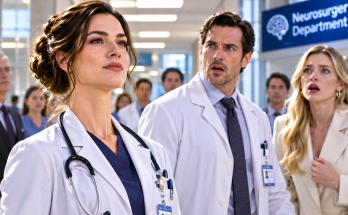
My Husband Divorced Me After I Worked Two Jobs to Put Him Through Medical School—He Called Me a Warehouse Nobody. Fifteen Years Later, I Returned to His Hospital as Chief of Neurosurgery, and He Begged Me to Save His New Wife’s Father
PART 1 — The Christmas He Threw Away the Woman Who Built His Future
“You’re no longer the kind of woman I want beside me, Hannah.”
My husband placed divorce papers on our kitchen table six days before Christmas.
I stared at him, struggling to understand what I was hearing.
Ethan had just graduated from medical school and secured a prestigious hospital position.
For six years, I had worked two jobs to help him reach that moment.
I loaded shipments at a warehouse during the day, made handmade quilts at night, and gave up my nursing education because we couldn’t afford both of our dreams.
Now he was standing in front of me wearing an expensive suit, holding a divorce agreement, and looking embarrassed to be married to me.
“What happened to us?” I whispered.
He sighed.
“We don’t belong in the same world anymore.”
I looked at the papers.
“Because you’re a doctor now?”
He shook his head.
“Because I’ve grown, Hannah. I have opportunities now. I meet important people. I need a wife who understands that world.”
I felt my throat tighten.
“And what am I?”
He looked directly into my eyes.
“You’re a warehouse worker. That’s all you’ve ever wanted to be.”
I couldn’t believe those words were coming from the man whose textbooks I had purchased with overtime money.
The man whose examination fees I had paid.
The man who used to call me every night and promise that one day we would build a beautiful life together.
I had even saved $4,200 to buy him a reliable used car for Christmas.
His old vehicle constantly broke down, and I worried about him driving home after exhausting hospital shifts.
The money was hidden inside an envelope in my bedroom drawer.
I had planned to surprise him after Christmas dinner.
Now I wondered whether I should simply throw it away.
Ethan pushed another document toward me.
“I’m willing to give you $20,000 so we can end this peacefully.”
I stared at him.
“You’re offering me twenty thousand dollars after six years?”
“Don’t make this difficult.”
I picked up the papers.
Then I asked the question that had been hurting me for months.
“Is there someone else?”
He looked away.
That was all the answer I needed.
A few days earlier, I had seen him leaving the hospital with a beautiful woman named Madison Reynolds.
She came from a wealthy family and had connections throughout the medical community.
I had suspected something.
Now I knew.
I called Ethan’s mother that evening.
I thought perhaps she would be shocked.
Instead, she sighed.
“Hannah, my son is entering a different level of society. You can’t expect him to remain attached to his old life forever.”
“His old life paid for his education.”
She became cold.
“Please don’t embarrass him. He has a future to protect.”
I ended the call.
For several hours, I sat on the floor beside my old nursing textbooks.
I remembered the classroom I had left.
The exams I had abandoned.
The dream I had promised myself I would return to someday.
Then I looked at the envelope containing Ethan’s Christmas gift.
I didn’t give him the car.
I kept the money.
The following morning, I contacted a divorce attorney named Rachel Foster.
She reviewed the agreement and warned me not to sign anything before understanding my legal rights.
I followed her advice.
The divorce took several months, but I protected my savings and received an appropriate settlement.
Ethan got the freedom he wanted.
I got something he never expected.
A second chance.
At thirty, I moved to Alaska to work for a nonprofit medical organization serving remote communities.
My job involved coordinating patient transportation, managing medical supplies, and helping clinics operate during difficult weather conditions.
It wasn’t glamorous.
But every day brought me closer to the world I had once dreamed of entering.
During my interview, the program director asked why I wanted to start over so far from home.
I answered honestly.
“I spent six years helping someone else become a doctor. Now I want to find out whether I can still become the person I once hoped to be.”
She smiled.
“Then perhaps you’re exactly where you need to be.”
I accepted the position.
And I began studying again.
PART 2 — THE WOMAN WHO RETURNED
Alaska changed everything.
The medical organization served isolated villages where severe weather could interrupt transportation and delay emergency treatment.
I worked alongside doctors, nurses, pilots, and emergency coordinators.
I watched people save lives with limited equipment and extraordinary determination.
One winter night, a pregnant woman in a remote settlement developed serious complications.
A violent storm had grounded the scheduled flights.
The medical team needed to coordinate an emergency evacuation while maintaining communication with the regional hospital.
I helped organize supplies, contact the medical transport team, and relay information through the emergency radio network.
The woman and her baby were eventually transferred safely.
Both survived.
That experience stayed with me.
I realized that I didn’t just want to work around medicine.
I wanted to practice it.
The program director, Dr. Susan Bennett, noticed how seriously I approached my responsibilities.
One afternoon, she found me studying anatomy during my lunch break.
“Hannah, what are you waiting for?”
I looked up.
“What do you mean?”
“You already know what you want. Stop treating your old dream like something you’re not allowed to have.”
I smiled.
But I was frightened.
I was older than many students.
I had limited money.
And I had already sacrificed six years of education.
Dr. Bennett encouraged me to apply for academic opportunities and helped me understand the steps required to return to school.
I completed my undergraduate studies.
Then I entered medical school.
It was difficult.
There were nights when I wondered whether I had made a terrible mistake.
There were examinations I barely passed and clinical rotations that left me exhausted.
But whenever I felt discouraged, I remembered the woman I had been on that Christmas morning.
The woman who had been told she wasn’t good enough to stand beside a doctor.
I refused to let that become the ending of my story.
Years passed.
I completed my medical training and specialized in neurosurgery.
I became particularly interested in complex brain injuries and emergency treatment for patients from remote communities.
Eventually, I became an attending surgeon.
Then I was promoted to lead a surgical program.
I also met someone who changed how I understood love.
His name was Michael Brooks.
He was an Air National Guard rescue pilot who often supported medical evacuations in difficult weather.
He never treated my career as a competition.
He celebrated my achievements and respected the years I had spent rebuilding my life.
For the first time, I felt loved without having to prove that I deserved it.
Then, fifteen years after my divorce, I received an unexpected invitation.
Northlake University Hospital in Chicago was searching for a new chair of neurosurgery.
They wanted someone with extensive surgical experience, strong leadership skills, and a commitment to improving emergency care.
I applied.
After several interviews, I received the offer.
The hospital was the same institution where Ethan had once begun his career.
I knew he might still be working there.
But I wasn’t returning to confront him.
I was returning because the position represented everything I had worked toward.
On my first morning, the hospital president, Dr. Andrew Collins, welcomed me in the main lobby.
“Dr. Miller, we’re delighted to have you leading our department.”
I had returned to using my maiden name years earlier.
We walked through the main atrium as staff members greeted us.
Then I heard a familiar voice.
“Dad, please sit down. You’re making this worse.”
I turned.
Ethan stood near the emergency department entrance.
His hair was thinner.
His face was older.
But I recognized him immediately.
Madison was standing beside him.
An elderly man sat in a wheelchair between them.
Ethan looked up.
His eyes met mine.
He stopped speaking.
Dr. Collins smiled.
“Dr. Parker, I’d like you to meet our new chair of neurosurgery.”
Ethan stared at me.
The president continued.
“Dr. Hannah Miller.”
Madison looked from him to me.
“Wait. Is that Hannah?”
I nodded politely.
“Hello, Madison.”
Ethan’s mouth opened.
But no words came out.
For fifteen years, he had believed I would never enter his professional world.
Now I was standing in front of him as the leader of the department.
But before anyone could say another word, the elderly man suddenly slumped forward in his wheelchair.
A nurse shouted for help.
Madison screamed.
Ethan rushed toward him.
Then he turned to me with a terrified expression.
“Hannah! Please! That’s Madison’s father!”
The emergency team began moving.
And when the first scan revealed a dangerous brain hemorrhage, Ethan realized that the woman he had once called a failure might be the only person in the hospital who could help his family.
PART 3 — THE DOCTOR HE NEVER BELIEVED SHE COULD BECOME
The emergency department changed instantly.
Nurses moved the patient onto a stretcher.
A respiratory therapist prepared equipment.
The emergency physician called for an urgent neurosurgical assessment.
Ethan followed the team, his face pale.
Madison was crying beside him.
“Please save my father,” she whispered.
I looked toward the patient.
His name was Robert Reynolds.
He was seventy-two years old and had suddenly developed a severe headache, weakness, and loss of consciousness.
The scan showed a large brain hemorrhage requiring immediate specialist attention.
I reviewed the images with the on-call neurosurgical team.
Then I made the necessary decisions.
“Prepare the operating room. I want the senior vascular neurosurgeon here immediately. Call anesthesia and make sure the blood products are available.”
Ethan stood behind me.
“Hannah, can you operate?”
I turned toward him.
“I lead this department, Dr. Parker. My team and I will make sure he receives the appropriate treatment.”
He looked stunned.
Madison grabbed his arm.
“Why are you talking to her like that? You know her!”
He lowered his eyes.
I continued reviewing the patient’s condition.
There was no time for personal history.
Robert was a patient.
Nothing else mattered.
I assembled the surgical team and helped lead the emergency operation.
The procedure was difficult.
The bleeding had placed dangerous pressure on surrounding brain tissue.
For several hours, everyone worked carefully.
Eventually, the team managed to control the bleeding and relieve the pressure.
When the operation ended, I stepped into the recovery area.
Madison immediately approached me.
“Is my father alive?”
I nodded.
“Your father survived the operation. He’s in critical care, and the next twenty-four hours will be very important.”
She covered her mouth and began crying.
Ethan stood behind her.
For a long moment, he simply looked at me.
Then he whispered:
“Thank you.”
I nodded.
“Please speak with the intensive care team. They’ll explain his condition and what happens next.”
I turned to leave.
But Ethan followed me into the corridor.
“Hannah, can we talk?”
I stopped.
“What about?”
He looked uncomfortable.
“I never imagined seeing you here.”
“Neither did I.”
He swallowed.
“You became a surgeon.”
“Yes.”
“And now you’re leading the department.”
“Yes.”
He lowered his head.
“I owe you an apology.”
I waited.
He continued.
“I was young. I was ambitious. I thought becoming a doctor meant I needed to leave my old life behind.”
I looked at him.
“You didn’t just leave your old life, Ethan. You left the person who helped you build it.”
He closed his eyes.
“I know.”
For a moment, neither of us spoke.
Then he asked:
“Do you ever think about what happened between us?”
I answered honestly.
“Sometimes. But I don’t spend my life wondering what would have happened if you had treated me differently.”
He looked up.
“Why not?”
“Because I finally built a life that doesn’t depend on your opinion.”
He nodded slowly.
Then his voice broke.
“I really thought you would never become anything.”
I held his gaze.
“That was your mistake. You thought my job was my worth.”
He began crying.
“I was wrong.”
I didn’t tell him that everything was forgiven.
Some things cannot be repaired simply because someone finally understands the damage.
Instead, I said:
“I hope you learn to treat people better than you treated me.”
Then I returned to my office.
Over the following days, Robert gradually improved.
He began responding to instructions and eventually regained enough strength to communicate with his family.
The recovery was not easy, but his doctors remained cautiously optimistic.
Madison visited me before leaving the hospital.
She looked exhausted.
“Dr. Miller, thank you for saving my father.”
I smiled.
“I’m glad he’s improving.”
She hesitated.
“There’s something I should tell you.”
I waited.
“When Ethan and I started dating, he told me his first marriage had ended because his wife couldn’t handle his success.”
I remained quiet.
Madison looked down.
“I didn’t know the truth. I didn’t know you had supported him through medical school.”
I replied gently.
“You don’t need to apologize for what you weren’t told.”
She nodded.
Then she left.
A few weeks later, Robert was transferred to rehabilitation.
The hospital staff continued monitoring his recovery.
And Ethan?
He eventually requested a meeting with me.
This time, he didn’t come asking for help.
He simply wanted to apologize properly.
I listened.
I accepted that he was sorry.
But I didn’t reopen the door to the past.
I had a life beyond the hospital.
A career I had built through years of hard work.
A partner who respected me.
And a future that no longer required me to prove anything to anyone.
On the evening of my first official departmental celebration, Dr. Collins raised a glass.
“To Dr. Hannah Miller, who reminds us that determination can change a life and that leadership is measured not only by achievements, but by the people we choose to lift along the way.”
Everyone applauded.
I looked around the room and thought about the young woman who had once worked overnight shifts to pay for another person’s education.
She had believed her dream was over.
But she had been wrong.
Ethan once told me we didn’t belong in the same world because he had become a doctor and I was only a warehouse worker.
Fifteen years later, I returned to his hospital wearing a white coat—not to prove that I was better than him, but to show myself that the dream I had abandoned was never truly gone.
And the greatest victory wasn’t becoming the doctor he never believed I could become.
It was discovering that my future had never depended on him in the first place.