PART 1 — THE NIGHT I DISCOVERED WHAT I HAD LOST
At 3:52 A.M., the front doors of my $92 million Manhattan mansion opened, and I stepped inside expecting to find the familiar silence of an empty home.
I was forty-eight years old, the founder and CEO of a construction empire valued at nearly $17 billion. I owned luxury apartments across New York, commercial buildings in Chicago, hotels in California, and properties in places I’d only visited for business meetings.
People called me a genius.
Business magazines called me a self-made billionaire.
My employees stood whenever I entered a room.
But that morning, I discovered something no amount of money could fix.
My wife was gone.
And so were our newborn twins.
I dropped my expensive leather suitcase beside the staircase and looked toward the living room. Everything appeared exactly as I’d left it two weeks earlier. The expensive paintings remained on the walls, the crystal chandelier still illuminated the marble floor, and the flowers on the dining table had been replaced.
But something felt terribly wrong.
There were no lights coming from the kitchen.
No television playing upstairs.
No familiar sound of Julia moving around the house.
I called her name.
“Julia?”
Silence.
I climbed the staircase and walked toward our bedroom.
The door was slightly open.
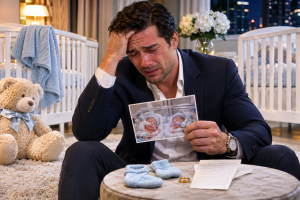
Inside, I noticed something sitting in the middle of the dresser.
My wife’s wedding ring.
Beside it were two tiny blue knitted socks.
And underneath them was a photograph of two premature newborn babies lying inside separate hospital incubators.
Miles and Nora.
My children.
I picked up the photograph.
Their little hands were barely bigger than my thumb. Their faces were covered with tiny medical tubes, and their bodies were wrapped in blankets that looked enormous compared with them.
I stared at the picture.
For fourteen days, I’d been enjoying expensive dinners, private beaches, and hotel suites with Sloane Bennett, my mistress.
Meanwhile, my children had been fighting for their lives.
I turned the photograph over.
Julia had written something on the back.
They arrived early, Daniel. Miles weighed three pounds and four ounces. Nora weighed two pounds and eleven ounces. I told them their daddy would come soon.
My fingers began trembling.
I sat on the edge of the bed and searched for the letter underneath the photograph.
It was folded carefully, with my name written across the envelope.
I opened it.
Daniel,
I don’t know whether you’ll read this tonight, tomorrow, or months from now.
I only know that I cannot keep waiting.
I waited when we were young and had almost nothing.
I waited when you promised that one day we would have a beautiful home and children running through its hallways.
I waited when you worked eighteen-hour days and forgot our anniversaries.
I waited when you missed dinners, birthdays, and holidays.
I even waited when you stopped looking at me the way you used to.
But this time, I was waiting beside two hospital incubators while our babies struggled to breathe.
I called you thirty-one times.
Thirty-one times, Daniel.
I wasn’t asking you to save the company, sign a contract, or attend another business meeting.
I only wanted their father.
I wanted someone to hold my hand while the doctors explained why our daughter needed special treatment.
I wanted someone to tell me that our son would be okay.
Instead, I watched other fathers arrive with flowers, balloons, and tears of happiness.
I watched mothers hold their husbands while their newborn babies slept against their chests.
And I wondered why I was sitting alone.
I have taken Miles and Nora somewhere safe.
Please don’t search for us because you suddenly feel guilty.
Search for us because you finally understand that we were your family before we became your responsibility.
Julia.
I read the letter twice.
Then a third time.
I looked at my phone.
Thirty-one missed calls.
I opened the call history.
Every single one came from Julia.
Some calls lasted only a few seconds before going to voicemail. Others were separated by minutes.
I remembered seeing those notifications.
I remembered ignoring them.
And I remembered the last conversation.
We had been at a private restaurant overlooking the Pacific Ocean. Sloane was wearing a white dress, and our table was decorated with candles.
My phone had vibrated.
Julia’s name appeared.
I answered.
“Daniel,” she whispered. “The doctors are taking me into surgery. The babies are coming.”
I had looked toward Sloane.
“Can’t this wait?”
There was a long silence.
Then Julia said something I’ll remember for the rest of my life.
“Please tell our children that I tried to keep their family together.”
The call ended.
I had put my phone back into my pocket and returned to dinner.
Now, sitting alone in our bedroom, I finally understood what she’d meant.
I grabbed my phone and called her number.
A recorded message informed me that the number was no longer in service.
I called again.
Nothing.
I contacted her sister, Natalie.
No answer.
I called our family doctor.
No answer.
I called the hospital where Julia had delivered.
After several transfers, a neonatal specialist finally agreed to speak with me.
“Mr. Shaw, both babies are doing well,” she explained.
I nearly collapsed with relief.
“Where are they? I want to see them.”
“I’m sorry, but I cannot disclose your wife’s current location without her authorization.”
“I’m their father!”
“I understand that, sir. However, your wife made specific arrangements concerning the children’s care.”
“What arrangements?”
The doctor paused.
“Your daughter, Nora, was born with a congenital heart condition. She required specialized monitoring. Your wife was also experiencing serious complications following delivery.”
I closed my eyes.
“Is Julia okay?”
“She has recovered sufficiently to leave the hospital, but she needs continued medical follow-up.”
“When did she leave?”
“Several weeks ago.”
Several weeks.
I had been gone for fourteen days, but the twins had already been born, treated, and discharged while I was still enjoying my vacation.
I looked down at the photograph again.
“Can you at least tell me whether my wife knows I called?”
The doctor hesitated.
“She knows you called.”
“Then why won’t she speak to me?”
“Mr. Shaw, perhaps you should ask yourself why she stopped expecting you to.”
The call ended.
For the first time in my adult life, I had no answer.
I walked into the nursery.
Two beautiful white cribs stood beside the windows.
Above them hung a little wooden sign that read:
MILES & NORA — OUR GREATEST DREAM.
There were stuffed animals, folded blankets, miniature clothes, and two matching rocking chairs.
On one chair sat a small blue blanket with my name embroidered on it.
I picked it up.
Julia had prepared everything.
She had even placed a framed photograph of the two of us on the shelf.
We were standing on a beach years earlier, laughing beneath the afternoon sun.
I remembered that day.
We had promised each other that no matter how successful I became, I would never forget where we started.
I held the blanket against my chest.
Then I noticed a small white envelope tucked beneath the rocking chair.
Inside was a hospital identification bracelet.
It belonged to Miles.
There was another one beside it.
Nora.
And underneath those bracelets was a handwritten note.
Daniel, if you ever decide to look for us, start with the place where we first dreamed about becoming parents.
I immediately knew where she meant.
Our little apartment in Brooklyn.
The apartment we had rented when we were twenty-seven.
The apartment where Julia had once told me she wanted twins.
I grabbed my car keys.
For the first time in fourteen years, I left my mansion without my driver, assistant, or security team.
I drove through the sleeping streets of Manhattan toward Brooklyn.
But when I arrived, I discovered something that made my heart stop.
Our old apartment building had been sold.
And the apartment where Julia and I had once dreamed about our future was now occupied by another family.
I knocked on the door anyway.
An elderly woman opened it.
“Can I help you?”
“My wife used to live here. Her name is Julia Shaw.”
The woman studied my face.
Then she disappeared into the apartment and returned holding a small cardboard box.
“Your wife left this for you,” she said.
I stared at the box.
“When?”
“About three weeks ago.”
I opened it.
Inside was an old photograph of Julia and me, a hospital document, and a tiny silver key.
There was also another letter.
The first sentence made my knees weak.
Daniel, if you are reading this, you finally came looking for your family.
But the final sentence was even more devastating.
And before you find us, you need to know what happened to the seventeen billion dollars you spent your life building.
PART 2 — THE SECRET MY WIFE HAD KEPT FOR FOURTEEN YEARS
I sat inside my car for nearly twenty minutes before opening the second letter.
The streets outside were quiet.
A delivery truck passed beneath the streetlights, and a couple walked their dog along the sidewalk.
Ordinary people were beginning ordinary mornings.
But my entire world was collapsing.
I unfolded Julia’s letter.
Daniel,
Do you remember the first construction project we worked on together?
It was a small apartment renovation in Brooklyn.
You had no money, no investors, and no employees.
You were convinced that the project would make us successful.
I remember sleeping on the office floor because we couldn’t afford a hotel.
I remember bringing you coffee at midnight.
I remember you telling me that one day we would build something so extraordinary that nobody would ever be able to take it away from us.
You were right.
But you forgot something.
We built it together.
I stopped reading.
That project.
I remembered it clearly.
I had always described it as the beginning of my empire.
But Julia had been involved in almost every decision.
She had negotiated with suppliers, organized the original financial documents, and introduced me to the investor who financed our first major development.
When the company grew, I offered her a position as vice president.
She refused.
“I don’t want to compete with you,” she’d said. “I want to build a family with you.”
I had interpreted her refusal as a preference for a quiet life.
Now I wondered whether I’d ever truly understood her.
I continued reading.
Years ago, before our company became publicly recognized, Julia had discovered that several early contracts had been signed under a separate investment agreement.
She had quietly retained a substantial ownership interest.
Not because she wanted to control me.
Because she wanted to protect the future we had promised each other.
The original documents had been placed inside a private trust.
That trust had grown alongside the company.
According to the documents, Julia held a controlling financial interest in a portion of the original development portfolio, including assets that had become extraordinarily valuable.
I stared at the numbers.
My assistant had spent years telling me I owned nearly everything.
But the legal structure was far more complicated.
Julia had never told me how much of our original empire remained legally connected to her.
And she had never used that power against me.
Until now.
The letter continued.
I never wanted your money, Daniel. I wanted you to remember that before you became a powerful man, you were a husband who promised to come home.
I placed the letter on the passenger seat.
Then I called my chief financial officer, Marcus.
He answered on the fourth ring.
“Sir? Is everything okay?”
“I need you to check something immediately.”
“What is it?”
“Find the original ownership documents for the Brooklyn development portfolio. The trust established during our first five years.”
There was a pause.
“Why?”
“Just find them.”
“Daniel, those documents are confidential. We haven’t reviewed the entire structure in years.”
“Then review them now.”
Marcus became unusually quiet.
Finally, he said, “Sir, I think you should come to the office.”
I drove directly to our headquarters.
At 6:40 A.M., I entered the executive conference room.
Marcus was already waiting with our general counsel, financial director, and two senior attorneys.
A thick folder sat in the middle of the table.
I opened it.
The first page showed the original investment agreement.
The second showed a series of amendments.
The third showed the ownership structure.
Then I reached the document that changed everything.
Julia’s name appeared beside the majority ownership designation of the original holding trust.
I looked at Marcus.
“What am I looking at?”
He adjusted his glasses.
“Your wife retained ownership rights in the original portfolio. Over time, the assets were consolidated into a much larger holding structure.”
“How much?”
He hesitated.
“Depending on the valuation methodology, the trust controls assets worth approximately $8.4 billion.”
I stared at him.
“What?”
“Your wife is the principal beneficiary and controlling party under the original agreement.”
I leaned back.
My wife.
The woman I’d left alone in a hospital.
The woman whose thirty-one calls I’d ignored.
Had been quietly protecting a financial empire worth billions.
But money wasn’t what frightened me.
It was the realization that she’d never needed my permission to leave.
She had her own resources, her own legal team, and the ability to provide a secure future for our children without depending on me.
I had spent years believing that I was the one who had given Julia everything.
In reality, she’d helped build the foundation beneath my entire life.
Marcus placed another document on the table.
“There’s something else.”
“What?”
“Your wife contacted the board last week.”
I looked up.
“For what reason?”
“She requested that all family-related financial guarantees be reviewed. She also instructed the trust administrators to remove your personal authority over several jointly established assets.”
“Can she do that?”
“Under the original agreement, yes.”
I stood.
“Where is she?”
“We don’t know.”
“Find out.”
Our general counsel intervened.
“Daniel, I strongly advise against attempting to use company resources to locate your wife without her consent.”
I glared at him.
“She’s my wife.”
“And she has legal rights independent of yours.”
His words felt like another slap.
I returned to my office.
On my desk was a photograph from our tenth wedding anniversary.
Julia was wearing a simple cream-colored dress.
I was standing behind her, smiling at the camera.
I remembered telling her that I would buy her anything she wanted.
She had laughed.
“All I want is more mornings with you.”
I had promised.
Then I had broken that promise thousands of times.
My phone rang.
Sloane.
I answered.
“Daniel, where are you? I’ve been trying to reach you.”
“I’m at the office.”
“Are we still going to Paris next week?”
I closed my eyes.
“Sloane, we’re finished.”
Silence.
“What?”
“I can’t do this anymore.”
“Are you serious?”
“Yes.”
She laughed nervously.
“Is this because your wife found out?”
“My wife has nothing to do with your relationship with me.”
“Then why are you suddenly ending everything?”
“Because I finally understand what I’ve done.”
Sloane became angry.
“You told me your marriage was over!”
I said nothing.
“You told me you were only staying because of the business and the children you planned to have someday!”
I looked at the photograph on my desk.
“We already had children.”
She fell silent.
Then she said, “I didn’t know.”
“Neither did I. That’s the problem.”
I ended the call.
That afternoon, I hired a private investigator, not to follow Julia or invade her privacy, but to locate the hospital and family records necessary to understand where I stood legally as the children’s father.
I also contacted a family attorney.
I wanted to see my children.
But my attorney explained that I needed to approach the situation carefully.
Julia had been granted temporary authority over the twins’ residential arrangements, and any attempt to force contact could make everything worse.
For the first time, I had to accept that being their father did not mean I could simply demand access.
Two days later, Natalie finally called.
Her voice was cold.
“Why are you calling me?”
“I need to know where Julia and the babies are.”
“You had fourteen days to ask that question.”
“I know.”
“No, Daniel. You don’t know.”
I closed my eyes.
“Please. I need to see my children.”
“Do you remember when Julia was admitted to the hospital?”
“Yes.”
“Do you remember what happened that night?”
I couldn’t speak.
“Nora stopped breathing for several seconds,” Natalie said.
My stomach tightened.
“The nurses worked on her. Julia was still recovering from surgery, but she stood beside that incubator and begged the doctors to save her daughter.”
I covered my mouth.
“Miles developed an infection. The doctors weren’t sure how quickly he’d recover.”
I felt tears forming.
“Where were you?” Natalie asked.
I couldn’t answer.
“You were drinking champagne with another woman.”
“I know.”
“Julia asked me to call you one more time. She wanted the babies to hear your voice.”
I lowered my head.
“I know.”
“No, you don’t. Because I made that call. I told you your daughter might not survive the night.”
I remembered that call.
I had seen Natalie’s name flash across the screen.
I had declined it.
Natalie continued.
“You sent me a message saying you were in an important meeting.”
I pressed my hand against my forehead.
“I was wrong.”
“Your wife nearly died, Daniel. And when she woke up, she asked whether you’d called.”
My throat tightened.
“What did you tell her?”
“I told her you were busy.”
There was a long silence.
Then Natalie said something that broke me.
“She smiled and said, ‘That’s okay. At least the babies have each other.’”
I began crying.
Not the kind of tears I could hide during a board meeting.
I cried like a man who had finally realized that his greatest failure wasn’t losing money or a business.
It was abandoning the people who loved him most.
Natalie eventually agreed to deliver a package to Julia.
It contained no expensive gifts, no jewelry, and no money.
I placed only three things inside.
The photograph from our old apartment.
The two hospital identification bracelets.
And a handwritten letter.
I wrote for hours.
I apologized for every missed anniversary, every forgotten promise, every evening Julia had eaten dinner alone.
I told her I didn’t expect forgiveness.
I told her I wanted to become a father, even if she never wanted to be my wife again.
And I promised that I would respect whatever decision she made.
Three days later, Natalie called again.
“Julia read your letter.”
My heart began racing.
“What did she say?”
“She cried.”
I closed my eyes.
“Does she want to see me?”
Natalie paused.
“She’s agreed to one meeting.”
“When?”
“Tomorrow. But there are conditions.”
“Anything.”
“You come alone. No driver, no security team, no lawyers, no expensive gifts.”
“Agreed.”
“And Daniel?”
“Yes?”
“Don’t arrive expecting the woman you left behind.”
The call ended.
I spent the entire night awake.
For the first time in years, I was afraid of entering a room.
Because tomorrow, I would finally meet the woman whose love I had taken for granted.
And I had no idea whether she would still recognize the man I had become.
PART 3 — THE TWO LITTLE HANDS THAT BROUGHT A BILLIONAIRE TO HIS KNEES
The following morning, I drove to a small residential house in Connecticut.
It wasn’t a mansion.
There were no marble floors, no expensive paintings, and no enormous security gates.
It was a modest white house with a small garden and a wooden porch.
A pair of miniature shoes sat beside the front door.
I parked my car across the street and remained inside for several minutes.
Then I noticed something through the front window.
A woman was sitting on the living-room floor.
She was holding a baby.
Another tiny baby was sleeping in a white bassinet beside her.
Julia.
I hadn’t seen her in twenty-one days.
She looked thinner.
Her hair was shorter, and there were faint shadows beneath her eyes.
But she was smiling.
She was smiling at our children.
I stepped out of the car.
My legs felt unusually weak.
I walked toward the front door and knocked.
Natalie opened it.
“She’s inside.”
I nodded.
Then I entered.
Julia looked up.
For several seconds, neither of us spoke.
I had imagined this moment countless times.
I thought I would apologize immediately.
I thought I would fall to my knees.
I thought I would hold her hands and promise to make everything right.
But when I finally saw her sitting there with our children, every rehearsed sentence disappeared.
“Hello, Daniel,” she said.
Her voice was calm.
Not angry.
Not emotional.
Just calm.
And somehow that hurt more than shouting would have.
“Hello, Julia.”
I looked at the babies.
Miles was sleeping against her chest.
Nora was lying in the bassinet, wearing a pale blue knitted outfit.
They were so small.
I had imagined holding them hundreds of times during the pregnancy.
I had imagined teaching Miles to ride a bicycle.
I had imagined walking Nora into her first school.
I had imagined birthdays, Christmas mornings, and family vacations.
But I had missed their first cries.
Their first nights.
Their first moments of opening their eyes.
I had missed everything.
“Can I come closer?” I asked.
Julia looked at me.
Then she nodded.
I approached the bassinet.
Nora opened her eyes.
She had dark hair like mine.
Her tiny fingers moved beneath the blanket.
I reached toward her, but stopped before touching her.
“She’s beautiful,” I whispered.
“They both are.”
Julia gently adjusted Miles.
“He’s stronger now. His lungs are improving.”
I nodded.
“And Nora?”
“She has regular appointments with her cardiologist. She’s stable, but we’ll need to monitor her condition.”
I swallowed.
“I want to help.”
Julia looked at me.
“Then start by learning what their doctors have told us.”
I nodded again.
She handed me a folder.
Inside were medical appointments, medication instructions, feeding schedules, and pages of notes.
Every detail had been written in Julia’s handwriting.
She had documented everything.
The times the babies ate.
How much milk they drank.
When they slept.
Their weights.
Their temperatures.
Their reactions to medication.
The names of every nurse and specialist.
I turned the pages slowly.
“How did you manage all this?”
“With help from Natalie and the nurses.”
“You were recovering from surgery.”
“Yes.”
“You must have been exhausted.”
“I was.”
I looked at her.
“I’m sorry.”
Julia said nothing.
“I am so sorry, Julia.”
She looked toward the window.
“You know what I remember most about the hospital?”
I shook my head.
“I remember a nurse asking me whether my husband was coming.”
She paused.
“I told her yes.”
I lowered my eyes.
“Then she asked when.”
Julia smiled sadly.
“I told her you were probably stuck in traffic.”
My chest tightened.
“I kept making excuses for you, Daniel. Even when I knew exactly where you were.”
I sat down opposite her.
“I don’t expect you to forgive me.”
“Good.”
“I don’t expect you to come home.”
“Good.”
“I just want to be their father.”
Julia looked directly into my eyes.
“Then be their father. Don’t make promises. Don’t give me another speech about how things will change. Show up.”
I nodded.
For the first time, I understood that an apology was not a transaction.
I couldn’t exchange expensive gifts for forgiveness.
I couldn’t transfer billions of dollars and expect my family to return.
I had to earn every moment.
Then Miles began crying.
Julia gently rocked him, but he continued fussing.
“Would you like to try holding him?” she asked.
I stared at her.
“Are you sure?”
“Support his head. He’s still very small.”
She carefully placed him in my arms.
My hands began trembling.
He weighed almost nothing.
His tiny face turned toward my chest.
I looked down at him.
“Hello, little man,” I whispered.
His fingers closed around my index finger.
I stopped breathing for a moment.
That tiny hand held me more tightly than any business contract ever could.
Then I began crying.
I cried so hard that Julia reached for a tissue.
I looked at my son and whispered:
“Daddy’s here.”
But even as I said it, I knew those words were not enough.
Because I’d already taught him something terrible before he could even understand language.
That his father might not come when he was needed.
I gently returned Miles to Julia.
Then I looked at Nora.
“Can I hold her too?”
Julia nodded.
I lifted my daughter carefully.
She was even smaller than her brother.
Her eyes opened, and she looked directly at me.
I kissed her forehead.
“I’m sorry, sweetheart.”
A tear landed on her blanket.
Julia watched me quietly.
Then she said something I wasn’t prepared to hear.
“Daniel, there’s another reason I asked you to come.”
I looked up.
“What is it?”
She reached toward a small wooden cabinet and removed a thick envelope.
Inside were legal documents.
“I’ve been advised to restructure the family trust.”
I glanced through the papers.
The financial arrangements were complicated, but one thing was clear.
Julia was separating the children’s future from my personal business interests.
Their education, medical expenses, and long-term care would be protected independently.
“You’re transferring the assets?” I asked.
“I’m protecting the children.”
I nodded.
“You should.”
She looked surprised.
“You’re not going to argue?”
“No.”
“Even though the trust controls billions?”
I looked at our daughter.
“Julia, I spent my entire life trying to become a man who could give his family everything.”
I paused.
“And then I abandoned them when they needed something I couldn’t buy.”
Julia lowered her eyes.
I continued.
“I don’t want their future to depend on whether I remain successful. I want them to have security whether I’m worth seventeen billion dollars or seventeen dollars.”
For the first time that morning, her expression softened slightly.
Then she told me something I would never forget.
“When the doctors said Nora might need another procedure, I was terrified.”
She took a breath.
“I thought about calling you again.”
I looked at her.
“But I stopped myself. I didn’t want to spend another night staring at my phone, hoping you’d remember that we existed.”
I couldn’t speak.
“I realized something in that hospital. Miles and Nora deserved to grow up in a home where love didn’t have to be begged for.”
She wiped her eyes.
“And I deserved that too.”
I nodded.
“You did.”
She looked toward the children.
“I haven’t decided whether our marriage can survive this.”
I felt my heart sink.
“But I have decided that the children deserve a father who doesn’t disappear.”
I nodded.
“Then I’ll be here.”
“Tomorrow?”
“Yes.”
“Next week?”
“Yes.”
“Even when work becomes difficult?”
I looked at her.
“I’ll rearrange my work.”
She shook her head.
“No, Daniel. I don’t want you to rearrange your work for two weeks and then disappear again. I want you to understand that being their father is part of your life, not an appointment you squeeze into your schedule.”
I lowered my head.
“You’re right.”
That afternoon, I left the house with no promise of reconciliation.
Julia didn’t kiss me goodbye.
She didn’t tell me she loved me.
She simply said that I could return the following morning if I respected the children’s routine.
I returned the following morning.
And the morning after that.
I learned how to prepare bottles.
I learned how to change diapers.
I learned the difference between Miles’s hungry cry and Nora’s tired cry.
I attended every medical appointment.
I sat in waiting rooms for hours.
I listened when doctors explained the smallest changes in their condition.
Sometimes I made mistakes.
Sometimes the babies cried whenever I held them.
Sometimes I felt so exhausted that I could barely keep my eyes open.
But I kept coming back.
I also made changes at the company.
I appointed a new chief operating officer and reduced my travel schedule.
I stopped attending unnecessary meetings.
I began leaving the office before dinner.
My employees were shocked.
My board members complained.
Some investors questioned my commitment.
But for the first time, their opinions no longer controlled my decisions.
Three months passed.
Miles gained weight.
Nora’s condition remained stable under careful medical supervision.
Julia gradually regained her strength.
And slowly, our conversations became less painful.
We began discussing ordinary things.
The weather.
The children’s sleeping habits.
Which toys they liked.
Whether we should buy a larger stroller.
One afternoon, I arrived at the house carrying a small wooden box.
Julia looked at it.
“What is that?”
I placed it on the table.
Inside were two tiny silver bracelets.
One had Miles’s name engraved on it.
The other had Nora’s.
Beneath them was a small photograph of our family.
It was the first picture we had taken together since the twins were born.
Julia picked it up.
For a moment, she smiled.
Then I handed her another envelope.
She looked at me suspiciously.
“What now?”
“Something I should have given you years ago.”
Inside was a document.
It was a letter from the board confirming the restoration of her full original ownership rights and an additional agreement protecting the children’s inheritance.
She read it carefully.
“You didn’t have to do this.”
“I know.”
“Why?”
“Because I finally understand that what belongs to you should never have depended on my permission.”
She looked at me for a long time.
Then she asked:
“Are you doing this because you want me back?”
I shook my head.
“I’m doing it because it’s right. Whether you ever come back or not.”
Julia folded the document.
Then she said something I hadn’t expected.
“I don’t hate you, Daniel.”
I looked at her.
“But I don’t trust you yet.”
I nodded.
“I understand.”
“Trust takes time.”
“I have time.”
She glanced toward the nursery, where Miles and Nora were sleeping.
“Then don’t waste it.”
That evening, I sat on the floor between their two cribs.
The house was quiet except for the gentle sounds of two newborn babies breathing.
I looked at my son.
Then my daughter.
I remembered the thirty-one calls.
I remembered the letter.
I remembered the fourteen days I had spent believing that money, luxury, and another woman’s attention were more important than my own family.
I had once believed that my greatest achievement was building a company worth $17 billion.
But that night, as I watched two tiny children sleeping peacefully, I finally understood something.
A company could be rebuilt.
A fortune could be recovered.
A mansion could be sold and replaced.
But a childhood could never be returned.
And the first fourteen days of my children’s lives would forever belong to someone else.
Six months later, on a quiet Sunday morning, Julia invited me to breakfast.
It was the first time she had done so since I returned.
I arrived early.
I brought no flowers, no expensive jewelry, and no gifts.
I simply brought fresh bread and the coffee she used to love when we were young.
She opened the door.
“You’re early,” she said.
“I didn’t want to be late.”
She looked at me.
Then she smiled faintly.
“Come inside.”
Miles was sleeping in his little chair.
Nora was awake, holding a soft toy.
I sat beside them.
Julia placed two cups of coffee on the table.
For several minutes, we talked about ordinary things.
Then she reached across the table and placed something in front of me.
My wedding ring.
I stared at it.
She touched the ring gently.
“I found this in the hospital bag,” she said. “I thought I’d lost it.”
I picked it up.
“Do you want me to wear it?”
Julia looked at me.
“I want you to understand what it means before you put it back on.”
I nodded.
She continued.
“Marriage isn’t a photograph, Daniel. It isn’t a house, a bank account, or a name on a legal document.”
She glanced toward the twins.
“It’s showing up. Especially when showing up is difficult.”
I held the ring in my palm.
“I understand.”
She didn’t answer immediately.
Then she reached for my hand.
It wasn’t a promise that everything would return to the way it had been.
It wasn’t forgiveness for everything I’d done.
It was simply the first small step toward something neither of us knew how to rebuild.
And I was willing to spend the rest of my life trying.
That night, I returned to my Manhattan mansion.
The same mansion I’d once believed represented the greatest achievement of my life.
But something had changed.
The nursery was no longer empty.
There were two little blankets hanging over the cribs, a collection of toys scattered across the carpet, and a photograph of Julia holding our twins above the fireplace.
I stood in the doorway for a long time.
Then my phone vibrated.
A message from Julia appeared.
The babies are asleep. Miles smiled today when you spoke to him. Nora held your finger for almost a minute.
I read it several times.
Then I typed:
Thank you for letting me be there.
Her reply came a few minutes later.
Don’t thank me for being their father. Just keep showing up.
I placed my phone on the table.
Then I walked into the nursery, pulled a chair between the two cribs, and sat down.
For the first time in my life, I wasn’t thinking about the next billion-dollar project.
I wasn’t thinking about my competitors.
I wasn’t thinking about my reputation.
I was listening to my children breathe.
And I finally understood the difference between having everything and having something worth coming home to.
I had spent fourteen days chasing a woman who meant nothing to my future, while the woman who had built my past was fighting to protect the future of our children.
I once thought being a successful man meant making the whole world wait for me.
Now I knew the greatest privilege in my life was that two tiny children might someday wake up, look toward the door, and find their father standing there.
And this time, I promised myself, I would never make them wait thirty-one calls.
THE END.