PART 1 — THE GIRL UNDER THE BELL
I remember the sound of the church bell more clearly than I remember my father’s voice.
It rang at exactly noon.
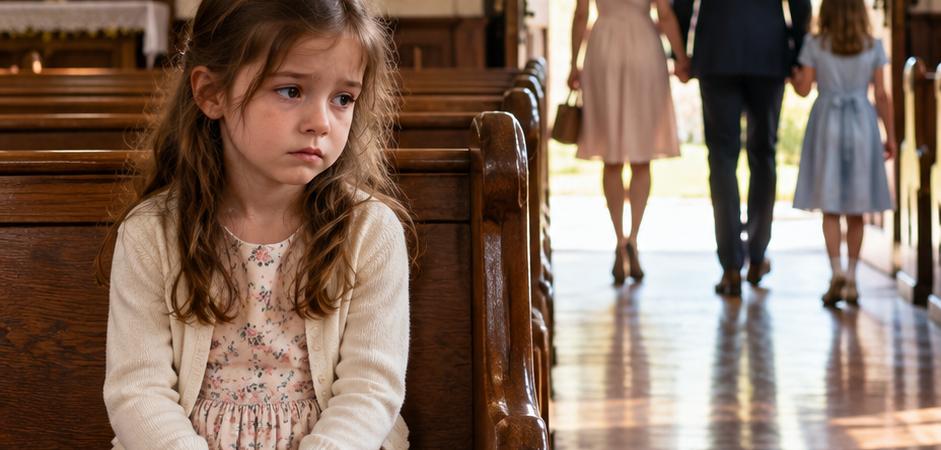
I was five years old, wearing a red sweater, white stockings, and the little black shoes my mother had polished that morning.
My father had taken my hand as we walked through the heavy wooden doors of Saint Gabriel’s Church.
“Stay right here, Lily,” he told me.
He led me toward the back of the church, beneath a massive bronze bell that hung above the old stone entrance.
My mother stood several steps behind him.
She looked frightened.
I remember that.
At the time, I thought she was simply tired.
My father knelt in front of me and fixed the ribbon in my hair.
“You’re a brave girl, aren’t you?”
I nodded.
“Good.”
He kissed my forehead.
Then he stood.
My mother rushed toward me and hugged me so tightly that I could barely breathe.
“Mommy?” I whispered.
She pulled away.
Her eyes were wet.
“Listen to your father, Lily.”
Then she kissed my cheek.
I watched them walk toward the doors.
I thought they were going to get something from the car.
I waited.
Five minutes.
Ten.
Twenty.
The church became quieter.
Finally, an elderly priest found me sitting alone on the steps beneath the bell.
“Where is your family, sweetheart?”
I pointed toward the doors.
“They went outside.”
The priest looked through the glass.
There was no one there.
My parents were gone.
They had left me.
I spent the next several months moving between strangers.
Social workers.
Temporary homes.
People who asked me questions I didn’t understand.
“What are your parents’ names?”
“Where did they live?”
“Do you remember anything about where they went?”
I remembered everything.
But nobody believed a five-year-old could remember enough to help them.
Eventually, I was taken in by a woman named Clara Bennett.
She was a quiet woman in her sixties who lived above a small flower shop.
Her apartment smelled like roses, old books, and cinnamon.
The first night, she placed a bowl of soup in front of me.
“You don’t have to call me Mom,” she said.
I stared at her.
“What should I call you?”
“Clara.”
That was all.
She never pretended to replace my parents.
She simply stayed.
When I had nightmares, she sat beside my bed.
When I got sick, she slept in the chair beside me.
When I asked why my parents left, she never invented an answer.
One night, when I was twelve, I finally asked her the question that had lived inside me for years.
“Was I bad?”
Clara stopped folding laundry.
“What?”
“Maybe that’s why they left.”
She walked over and knelt beside me.
“Lily, listen carefully.”
Her voice trembled.
“Children don’t make adults abandon them.”
I looked down.
“Then why did they?”
Clara didn’t answer.
Instead, she hugged me.
Years passed.
I grew up.
I graduated from college.
I became a teacher.
I built a small life that didn’t depend on people who had already chosen to leave me.
I rarely thought about my parents anymore.
Until my twenty-first birthday.
That morning, I arrived at Saint Gabriel’s Church to deliver donated books to the children’s program.
The church looked exactly the same.
Same wooden pews.
Same stained glass.
Same massive bell above the entrance.
And then I saw her.
A woman in a long black coat stood near the altar.
She was older.
Her hair was almost completely gray.
But her eyes—
I knew those eyes.
She looked directly at me.
“Lily?”
I froze.
She walked toward me.
Then she pulled something from her coat.
A small silver key.
She placed it in my palm.
“My name is Margaret,” she whispered.
My heart stopped.
“My mother’s name was Margaret.”
The woman began to cry.
“I know.”
PART 2 — THE KEY
I couldn’t breathe.
For sixteen years, I had imagined meeting my mother.
Sometimes I imagined screaming at her.
Sometimes I imagined forgiving her.
Sometimes I imagined walking away without saying a word.
But I had never imagined her standing in front of me with tears running down her face.
“Why?” I asked.
She reached for my hand.
I pulled away.
“Don’t touch me.”
She lowered her head.
“You have every right to hate me.”
“I don’t hate you.”
I swallowed hard.
“I just don’t know you.”
That sentence seemed to break her.
She sat down on the nearest pew.
“I left you because your father told me we had no choice.”
I laughed bitterly.
“You left your five-year-old daughter because he told you to?”
“It wasn’t that simple.”
“It was exactly that simple for me.”
She stared at the floor.
“Your father was being threatened.”
I said nothing.
“He had discovered something about his employer. Something dangerous. He was supposed to testify.”
My stomach tightened.
“What did that have to do with me?”
Margaret looked at the silver key in my hand.
“Everything.”
She explained that my father had worked as an accountant for a powerful construction company.
He had discovered that millions of dollars were being moved through fake charities and hidden accounts.
When he threatened to expose it, someone threatened our family.
At first, my parents tried to protect me by sending me to relatives.
But someone found me.
That was when my father became desperate.
“He believed the only way to keep you alive was to make everyone think you had been abandoned,” my mother said.
I stared at her.
“So you left me in a church?”
She closed her eyes.
“We thought you would be safer there.”
“Safer?”
My voice cracked.
“I spent years wondering what was wrong with me.”
“I know.”
“No, you don’t.”
She looked at me.
“You don’t know what it’s like to wait for your mother every birthday.”
Her face collapsed.
“I waited too.”
“Then why didn’t you come back?”
She hesitated.
That hesitation frightened me more than anything she had said.
“Because your father disappeared.”
I stopped breathing.
“What?”
“He was supposed to meet me two days after we left you.”
“But he never came.”
“Never.”
Margaret told me she had spent years searching for him.
Eventually, she had been forced to disappear herself.
She changed her name.
Moved from city to city.
Never contacted me because she believed the people threatening my father were still watching.
“Then why come back now?”
She looked at the church doors.
“Because I finally found something your father left behind.”
She pointed toward the silver key.
I stared at it.
“What does it open?”
“A box.”
“Where?”
“Your father hid it here.”
I looked around the church.
She whispered:
“Under the bell.”
My heart began pounding.
We walked together toward the back entrance.
The massive bell hung above us.
Margaret pointed toward the stone wall.
“There.”
There was a small metal panel I had never noticed.
I inserted the key.
Click.
The panel opened.
Inside was a narrow wooden box.
My hands shook as I pulled it out.
There were documents inside.
Bank records.
Photographs.
Letters.
And one envelope with my name written across the front.
LILY.
My mother stepped back.
“That letter was written by your father.”
I opened it.
The first sentence destroyed everything I thought I knew.
My little girl, if you’re reading this, then I failed to come back for you.
I covered my mouth.
The letter continued.
My father explained that he had discovered something even worse than financial crimes.
Someone inside the company had been using children’s charities to move stolen money.
And one of those charities—
was connected to Saint Gabriel’s Church.
I looked up.
My mother was crying.
“Who was involved?” I whispered.
She shook her head.
“Keep reading.”
I turned the page.
A name was circled in red ink.
My blood went cold.
It was the name of the priest who had found me beneath the bell sixteen years earlier.
Father Thomas.
The same man who had helped arrange my adoption.
The same man who had visited Clara every Christmas.
The same man I had trusted my entire childhood.
But there was one more sentence beneath his name.
I read it twice.
Then a third time.
He knows where your mother is.
I looked at Margaret.
She was gone.
PART 3 — THE TRUTH BENEATH THE BELL
I ran through the church.
“Mom!”
No answer.
The doors were open.
Rain poured across the steps.
She had disappeared.
For the first time in sixteen years, I felt the same terror I had felt as a five-year-old.
Someone was leaving me again.
But this time, I wasn’t a child.
I called Clara.
She answered immediately.
“Lily?”
“Clara, I found a letter from Dad.”
Silence.
Then she whispered:
“Where?”
“Saint Gabriel’s.”
Another silence.
“Lily, leave the church.”
My stomach dropped.
“Why?”
“Just go home.”
“Clara…”
“Please.”
Her voice broke.
“Don’t trust anyone.”
The call ended.
I stood completely still.
For years, Clara had been the one person I trusted without question.
Now I wasn’t sure what to believe.
I returned to the hidden box.
There was one final envelope beneath the documents.
It wasn’t addressed to me.
It was addressed to Clara.
My hands began shaking.
I opened it.
Inside was a photograph.
My father.
My mother.
Clara.
And Father Thomas.
All standing together outside the church.
The photograph had been taken one week before I was abandoned.
I stared at Clara’s face.
She had known my parents.
She had known the truth.
I rushed home.
Clara was sitting in her usual chair.
She didn’t look surprised when I walked through the door.
“You found it,” she whispered.
I placed the photograph on the table.
“You knew.”
She closed her eyes.
“Yes.”
My heart shattered.
“How long?”
“Since before you came to live with me.”
“Why didn’t you tell me?”
“Because your father made me promise.”
“Was he alive?”
Clara looked away.
That was answer enough.
My father had survived.
He had been hiding.
For sixteen years.
I couldn’t understand.
“Where is he?”
Clara finally looked at me.
“Dead.”
I froze.
“When?”
“Three years ago.”
She reached into a drawer and pulled out another letter.
“He died believing you were safe.”
I took the letter.
My father had written it shortly before his death.
He explained everything.
The people who had threatened him eventually disappeared.
The investigation had ended.
But he was too afraid to return because he believed anyone connected to him could still become a target.
He had watched me from a distance.
My graduation.
My first teaching job.
My twenty-first birthday.
He had been there.
He had wanted to approach me.
But he never did.
At the bottom of the letter was a sentence I will never forget:
“I didn’t leave because I stopped loving you. I left because I loved you badly.”
I cried until I couldn’t breathe.
But there was still one question.
“Where is Mom?”
Clara looked toward the window.
“She went to meet Father Thomas.”
My blood ran cold.
We drove back to Saint Gabriel’s.
The church was empty.
Except for the bell.
And beneath it stood Margaret.
Father Thomas was facing her.
“You shouldn’t have come back,” he said.
Margaret turned.
“I came back for my daughter.”
I stepped from the shadows.
“No.”
Both of them turned.
“I came back for the truth.”
Father Thomas looked at me for a long moment.
Then he sighed.
“I always wondered when you would find out.”
That sentence told me everything.
He admitted that my father had discovered the money scheme.
He admitted that the church had unknowingly been used to transfer funds through charitable accounts.
But he denied knowing who had ordered the threats.
Then Margaret spoke.
“I know.”
She pulled another document from her coat.
“The man who ordered everything was your father’s business partner.”
Father Thomas stared at her.
“He confessed before he died.”
For years, everyone had believed my father had abandoned me.
But the truth was more complicated.
He had sacrificed his relationship with me because he believed distance could protect me.
My mother had stayed away because she was afraid.
Clara had raised me because she had promised my father she would keep me safe.
And Father Thomas had carried the secret because he believed exposing it would put more lives at risk.
None of them had made the right choices.
But none of them had stopped loving me.
That night, I stood beneath the same bell where my childhood had ended.
My mother approached slowly.
“I can’t ask you to forgive me.”
I looked at her.
“You shouldn’t.”
She nodded through her tears.
“I just want the chance to know you.”
I looked at the church doors.
Sixteen years earlier, I had watched my parents walk through them.
This time, I wasn’t the abandoned little girl sitting on a wooden step.
I was an adult woman who finally knew the truth.
I took my mother’s hand.
Not because everything was forgiven.
Not because the past had disappeared.
But because I finally understood something Clara had tried to teach me years ago:
Sometimes the truth doesn’t erase the pain.
It simply gives you the freedom to stop blaming yourself for it.
The church bell rang above us.
And for the first time in my life—
I didn’t hear it as the sound of someone leaving.
I heard it as the sound of someone finally coming home.