Part 1 — The Janitor
Nobody paid much attention to Samuel.
He had worked as a janitor in the company’s headquarters for nearly six years.
Every morning, he quietly cleaned the executive floor.
He rarely spoke.
He never complained.
And most executives barely noticed him.
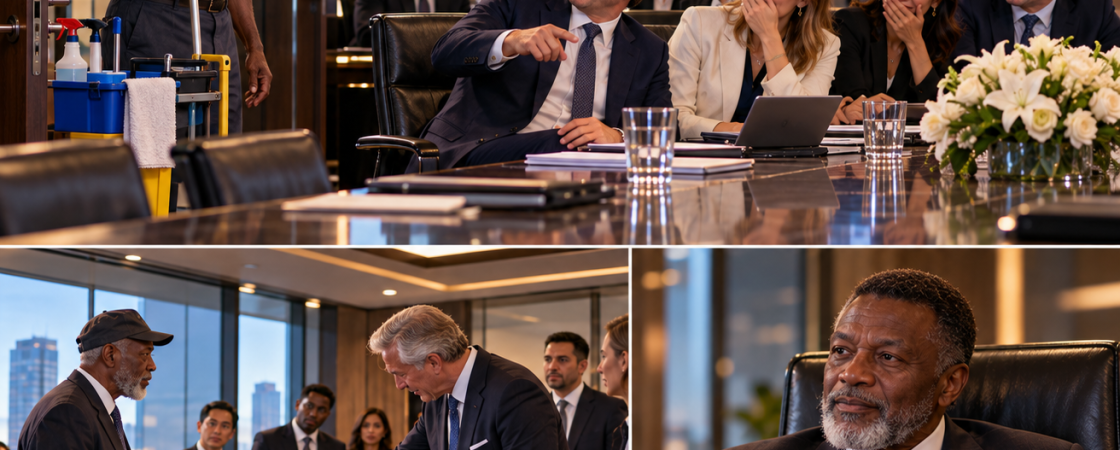
One Tuesday morning, Samuel pushed his cleaning cart into the boardroom while a major meeting was taking place.
The CEO, Richard, looked at him.
“Not now.”
Samuel nodded.
“Sorry, sir. I just need to empty the bins.”
One of the executives laughed.
“Can’t you do that later?”
Another joked,
“Maybe the boardroom is too fancy for him.”
A few people laughed.
Samuel simply lowered his head and continued working.
Then he noticed a folder sitting beside the CEO.
A document was sticking out.
Samuel stopped.
“Excuse me.”
Everyone looked at him.
“The date on that document is wrong.”
The CEO frowned.
“What?”
Samuel pointed toward the folder.
“That acquisition agreement expired last month.”
The room went silent.
Richard picked up the document.
“How would you know that?”
Samuel didn’t answer.
The CFO looked at the paperwork.
He checked the date.
Samuel was right.
The agreement had expired.
The company was about to approve a multimillion-dollar transaction using an invalid document.
Richard stared at Samuel.
“Where did you learn about corporate agreements?”
Samuel smiled faintly.
“Long time ago.”
Then he pushed his cart toward the door.
One executive laughed.
“Nice guess.”
Samuel stopped.
He turned around.
“It wasn’t a guess.”
And he walked out.
Nobody thought much about it.
Until three hours later, the CEO received a phone call.
His expression changed.
He immediately stood up.
“Cancel the meeting.”
Everyone looked confused.
Then the CEO walked toward the boardroom door.
Samuel was standing outside with his cleaning cart.
Richard looked at him.
Then he said:
“Mr. Chairman.”
Part 2 — The Man Behind the Uniform
Everyone in the hallway froze.
The CFO stared at Samuel.
“Chairman?”
Samuel nodded.
Richard turned toward the executives.
“Everyone, please leave the room.”
Nobody moved.
“Now.”
The executives slowly walked out.
Only Samuel and Richard remained.
Richard closed the door.
“I didn’t know you were coming today.”
Samuel smiled.
“I’ve been here every day.”
“But…”
Richard looked at the janitor’s uniform.
“I don’t understand.”
Samuel removed his work badge.
Underneath it was another identification card.
Samuel Okoro — Chairman of the Board.
Richard stared at it.
Samuel sat down.
“I’ve spent the last six months working here without revealing my identity.”
“Why?”
“I wanted to see the company from the ground up.”
Samuel explained that several employees had complained about management treating lower-level workers poorly.
He wanted to understand the culture without executives changing their behavior because they knew the chairman was watching.
He had seen employees being ignored.
He had watched managers take credit for workers’ ideas.
He had seen executives speak disrespectfully to cleaners, security guards, assistants, and interns.
And he had watched millions of dollars being approved without proper review.
Richard looked embarrassed.
“So you were testing us?”
“No.”
Samuel shook his head.
“I was observing.”
Then he placed a folder on the table.
“I’ve been documenting what I’ve seen.”
Inside were reports.
Employee complaints.
Financial concerns.
Management evaluations.
And photographs of several workplace incidents.
Richard swallowed.
“What happens now?”
Samuel looked at him.
“That depends.”
“On what?”
“Whether you’re willing to change.”
Richard sat down.
Then Samuel opened another document.
It was the acquisition agreement from that morning.
“This transaction almost went through using an expired contract.”
Richard nodded.
“Because nobody checked the date.”
Samuel looked at him.
“Except the janitor.”
Richard lowered his eyes.
“I understand.”
Samuel stood.
“Good.”
Then he walked toward the boardroom.
But before entering, he turned around.
“One more thing.”
Richard looked up.
“What?”
Samuel smiled.
“Tomorrow, I want every employee in this building at the town hall.”
Part 3 — “Mr. Chairman”
The next morning, everyone gathered in the company’s main auditorium.
Employees filled every seat.
Some were confused.
Others were nervous.
Samuel walked onto the stage.
He was no longer wearing his janitor’s uniform.
He wore a dark tailored suit.
A large screen behind him displayed his name:
SAMUEL OKORO — CHAIRMAN
The room erupted in whispers.
The employees who had laughed at him looked shocked.
Samuel smiled.
“Good morning.”
The room became silent.
“I’ve spent six years working for this company.”
People stared at him.
“Some of you knew me as Samuel.”
Others had only known him as the quiet man who cleaned the offices.
He paused.
“Both were true.”
A few people laughed nervously.
Samuel continued.
“I wasn’t pretending to be someone else.”
“I was simply doing a different job.”
Then he addressed the executive team.
“I’ve learned something important.”
He explained that leadership wasn’t measured by expensive suits, corner offices, or impressive titles.
It was measured by how people treated those who couldn’t offer them anything in return.
The employees applauded.
Then Samuel announced several changes.
Managers would be evaluated on workplace conduct.
Employee complaints would be reviewed independently.
Financial approvals would receive additional oversight.
And employees at every level would have access to senior leadership.
Finally, Samuel turned toward Richard.
“The CEO and I have discussed the events of the past several months.”
Everyone became quiet.
Richard stood.
“I made mistakes.”
He looked around the auditorium.
“I underestimated people because of their job titles.”
Samuel nodded.
“That is exactly the problem.”
Richard remained CEO, but several leadership responsibilities were restructured under board oversight.
After the meeting, one of the young employees approached Samuel.
“Why did you stay silent for so long?”
Samuel smiled.
“Because people reveal a lot when they think nobody important is watching.”
He picked up his old cleaning badge from his pocket.
“I’ll keep this.”
The employee laughed.
“Why?”
Samuel looked at it.
“Because it reminds me that every job matters.”
Then he walked toward the elevator.
The same executives who had once laughed when he entered the boardroom now stood respectfully as he passed.
And from that day forward, whenever Samuel entered a room, nobody asked what his job was.
They already knew.
He was the man who had cleaned their offices.
And the chairman who had been watching all along.