PART 1 — The Name Inside the Uniform
My grandfather never talked about the Army.
Not because he disliked his service.
Because whenever someone asked, he would simply say:
“The important thing is that I came home.”
That was all.
No stories.
No medals displayed.
No old photographs on the wall.
After he passed away, my family gathered at his house to sort through his belongings.
Most of his things were ordinary.
Old books.
Fishing equipment.
Family photographs.
Then my mother found a large military trunk hidden in the back of his closet.
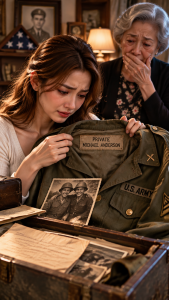
Inside was my grandfather’s Army uniform.
It was carefully folded.
Still in perfect condition.
My mother smiled.
“I haven’t seen this since I was a child.”
I picked it up.
The fabric smelled like old memories.
As I looked closer, I noticed something strange.
Inside the jacket, beneath the collar, there was a name sewn into the fabric.
Not my grandfather’s name.
A different one.
PRIVATE MICHAEL ANDERSON
I frowned.
“Who is Michael Anderson?”
Everyone looked at each other.
Nobody knew.
My grandfather’s name was Thomas Carter.
Michael Anderson wasn’t a relative.
He wasn’t a family friend.
He wasn’t mentioned anywhere in our records.
I searched through the pockets.
Inside one pocket was an old photograph.
It showed two young soldiers standing together.
One was my grandfather.
The other was a man I had never seen before.
On the back of the photograph, my grandfather had written:
“The man who gave me a second chance.”
My heart started beating faster.
Then I found something else.
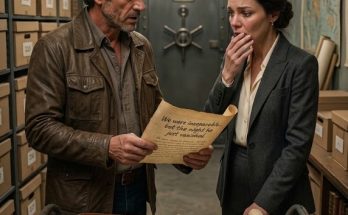
A folded letter.
The envelope was worn.
But the handwriting was my grandfather’s.
It was addressed to:
“Michael’s Family.”
I opened it carefully.
The first sentence made me freeze.
“I am sorry it took me this long to tell you what your son did.”
I looked at the uniform again.
The unknown name.
The photograph.
The letter.
For decades, my grandfather had kept a secret.
And somehow, it involved a soldier whose name was hidden inside his uniform.
PART 2 — The Soldier Who Was Forgotten
I spent the next few days trying to uncover who Michael Anderson was.
I searched military records.
Old newspapers.
Veteran databases.
Finally, I found him.
Michael Anderson had served in the same Army unit as my grandfather.
But his record contained only a few details.
He had been listed as:
Missing in Action.
I stared at the screen.
Missing.
Not killed.
Not returned.
Missing.
I contacted a veterans’ organization and eventually spoke with an elderly man named Frank Miller.
When I showed him the photograph, he became silent.
“Where did you get this?”
“My grandfather.”
He looked closely.
“That’s Thomas Carter.”
“Yes.”
Frank touched the photograph.
“And that’s Michael.”
“What happened to him?”
Frank sighed.
“Most people forgot his name.”
“Why?”
“Because Thomas never let anyone forget.”
Frank explained that during a mission overseas, my grandfather and Michael had been together when their unit came under heavy fire.
My grandfather was injured.
Michael went back to help him.
“He could have escaped,” Frank said.
“But he didn’t.”
“What happened?”
“No one knows exactly.”
Frank told me that Michael disappeared during the mission.
My grandfather survived.
But he refused to talk about the event.
“He blamed himself,” Frank said.
I looked at the uniform.
“The name inside his jacket…”
Frank nodded.
“That was probably his way of remembering.”
I returned home and opened the letter again.
This time, I read the entire thing.
My grandfather had written:
“Michael saved my life when I had already accepted I wouldn’t make it home.”
Then:
“I wore his name close to my heart because the world should never forget his sacrifice.”
I stopped reading.
My grandfather hadn’t stolen the uniform.
He hadn’t replaced his own name.
He had secretly sewn Michael’s name inside because he wanted to carry his friend’s memory with him.
But there was one thing I still didn’t understand.
Why was the letter addressed to Michael’s family?
At the bottom of the page, my grandfather had written:
“I finally found where Michael’s family lives.”
Then he included an address.
PART 3 — The Name That Came Home
The address led me to a small house in another state.
An elderly woman opened the door.
I introduced myself.
When I mentioned my grandfather’s name, her expression changed.
“Thomas Carter?”
I nodded.
She covered her mouth.
“I never thought anyone would come.”
Her name was Elizabeth Anderson.
Michael’s younger sister.
She invited me inside.
On her wall was a photograph.
The same photograph my grandfather had kept.
Only hers was larger.
“I always wondered what happened to him,” she said.
I handed her the letter.
She read it slowly.
Tears filled her eyes.
“My brother saved your grandfather?”
I nodded.
“He never forgot him.”
Elizabeth smiled sadly.
“He was always like that.”
“Like what?”
“Always helping someone else.”
She showed me a box of Michael’s belongings.
Inside was another letter.
This one was written by Michael before the mission.
It was never delivered.
The letter said:
“If I don’t come back, I hope someone remembers that I tried to do the right thing.”
Elizabeth looked at me.
“Your grandfather remembered.”
I finally understood why my grandfather kept Michael’s name hidden inside his uniform.
It wasn’t a secret.
It was a promise.
For decades, he carried the name of the soldier who saved his life.
Not because he wanted people to know his own story.
Because he wanted people to know Michael’s.
When I returned home, I carefully placed my grandfather’s uniform in a glass case.
But I didn’t display only his name.
I added a small plaque beside it:
“Thomas Carter carried this uniform.
Michael Anderson gave it meaning.”
Years later, whenever someone asked about my grandfather’s Army service, I no longer said:
“He didn’t talk about it.”
I said:
“He spent his life making sure another soldier wasn’t forgotten.”
Because sometimes the greatest honor a soldier can give another isn’t a medal.
It is remembering their name.