PART 1 — The Medal in the Drawer
My father never talked about the Army.
Not even when people asked.
Whenever someone mentioned his military service, he would simply smile and say:
“I did what I had to do.”
That was all.
No stories.
No pictures on the wall.
No medals displayed.
For most of my life, I believed my father just wanted to forget those years.
After he passed away, I began cleaning out his old bedroom.
Inside his closet was a wooden drawer he had always kept locked.
I searched through his belongings and found the key taped beneath an old photograph frame.
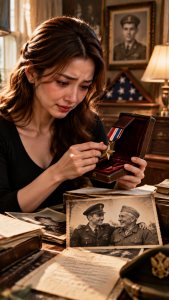
Inside the drawer was a small velvet box.
When I opened it, I found a military medal.
I recognized it immediately.
A medal of honor and bravery.
But what confused me was the note beneath it.
It said:
“Awarded for saving the life of Thomas Carter.”
My heart stopped.
Thomas Carter was my grandfather.
But that was impossible.
My grandfather had always told us he met my grandmother after the war.
He never mentioned my father saving his life.
I looked closer at the medal.
There was another name written on the certificate.
Captain William Carter.
My father.
I found an old photograph underneath.
It showed two young soldiers standing together.
One was my father.
The other was my grandfather.
They were smiling.
On the back of the photograph, my father had written:
“The man I saved became the father I never had.”
I sat there for a long time.
My entire understanding of my family had just changed.
Then I noticed something else inside the box.
A folded letter.
The envelope had my name on it.
My father’s handwriting.
The first line said:
“I never told you how your grandfather came into my life.”
PART 2 — The Soldier My Father Saved
I opened the letter carefully.
My father’s words explained a story I had never heard.
Before I was born, my father had served overseas.
During one mission, his unit came under heavy fire.
Several soldiers were injured.
Among them was a young soldier named Thomas Carter.
My grandfather.
My father wrote:
“Thomas was trapped, and everyone thought it was too dangerous to go back.”
But my father went anyway.
He carried Thomas to safety.
The rescue nearly cost him his own life.
After recovering, Thomas never forgot what happened.
Years later, they discovered they lived in the same city.
They became close friends.
Then something unexpected happened.
Thomas introduced my father to his daughter.
My grandmother.
My father wrote:
“I went to meet the family of the man I saved. I didn’t know I was about to meet the woman who would change my life.”
I stared at the letter.
My grandfather wasn’t just a soldier my father rescued.
He became family.
My father married my grandmother.
And Thomas became his father-in-law.
But there was one thing I still didn’t understand.
Why had my father hidden the medal?
Why had he never told anyone?
At the bottom of the letter, he answered.
“I didn’t want anyone to think I saved Thomas because I wanted recognition.”
“I saved him because he was my brother on that battlefield.”
I wiped away tears.
My father had spent his whole life avoiding attention.
Then I found another document.
It was an unfinished letter.
This one was written by my grandfather.
It said:
“William, you always tell people you were just doing your duty.”
“But you gave me a second chance at life.”
I looked at the medal again.
It wasn’t a symbol of war.
It was a symbol of friendship.
Then I noticed the date.
The medal had been awarded one year before my grandparents married.
My father had saved the man who would eventually become his own father.
PART 3 — The Medal’s True Meaning
After discovering the truth, I searched through my grandfather’s old belongings.
I found a small notebook.
Inside were years of handwritten memories.
Most pages were about my father.
One entry caught my attention.
It was written shortly before my grandfather died.
“People call William a hero because of the medal.”
“But I know the truth.”
“He was a hero before anyone gave him a piece of metal.”
I closed the notebook.
For years, I thought my father avoided talking about the Army because those memories were painful.
But now I understood.
He wasn’t hiding a painful memory.
He was protecting a meaningful one.
He didn’t want the medal to tell his story.
He wanted the person behind the medal to matter more.
I placed the medal beside the photograph of my father and grandfather.
Two soldiers.
Two generations.
One moment that connected them forever.
Then I found one final note inside the velvet box.
My father’s handwriting.
It said:
“If my child ever finds this medal, tell them this.”
“The greatest thing I ever received wasn’t this award.”
“It was the family that came from the man I saved.”
I looked at the photograph one more time.
My father had spent his life refusing to call himself a hero.
But now I knew why.
Because in his eyes, the medal was never about him.
It was about a promise.
A promise between two soldiers who survived together.
And a reminder that sometimes the greatest moments in life don’t end on the battlefield.
Sometimes they become the beginning of a family.
My father didn’t keep his medal hidden because he was ashamed of his past.
He kept it hidden because the person he saved became the greatest gift of his future.