PART 1 — The Gate He Wouldn’t Cross
My uncle never talked about his Army years.
Not because he hated the military.
Because there was one place he refused to return to.
Fort Harrison.
The Army base where he had spent the final years of his service.
Every year, the base held a veterans’ reunion.
Every year, my uncle received an invitation.
And every year, he threw it away.
I never understood why.
“Don’t you want to see your old friends?” I asked him once.
He looked toward the window.
Then quietly said:
“Some doors are better left closed.”
At the time, I thought he was being dramatic.
My uncle Daniel was the strongest person I knew.
He was calm.
Kind.
Always ready to help others.
But whenever someone mentioned Fort Harrison, his expression changed.
Twenty-five years after he left the Army, our family received an invitation to a special ceremony at the base.
The Army wanted to honor former soldiers from his unit.
I convinced him to go.
“You can’t avoid this place forever,” I told him.
He smiled sadly.
“I already did for twenty-five years.”
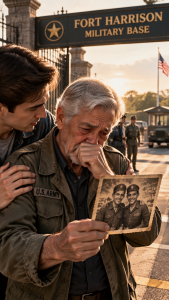
When we arrived at the entrance gate, he stopped.
His hand tightened around his old Army jacket.
He stared at the sign.
FORT HARRISON MILITARY BASE
Then he shook his head.
“I can’t.”
I looked at him.
“Uncle Daniel, we’re already here.”
He stepped backward.
“No.”
His voice was quiet.
“But why?”
He looked at the gate.
Then whispered:
“Because the last time I walked through those gates, I left someone behind.”
I froze.
“What do you mean?”
He didn’t answer.
Instead, he handed me a small envelope.
“I was hoping I would never have to explain this.”
Inside was an old photograph.
It showed my uncle and another soldier standing outside the same gate.
On the back was written:
“The day everything changed.”
The other soldier had been crossed out.
Underneath was a name.
SERGEANT MICHAEL HARRIS.
I looked at my uncle.
“Who is he?”
My uncle closed his eyes.
“The reason I never came back.”
PART 2 — The Soldier Who Was Forgotten
That night, my uncle finally told me the truth.
Twenty-five years earlier, he and Michael Harris had been best friends.
They joined the Army together.
Trained together.
Served together.
“Michael wasn’t just my friend,” my uncle said.
“He was my brother.”
During their final assignment at Fort Harrison, something happened during a training exercise.
A soldier was injured.
The situation became dangerous.
Michael volunteered to help.
My uncle followed him.
“I was supposed to watch his back.”
His voice became heavier.
“But I failed.”
I looked at him.
“What happened?”
My uncle explained that during the mission, Michael disappeared.
Search teams looked for him.
Days passed.
Then weeks.
Eventually, Michael was declared missing.
My uncle never accepted that.
“He was alive when I last saw him.”
“Then why did everyone say he was gone?”
“Because they never found him.”
My uncle spent years blaming himself.
He left the Army.
Moved away.
And never returned to Fort Harrison.
I looked at the photograph.
“Is that why you won’t go back?”
He nodded.
“I don’t deserve to stand there with the people who came home.”
I didn’t know what to say.
Then I remembered the envelope.
“There was something else inside.”
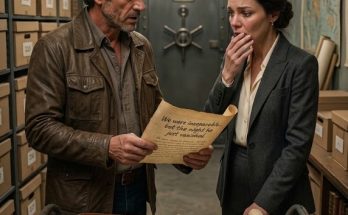
I opened the remaining pages.
It was a letter.
Not from my uncle.
From Michael.
The date was written three months after his disappearance.
My hands shook.
I read the first line:
“Daniel, if you’re reading this, then someone finally found the letter.”
My uncle grabbed the page.
“Where did you get that?”
“It was in the envelope.”
He continued reading.
The letter said:
“You didn’t leave me behind.”
“You came back for me when nobody else would.”
My uncle stared at the words.
His eyes filled with tears.
Then I read the final sentence.
“If I ever get home, I hope you forgive yourself before I can find you.”
My uncle sat silently.
For twenty-five years, he had carried guilt.
But the letter suggested something else.
Michael didn’t blame him.
Then I noticed something strange.
A return address was written on the envelope.
A town.
A state.
A place only a few hours away.
PART 3 — The Man Behind the Gate
The next morning, my uncle and I drove to the address.
Neither of us knew what we would find.
When we arrived, we saw a small house with an American flag outside.
An elderly man opened the door.
My uncle froze.
The man looked at him.
Then smiled.
“Daniel.”
My uncle couldn’t speak.
The man stepped forward.
They hugged.
It was Michael Harris.
Alive.
After twenty-five years, the soldier everyone thought was gone was standing in front of us.
We sat inside while Michael explained what happened.
During the mission, he had survived.
But he suffered serious injuries.
He spent months recovering away from the base.
By the time he returned, records had already listed him as missing.
He tried to contact my uncle.
But circumstances kept them apart.
“I wrote that letter because I wanted you to know one thing,” Michael said.
“What?”
“You never failed me.”
My uncle looked down.
“I should have found you.”
Michael shook his head.
“You came back for me.”
The two men sat quietly.
Twenty-five years of pain.
Twenty-five years of believing the worst.
All because they never had the chance to talk.
A month later, my uncle returned to Fort Harrison.
This time, he walked through the gates.
Slowly.
But he walked.
He stopped at the old training field.
Michael stood beside him.
My uncle looked around.
“I thought this place only held bad memories.”
Michael smiled.
“It also holds the day you saved my life.”
I watched my uncle look at the base one more time.
For years, he believed those gates represented his greatest failure.
But they represented something else.
Friendship.
Loyalty.
A promise kept.
Before we left, my uncle placed the old photograph in the base memorial.
On the back, he added one sentence:
“Some soldiers return from war. Others spend years finding their way home.”
And for the first time in twenty-five years,
my uncle walked through those gates without fear.