PART 1 — THE BOOK THEY THOUGHT WAS WORTHLESS
My name is Clara Bennett.
The morning we buried my grandmother, everyone in my family was grieving differently.
My uncles cried.
My cousins stood in silence.
My mother kept holding tissues to her eyes.
My father, Raymond, barely reacted at all.
He stood beside the graveside flowers with his hands in his coat pockets, watching the cemetery workers lower the casket.
Grandma Evelyn had raised me for most of my childhood.
Whenever my father called me difficult, she defended me.
Whenever he said I would never amount to anything, she told me I was smarter than I realized.
And two nights before she died, she called me to her bedside.
Her voice was weak.
Her fingers were cold.
She pressed something into my palm.
It was an old green bank ledger.
“Clara,” she whispered, “don’t let your father see this.”
I stared at her.
“What is it?”
She looked frightened.
“Promise me.”
I promised.
Then she said something I couldn’t understand.
“He’ll tell you it’s worthless.”
The next morning, she died.
I never got the chance to ask what she meant.
Now, at the cemetery, the last prayer had ended.
Everyone began walking back toward their cars.
My father suddenly reached into his coat.
He pulled out the ledger.
My heart stopped.
“Dad…”
He looked at me and laughed.
“So this is what your grandmother thought was so important.”
He tossed it toward the open grave.
It landed against the flowers beside the casket.
My mother gasped.
My uncle looked away.
My father’s voice was cold.
“Probably nothing but old deposits.”
Then he smiled.
“She spent her whole life counting pennies.”
My younger half-brother laughed.
“Maybe there are twenty dollars in there.”
Everyone chuckled.
I didn’t.
I stared at that little green book lying in the dirt.
Then my father said:
“Let it stay with her.”
He turned and walked away.
I waited.
I watched every relative leave.
The cemetery became quiet.
Only then did I step forward.
I climbed down carefully and picked up the ledger.
My hands were shaking.
Mud covered the cover.
I wiped it clean with my sleeve.
Then I opened the first page.
Grandma Evelyn’s name was written there.
Below it was a line in her handwriting.
If Raymond says there is nothing here, check the last transaction before you believe him.
My heart began pounding.
I turned the pages.
At first, everything looked ordinary.
Small deposits.
Twenty dollars.
Fifty.
One hundred.
Cash from sewing jobs.
Holiday deposits.
Money from selling cakes.
Then suddenly, the numbers became much larger.
Five thousand.
Ten thousand.
Twenty-five thousand.
I turned another page.
A series of withdrawals appeared.
Each one was signed with initials.
R.B.
Raymond Bennett.
My father.
I felt sick.
I had always known my father borrowed money from Grandma.
What I hadn’t known was how much.
I kept turning pages.
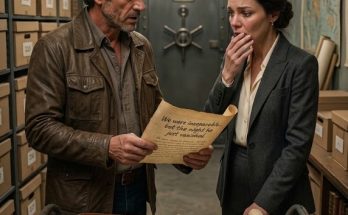
Then I found a folded note.
I recognized Grandma’s handwriting immediately.
Clara, your father doesn’t know about the second account. He thinks he emptied everything years ago.
I stopped breathing.
Second account.
I read the next line.
The red seal will tell the bank where to look. Do not ask your father anything.
At the bottom was a bank number.
And one final sentence.
You were the only person I trusted to finish this.
I folded the note.
That night, I couldn’t sleep.
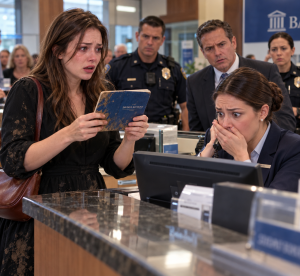
At 8:15 the next morning, I walked into the old First County Bank near downtown.
I carried the ledger inside a plain canvas bag.
A young teller smiled.
“Good morning. How can I help you?”
I placed the ledger on the counter.
“My grandmother passed away yesterday.”
“I’m sorry.”
“She left this with instructions for me to bring it here.”
The teller opened the ledger.
She typed the account number.
Then stopped.
Her fingers froze above the keyboard.
She entered it again.
This time, she looked at me.
“Miss Bennett…”
“Yes?”
“Did your grandmother ever tell you about an account linked to this ledger?”
“No.”
The teller stood.
“Please wait here.”
She walked quickly toward the manager’s office.
A few seconds later, she returned with an older man.
He looked at the ledger.
Then at me.
Then back at the ledger.
His expression had changed completely.
“Clara,” he said quietly, “who gave you this?”
“My grandmother.”
He swallowed.
“Then you need to know something.”
“What?”
He closed the lobby door.
“Your father has been coming to this bank for years asking us to confirm that this account no longer exists.”
My heart dropped.
The manager opened a file.
And on the first page was a number so large that I had to read it twice.
My grandmother had not died with an empty account.
She had left behind a fortune.
And my father had spent years trying to make sure I never found it.
PART 2 — THE ACCOUNT HE COULDN’T HIDE
The manager, Mr. Lawson, asked me to sit down.
He explained that my grandmother had opened a second account nearly twenty years earlier.
It was a protected trust account.
My father had no ownership rights.
But over the years, he had repeatedly requested information about it.
“Why?”
“Because he knew it existed.”
I stared at the file.
“How much is in it?”
Mr. Lawson hesitated.
“Approximately $640,000.”
My hands went cold.
“Six hundred forty thousand?”
He nodded.
“That was the balance before your grandmother’s final deposit.”
I thought about Grandma’s tiny house.
Her old sewing machine.
The coupons she clipped.
The way she turned off lights in empty rooms.
She had lived like someone who believed every dollar mattered.
And all along, she had been protecting something enormous.
“Why didn’t she tell me?”
“She intended to.”
He pulled out a sealed envelope.
“She instructed us to release this after her death.”
I opened it.
Grandma had written another letter.
Clara, if you are reading this, Raymond has probably already told you the account is worthless.
I smiled sadly.
She knew him better than anyone.
The letter continued.
Years ago, your father persuaded me to withdraw money from my savings. He said he needed it for the family business. He never returned it.
I looked at Mr. Lawson.
“He stole from her.”
The manager nodded.
“Several withdrawals appear to match that history.”
I kept reading.
I never confronted him because I knew he would deny everything. So I created the second account and moved what I had left.
Then came the part that stunned me.
But the money was never meant for Raymond. It was meant for you.
I covered my mouth.
Grandma had known.
She had watched me struggle.
She had known my father was trying to control the family finances.
And she had quietly protected me.
Then I reached the final paragraph.
The trust becomes yours when you present this ledger and the red seal to the bank.
I looked up.
“The red seal?”
Mr. Lawson opened the back cover.
There was a small red stamp.
He nodded.
“That confirms the trust instruction.”
I sat back.
For years, my father had told everyone Grandma had left behind almost nothing.
He had complained about funeral expenses.
He had even suggested selling her house.
But he had known about the money.
And he had hoped I would never look closely enough to find it.
I left the bank with copies of everything.
That evening, my father called.
“Where have you been?”
“At the bank.”
Silence.
“Why?”
I looked at the ledger on my table.
“I found something Grandma left.”
My father’s voice changed.
“What did you find?”
“An account.”
Another silence.
Then:
“Clara, listen to me carefully. Whatever you think you found, it’s not what you think.”
I smiled.
“That’s exactly what Grandma predicted you’d say.”
He hung up.
Ten minutes later, my mother called.
“Please don’t make trouble.”
I asked:
“Did you know?”
She cried.
“Your father said the money was gone.”
“Did you know about the second account?”
“No.”
I believed her.
Then my father sent a message.
We need to meet tomorrow.
I replied:
No. My attorney will contact you.
That night, I hired one.
The following day, the bank investigation began.
They reviewed the older withdrawals.
They compared signatures.
They checked account access logs.
And one detail stood out.
My father hadn’t simply borrowed money.
Some documents suggested he had attempted to make it appear that Grandma had authorized additional transfers.
The bank manager froze several linked transactions.
Then he told me something even more disturbing.
“There’s another document.”
“What document?”
“A beneficiary change request.”
“Whose?”
“Yours.”
I frowned.
“I never signed one.”
“I know.”
He handed me a copy.
My father’s name was listed as the person submitting it.
The document claimed I had agreed to release my rights to the trust.
But the signature wasn’t mine.
My father had tried to take control of the account after Grandma died.
And he had done it before the funeral was even over.
That’s when I understood why he had thrown the ledger into the grave.
He didn’t want the book buried.
He wanted the evidence buried.
But there was one thing he didn’t know.
Grandma had made copies.
And one of them had already been sent to the bank.
PART 3 — WHAT MY GRANDMOTHER LEFT BEHIND
The investigation continued for several months.
The bank preserved the original records.
My attorney obtained the trust documents.
The forged beneficiary request was submitted for examination.
And the older withdrawals were traced.
My father had been taking money from Grandma for years.
He told her it was for investments.
Business emergencies.
Medical bills.
But the records showed something else.
Much of the money had gone toward his personal debts.
Private purchases.
And payments to people I had never heard of.
The hardest part was discovering that Grandma had known exactly what was happening.
She had just been waiting for the right moment to protect me.
My father eventually admitted some of the withdrawals.
He claimed he had intended to repay everything.
The trust documents said otherwise.
The money had always belonged to Grandma.
And after her death, it legally passed according to the trust she had created.
To me.
My father lost access to the family accounts.
The attempted transfer was voided.
The disputed withdrawals became part of the legal investigation.
And the property he had planned to sell was placed under court protection while everything was sorted out.
One afternoon, I returned to Grandma’s house.
It was quiet.
Her sewing machine was still beside the window.
Her cardigan still hung behind the kitchen door.
I opened the drawer where she used to keep coupons.
Inside was a photograph of me at twelve years old.
On the back, she had written:
My brave girl. One day you’ll understand why I never stopped saving.
I cried.
Not because of the money.
Because I finally understood.
She had spent years preparing for a day when I would need protection from someone I loved.
The money was only part of her plan.
The real inheritance was the evidence.
The proof that I had not imagined what my father was doing.
The proof that Grandma had believed me.
Months later, I met my father one final time.
He looked older.
Tired.
He stared at me across the table.
“Your grandmother turned you against me.”
I shook my head.
“No.”
“She always hated me.”
“No.”
I placed a copy of the ledger between us.
“She protected me from you.”
He looked down.
For the first time, he didn’t have an answer.
I continued:
“You told everyone she died with nothing.”
He said nothing.
“You threw her last bank book into her grave.”
Still nothing.
“You tried to take the trust.”
His hands tightened.
Then he whispered:
“I made mistakes.”
I nodded.
“Yes.”
“I’m still your father.”
I looked at him.
“That doesn’t erase what you did.”
He lowered his eyes.
I walked away.
I didn’t need revenge.
I didn’t need to humiliate him.
I didn’t even need the money to prove anything.
Because Grandma had already proved it.
She had believed in me enough to prepare for a future she wouldn’t live to see.
I used part of the trust to restore her home.
I kept the sewing room exactly as she had left it.
Another portion went into investments for my own future.
And I created a small scholarship in her name for young women who needed help finishing school.
I kept the green ledger in a glass box on my desk.
Not because it was valuable.
Because every time I looked at it, I remembered the woman who had quietly protected me when almost nobody else did.
The day we buried Grandma, my father laughed and told me her savings book was worthless.
The next morning, a bank manager closed the doors and told me the account was worth more than I had ever imagined.
But even that wasn’t the greatest surprise.
The greatest surprise was learning that my grandmother had never been powerless.
She had simply been patient.
She knew the truth would eventually need a witness.
So she left me one.
A little green ledger.
A red seal.
A handwritten note.
And a final lesson.
Never let someone convince you that evidence is worthless just because they are afraid of what it proves.
My father thought throwing that book into the grave would bury the truth with her.
He was wrong.
The truth had never belonged to the grave.
It belonged to me.
And when I walked out of that bank the next morning, I wasn’t carrying my grandmother’s bank book anymore.
I was carrying the last thing she had ever given me:
the proof that she had believed in me all along.