Part 1 — The locked gate
My name is Rachel Dawson.
I was twenty-eight when I learned that a wedding can reveal more about a relationship in ten minutes than years of dating ever could.
My fiancé, Daniel, and I had been together for four years.
We were supposed to get married on a Saturday afternoon at his parents’ large country home outside the city.
Nearly sixty people were invited.
My parents had driven in from another state.
Friends had booked hotel rooms.
The caterer had arrived.
The flowers were already arranged.
Everything was ready.
Or so I thought.
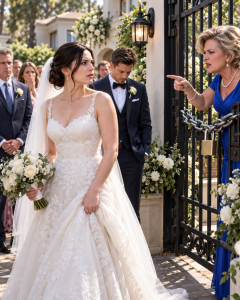
When my parents and I arrived at the property, we found the front gate locked with a thick chain.
My future mother-in-law, Marilyn, was standing on the other side.
She wore a formal navy dress and held the key in one hand.
I stepped out of the car.
“Marilyn?”
She smiled.
“You’re early.”
I looked at the chain.
“Why is the gate locked?”
She raised her chin.
“Because I have something to say before you enter my home.”
Behind me, my mother whispered:
“What is happening?”
Marilyn looked directly at me.
“You have been too comfortable.”
I thought I had misheard her.
“What?”
“You walk into this family as though everything belongs to you.”
“My name isn’t even on the house.”
“That isn’t what I mean.”
She pointed toward the gate.
“Today, you’re going to wait outside for an hour.”
My father stared at her.
“Excuse me?”
Marilyn ignored him.
“I was told by a spiritual adviser that a bride should enter a marriage with humility.”
I almost laughed.
“You are keeping me outside my own wedding because someone told you I need to be humbled?”
She smiled.
“Yes.”
I turned toward Daniel.
He was standing beside the porch.
I expected him to be furious.
Instead, he walked toward me and lowered his voice.
“Rachel, please just go along with this.”
I stared at him.
“Your mother locked the wedding party outside.”
“It’s only an hour.”
“She is humiliating me.”
“Don’t make it worse.”
I couldn’t believe what I was hearing.
Then Marilyn called from the gate:
“If she wants to marry my son, she can learn how this family works.”
I looked at Daniel.
“And this is how your family works?”
He rubbed his forehead.
“Please.”
That one word told me everything.
For years, I had helped Daniel’s family.
When the house needed a new roof, I paid part of the cost.
When the kitchen flooded, I paid the repair company.
When the heating system failed, I covered the replacement.
When Marilyn wanted new furniture for the living room, I bought it.
When Daniel said his parents were struggling with their mortgage, I quietly transferred money.
I never kept score.
I thought we were building a future together.
But standing outside that gate, I suddenly realized I had been contributing to a family that didn’t even think I deserved to walk through its front door.
My father came beside me.
“You don’t have to do this.”
I looked at him.
“I know.”
I took off my veil.
My mother gasped.
Daniel stared.
“What are you doing?”
I handed the veil to my mother.
“I’m not waiting.”
“What?”
I looked at Daniel.
“The wedding is canceled.”
His face went pale.
“Rachel, don’t do this.”
“I already did.”
Marilyn began shouting.
“You’re being dramatic!”
I looked through the gate.
“No.”
I picked up my bouquet and placed it on the hood of my car.
“I’m finally being honest.”
Daniel rushed toward me.
“We can talk about this.”
“We’ve talked for four years.”
“You’re throwing away our marriage over one stupid argument.”
I shook my head.
“No.”
I looked directly at him.
“I’m ending it because when your mother humiliated me, you asked me to cooperate instead of asking her to stop.”
Then I got into my car.
Daniel stood in the driveway watching me leave.
That night, I turned off my phone.
The following morning, I made one call.
Not to Daniel.
Not to Marilyn.
To my attorney.
Then I opened the folder I had been keeping for four years.
Inside were every invoice, bank transfer, receipt, renovation contract, and payment connected to that house.
The total was $86,413.
And nearly every payment had been made by me.
At 9:00 a.m., I returned to the property.
Two moving trucks were behind me.
Daniel opened the gate this time.
He looked confused.
“Rachel, what is this?”
I stepped out.
“You wanted me to learn how your family works.”
I held up the folder.
“So now you’re going to learn how paperwork works.”
Part 2 — The money they forgot about
Daniel stared at the trucks.
“What are you doing?”
“I’m collecting my property.”
Marilyn came running down the driveway.
“You can’t take anything!”
I handed her a copy of my lawyer’s letter.
“Actually, I can.”
She glanced at it.
Her face changed.
“What is this?”
A detailed inventory of the items I had purchased.
The refrigerator.
The dining table.
The living-room sofa.
The television.
The bedroom furniture.
The patio set.
The washer and dryer.
Even the custom lighting fixtures.
Daniel looked at me.
“You’re serious?”
“Yes.”
Marilyn folded her arms.
“You gave those to the family.”
“No.”
“I paid for them.”
“For family.”
“That doesn’t mean you own them.”
I nodded.
“That part is true.”
She looked relieved.
Then I continued:
“Some were gifts. Some were purchased directly by me. My attorney has separated them according to the invoices.”
She looked at Daniel.
He looked uncomfortable.
Then I opened the folder.
“There’s something else.”
Daniel swallowed.
I held up a stack of receipts.
“Your mortgage.”
He stared.
“The transfers I made.”
His face went pale.
“You said that money was helping us temporarily.”
“It was.”
“Temporary for four years?”
Silence.
Marilyn suddenly became defensive.
“We were going to repay you.”
“There’s no repayment schedule.”
She looked away.
The moving crew started carefully removing the furniture listed as mine.
Daniel followed me into the living room.
“You’re really doing this?”
I looked at him.
“You told me to adjust to your family’s rules.”
He lowered his voice.
“I thought you were going to marry me.”
“So did I.”
He looked heartbroken.
“Do you still love me?”
I paused.
“Yes.”
His eyes lifted.
“But I don’t trust you.”
That hurt him.
But it was the truth.
A few minutes later, Marilyn blocked the doorway.
“You are not taking the chandelier.”
I held up the invoice.
“I paid for it.”
“No, it belongs to the house.”
My attorney stepped forward.
“Mrs. Dawson paid the full amount, and we have documentation showing it was a removable fixture.”
Marilyn moved aside.
The chandelier came down.
Then the television.
Then the patio furniture.
Then the dining set.
By noon, the house looked completely different.
Daniel stood in the middle of the room.
He looked around.
“I never realized how much you bought.”
I said nothing.
Then he noticed another envelope.
“What is that?”
I handed it to him.
“Your mother’s credit-card statement.”
He opened it.
The statement showed several purchases made with a card I had added as an emergency authorized user.
Luxury shopping.
Weekend hotels.
Expensive restaurants.
I had added the card because Marilyn told me she needed help during a difficult period.
She had used it to maintain a lifestyle she couldn’t afford.
Daniel sat down.
“She told me you were only helping with necessities.”
I nodded.
“I thought I was.”
Then he looked at the final page.
There were cash withdrawals.
Several had occurred the day before the wedding.
He stared at the dates.
“She was going to use my money for the wedding.”
I nodded.
“Apparently.”
Marilyn walked into the room.
“That’s none of your business.”
Daniel looked at her.
“Mom.”
She stopped.
He held up the statement.
“You used Rachel’s account?”
“I was going to pay it back.”
“When?”
She had no answer.
That was when Daniel finally understood.
The locked gate wasn’t an isolated insult.
It was part of a much bigger pattern.
His family had grown comfortable using my money while telling me I should be grateful for the privilege of being included.
And I had been too busy trying to become a good future daughter-in-law to notice.
By the end of the afternoon, the moving trucks were full.
But one thing remained.
My former engagement ring.
I placed it on the kitchen counter.
Daniel stared at it.
“You’re giving it back?”
“Yes.”
“I bought that.”
“I know.”
He looked at me.
“Please don’t leave it.”
I shook my head.
“You’re right.”
“About what?”
“You’re my fiancé.”
He stared at me.
“Or you were.”
I walked toward the door.
Before I left, Marilyn shouted:
“You’ll regret this!”
I turned.
“No.”
I looked at her calmly.
“I regret staying quiet.”
Then I walked out.
That evening, Daniel called me twenty-three times.
I didn’t answer.
The next morning, my attorney called.
“You should come to the office.”
“Why?”
“We found something in the mortgage file.”
“What?”
“A document your fiancé signed last year.”
“What kind of document?”
She paused.
“It gives his mother authority over the property if he defaults.”
I frowned.
“Why would he sign that?”
She was quiet.
“Because the house may already be in serious financial trouble.”
And suddenly, I realized the $86,413 wasn’t the biggest amount at stake.
Part 3 — What the wedding was really hiding
The financial problems were much worse than I had known.
The house had been refinanced twice.
Several credit cards were behind.
There was a private loan.
And Marilyn had used Daniel’s name to guarantee part of it.
The family had been trying to keep the financial situation hidden.
Daniel had known some of it.
But not all.
He admitted that his mother had convinced him the wedding expenses would somehow solve the problem.
He was expecting a large cash contribution from relatives.
He also believed I would eventually help cover the remaining costs.
That was why the wedding had become so important.
The ceremony wasn’t simply a celebration.
It was part of their financial plan.
I sat across from my attorney.
“So they expected me to pay for the wedding after locking me outside?”
She gave a small nod.
“That’s what the documents suggest.”
I closed my eyes.
I remembered standing outside that gate.
Holding my bouquet.
Listening to Marilyn talk about humility.
All the while, they had already been counting on my money.
That was the moment I stopped wondering whether I had overreacted.
I hadn’t.
The wedding was canceled permanently.
The deposits were divided according to each contract.
The family had to renegotiate their debts.
Daniel moved out of his parents’ house.
For the first time, he had to handle his own finances.
He found an apartment.
Sold his expensive car.
Paid down his personal debts.
And started working with a financial counselor.
Months passed.
He eventually sent me a letter.
Not a text.
Not a phone call.
A letter.
He wrote:
I thought I was protecting my family.
I was actually protecting a system that had made you responsible for everyone’s problems.
Then:
I should have stood beside you at that gate.
I read the letter twice.
At the bottom was one final sentence.
I’m sorry I waited until you walked away to understand your value.
I never married Daniel.
But I didn’t hate him either.
He had made a terrible choice.
Then he spent the next few years learning how to live differently.
As for the house, the family eventually sold it.
My money that had been documented as loans was recovered through legal settlement.
The items that were clearly mine were returned.
The rest stayed with the property.
I bought a small home of my own.
Nothing enormous.
Just three bedrooms, a little garden, and a porch where I could drink coffee without anyone telling me I was taking up too much space.
Six months after moving in, my father helped me plant roses along the walkway.
“You look happier,” he said.
“I am.”
He smiled.
“You know what I remember about your wedding day?”
“What?”
“You took off the veil.”
I laughed.
“That’s what you remember?”
“Yes.”
“Why?”
“Because that was the first time you chose yourself without apologizing.”
I thought about that.
He was right.
The wedding never happened.
And for a while, I considered that a failure.
Now I see it differently.
That gate didn’t keep me out of a marriage.
It showed me what the marriage would have required from me.
Silence.
Obedience.
Money.
And endless adjustment.
The ceremony was canceled before I said “I do.”
And I’m grateful it was.
Because sometimes the most expensive mistake in your life is the one you almost make.
The $86,413 I spent helping Daniel’s family was painful to recover.
But losing those dollars was nothing compared with what I could have lost if I’d stayed.
My independence.
My peace.
My confidence.
My sense of self.
One year later, I received another wedding invitation.
Not mine.
Daniel had sent it.
He wasn’t getting married.
He was inviting me to the opening of a small business he had built on his own.
No family money.
No borrowed funds.
No elaborate celebration.
Just a modest office and a fresh start.
I attended.
He met me at the door.
“Thank you for coming.”
“I wanted to see what you built.”
He smiled.
“I finally built something without expecting someone else to rescue me.”
I nodded.
“That sounds healthy.”
He laughed.
“It is.”
We talked for ten minutes.
No arguments.
No resentment.
Just two people who had once planned a wedding together and eventually learned that the wedding wasn’t the important part.
The important part was who you became afterward.
I never wore the wedding dress again.
I donated it.
The engagement ring went back to Daniel.
The receipts stayed in a folder in my desk.
Not because I wanted revenge.
Because they remind me that kindness without boundaries can turn into a burden you never agreed to carry.
And whenever I think about the woman standing outside that locked gate, I feel proud of her.
She didn’t scream.
She didn’t beg.
She didn’t fight for a seat at a table where she was being humiliated.
She simply walked away.
Then she handled the rest with documents, patience, and a clear head.
My future mother-in-law wanted to teach me humility.
Instead, she taught me something far more valuable.
Never confuse being welcomed into someone’s family with being respected by them.
And the morning I returned with those two moving trucks, I wasn’t trying to punish anyone.
I was simply taking back the things that belonged to me.
The wedding never happened.
But something better did.
I finally learned that leaving the wrong door closed can be the beginning of opening the right one.
The gate was locked that morning.
But for the first time in years, I realized I was completely free.