My Aunt Burned Grandma’s Last Letter at the Funeral—Then the Ashes Revealed a Name That Changed Everything
PART 1 — THE LETTER
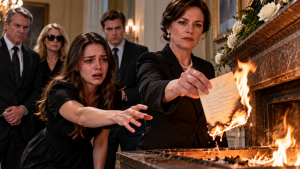
My aunt threw my grandmother’s last letter into the funeral fireplace and smiled.
“Some things should stay buried with the dead.”
Everyone in the room went silent.
I stared at the flames.
That letter had been addressed to me.
My grandmother, Evelyn Carter, had died three days earlier.
She had spent the final month of her life in a quiet hospice room, where she barely spoke to anyone except me.
The night before she died, she grabbed my wrist.
“Lena,” she whispered, “when they tell you I left nothing…”
She stopped to catch her breath.
“Don’t believe them.”
I promised her I wouldn’t.
She pointed toward the drawer beside her bed.
“There’s a letter.”
“Who is it for?”
“You.”
But before I could ask anything else, my aunt Margaret entered the room.
Grandma immediately stopped talking.
Margaret had always controlled the family.
She handled Grandma’s finances.
She organized appointments.
She spoke to lawyers.
And, according to everyone, she was the daughter Grandma trusted most.
After the funeral, Margaret gathered the family in Grandma’s old house.
She stood beside the fireplace holding a sealed envelope.
“This was found among Mother’s things.”
I recognized the handwriting.
My heart jumped.
“That’s mine.”
Margaret looked at me.
“No.”
She opened the envelope.
Inside was a single page.
She glanced at it.
Then her expression changed.
Without saying a word, she threw the letter into the fire.
I jumped forward.
“What are you doing?”
She blocked me.
“Your grandmother wasn’t herself near the end.”
“You didn’t even read it!”
“I did.”
“What did it say?”
Margaret smiled coldly.
“Nothing that matters.”
Then she turned away.
The fire burned quickly.
But one corner of the paper didn’t catch.
I waited until everyone left the room.
Then I used the fireplace poker to pull the blackened paper from the ashes.
Most of the writing was gone.
But three words remained.
“ASK THE BANK.”
Below them was a number.
4729.
I knew that number.
It was Grandma’s old safety-deposit box.
The same box Margaret had told everyone had been closed years ago.
I drove to the bank before it closed.
The manager looked at the number.
Then he looked at me.
“Are you Evelyn Carter’s granddaughter?”
“Yes.”
He locked the office door.
“Your grandmother left very specific instructions.”
“What instructions?”
He opened a file.
“She said that if Margaret ever destroyed the letter…”
He paused.
“…we were to give you the box.”
My heart began pounding.
“What’s inside?”
The manager didn’t answer.
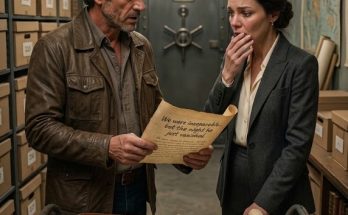
Instead, he placed an old brass key on the desk.
And whispered:
“Your grandmother said the truth inside this box could destroy your family.”
PART 2 — THE BOX
The safety-deposit box contained no money.
It contained something much worse.
Photographs.
Bank statements.
Property documents.
And a small cassette recorder.
On top of everything was a note.
“Lena, start with the photograph.”
I picked it up.
It showed my grandmother standing outside a hospital.
Beside her was a young woman holding a newborn baby.
I didn’t recognize the woman.
Then I turned the photograph over.
My grandmother had written:
“This is your mother.”
I froze.
My mother had died when I was six.
I barely remembered her.
According to my family, she had abandoned us shortly after I was born.
But Grandma’s note continued:
“Your mother never abandoned you.”
I couldn’t breathe.
I pressed PLAY on the cassette recorder.
My grandmother’s voice filled the tiny bank office.
“Lena, if you are hearing this, then Margaret has probably told you that your mother was irresponsible.”
“She will tell you that your mother left voluntarily.”
“She will tell you that I raised you because your mother didn’t want you.”
Grandma paused.
Then her voice became softer.
“That is a lie.”
Tears filled my eyes.
“My daughter tried to take you with her.”
“She was stopped.”
I stared at the photograph.
“By whom?”
Grandma answered:
“Margaret.”
I felt sick.
My aunt had spent twenty years telling me my mother abandoned me.
But Grandma’s recording revealed something else.
My mother had discovered that Margaret was secretly taking money from Grandma’s accounts.
She threatened to expose her.
Margaret responded by telling the family that my mother had become unstable.
Then, shortly before my sixth birthday, my mother disappeared.
Everyone believed she had left.
She hadn’t.
She had been fighting to regain custody of me.
Then the recording stopped.
I looked at the bank manager.
“What happened to my mother?”
He looked uncomfortable.
“I don’t know.”
I opened the next folder.
Inside was an old police report.
The final page had been removed.
But someone had written a note in the margin:
“Check the cemetery records.”
I searched the database.
My mother’s name appeared.
But there was no grave.
Instead, there was a hospital record from twenty years earlier.
A patient under another name.
Same birth date.
Same medical history.
Same photograph.
My mother had survived.
She had changed her name.
She had been alive all these years.
I couldn’t believe it.
Then my phone rang.
Margaret.
I answered.
“Where are you?”
“At the bank.”
Silence.
“You opened the box.”
“Yes.”
“You need to stop.”
“Why?”
“Because you don’t know what you’re doing.”
“I know you lied about my mother.”
Margaret began crying.
“I was trying to protect you.”
“From what?”
“From the truth.”
“What truth?”
Her voice dropped to a whisper.
“Your mother isn’t the person you should be looking for.”
I froze.
“Then who should I look for?”
Margaret hung up.
A few seconds later, a text arrived.
It contained one address.
And one sentence:
“Go there before your father does.”
PART 3 — THE WOMAN WHO WAITED
The address led me to a small house outside town.
An elderly woman opened the door.
The moment she saw me, she began crying.
“You have Evelyn’s eyes.”
I stared at her.
“Who are you?”
She stepped aside.
“I’ve been waiting twenty years for you.”
Inside the house were dozens of photographs.
Me as a baby.
Me at school.
Me at birthdays.
Photos I had never seen.
Then I saw one of my mother.
Alive.
Standing beside the woman.
I whispered:
“Where is she?”
The woman looked toward the hallway.
“She knows you’re here.”
A door opened.
A woman walked into the room.
I knew her immediately.
Not because I remembered her face.
Because I remembered her voice.
She had sung to me when I was six.
A lullaby.
One I had forgotten.
My mother stopped several feet away.
Neither of us moved.
Then she whispered my childhood nickname.
The nickname only she had ever used.
I began crying.
“Mom?”
She nodded.
“I never left you.”
I ran into her arms.
For several minutes, neither of us spoke.
Then she told me everything.
Margaret had discovered my mother was investigating the missing money.
She threatened her.
When my mother refused to stop, Margaret arranged for her to be blamed for financial fraud.
My mother fled because she was afraid she would be arrested for something she hadn’t done.
Grandma knew the truth.
But she couldn’t prove it.
So she spent the next twenty years collecting evidence.
The safety-deposit box contained everything.
Every fraudulent transfer.
Every forged signature.
Every secret account.
And one final document.
A confession signed by Margaret.
My mother looked at me.
“Your grandmother wanted you to have the truth.”
“Why didn’t she tell me?”
“She was afraid Margaret would hurt you.”
I thought about the funeral.
The letter.
The fire.
The ashes.
Then I understood.
Margaret hadn’t burned the letter because it was worthless.
She burned it because it was dangerous.
The police eventually recovered the financial records.
The investigation revealed years of fraud.
Margaret was charged.
The family house was placed under legal protection while the estate was settled.
But the biggest surprise came later.
My grandmother had left the majority of her estate to my mother.
Not Margaret.
And she had left me the house where I had grown up.
I returned there one evening with my mother.
The fireplace was cold.
I stood where Margaret had burned the letter.
On the floor, beneath the ashes, I found one tiny piece of paper I had missed.
Grandma’s handwriting was still visible.
Only one sentence remained:
“If they burn the truth, follow the ashes.”
I smiled through my tears.
My mother took my hand.
“I wish I had found you sooner.”
I looked at her.
“You came back.”
“That wasn’t enough.”
“It is now.”
We stood together in the quiet room.
For twenty years, I had believed my mother abandoned me.
For twenty years, she had believed I hated her.
And for twenty years, my grandmother had carried the truth alone.
Sometimes the worst family secrets aren’t hidden because people don’t love each other.
They’re hidden because someone is afraid the truth will destroy everything.
But Grandma had understood something none of us did.
A family built on a lie is already broken.
The truth doesn’t destroy it.
Sometimes…
the truth is the only thing that gives it a chance to heal.