Part 1 — The secret in the hallway
My name is Daniel Brooks.
My mother, Helen, had been sick for almost two years.
Cancer had changed everything about our family.
The woman who once filled every room with laughter now spent most of her days resting in bed.
Some mornings she felt strong enough to sit at the kitchen table.
Other mornings, she barely had enough energy to lift a cup.
My father, Charles, was her husband of thirty-one years.
I trusted him.
At least, I thought I did.
Whenever I couldn’t get home from college, Dad told me not to worry.
“I’ve got your mother.”
So I believed him.
My aunt Marianne, Mom’s younger sister, also visited often.
She brought flowers.
Soup.
Books.
She sat beside Mom and talked about childhood memories.
Everyone thought she was being a wonderful sister.
I did too.
Until one Thursday afternoon, I came home unexpectedly.
I had planned to surprise Mom.
Instead, I heard voices coming from the kitchen.
Dad.
And Marianne.
I stopped in the hallway.
I expected them to be discussing Mom.
Then Marianne whispered:
“I can’t keep waiting forever.”
My heart tightened.
Dad answered:
“We have to wait until everything is settled.”
“What about the house?”
“It’s already being handled.”
I froze.
Then Marianne said:
“And the wedding?”
Dad laughed softly.
“After the funeral.”
I stopped breathing.
The funeral.
My mother’s funeral.
I pressed myself against the wall.
Marianne continued.
“She still believes you’re devoted to her.”
Dad sighed.
“She won’t know anything now.”
Then he said the words that changed the way I saw my father forever.
“The trust is the important part. Once Helen signs the last documents, we’re safe.”
I nearly stepped into the kitchen.
Then I heard Mom coughing from upstairs.
I backed away.
I couldn’t confront them.
Not with my mother lying just a few rooms away.
That night, I stayed beside her.
She held my hand.
“Your father has been wonderful.”
My chest hurt.
“I know, Mom.”
“You’re lucky to have a father like him.”
I wanted to scream.
Instead, I kissed her forehead.
“You should rest.”
She smiled.
“I’ll see you tomorrow.”
I didn’t know it would be one of the last full conversations we ever had.
Over the next several weeks, I watched everything differently.
Dad was suddenly very interested in paperwork.
Marianne kept asking questions about the estate.
Which accounts were joint?
Which property was in Mom’s name?
Which documents still needed signatures?
I started photographing everything I could legally access.
Not because I wanted revenge.
Because I needed to know what they were planning.
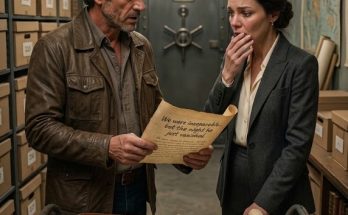
Then I found something.
A folder in Dad’s study.
Inside was a draft amendment to Mom’s family trust.
The document would transfer the lake house and several investment accounts into a private company.
The company was registered to Marianne.
Mom had never signed the final version.
But the draft already had a line prepared for her signature.
I copied everything.
Then I contacted Mom’s longtime attorney.
He was stunned.
“Did your mother authorize this?”
“No.”
He reviewed the document.
“This should never have been prepared without her knowledge.”
I asked him what would happen if she refused to sign.
“It would go nowhere.”
“Then why are they doing it?”
He looked at me.
“You’re asking the wrong question.”
“What is the right one?”
“Why do they believe they will have the opportunity to pressure her into signing?”
I already knew.
They were waiting for her to become too weak to resist.
I felt sick.
Mom died two months later.
Quietly.
With me holding her hand.
Dad cried at the funeral.
Marianne cried too.
Everyone believed they were grieving.
I knew better.
Three weeks after Mom’s funeral, Dad announced his engagement.
To Marianne.
People were shocked.
He called it an unexpected love story.
He said grief had brought them together.
He said they had become close while caring for Mom.
I stood there listening.
Every sentence was a lie.
But I said nothing.
Then he told me the wedding would be small.
“It’ll help us move forward.”
I smiled.
“Of course.”
He looked relieved.
He thought I had accepted it.
I hadn’t.
I spent the next two weeks collecting everything.
The messages.
The trust documents.
The financial records.
The timeline of their meetings.
And one photograph from the night I overheard them.
Not of them together.
Of the folder on the kitchen counter.
The one containing the trust amendment.
The wedding day arrived.
Their reception was held at a beautiful country club.
Around eighty people attended.
Dad wore a dark suit.
Marianne wore ivory.
They smiled for photographs.
They cut the cake.
They thanked everyone.
Then Dad raised his glass.
“To new beginnings.”
Everyone applauded.
I watched quietly.
When the speeches ended, I approached the head table.
Marianne smiled.
“Daniel.”
Dad stood.
“I’m glad you came.”
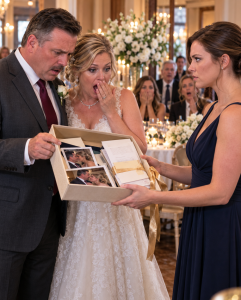
I handed him a small black gift box.
“I brought you something.”
He laughed.
“You shouldn’t have.”
“Open it.”
He lifted the lid.
Inside was a framed photograph.
It showed Mom smiling at a family picnic years earlier.
Dad stared at it.
Marianne smiled.
“What a sweet memory.”
Then Dad noticed something behind the photograph.
A folded document.
He pulled it out.
His smile vanished.
I watched him read the first page.
Then the second.
Marianne leaned closer.
“What is it?”
Dad whispered:
“No.”
I looked at both of them.
“You should read it together.”
Marianne’s face went pale.
Because the document inside the box was the original trust agreement.
And beside it was the draft they had tried to change.
The signatures didn’t match.
The transfer had never happened.
The lake house wasn’t theirs.
The investment accounts weren’t theirs.
And the attorney who had witnessed Mom’s original trust agreement was standing behind me.
He had come with me.
Dad’s hand began shaking.
“You planned this.”
“No,” I said.
“Mom planned it years before you betrayed her.”
Then I placed one final item on the table.
A small brass key.
Marianne stared at it.
“What’s that?”
I looked at Dad.
“The key to the safe deposit box where Mom kept the original evidence.”
His face changed completely.
Because he suddenly understood.
I hadn’t come to ruin their wedding.
I had come to make sure they could never rewrite what happened.
Part 2 — The box my mother left behind
The room became strangely quiet.
Guests were beginning to notice.
Dad pulled me aside.
“Daniel, please.”
“Please what?”
“Not here.”
I looked at him.
“Why not here?”
He lowered his voice.
“Because this is my wedding.”
I nodded.
“And Mom’s funeral was my mother’s funeral.”
He looked away.
“You don’t understand.”
“I understand exactly.”
I told him I had heard him and Marianne that afternoon in the kitchen.
His eyes widened.
“You were there?”
“Yes.”
He swallowed.
“You heard everything?”
“Enough.”
Marianne walked toward us.
“Daniel, whatever you think you heard—”
“I don’t think.”
I opened my phone.
“I recorded the conversation.”
Her face went completely blank.
I hadn’t secretly recorded the conversation myself.
The recording came from a home security system Dad had installed years earlier.
He had forgotten one camera covered the kitchen entrance.
The system had automatically archived the audio.
The attorney had verified it.
Marianne started crying.
“You don’t know what it was like.”
I stared at her.
“To watch your sister dying?”
She covered her face.
“I loved Helen.”
“No.”
I shook my head.
“You loved what you thought would come after Helen.”
Dad stepped between us.
“Enough.”
I looked at him.
“You were already planning a wedding.”
“We were confused.”
“You discussed the estate.”
“We were trying to understand the finances.”
“You discussed the trust.”
He said nothing.
Then the attorney stepped forward.
“Mr. Brooks, you should not say anything else without counsel present.”
Dad glared at him.
“You’re her attorney.”
“Yes.”
“My wife’s attorney.”
“Yes.”
“So why are you here?”
The lawyer looked at me.
“Because your wife left instructions.”
Dad froze.
“What instructions?”
The attorney placed an envelope on the table.
“Helen asked me to release this after her death.”
I stared at the envelope.
My name was written across it.
Daniel.
I opened it.
Mom’s handwriting.
My hands started shaking.
My son,
If you’re reading this, I am gone.
I swallowed hard.
There are things about your father’s behavior that I did not tell you.
Dad’s face changed.
He whispered:
“Helen knew?”
The attorney didn’t answer.
I continued reading.
I know your father has become distant. I also know Marianne has been asking questions about the house and the trust.
My chest tightened.
Mom had known.
She had been watching.
I don’t know whether I’m wrong about them. I pray that I am.
Then came the sentence that broke me.
But if I’m right, don’t confront them while I’m still alive.
I looked at Dad.
He sat down.
The letter continued.
I don’t want my final weeks filled with a battle I may not survive.
Tears filled my eyes.
Mom had known something was wrong.
But she had chosen peace.
Then:
Protect the original trust documents. Protect the lake house. Most of all, protect yourself from anyone who tells you grief requires forgiveness.
I folded the letter.
Marianne was crying.
Dad looked defeated.
The attorney explained that the original trust placed the lake house and investments under a protected structure that could not be altered without independent legal review.
They had tried to bypass that process.
The draft document in the gift box proved it.
Then I opened the final envelope.
Inside was a list of dates.
Every date Marianne had visited.
Every large transfer from Dad’s account.
Every meeting with the financial adviser.
Everything Mom had quietly documented.
At the bottom was one sentence:
I may never know whether my suspicions are right. But if you ever need the truth, follow the money.
So I did.
The following months revealed more than I expected.
Dad had been moving small amounts of money into an account connected to Marianne.
At first, each transfer was insignificant.
Then they grew.
Over eighteen months, the total exceeded $140,000.
Marianne had also received jewelry that belonged to Mom.
Several pieces had been removed from a safe.
Dad claimed Mom had given them to her.
The dates didn’t match.
The records proved otherwise.
The truth became impossible to explain away.
But there was something neither of them expected.
Mom had left the majority of her personal estate to me.
Not because she hated Dad.
Because she had discovered that Dad had been planning to alter the trust.
And she no longer trusted him with control.
The revelation changed everything.
Dad’s new marriage didn’t last.
Within months, legal disputes began.
Assets were reviewed.
Accounts were frozen while the transactions were investigated.
Marianne returned several pieces of jewelry.
Dad hired an attorney.
Then, one afternoon, I received a message.
Please come see me. I need to tell you something about your mother.
It was from Marianne.
I almost ignored it.
But something told me to go.
When I arrived, she was sitting alone at the kitchen table.
The same kitchen where I had first heard the secret.
She looked older.
Tired.
“I owe you the truth.”
I didn’t sit down.
“What truth?”
She started crying.
“I wasn’t the one who planned everything.”
I stared at her.
“Then who?”
She took a breath.
“Your father.”
My stomach tightened.
“He told me your mother was going to leave him.”
I said nothing.
“He told me she had already decided to change the trust.”
“And?”
“He said he needed help.”
“What kind of help?”
She looked at me.
“He wanted me to convince Helen to sign the documents.”
I closed my eyes.
“So you helped him.”
“Yes.”
“While Mom was dying.”
She nodded.
I looked at her.
“Did you love her?”
She cried.
“Yes.”
“Then you should have protected her.”
She had no answer.
Before I left, she handed me a final envelope.
Inside was a receipt.
A private investigator.
The investigator had been hired by Dad almost a year before Mom died.
I stared at it.
“What was he investigating?”
Marianne whispered:
“You.”
My stomach dropped.
“Me?”
She nodded.
“Your father was trying to find out whether your mother had told you about the trust.”
Suddenly, everything made sense.
They weren’t only waiting for Mom to die.
They were worried she had told me the truth.
And apparently, she had.
Part 3 — The wedding gift they never expected
I didn’t tell Dad about Marianne’s confession.
I gave it to the attorney.
The investigator’s records were obtained.
They showed that Dad had been monitoring family finances for months.
He had been trying to determine what Mom had told me.
The documents created a clear timeline.
He knew about the trust.
He knew the lake house wasn’t automatically his.
He knew Mom had the authority to block him.
And he had been preparing to change the arrangement before she became too weak to object.
The wedding had never been the beginning of their new life.
It had been the final step in a plan they thought would make everything easier.
But they had overlooked one thing.
Mom had prepared for exactly this possibility.
After the legal process ended, the lake house remained in the protected trust.
The investments were divided according to Mom’s original wishes.
The jewelry that had belonged to her was returned to the family.
And Dad lost control over the assets he had tried to redirect.
Marianne moved away.
We rarely spoke.
Not because I wanted revenge.
Because some betrayals leave a distance that doesn’t need to be crossed.
Dad eventually asked to see me.
We met in a quiet diner.
He looked older.
“I should have told you.”
“Yes.”
“I loved your mother.”
“I believe you.”
He looked surprised.
“Then why can’t you forgive me?”
I thought for a moment.
“Because forgiveness isn’t something I can use to erase what happened.”
He nodded.
“I made terrible choices.”
“Yes.”
“Would your mother hate me?”
I shook my head.
“No.”
He looked relieved.
Then I continued:
“She would probably want you to admit the truth.”
He lowered his eyes.
“I was afraid.”
“Of what?”
“Losing everything.”
I stared at him.
“You did lose something.”
“What?”
“Her trust.”
He didn’t answer.
I left soon afterward.
The lake house eventually became mine.
But I didn’t live there immediately.
For a long time, I couldn’t walk through the rooms without thinking about Mom.
Eventually, I returned.
I kept her reading chair.
Her garden.
Her blue dishes.
Her favorite lamp beside the window.
And I framed the photograph from the wedding gift.
The picture of Mom smiling.
Not the documents.
Not the evidence.
Her smile.
Because I wanted the house to remember her for who she was, not for how she died.
A year later, I invited a few relatives over.
It was a quiet dinner.
No speeches.
No drama.
Just family.
I placed Mom’s photograph on the mantle.
Then I told them the story.
Not every detail.
Just enough.
When I finished, my aunt asked:
“Why did you expose them at the wedding?”
I thought about it.
“I didn’t.”
Everyone looked at me.
“I exposed the truth.”
There was a difference.
I never shouted.
I never humiliated them.
I didn’t ruin their wedding decorations.
I didn’t call the guests one by one.
I simply handed them the evidence they had spent months believing would never surface.
The gift box wasn’t revenge.
It was a record.
The photograph reminded them of the woman whose memory they had tried to replace.
The trust agreement showed what she had actually wanted.
The brass key opened the safe deposit box containing the original documents.
And the final letter reminded me that my mother had trusted me to protect the truth even after she was gone.
That was her final gift.
Not money.
Not property.
Trust.
Years later, I still keep the little black box.
Sometimes I open it.
Inside is the brass key.
The photograph.
And my mother’s letter.
I don’t keep them because I want to stay angry.
I keep them because they remind me of something important.
People can rewrite stories.
They can change dates.
They can create explanations.
They can tell everyone they were “just two lonely people who found each other.”
But documents don’t care about the story.
Neither does time.
And neither does a person who was there.
My father once thought grief would make everyone too distracted to ask questions.
Marianne thought my mother’s death would finally clear the way for their future.
They were wrong.
Because my mother had already protected the life she built.
She just needed someone willing to finish what she started.
That person became me.
And when I think about the wedding now, I don’t remember the cake.
I don’t remember the flowers.
I don’t remember the speeches.
I remember my father opening the black box.
I remember the smile disappearing from his face.
I remember Marianne leaning over his shoulder.
And I remember the exact moment they realized the future they had been planning while my mother was dying…
had already been taken out of their hands.
Not by me.
By the truth.
That’s what I learned from everything that happened.
You cannot build a future on top of someone else’s suffering and expect the past to stay buried.
My mother died believing she had to protect everyone from conflict.
But in the end, she left me something much stronger than conflict.
She left me the truth.
And the truth didn’t need revenge.
It only needed to be opened.
That little black box did not destroy their wedding.
It simply opened the story they had been trying to close.