PART 1 — The Day They Chose The Wrong Father
The principal looked at the hospital report and calmly said:
“Mr. Carter, teenagers make mistakes. Your daughter’s injuries were part of a school tradition.”
A school tradition.
That was the phrase that stayed in my mind.
Because my sixteen-year-old daughter had not come home crying because someone called her a name.
She had come home with a broken wrist, bruises across her back, and a video circulating online showing five wealthy students forcing her to the ground while everyone watched.
And the adults responsible?
They called it a prank.
My name is Daniel Carter.
For twenty-two years, I served in the United States Army.
I spent my career learning one lesson:
The most dangerous threats are not always the loudest.
Sometimes they come dressed in expensive clothes.
Sometimes they have powerful parents.
And sometimes they believe money makes them untouchable.
After retiring, I moved with my daughter Emily to Westridge, Ohio.
I wanted a quiet life.
No more deployments.
No more fighting.
No more looking over my shoulder.
My wife Sarah passed away three years earlier after a long illness.
Before she left us, she made me promise one thing.
“Daniel… protect her heart. Not just her body.”
I promised.
And I meant it.
Emily was everything good in this world.
She volunteered at animal shelters.
She helped younger students with homework.
She played piano when she was stressed.
She never looked for trouble.
But trouble found her.
At first, she became quiet.
Her laughter disappeared.
She stopped eating dinner with me.
When I asked what was wrong, she always said:
“I’m okay, Dad.”
But I knew that sentence.
Soldiers use it.
People use it when they are trying to survive.
Then came Friday afternoon.
Emily walked through the front door twenty minutes late.
Her backpack dropped onto the floor.
She stood there silently.
I immediately noticed something was wrong.
“Emily.”
She looked up.
Her eyes were red.
“Dad… please don’t do anything.”
Those words scared me more than tears.
“Show me what happened.”
She shook her head.
“I can handle it.”
“No,” I said quietly.
“You shouldn’t have to.”
Slowly, she pulled up her sleeve.
My hands became cold.
Her wrist was swollen and wrapped in a temporary bandage.
Then she showed me the bruises hidden beneath her jacket.
Five students had cornered her after school.
They called it an initiation.
They wanted her to “prove” she belonged.
When she refused, they pushed harder.
One of them recorded everything.
And they uploaded it online.
The next morning, I walked into Westridge High School.
I carried medical records.
Police reports.
And the video evidence.
The principal, Richard Lawson, barely looked concerned.
“These kids come from excellent families,” he said.
I stared at him.
“My daughter was assaulted.”
He sighed.
“Mr. Carter, you need to understand. These are influential families.”
“Influential?”
“Yes. Their parents donate heavily to this school.”
I looked around his office.
Beautiful furniture.
Awards on the wall.
Photos with important people.
Then I asked one question:
“If my daughter’s father had no money, would you still call this a tradition?”
The principal looked away.
That answer told me everything.
I turned toward the door.
“Mr. Carter,” he called.
“You should think carefully before making accusations.”
I stopped.
Then I smiled.
Because he had no idea who he was warning.
“I spent twenty-two years thinking carefully before every decision I made.”
I walked out.
That afternoon, the five students’ families hired expensive lawyers.
They claimed Emily had exaggerated.
They claimed I was threatening their children.
They claimed I was unstable.
They thought I was just another angry father.
They were wrong.
Because I was not preparing for revenge.
I was preparing for the truth.
PART 2 — The Secret They Never Expected
Three days later, I received a letter from the court.
The five families were suing me.
Their accusation?
“Emotional harassment.”
They wanted money.
They wanted silence.
Most importantly…
They wanted control.
Their attorney stood in front of reporters and said:
“Mr. Carter is a former soldier who cannot adjust to civilian life.”
The town started whispering.
People who knew nothing about me suddenly believed everything they heard.
But they forgot one thing.
The truth does not need popularity.
It only needs evidence.
I spent the next week collecting everything.
The deleted messages.
The hidden videos.
The witnesses who were too afraid to speak.
Then I found something nobody expected.
The school had been hiding complaints about these students for years.
Other victims.
Other families.
Other children who stayed silent because they knew the same thing:
Money protected the powerful.
The night before the hearing, Emily sat beside me.
“Dad… what if we lose?”
I looked at her.
“We already won something important.”
“What?”
“You told the truth.”
She looked down.
“I was scared.”
“I know.”
“Then why didn’t you stop them?”
I smiled sadly.
“Because sometimes the strongest thing a person can do is stand up after someone tries to break them.”
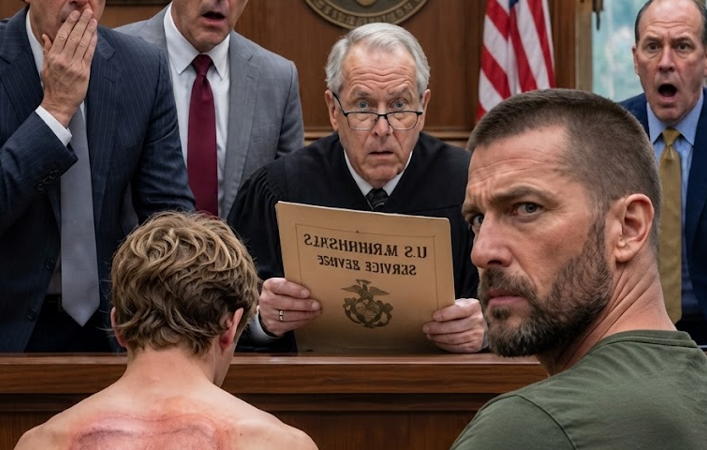
The next morning, the courtroom was packed.
The five fathers arrived wearing expensive suits.
They looked confident.
Their lawyers smiled.
They thought this was going to be easy.
Then my attorney placed one folder on the table.
Inside was everything.
Every message.
Every video.
Every complaint.
The courtroom became silent.
One father whispered:
“This is impossible.”
The judge looked through the documents carefully.
Then he asked:
“Why was this information not reported earlier?”
Nobody answered.
Because everyone knew.
People had chosen money over justice.
The opposing lawyer stood up.
“Your Honor, Mr. Carter has military training. He is dangerous.”
The courtroom became tense.
The judge looked at me.
“Mr. Carter, is that true?”
I stood.
“Yes, Your Honor.”
The lawyer smiled.
Then I continued.
“My training taught me discipline.”
I paused.
“It taught me patience.”
“And it taught me that protecting innocent people sometimes requires standing against those who believe they cannot be challenged.”
Nobody spoke.
Then the judge looked at the five fathers.
And asked:
“Gentlemen… are you certain you want this case to continue?”
For the first time…
They looked afraid.
PART 3 — The Day The Powerful Lost Their Power
The courtroom changed completely after that moment.
The fathers who once walked in like kings suddenly looked like ordinary men.
Their lawyers stopped smiling.
The school officials avoided eye contact.
Because the truth was finally sitting in front of everyone.
The judge reviewed the evidence for hours.
Then he delivered his decision.
The families’ lawsuit was dismissed.
The school was ordered to cooperate with the investigation.
And the five students who had hurt Emily faced serious consequences.
But the biggest change happened outside the courtroom.
Other students started speaking.
Parents who had been silent for years finally told their stories.
The town learned that protecting a reputation had allowed cruelty to continue.
Months later, Emily returned to school.
She was not the same girl who had walked through my door broken.
She was stronger.
One evening, I found her playing piano again.
The same song her mother used to love.
I stood there quietly.
She noticed me.
“Dad?”
“Yeah?”
“Are you proud of me?”
I smiled.
“More than you know.”
She looked at the piano.
“I thought being strong meant never being afraid.”
I shook my head.
“No, Emily.”
“Being strong means being afraid… and still choosing to stand.”
Years earlier, I thought my battles ended when I left the military.
I was wrong.
Some battles happen in places where nobody expects them.
Not on battlefields.
Not in foreign countries.
Sometimes they happen in schools.
Sometimes in courtrooms.
Sometimes inside a person’s heart.
And sometimes…
the quietest person in the room is the one everyone should have feared.
Because silence does not always mean weakness.
Sometimes silence means someone is waiting for the right moment to reveal the truth.