My Stepmother Sold My Father’s House While I Was Away—Then the Bank Manager Saw My Name on the Original Deed
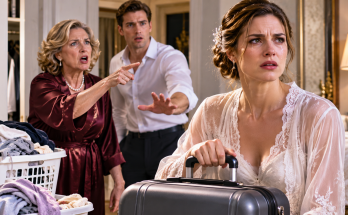
The first thing my stepmother said when I came home was:
“You shouldn’t have come back.”
I had been away for almost a year, working in another state and trying to rebuild my life after my father’s death.
I returned expecting to find the old family house exactly as I remembered it.
Instead, there was a giant FOR SALE sign in the front yard.
A moving truck was parked beside the garage.
And strangers were carrying my father’s furniture out of the house.
I walked toward the front door.
My stepmother, Evelyn, stepped outside.
She looked at my suitcase.
“You’re too late.”
“Too late for what?”
She smiled coldly.
“I sold the house.”
I stared at her.
“You can’t sell Dad’s house.”
She laughed.
“Your father left everything to me.”
I pulled out my phone.
“Then show me the will.”
Her smile disappeared.
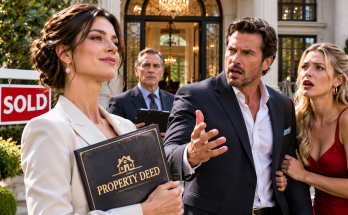
Before she could answer, an older man in a gray suit walked out of the house.
He was the bank manager.
He looked at me.
Then he looked at Evelyn.
Then suddenly his expression changed.
“Wait…”
He opened the folder in his hands.
“What’s your full name?”
I told him.
He slowly turned one page.
Then another.
Finally, he looked directly at Evelyn.
“Mrs. Carter…”
His voice became very serious.
“You may want to sit down.”
Evelyn frowned.
“Why?”
The bank manager pointed to the document.
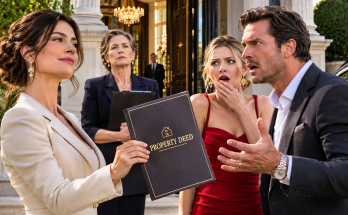
“Because the original deed doesn’t belong to you.”
He looked at me.
“It belongs to her.”
Part 1
I couldn’t move.
My stepmother stared at the bank manager.
“That is impossible.”
He shook his head.
“I personally verified the deed this morning.”
Evelyn grabbed the folder.
She read the first page.
Then her face went completely white.
My name was there.
My father’s name was beside it.
And the date was from twenty-two years earlier.
I had been twelve years old.
“Dad never told me this,” I whispered.
The bank manager looked at me.
“Your father placed the property into a protected family trust.”
“Why?”
He hesitated.
“That’s what we need to find out.”
Evelyn suddenly became angry.
“This is some kind of mistake!”
But the bank manager shook his head.
“No. The sale cannot proceed.”
The movers stopped.
The buyers standing outside began arguing.
Evelyn turned toward me.
“You knew about this.”
“I didn’t.”
“You’re lying.”
I looked at her.
“Why would I lie about something I didn’t even know existed?”
She didn’t answer.
That evening, I returned to the house.
My father’s study had been almost completely emptied.
But one thing remained.
His old wooden desk.
I opened the bottom drawer.
Inside was a small envelope with my name on it.
My father’s handwriting.
For Emma — when you finally come home.
My hands started shaking.
I opened it.
The letter began:
My daughter,
If Evelyn tells you I left everything to her, don’t believe her.
I stopped breathing.
Then I read the next line.
I knew she would eventually try to sell the house.
My heart began pounding.
My father had known.
The letter continued:
There is something beneath this house that is worth far more than the property itself.
I looked around the room.
Then came the final sentence:
Before you trust anyone, find the room behind the library wall.
Part 2
The library had been locked for years.
I remembered my father always telling me:
“Some rooms are better left alone.”
Now I understood why.
I searched the bookshelves.
Nothing.
Then I noticed one old book sitting slightly farther forward than the others.
I pulled it.
A section of the wall clicked.
The entire bookshelf moved.
Behind it was a narrow staircase.
At the bottom was a hidden room.
Inside were boxes.
Photographs.
Contracts.
Bank statements.
And dozens of letters.
My father’s company had been worth millions.
But the documents showed that someone had been secretly transferring money from it for more than a decade.
I found the name.
Evelyn.
My stepmother.
I sat down.
She had been stealing money from my father’s company long before he died.
But there was something even worse.
My father had discovered it.
And he had secretly recorded her.
I found an old digital recorder.
I pressed play.
My father’s voice filled the room.
“I know what you’ve been doing.”
Evelyn’s voice answered:
“You don’t understand.”
“I understand perfectly.”
“You’ll lose everything if you expose me.”
My father laughed bitterly.
“Everything?”
Then he said:
“No. You will.”
The recording ended.
I stared at the device.
Suddenly I heard footsteps upstairs.
Someone was inside the house.
I grabbed the recorder and ran toward the staircase.
Evelyn was standing in the library.
She stared at me.
“What did you find?”
I didn’t answer.
She stepped closer.
“Emma, give me the recorder.”
“No.”
Her face changed.
“You don’t understand what you’re dealing with.”
“I understand that you stole from Dad.”
She froze.
Then she whispered:
“He wasn’t your real father.”
The words hit me harder than I expected.
“What?”
Evelyn looked away.
“Your father adopted you.”
“I know.”
“No.”
She turned back.
“You weren’t just adopted.”
“You were the daughter of the woman who originally owned this property.”
I couldn’t speak.
Evelyn continued.
“Your biological mother died when you were a baby.”
“She left this entire estate to you.”
I stared at her.
“Then why did Dad have it?”
“Because your father was appointed guardian.”
She swallowed.
“And he spent twenty-two years protecting your inheritance from me.”
I suddenly understood.
My father hadn’t simply given me the house.
He had protected something that had belonged to me since birth.
Then Evelyn whispered:
“But there is one thing your father never knew.”
She smiled.
“The original trust contains another beneficiary.”
Part 3
I called the bank manager immediately.
He arrived with the trust documents.
We opened the original file.
There were two names.
Mine.
And another.
I stared at the second name.
It belonged to my father’s younger brother, Daniel.
He had disappeared from the family years ago.
I remembered my father always refusing to discuss him.
The bank manager explained that Daniel had been named as a temporary trustee.
But he had never received ownership.
He had only been responsible for protecting the property until I turned twenty-five.
I was now twenty-seven.
The trust had automatically transferred everything to me two years earlier.
That was why Evelyn had suddenly tried to sell the house.
She knew her window was closing.
But there was another surprise.
Daniel was alive.
And he arrived the following morning.
He walked into the house carrying an old suitcase.
He looked at me.
“You look just like your mother.”
I began crying.
Daniel told me the truth.
My biological mother had owned several properties.
She had died unexpectedly.
My father had married her shortly before her death.
He raised me as his own daughter.
And when he discovered Evelyn had been stealing money, he spent years protecting my inheritance.
He never told me because he wanted me to grow up without believing that money made me special.
At the bottom of the original trust was one final note from my father.
I read it alone.
Emma,
I could have told you that this house was yours when you were twelve.
But then you might have grown up believing the house was more important than the people inside it.
So I gave you something more valuable first.
A childhood.
A family.
And the chance to become someone without knowing what you would inherit.
I pressed the letter against my heart.
Then I read the final sentence.
“Now that you know what belongs to you, remember that ownership is not the same thing as worth.”
Evelyn was eventually arrested for financial fraud.
The attempted sale was canceled.
The house remained mine.
But I didn’t sell it.
I turned the old property into a community center named after my father.
The library became a reading room.
The garden became a place where local families could gather.
And my father’s study remained exactly as he had left it.
Years later, I found myself sitting at his old desk again.
The same desk where I had discovered the first letter.
I opened the drawer.
There was nothing inside.
Then I smiled.
Because I finally understood what my father had been trying to tell me.
My stepmother had believed the house was valuable because it could be sold.
The bank believed it was valuable because of its legal title.
My biological mother had left it to me because it was part of her legacy.
But my father had understood the truth.
A house isn’t valuable because of who owns it.
It’s valuable because of the love and memories built inside it.
And the greatest thing my father left me wasn’t the property.
It was the proof that, even when everyone else saw me as an inheritance,
he had always seen me as his daughter.