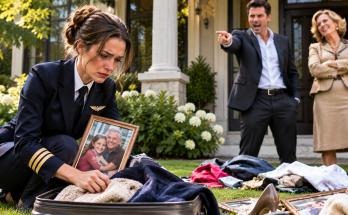
My Fiancé Told Me to Send My Late Sister’s Twins Away Before Our Wedding—So I Canceled the Ceremony and Exposed the Secret He Had Been Hiding From Me
Three weeks before our wedding, my fiancé looked at my late sister’s six-year-old twins and said, “You have until Friday to find them another home, or I’m walking away.” I didn’t scream. I didn’t cry in front of him. I simply smiled and told him I understood. By the following Sunday, he was standing in front of our wedding guests, wondering why the bride had disappeared—and why a lawyer was waiting beside the empty altar with a sealed envelope bearing his name.
PART 1 — The Promise I Made to My Sister
My name is Claire Bennett, and I was twenty-nine when I learned that the person I planned to marry was not the person I thought he was.
I had been engaged to Marcus Reed for nearly two years. We met at a charity fundraiser, fell in love quickly, and spent the next several years building what I believed was a solid relationship.
Marcus was ambitious, confident, and charming. He worked as a regional sales director for a luxury property company and talked constantly about our future. He wanted a large house, a successful career, and a wedding everyone would remember.
I wanted those things, too.
But I also wanted a family where nobody had to beg to be loved.
That belief came from my older sister, Olivia.
Olivia was six years older than me. When our parents divorced, she became the person who made sure I never felt caught between them. She helped me with homework, packed lunches when our mother worked late, and saved her babysitting money to buy me a birthday present when she couldn’t afford anything else.
She was the first person I called when Marcus proposed.
She screamed so loudly that I had to hold the phone away from my ear.
“Claire, finally!” she shouted. “I was beginning to think he’d never ask!”
Then she made me promise something.
“If anything ever happens to me, you take care of my babies.”
I laughed because the thought seemed impossible.
“Nothing is going to happen to you, Olivia.”
She looked at me seriously.
“Promise me anyway.”
So I did.
Olivia had twin boys, Ethan and Evan, who were six years old. They were completely different despite looking almost identical. Ethan was quiet and observant, while Evan asked approximately a thousand questions every day.
They loved dinosaurs, chocolate pancakes, and building enormous towers out of anything they could find.
They also adored Marcus.
He bought them matching football jerseys for their birthdays and once spent an entire afternoon teaching them how to make paper airplanes. When Olivia saw the boys racing around the garden, she told me she was relieved I had found someone who seemed to love them.
“He’ll make a wonderful uncle,” she said.
I believed her.
Then, one winter evening, Olivia and her husband were killed in a highway accident while returning from a family gathering.
The police called me just after midnight.
I remember standing barefoot in my kitchen, gripping the counter while the officer explained what had happened. I kept asking him to repeat himself because my mind refused to accept the words.
My sister was gone.
Her husband was gone.
And two little boys were sleeping at a neighbor’s house, waiting for their parents to come home.
I drove to them immediately.
When I entered the guest bedroom, Ethan sat up and asked whether his mother was hurt.
I couldn’t answer.
Evan began crying before I had even reached the bed.
I gathered both boys into my arms and held them while their world fell apart.
The following morning, I contacted an attorney and began the process of becoming their legal guardian. Olivia had named me as her preferred guardian in her estate documents, and after the necessary assessments and court proceedings, the arrangement was approved.
I moved the boys into my home.
I rearranged the spare bedrooms, bought child-sized furniture, found a school near my office, and learned how to braid hair even though neither boy had any.
I attended grief counseling with them and sat outside their bedroom when nightmares woke them in the middle of the night.
I was grieving, too.
Some nights, after the boys finally fell asleep, I sat on the kitchen floor and cried because I missed my sister so badly that it physically hurt.
But every morning, two little voices called my name.
And every morning, I got up.
Marcus initially seemed supportive.
He helped move the boys’ belongings into my house and brought groceries after the funeral. He told my relatives that we would face the challenge together.
“You don’t have to do this alone,” he promised.
For a while, I believed him.
But as the weeks passed, his attitude began to change.
He complained about the boys’ toys in the living room. He became irritated when I had to leave work early because Evan was sick. He criticized me for spending money on therapy and told me that children needed discipline, not constant emotional attention.
I tried to explain that they had lost both parents in a single night.
“They need time,” I told him.
“And what about us?” he replied. “When do we get our life back?”
I didn’t know how to answer.
Our wedding was scheduled for late spring. We had booked a beautiful country club, ordered invitations, and paid deposits to several vendors. Marcus had insisted on an elaborate celebration because he wanted the day to feel unforgettable.
I had imagined Ethan and Evan walking down the aisle as ring bearers.
They were excited about it, too.
Evan practiced carrying a pillow around the house, while Ethan asked whether he could wear a watch like Marcus.
I couldn’t bear to tell them that things were changing.
Then, one Thursday evening, Marcus arrived at my house carrying a folder.
He placed it on the kitchen counter and announced that we needed to have a serious conversation.
“What is it?” I asked.
He looked toward the living room, where the boys were watching a movie.
“I’ve been thinking about our situation.”
“Our situation?”
“The guardianship.”
My stomach tightened.
“What about it?”
He took a breath.
“I didn’t sign up to raise two children. I thought this arrangement would be temporary while the family figured something out.”
I stared at him.
“The family has figured it out. I’m their guardian.”
“Claire, you’re twenty-nine. We haven’t even started our marriage, and already our entire life revolves around two kids.”
“They’re not just two kids. They’re my sister’s sons.”
“And I feel sorry for what happened to them,” he replied, “but sympathy doesn’t mean I have to spend the rest of my life raising them.”
I felt as though someone had opened a door beneath my feet.
“What are you asking me to do?”
“Find another arrangement. Foster care, a suitable family member, whatever. You have until Friday to decide.”
I couldn’t believe what I was hearing.
“And if I refuse?”
He looked directly at me.
“Then there won’t be a wedding.”
For a moment, I couldn’t speak.
I had imagined disagreements with Marcus. I had imagined difficult conversations about finances, work, and where we would live.
I had never imagined that he would ask me to abandon two children who had already lost everything.
“They’re six years old,” I whispered. “They’ve buried their parents. I’m the only family they have who can take them permanently.”
“Then perhaps you should have thought about that before agreeing to become their guardian.”
I looked at him in disbelief.
“You know I promised Olivia.”
“Your promise to your sister shouldn’t determine my entire future.”
The worst part wasn’t that Marcus wanted a different life.
He was entitled to decide what he wanted.
The worst part was that he had waited until the wedding was almost here to force me to choose, believing that the money, the invitations, the guests, and the years we had invested would make me surrender.
I glanced toward the living room.
Ethan had fallen asleep against Evan’s shoulder. The television cast a soft blue glow across their faces.
They looked so peaceful.
They had no idea that the man they trusted was demanding that I send them away.
I turned back to Marcus.
“All right,” I said quietly. “I hear you.”
His shoulders relaxed.
“Good. I knew you’d understand once you thought about it.”
He kissed my cheek, picked up his folder, and left.
I stood in the kitchen long after his car disappeared.
Then I went into the living room, carefully lifted Ethan’s head from Evan’s shoulder, and tucked a blanket around them.
I remembered my sister’s final promise.
Take care of my babies.
I had promised her I would.
And I intended to keep that promise.
The next morning, Marcus texted me a list of things he wanted us to discuss before the wedding. He included the guest seating plan, the honeymoon reservations, and the final payment for the reception.
He seemed completely certain I would do what he wanted.
He had forgotten one important detail.
Olivia had left behind more than her children.
She had also left documents that I had barely begun to examine—and one of them had a connection to Marcus that I never would have suspected.
I opened the folder from her estate attorney.
Inside was a letter addressed to me, written in my sister’s familiar handwriting.
The first line read:
Claire, if you’re reading this, something has happened that I hoped would never happen. Please don’t sign anything connected to Marcus Reed’s property company until you’ve spoken to my attorney.
I read the sentence twice.
Then I looked at the date.
Olivia had written the letter seven months before her death.
And suddenly, I wasn’t just wondering whether I could still marry Marcus.
I was wondering why my sister had warned me about him at all.
PART 2 — The Secret in My Sister’s Letter
I didn’t confront Marcus about the letter immediately.
I wanted to understand what Olivia had discovered before I made accusations I couldn’t support.
The following morning, I called Olivia’s estate attorney, Mr. Harris, and arranged to meet him.
He greeted me with sympathy and brought out a file containing copies of several documents Olivia had left with him.
“Your sister was concerned about a business arrangement involving Marcus,” he explained. “She asked me to preserve these records in case you ever needed them.”
“What kind of arrangement?”
He slid a copy of a company agreement across the desk.
The document involved a property investment firm where Marcus had worked several years earlier. Olivia had apparently helped a friend review some financial paperwork and noticed inconsistencies in a transaction involving several investors.
She had not accused Marcus of a crime. She had simply wanted to understand why the records didn’t match the explanations he had given people.
The more she investigated, the more questions she found.
A group of investors had contributed money to a residential development project. The project was delayed, and the company had reported financial losses. Yet certain internal documents suggested that money had been redirected through related businesses without clear explanations.
Marcus’s name appeared in correspondence about the transaction.
I felt sick.
“Are you saying he stole money?”
“I’m not saying that,” Mr. Harris replied firmly. “These documents raise questions, but they don’t establish that he committed a crime. Your sister wanted the records preserved so the facts could be examined properly.”
He showed me another letter.
Olivia had written to Marcus asking him to explain several inconsistencies. His response had been dismissive. He told her she was interfering in matters she didn’t understand and warned her not to spread rumors.
My sister had kept the correspondence.
I remembered the argument Olivia had mentioned several months before her death. She had told me she was worried about something Marcus had said to her husband.
When I asked for details, she simply replied, “It’s probably nothing. I don’t want to worry you before the wedding.”
Now I wondered whether she had been trying to protect me.
Mr. Harris handed me a final envelope.
“This one was meant for you personally. Your sister asked me not to open it unless you came to see me.”
Inside was a handwritten note.
Claire, I love you, and I trust your judgment. But please remember that the way someone treats people who cannot benefit them tells you more than their promises ever will. If Marcus is pressuring you to make a decision that feels wrong, take a step back and look carefully at what he’s asking you to give up.
I sat quietly for a long time.
Olivia had known something was wrong.
She had tried to warn me without destroying my happiness based on suspicions she could not prove.
I left the office with copies of the records and a recommendation to seek independent legal advice before taking any further action.
That afternoon, I contacted an attorney who specialized in business disputes. I explained that I had found documents raising questions about Marcus’s former business dealings and wanted to understand whether they should be referred to the appropriate authorities.
The attorney reviewed the papers and advised me not to share them publicly or use them as leverage in a personal dispute. If the documents suggested wrongdoing, the proper course was to preserve them and allow the relevant professionals to investigate.
I agreed.
I wasn’t going to threaten Marcus or make a public accusation.
I was going to protect myself and my family.
Meanwhile, Marcus became increasingly confident that he had won.
He called to ask whether I had contacted a social worker about the boys.
“No,” I replied.
“Claire, we don’t have much time.”
“I know.”
“So what have you decided?”
“I’ve decided to meet you at the wedding venue on Sunday.”
He sounded relieved.
“Perfect. We’ll finalize everything there.”
I hung up and began making arrangements.
First, I contacted the wedding planner and explained that I needed to discuss a possible cancellation. We reviewed the contracts and identified which expenses could be recovered and which could not.
I also informed the officiant that the ceremony might not proceed.
Then I spoke with the boys’ counselor about how to keep their routine stable during the coming weeks. I made sure their school arrangements and care were secure, regardless of what happened with my relationship.
Their future could not depend on whether Marcus approved of them.
Next, I contacted the business attorney and provided the records Olivia had preserved. The attorney advised me to keep the original documents safe and to avoid discussing the investigation with Marcus while the information was being reviewed.
I followed that advice.
On Saturday, Marcus arrived at my house carrying a garment bag.
“I brought your wedding dress,” he announced. “The alterations are finished.”
He hung it carefully on the closet door.
Then he looked at the boys’ drawings taped to the wall.
“Have you found somewhere for them to go?”
I felt a wave of anger, but I kept my voice steady.
“I’ve made arrangements for the future.”
He smiled.
“Good. That’s all I wanted.”
I stared at him.
“Is it?”
He frowned.
“What does that mean?”
“It means I’ve been thinking about what kind of family I want.”
He stepped closer and took my hands.
“Claire, I know this has been difficult. But once the boys are settled somewhere else, we can move forward. You’ll see that this is the right decision.”
I gently pulled my hands away.
“We’ll talk tomorrow.”
He left looking satisfied.
That evening, I sat at the kitchen table after the boys went to bed and read Olivia’s letter again.
I thought about the woman who had raised me when our parents were struggling. I thought about the promises she had made to her children, the life she had built for them, and the trust she had placed in me.
I also thought about Marcus.
I had spent years believing that a successful relationship meant compromising, forgiving, and finding ways to meet in the middle.
But there was no middle ground between protecting two grieving children and abandoning them because they were inconvenient.
I could not build a marriage by betraying the person who had trusted me most.
At midnight, I wrote a letter to Marcus.
I kept it short.
I explained that I would not send the boys away, that I would not proceed with the wedding, and that I wanted all future communication about shared bookings and property matters handled calmly and in writing.
I didn’t mention Olivia’s documents or the business investigation.
That was a separate matter, and it would be handled properly.
I placed the letter in a sealed envelope and put it in my bag.
On Sunday morning, I dressed in a simple navy-blue dress instead of my wedding gown. I left the boys with my aunt, who had offered to take them to the park for the afternoon.
Before I left, Evan wrapped his arms around my waist.
“Are you going to marry Marcus today?”
I knelt beside him.
“No, sweetheart.”
His eyes widened.
“Why?”
“Because sometimes grown-ups realize that they want different things, and it’s better to be honest than to pretend.”
Ethan studied my face.
“Are we going to have to leave?”
I held both boys close.
“Never because someone asks me to abandon you. You’re staying with me.”
They hugged me tightly.
I kissed their foreheads and promised to return before dinner.
Then I drove to the venue.
Marcus had invited several relatives and friends to a small pre-wedding gathering. He believed we were meeting to finalize the arrangements, and he expected me to announce that the boys would be placed with another family.
He had even told his mother that the problem was solved.
When I walked through the entrance, I saw the decorated tables, the floral arrangements, and the large sign bearing our names.
Marcus stood near the altar, laughing with two friends.
He turned when he saw me.
His smile widened.
“There she is! Ready to make our future official?”
I walked toward him, holding the envelope.
“Yes,” I said. “I’m ready to make my decision official.”
His smile never wavered.
He still thought I was there to surrender.
He had no idea that the wedding was already canceled, that my sister’s records were being reviewed, and that the woman he expected to control had finally stopped asking for permission to protect her own family.
PART 3 — The Empty Altar and the Final Truth
Marcus took my hand as I approached the front of the room.
“Everyone’s been waiting to hear what you’ve decided,” he said.
I gently withdrew my hand.
“Then let’s begin.”
His mother stood beside the first row, smiling as if the difficult conversation were already behind us.
A few relatives looked confused when they noticed I wasn’t wearing my wedding dress.
Marcus noticed, too.
“Where’s your dress?”
“I won’t be needing it.”
His expression changed.
I placed the envelope on the small table beside the altar.
“Marcus, I am not sending Ethan and Evan away. They are my family, and I am their guardian. I will not abandon them to preserve a wedding.”
His jaw tightened.
“Claire, we discussed this.”
“Yes. You gave me an ultimatum.”
“I gave you a choice.”
“And I made one.”
He looked around at the guests.
“You’re embarrassing me.”
I shook my head.
“I’m telling you the truth. You asked me to choose between marrying you and keeping my promise to my sister. I choose my brothers.”
His mother stepped forward.
“You can’t throw away a relationship because of one argument.”
“It wasn’t one argument,” I replied. “It was a demand that I abandon two children who had already lost their parents.”
Marcus lowered his voice.
“Stop this. We can discuss it privately.”
“We already did. You told me the wedding was off if I kept them. I’m simply accepting your decision.”
I turned toward the wedding planner, who had been waiting nearby.
“The cancellation has been handled according to the contract. The remaining arrangements are documented, and any outstanding matters will be resolved through the proper channels.”
The planner nodded.
Marcus looked from her to me.
“You canceled the wedding?”
“Yes.”
“Without even asking me?”
“I asked you to meet and discuss our future. You assumed I would do what you wanted.”
He looked furious.
“You’re making a huge mistake.”
“Maybe you’ll think that. But I won’t regret protecting my family.”
His mother began crying.
“Marcus has worked so hard for this day.”
“So have I,” I replied. “But a wedding is one day. The way we treat the people who depend on us matters for a lifetime.”
I picked up the envelope.
Inside was the letter I had written the night before, confirming that I was ending our engagement. I handed it to Marcus.
He read the first few lines, then looked up.
“You can’t be serious.”
“I am.”
He crumpled the edge of the paper in his hand.
“What am I supposed to tell everyone?”
“The truth about why the wedding isn’t happening.”
For several seconds, no one spoke.
Then Marcus did something I had never seen him do before.
He looked frightened.
Not because I was shouting or threatening him, but because he finally understood that I wasn’t going to be persuaded to change my mind.
He stepped closer and spoke quietly.
“Claire, please. We can work this out. I’ll get used to the boys. We can hire help. I’ll even look into counseling.”
I felt a pang of sadness.
A year earlier, I would have accepted those promises immediately. I would have convinced myself that love could overcome anything if I were patient enough.
But the promise he was making now was not the promise I needed.
He was offering to tolerate my brothers after I had already shown him that I would not abandon them.
“I hope you learn to understand what family means,” I said. “But I can’t marry you just because you’re afraid of losing me.”
He shook his head.
“So that’s it? Seven years, gone?”
“Seven years mattered to me. That’s why this hurts. But they don’t obligate me to spend the rest of my life in a marriage that requires me to betray my own values.”
I turned toward the exit.
Before I reached the door, Marcus called after me.
“You’re going to regret choosing them over me!”
I stopped.
Then I answered without raising my voice.
“I didn’t choose them over you. I chose not to abandon them. You decided you couldn’t be part of that life.”
And I left.
I did not stay to watch him explain himself to the guests. I did not ask anyone to take sides. I did not share my sister’s documents or use the business concerns to humiliate him.
That wasn’t my purpose.
My purpose was to end a relationship that had become incompatible with the family I was responsible for protecting.
The following weeks were difficult.
Some relatives told me I should have compromised. Others said Marcus had shown his true character and that I had made the right decision.
I stopped trying to convince everyone.
I focused on Ethan and Evan.
They needed routine, reassurance, and a home where they didn’t have to wonder whether someone would send them away.
I took them to school every morning, helped with their reading, and learned how to make their favorite pancakes. We continued attending counseling, and I made sure they had time to talk about their parents whenever they needed to.
They began to laugh more often.
They started inviting classmates over.
One afternoon, Evan asked whether we could plant flowers in the garden because his mother had loved flowers.
We spent the entire Saturday digging small holes and planting colorful blooms along the fence.
Ethan placed a little wooden marker beside the first plant.
He had written his mother’s name on it.
I knelt beside him.
“That’s beautiful, sweetheart.”
He looked at me seriously.
“Mommy isn’t here, but we can still remember her.”
I hugged him.
“Yes. We always can.”
Meanwhile, the business attorney continued reviewing the records Olivia had preserved. The documents were referred through the appropriate channels for further examination. I did not know what the final findings would be, and I refused to make assumptions based on incomplete information.
Months later, I learned that the review had identified discrepancies requiring additional investigation into the property company’s transactions. Marcus was asked to provide information about several business decisions, and the company began an internal review.
I did not celebrate his difficulties.
I had never wanted revenge through false accusations or public humiliation. I wanted the truth to be examined by people qualified to determine what had happened.
Olivia had preserved the records because she believed the questions deserved answers.
I respected that.
As for Marcus, he sent several messages asking to meet. Some were apologetic, while others accused me of ruining his life.
I replied only once.
“I hope you find the future you want. I wish you well, but our relationship is over. Please respect that decision.”
Then I stopped responding.
I never learned whether he eventually understood why his ultimatum had been wrong.
Perhaps he did.
Perhaps he continued to believe that I had chosen an inconvenient responsibility over a promising marriage.
That was no longer something I could control.
A year after Olivia’s death, I took the boys to visit her grave.
We brought flowers from our garden and placed them beside her name.
Ethan stood quietly for a moment before speaking.
“Mommy, Claire takes care of us.”
My throat tightened.
Evan placed a drawing beside the flowers. It showed three people standing beneath a bright yellow sun, with a fourth figure in the sky holding a heart.
I wrapped my arms around both boys.
For the first time in months, I felt that I could breathe without carrying the weight of every promise alone.
I had learned how to ask for help. My aunt helped with school pickups when work became busy. Friends brought meals during difficult weeks. The boys had counselors, teachers, and relatives who cared about them.
I was still their guardian, but I no longer believed that loving them meant doing everything by myself.
And I finally understood that the future I had imagined with Marcus was not the only future available to me.
I could build a life around the people I loved.
I could pursue my career, travel with the boys when they were older, and someday find a partner who understood that family was not a burden to be negotiated away.
I didn’t need a perfect life.
I needed an honest one.
Sometimes I still think about the wedding day. I remember the flowers, the empty altar, and Marcus’s stunned expression when he realized I wasn’t going to change my mind.
But I no longer think of that day as the day my dream ended.
I think of it as the day I stopped confusing a dream with a promise someone else had made conditional.
My sister had trusted me with her children.
I had promised to protect them.
And I kept that promise.
Marcus wanted me to believe that loving my brothers would cost me everything.
Instead, keeping them gave me a clearer understanding of what I could never afford to lose: my integrity, my self-respect, and the trust of two little boys who had already experienced more heartbreak than most children could imagine.
I did not need to punish Marcus to prove I was strong.
I only needed to stop letting him decide what I was allowed to love.
The greatest lesson was not that I could walk away from a wedding. It was that I could walk away from anyone who demanded that I abandon my family to earn their love.
And every night, when Ethan and Evan tell me goodnight, I remember the promise I made to Olivia.
Her children still have a home.
They still have someone who shows up.
And they will never have to wonder whether they are worth choosing.