My Stepmother Changed the Locks After My Husband Died and Tried to Sell My Baby’s Home—Then the Family Lawyer Revealed the Secret My Mother Had Left Behind
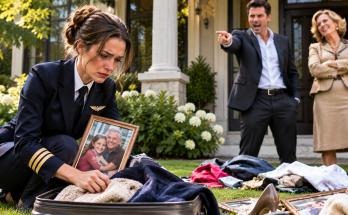
Three days after my husband’s funeral, my father arrived at my house with my twenty-six-year-old stepmother and announced that I had until sunset to leave. I was seven months pregnant, still wearing my wedding ring, and barely able to sleep without crying. “This property belongs to the family now,” he said, tossing a set of new keys onto the table. My stepmother smiled and told me my unborn baby would be better off somewhere else. I refused to move. My father grabbed my suitcase and ordered me out, certain that grief had made me too weak to fight him. But as I reached for my phone, it rang. The caller was the family lawyer I hadn’t spoken to in eleven years. His first words changed everything: “Emma, your mother left instructions for exactly this situation. And your father has just made a very expensive mistake.”
PART 1 — The Day My Father Tried to Erase Me
My name is Emma Parker. I was thirty years old when my husband, Daniel, died in a highway accident and the people who should have protected me decided that my grief made me an easy target.
Daniel and I had been married for six years. We lived in a beautiful house outside Albany, New York, with a wide front porch, a small garden, and a spare bedroom we had spent months preparing for our daughter.
I was seven months pregnant.
We had already chosen her name: Sophie.
Daniel had painted the nursery a soft cream color and assembled the crib himself. He had left a tiny stuffed rabbit on the windowsill because he said Sophie needed something waiting for her before she arrived.
Every time I entered that room after his death, I had to remind myself to breathe.
Daniel had been my safe place.
He knew about my childhood, my difficult relationship with my father, and the reasons I had spent years keeping my distance from my family.
My father, Robert Parker, had always believed that love meant obedience.
When I was a child, he made every decision for me. He chose my activities, criticized my friends, and treated any disagreement as disrespect.
My mother, Elizabeth, was different.
She was gentle but strong, the sort of woman who could calm an argument simply by asking everyone to sit down. She taught me to be independent and insisted that I should never confuse family loyalty with surrendering my judgment.
When she died of cancer eleven years earlier, my world changed.
My father remarried less than a year later.
His new wife, Vanessa, was twenty-six when they married. She was closer to my age than to his, and she seemed determined to establish herself as the most important woman in the family.
At first, I tried to be polite.
But Vanessa constantly criticized my mother, rearranged her belongings, and complained whenever I visited the family home.
Eventually, I stopped going.
My father blamed me for the distance.
“You can’t keep living in the past, Emma,” he told me.
I wanted to explain that I wasn’t living in the past. I was simply refusing to let someone else rewrite it.
But I had learned that arguing with him rarely changed anything.
Daniel understood.
After we married, he never pressured me to reconcile with my father. He told me that I could leave the door open without allowing anyone to walk over me.
I loved him for that.
When Daniel and I bought our house, we used our savings and a mortgage we could comfortably afford. We registered the property in both our names.
It wasn’t a mansion, but it was ours.
It was where we planned to raise our daughter, celebrate birthdays, and grow old together.
Then, on an ordinary Thursday afternoon, Daniel left for a business meeting and never returned.
A police officer called that evening.
I remember standing beside the kitchen counter, one hand resting on my stomach, while the officer explained that there had been an accident.
I asked him to repeat himself three times.
I kept waiting for him to say there had been a mistake.
There wasn’t.
Daniel was gone.
The days that followed passed in a blur of condolences, paperwork, flowers, and sleepless nights. Friends brought meals. Daniel’s sister helped organize the funeral. I sat in the nursery and held the tiny rabbit he had bought for Sophie.
I didn’t know how I would raise our daughter without him.
But I knew I would try.
Three days after the funeral, someone unlocked my front door.
I was sitting on the sofa when my father walked into the living room.
Vanessa followed him, carrying a leather handbag and wearing an expression of mild amusement.
I stared at them.
“How did you get in?”
My father held up a key.
“I had a copy made.”
“You had no permission to enter my house.”
He ignored me and placed a folder on the coffee table.
“We need to discuss the property.”
I looked at the folder.
“What about it?”
“Daniel is gone. You have a baby coming, and you won’t be able to manage this place on your own. I’ve decided to arrange a sale.”
For a moment, I thought grief had made me misunderstand him.
“You’ve decided to do what?”
Vanessa wandered toward the kitchen.
“Your father is trying to help, Emma. You should be grateful.”
I turned back to him.
“This is my home.”
“It’s a family property now.”
“No. Daniel and I bought it together. My name is on the deed.”
My father laughed.
“You’re grieving and emotional. You don’t understand how these things work.”
I felt anger rise through my exhaustion.
“I understand that you cannot sell my house without the proper authority.”
His expression hardened.
“Watch your tone.”
“Get out.”
Vanessa returned from the kitchen, smiling.
“You really think you can manage a house, a baby, and all the expenses on your own? Perhaps your father is right. Maybe you should move somewhere smaller.”
I looked at her.
“You have no say in this.”
She shrugged.
“I live with your father. That makes it my business.”
My father opened the folder and pushed several pages toward me.
“Sign these documents. They’ll allow me to handle the sale and manage the remaining financial matters.”
I didn’t touch them.
“I’m not signing anything.”
His jaw tightened.
“Emma, don’t make this difficult.”
“You walked into my home without permission and told me you were selling it. You don’t get to call me difficult because I said no.”
For a moment, he looked genuinely shocked.
Then he grabbed my suitcase from beside the stairs.
I had packed it with some of Daniel’s clothes, intending to take them to his sister’s house for safekeeping.
My father threw it toward the front door.
Clothes spilled across the floor.
“Fine,” he snapped. “If you won’t cooperate, you can leave.”
I stared at him.
“I’m not going anywhere.”
He moved toward me and seized my arm.
I pulled away.
“Don’t touch me!”
He grabbed the suitcase again and shoved it through the open doorway.
Vanessa laughed.
“Honestly, Emma. You make everything so dramatic.”
I stood frozen, one hand over my stomach.
My father pointed toward the porch.
“You have until sunset. After that, don’t expect me to help you.”
I was frightened, exhausted, and still grieving.
But something inside me finally became clear.
I had spent eleven years trying to keep peace with a man who believed my boundaries were an insult.
I had no intention of teaching my daughter that she had to accept the same treatment.
I took out my phone.
My father smirked.
“Who are you calling? Your husband’s family?”
“No.”
I called Daniel’s attorney, Michael Bennett.
Michael had helped us prepare our wills and property documents. I hadn’t spoken to him since Daniel’s funeral because I had barely been able to manage the necessary paperwork.
He answered immediately.
“Emma, I’m glad you called. How are you holding up?”
“My father is trying to force me out of my house. He’s brought documents for me to sign, and he says he intends to sell the property.”
There was a pause.
“Have you signed anything?”
“No.”
“Good. Don’t sign anything, and don’t hand over any original documents. If you feel unsafe, move somewhere secure and contact the authorities. I can address the property issue through the proper channels.”
My father rolled his eyes.
“Tell him this is a family matter.”
Michael heard him.
“Mr. Parker, this is a legal matter. You should not attempt to transfer or sell property without the necessary authority.”
My father’s expression changed.
Michael continued.
“Emma, there’s something else you should know. Your mother left a sealed letter with our firm many years ago. She instructed us to contact you if anyone tried to pressure you into surrendering your inheritance or property rights.”
I stopped breathing for a moment.
“My mother?”
“Yes. The letter contains instructions concerning an estate arrangement that was established after her death. I believe it may be relevant to what’s happening now.”
My father stepped toward me.
“What is he talking about?”
I turned away from him.
Michael’s voice became more serious.
“Emma, I need you to understand that your father does not automatically control your assets simply because he’s your parent. Let me review the documents before you make any decisions.”
I looked at the folder on the table.
Then at the suitcase lying open on the porch.
For the first time since Daniel died, I felt something other than helplessness.
I felt a small, stubborn spark of hope.
My father snatched his keys from the table.
“This isn’t over,” he said.
“No,” I replied. “It isn’t.”
He walked out with Vanessa behind him.
But before the door closed, she looked back at me and smiled.
“You should have signed the papers.”
I watched them leave.
Then I called my sister-in-law, Daniel’s sister, who agreed to come stay with me.
Michael promised to review the documents immediately.
And as I sat alone in the house Daniel and I had built together, I began to wonder what my mother had known eleven years earlier that had made her prepare for a day like this.
PART 2 — The Letter My Mother Never Wanted Me to Need
Michael arrived the following morning with a second attorney from his firm.
He brought copies of my mother’s estate documents, the deed to our house, and a sealed envelope bearing her handwriting.
I recognized it immediately.
My mother had always written my name with a small curl at the end of the final letter.
I ran my fingers over the envelope.
“Why didn’t you give this to me when she died?”
Michael sat across from me.
“Your mother gave us specific instructions. She wanted the letter delivered if there was a dispute involving your inheritance or an attempt to pressure you into surrendering your rights. Until then, she asked us to keep it private.”
I opened the envelope carefully.
Inside was a letter and several documents relating to a trust my mother had established before her death.
The letter began simply.
My darling Emma,
If you are reading this, something has happened that makes me fear you are being pressured or treated unfairly. I wish I could be there to help you, but I want you to remember something I have told you since you were little: you are allowed to protect yourself, even when the person hurting you is family.
Tears blurred the page.
My mother had known how difficult my relationship with my father had become.
She had also known that I would spend years hoping he might change.
The letter continued.
I have arranged for part of my estate to be held in trust for your benefit. I chose independent trustees because I wanted you to have financial security without having to depend on anyone’s goodwill.
Your father knows that I created an estate plan, but he is not authorized to manage the trust or make decisions on your behalf.
I looked up.
“My father knew about this?”
Michael nodded.
“He knew that your mother had made arrangements, but the documents do not give him control of the trust.”
I returned to the letter.
My mother explained that the trust had been created using investments and savings she had kept separate during her marriage. It was intended to support my education, future housing, and other needs she believed might arise.
The trust did not own my house, and it did not automatically determine who would inherit Daniel’s assets.
But it was an independent source of protection that my father could not simply claim.
The final paragraph made me cry.
If your father ever tells you that being a good daughter means giving him control of your life, remember that I raised you to become your own person. I loved him once, and I hope he finds peace. But you do not have to sacrifice your future to prove that you love your family.
I held the letter against my chest.
For years, I had imagined that my mother’s death meant losing the only person who understood me.
Now I realized that she had left me something more than money.
She had left me a reminder that I was allowed to make my own decisions.
Michael reviewed the property documents next.
My name was indeed listed on the deed to the house I shared with Daniel. My father’s folder contained a proposed authorization and a draft sale agreement, but neither document gave him ownership or authority to sell the property.
Because Daniel had died, his share of the property needed to be handled according to the deed, his will, and the applicable estate procedures.
That process would take time.
But it did not give my father the right to force me out.
Michael advised me to keep the documents safe, avoid signing anything without legal advice, and contact the authorities if my father attempted to enter the house or threaten me again.
I agreed.
Then he showed me something unexpected.
Two months before Daniel’s accident, Daniel had contacted Michael to update his estate arrangements.
He had asked for guidance on protecting me and our unborn child if he died before Sophie was born.
I stared at the document.
“Daniel never told me.”
“He may not have wanted to frighten you,” Michael said. “He was concerned about ensuring that you and the baby would have financial support.”
The estate plan included provisions for managing Daniel’s assets and supporting Sophie. It also named people who could assist with administrative responsibilities if I became unable to act.
My father was not among them.
I felt both comforted and heartbroken.
Daniel had been preparing for the future while I was choosing paint colors for the nursery.
He had wanted to protect us.
Michael explained that the estate still needed to be administered properly. The documents did not mean that every asset automatically transferred to me, and the exact ownership of Daniel’s business interests would depend on the relevant agreements.
But the arrangements gave us a clear starting point.
Meanwhile, my father began calling repeatedly.
When I finally answered one call, he sounded furious.
“Who gave you the right to bring lawyers into this?”
I almost laughed.
“You brought legal documents into my house and told me to sign them.”
“I was trying to help you.”
“Then why did you try to force me out?”
He went silent.
I continued.
“I have spoken with Michael. You have no authority to sell the house or manage my mother’s trust.”
His voice rose.
“Your mother would never have wanted you to treat me like this!”
I looked at her letter.
“She wanted me to be safe.”
He hung up.
Later that afternoon, Vanessa sent me a message.
She accused me of being selfish and said my father had every right to help manage my affairs because I was pregnant and grieving.
I did not respond.
Instead, I sent the message to Michael.
He advised me to keep a record of any further attempts to pressure me.
Over the following week, the legal situation became clearer.
The attorney handling Daniel’s estate confirmed that the property and other assets would be dealt with according to the governing documents and applicable law.
The independent trustee confirmed that my father’s involvement was not required for the trust to operate.
And the proposed sale documents were withdrawn after Michael formally notified the parties that my father lacked authority to act on my behalf.
That should have been the end of it.
But my father was not accustomed to hearing no.
One evening, I returned from a prenatal appointment and found him standing near my front door.
He had brought a locksmith.
I immediately called the police and contacted Michael.
The locksmith stepped away when he realized there was a dispute over the property and no clear authorization to change the locks.
My father shouted that I was turning everyone against him.
I stayed inside the house until the officers arrived.
They spoke with both of us and documented the situation. They instructed my father to leave the property and advised him that any ownership or estate dispute needed to be addressed through the appropriate legal process.
When he finally left, I sat on the floor beside the nursery and cried.
I was tired of being afraid.
I was tired of feeling that every boundary would lead to another confrontation.
But I also felt stronger than I had the week before.
My mother had given me the courage to stop apologizing for protecting myself.
Daniel had left me a plan.
And I had people willing to help me follow it.
The next morning, Michael called with an update.
The documents my father had presented were being reviewed because they appeared to claim authority he did not possess.
He warned me not to assume that the documents were fraudulent until the evidence had been examined.
Then he said something that made me sit upright.
“Emma, your father has also contacted a representative of Daniel’s former business, claiming that you authorized him to discuss the estate on your behalf.”
I stared at the wall.
“I never did that.”
“I know. The company has requested written confirmation, and we have provided it. They will not recognize him as your representative.”
My father had not simply tried to take my house.
He had tried to insert himself into the administration of Daniel’s estate and my mother’s trust.
And now the records were beginning to show how far he had gone.
PART 3 — The Home My Daughter Would Never Have to Beg For
Three weeks later, I gave birth to Sophie.
She arrived a little earlier than expected, and the medical team kept a close eye on her during her first days.
When the nurse placed her in my arms, I looked at her tiny face and felt a wave of love so powerful that it frightened me.
Daniel should have been there.
He should have held her, counted her fingers, and complained that she had more hair than he expected.
I cried for him while Sophie slept against my chest.
But I also made her a promise.
I would build a life where she felt safe.
I would teach her that love did not mean obedience and that family members were not entitled to control her simply because they shared her blood.
My sister-in-law stayed with me during the first week after we came home.
Michael handled the legal correspondence, allowing me to focus on recovering and caring for Sophie.
The property matter was eventually clarified.
My name remained on the house deed, and Daniel’s share was handled through his estate according to the applicable documents. My father had no authority to force a sale or remove me from the property.
My mother’s trust continued operating under its own terms, managed by the independent trustees she had selected.
Daniel’s estate was also administered according to his will and the relevant business agreements.
I did not suddenly become the owner of every asset associated with his company, and I did not need to.
What mattered was that the arrangements were respected and my father could not simply claim control because he believed I was too vulnerable to resist him.
The disputed documents were reviewed through the appropriate process.
The evidence established that my father had no authority to represent me in the estate matters. Questions about how the documents had been prepared and submitted were handled by the relevant professionals and authorities.
I did not demand a particular punishment.
I wanted the facts established and my rights protected.
Several months later, my father requested another meeting.
Michael advised me that I could decline, but I agreed to a short conversation at his office.
Richard arrived alone.
He looked older, and for the first time in my life, he seemed uncertain about what to say.
“I never intended for things to become this bad,” he began.
I looked at him.
“You tried to force me out of my house while I was pregnant.”
“I thought you needed help.”
“Help doesn’t begin by taking away someone’s choices.”
He lowered his eyes.
“I was worried about the property and the money.”
“Then you should have asked me what I needed.”
He rubbed his hands together.
“I thought you would refuse to listen.”
I felt a deep sadness.
“You didn’t give me the chance.”
He was quiet for a long time.
Then he asked whether he could meet Sophie.
I looked at him carefully.
I wanted my daughter to have a loving family. But I would not expose her to the same behavior I had spent years trying to escape.
“That depends on whether you can respect my boundaries,” I told him. “You cannot enter my home without permission. You cannot make decisions about my property or finances. And you cannot use Sophie to pressure me.”
He looked hurt.
“I’m her grandfather.”
“That relationship matters. But it doesn’t erase what happened.”
He nodded slowly.
I did not promise him immediate forgiveness.
I did not tell him that everything was fine.
I simply told him what would need to change before we could consider rebuilding our relationship.
For the first time, I left the decision in his hands.
Months passed.
I changed the locks, installed a security system, and organized the estate documents in a secure place. I also arranged for a property manager to help with maintenance while I adjusted to life with a newborn.
The house began to feel like home again.
I painted the nursery a soft yellow because Sophie seemed to brighten every room she entered.
I placed Daniel’s photograph on the shelf beside the stuffed rabbit.
Sometimes I spoke to him while I rocked her to sleep.
I told him about her first smile, her first laugh, and the way she curled her fingers around mine.
I told him that I missed him.
And I told him that I was trying to be brave.
One afternoon, I found the letter from my mother inside the folder Michael had given me.
I read it again.
You do not have to sacrifice your future to prove that you love your family.
For most of my life, I had believed that a good daughter should endure almost anything to keep the family together.
I had thought that saying no made me ungrateful.
I had mistaken fear for respect and silence for peace.
Now I understood that a family could not be healthy if one person’s comfort depended on another person’s surrender.
I could love my father without letting him control me.
I could remember my mother without living in fear of losing her approval.
I could grieve Daniel without allowing that grief to make me helpless.
And I could raise Sophie without repeating the mistakes that had hurt me.
On Sophie’s first birthday, I invited a few close friends and relatives to the garden.
There were balloons, a small cake, and a blanket spread beneath the tree Daniel had planted before she was born.
My sister-in-law brought a framed photograph of Daniel holding my hand at our wedding.
I placed it beside the cake.
As everyone sang, I held Sophie and watched her reach toward the candles.
I thought about the morning my father had thrown my suitcase onto the porch.
I remembered how frightened I had been.
I remembered thinking that I might lose my home, my inheritance, and the last connection to the life Daniel and I had built.
But I had not lost them.
I had asked for help.
I had refused to sign documents I did not understand.
I had allowed the proper legal process to establish the facts.
And I had learned to protect myself without becoming the person who hurt me.
My father eventually sent another letter.
He acknowledged that he had acted wrongly when he entered my home and tried to force me out. He said he regretted frightening me during an already painful time.
I appreciated the acknowledgment.
But trust was not something I could restore with a single reply.
I told him that I was willing to consider gradual contact if he continued to respect my boundaries.
That was all I could offer.
The future would depend on his actions, not his promises.
As for Vanessa, I had no interest in arguing with her or proving that I was a better person. She could believe whatever she wanted.
My life no longer revolved around winning their approval.
It revolved around raising Sophie, protecting our home, and building a peaceful future.
That evening, after everyone left, I carried Sophie into the nursery.
She was asleep before I finished singing her favorite lullaby.
I laid her gently in the crib and tucked the blanket around her.
Then I sat in the rocking chair and looked at Daniel’s photograph.
I missed him with an ache that never completely disappeared.
But I knew he would have wanted me to keep going.
I knew my mother would have wanted the same.
And for the first time since the funeral, I felt that I was not simply surviving.
I was building something new.
My father thought grief had made me weak enough to surrender my home. He thought being my parent gave him the right to control my future. But my mother had prepared for the possibility that I might one day need protection, and my husband had made sure our daughter and I would not be left without support.
I did not win by destroying my father.
I won by refusing to let him decide what I deserved.
I kept my home.
I protected my daughter’s future.
And I learned that I could love the people who had hurt me without giving them permission to hurt me again.
Because the greatest gift a parent can leave a child is not money, property, or a collection of legal documents.
It is the confidence to stand up, make a decision, and know that being loved should never require being afraid.
And that is the lesson I intend to give Sophie for the rest of my life.