My Father Locked Me Out of My Late Husband’s Mansion While I Was Pregnant—Then His Lawyer Discovered the Secret Clause That Could Cost Him Everything
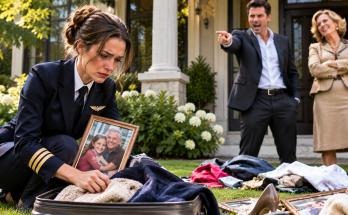
Two weeks after my husband died, my father arrived at the mansion I had shared with him, changed the locks, and told me I was no longer welcome inside. I was seven months pregnant, still wearing my wedding ring, and carrying the only suitcase I had managed to pack before his security guards blocked the entrance. My stepmother stood beside him, smiling as she admired the house she believed she was about to inherit. “You have nowhere to go now,” my father said. “Sign the documents, and perhaps I’ll let you keep a little money.” I didn’t beg. I didn’t scream. I called my late husband’s attorney. Twenty-five minutes later, a black sedan pulled through the gates, and the attorney stepped out carrying a sealed envelope. When my father saw the signature on the first page, his confidence vanished. “You should have read the agreement before changing those locks,” the attorney told him. “Because the moment you tried to take this house, you triggered the very clause your son-in-law put in place to stop you.”
Part 1 — The House My Father Thought He Could Steal
My name is Natalie Brooks. I was thirty-two years old when I discovered that losing my husband could also mean discovering who my family really was.
My husband, Ethan Brooks, died in a car accident on a rainy highway outside Philadelphia.
He was thirty-six.
We had been married for five years, and I was seven months pregnant with our first child.
Ethan was the kind of man who remembered the smallest details. He knew how I liked my coffee, which songs made me cry, and why I always checked the front door twice before going to bed.
He had built a successful technology consulting company from a small office above a bakery. Over the years, his business grew into a respected firm with several major corporate clients.
But Ethan never measured success by money alone.
He wanted a family, a home, and enough time to enjoy both.
Our mansion sat on several acres outside the city. It had a long driveway, a beautiful garden, and a nursery Ethan had spent an entire weekend decorating.
He had painted the walls pale yellow because he thought a soft color would make our daughter feel peaceful.
Beside the crib sat a stuffed elephant he had purchased during a business trip.
Whenever I walked into that room, I could almost hear him telling me that our little girl would have the happiest childhood imaginable.
Then the accident happened.
I received the call while folding baby clothes in the living room.
A police officer asked whether I was Ethan’s wife.
I said yes.
He asked me to sit down.
I knew before he finished speaking.
The next several days were a blur of funeral arrangements, condolences, paperwork, and sleepless nights. Ethan’s sister stayed with me because I was too frightened to be alone.
My father, William Carter, attended the funeral wearing a black suit and an expression of solemn concern.
To everyone else, he looked like a grieving father who wanted to protect his daughter.
I knew better.
My father had spent most of my childhood treating love as something I had to earn.
He criticized my decisions, dismissed my accomplishments, and expected me to follow his instructions without question.
When my mother died, he became even more controlling.
He later married Sabrina, a woman twenty-seven years younger than him who enjoyed luxury shopping, expensive vacations, and reminding everyone that she was the most important person in the room.
Sabrina and I had never been close.
She disliked Ethan because he refused to let my father interfere in our marriage.
Whenever my father criticized me, Ethan calmly reminded him that I was an adult and that our decisions belonged to us.
My father never forgave him for that.
After Ethan’s funeral, I hoped my father might finally put aside his resentment.
Instead, he waited until I was alone.
Two weeks after the funeral, I returned from a prenatal appointment and found a black SUV parked across the driveway.
Two security guards stood beside the front entrance.
My father was waiting on the steps.
Sabrina stood behind him wearing a cream-colored coat and sunglasses.
I stopped walking.
“What’s happening?”
My father held up a set of keys.
“I’ve changed the locks.”
For a moment, I thought I had misunderstood him.
“Why?”
“Because this property needs to be secured while the estate is settled.”
I stared at him.
“This is my home.”
He sighed impatiently.
“Natalie, don’t make this difficult. Ethan is gone, and you have a child coming. You cannot possibly manage this place alone.”
I walked toward the entrance.
“Move aside.”
One of the guards stepped in front of me.
I turned to my father.
“Tell him to move.”
My father didn’t.
Instead, he handed me a thick folder.
“These are documents authorizing me to manage the property and certain financial matters. Sign them, and I’ll make sure you’re taken care of.”
I opened the folder.
The first page appeared to give him authority to act on behalf of Ethan’s estate.
The second contained a proposed agreement requiring me to surrender certain claims relating to the house.
I felt my stomach tighten.
“Who prepared these?”
“An attorney.”
“Which attorney?”
“That doesn’t matter.”
“It matters to me.”
His expression hardened.
“You have always been difficult when someone tries to help you.”
Sabrina laughed softly.
“William, she is grieving. She doesn’t understand that the practical decisions need to be made by someone capable.”
I looked at her.
“You have no authority over my home.”
She smiled.
“Perhaps not yet.”
Those two words chilled me.
I turned back to my father.
“Ethan and I owned this property together. My name is on the deed. You cannot simply change the locks and tell me to leave.”
My father stepped closer.
“Do not lecture me about property.”
“Then stop trying to take mine.”
His face turned red.
He grabbed the suitcase I had brought from the car and threw it onto the driveway.
It landed on its side, and several baby clothes spilled onto the pavement.
I stared at the tiny pink blanket lying near his shoes.
Something inside me broke.
“Pick that up,” I whispered.
He folded his arms.
“What?”
“The baby’s blanket. Pick it up.”
Sabrina laughed.
“Oh, Natalie. Don’t turn this into a performance.”
I bent carefully to retrieve the blanket, one hand supporting my stomach.
My father pointed toward the road.
“You need to leave.”
I looked at the guards.
Then at the house.
Then at the man who had raised me.
“You are throwing your pregnant daughter out of her own home?”
“I’m making a necessary decision.”
“No. You’re making a decision you think I won’t challenge.”
He stepped toward me.
“Sign the papers, and we can avoid an ugly dispute.”
I straightened slowly.
“I’m not signing anything.”
His eyes narrowed.
“Then you can find somewhere else to live.”
I felt frightened, but beneath the fear was a clarity I had not experienced in years.
I took out my phone.
My father smirked.
“Who are you calling? Ethan’s sister?”
“No.”
I called Ethan’s attorney, Jonathan Reed.
Jonathan had handled our property documents and helped Ethan prepare his estate plan.
He answered immediately.
“Natalie? Is everything all right?”
“No. My father has changed the locks on our house and is trying to make me sign documents giving him control of the property.”
Jonathan became silent for a moment.
“Have you signed anything?”
“No.”
“Good. Don’t sign anything, and don’t attempt to force your way inside. If you feel unsafe, contact the police. I’m going to review the property documents and come to you.”
I looked at my father.
“He says he has authority over the estate.”
Jonathan’s voice became firm.
“Mr. Carter has no authority simply because he is your father. We need to establish exactly what documents he is relying on.”
My father stepped closer.
“Give me that phone.”
I moved away.
Jonathan heard him.
“Natalie, stay somewhere safe. I’m contacting the estate administrator now.”
He paused.
“There is something else you need to know. Ethan asked me to prepare a special set of instructions several months ago. He was concerned that someone might try to interfere with your property rights after his death.”
My heart began pounding.
“What kind of instructions?”
“I need to verify the complete documents before explaining them. But I can tell you that Ethan made specific arrangements to protect your interests and the baby’s.”
I looked at the mansion.
My father stood at the entrance as though he had already won.
Sabrina was examining the front windows, apparently deciding where she wanted to put her furniture.
I felt tears gather in my eyes.
But I refused to let them see me cry.
“Jonathan,” I said, “please come as soon as you can.”
“I’m on my way.”
I ended the call.
My father laughed.
“You think an attorney is going to save you?”
“No,” I replied. “I think the truth will.”
He turned toward the guards.
“Keep her away from the entrance.”
I picked up my suitcase and moved toward my car.
As I did, Jonathan sent me a message.
Do not sign or surrender anything. I have found the clause Ethan asked me to prepare. Your father needs to see it before he takes another step.
I read the message twice.
Then I looked back at the house.
For the first time since Ethan died, I felt that he had left me something stronger than money.
He had left me a way to stand up for myself.
And my father had no idea what was coming.
Part 2 — The Clause Ethan Prepared in Secret
Jonathan arrived twenty-five minutes later.
He stepped out of a black sedan carrying a leather briefcase and a thick envelope.
My father immediately walked toward him.
“You’re wasting your time. This is a family matter.”
Jonathan stopped several feet away.
“Mr. Carter, property ownership and estate administration are legal matters. I recommend that we discuss the documents calmly.”
Sabrina folded her arms.
“We have documents proving that William is authorized to handle everything.”
Jonathan looked at the folder she was holding.
“Then we should examine them.”
He asked everyone to remain outside while he reviewed the paperwork. My father refused at first, but he eventually agreed to speak with Jonathan near the front entrance.
I stood beside my car, holding the suitcase that contained my daughter’s clothes.
Jonathan opened his briefcase.
“The first issue is the house,” he said. “The deed identifies Ethan and Natalie as co-owners. Any transfer must follow the applicable ownership documents and estate procedures.”
My father scoffed.
“Ethan is dead. Someone has to manage the property.”
“Correct. But that does not mean you automatically become that person.”
Jonathan placed a copy of the deed on the table near the entrance.
“The second issue is the document you have asked Natalie to sign. It purports to give you authority to act on her behalf and surrender certain property claims. She has not signed it, and she has not authorized you to represent her.”
My father looked toward me.
“She doesn’t understand what she’s doing.”
Jonathan replied calmly.
“She has independent legal representation available to her. She is entitled to make her own decisions.”
Sabrina interrupted.
“This is ridiculous. William is trying to protect the family.”
Jonathan opened the envelope.
“Then you should have no objection to reviewing the provisions Ethan put in place.”
He removed a document and placed it on the table.
The heading referred to a set of estate administration instructions and conditions attached to a separate business agreement.
I recognized Ethan’s signature at the bottom.
My father leaned forward.
“What is that?”
Jonathan explained that Ethan had updated several arrangements before his death. Some related to his company, while others addressed how certain assets would be managed if he died unexpectedly.
The documents did not give me automatic ownership of every business asset. They established procedures for handling his interests and protecting the people he had named.
One provision required an independent review if anyone attempted to obtain control of specified assets through an unauthorized representation or an unverified transfer request.
If the trustee or company received conflicting instructions, the disputed transaction had to be paused until the relevant authority was established.
My father frowned.
“That has nothing to do with this house.”
“Not directly,” Jonathan said. “But it does affect your claim that you can manage the estate and represent Natalie.”
He showed my father another page.
It listed the people authorized to communicate with the trustee and the company.
My father was not among them.
The documents also identified the independent professionals responsible for reviewing disputed instructions.
Jonathan continued.
“Your request to manage the property and estate cannot proceed simply because you have delivered a set of papers. We need to establish whether those papers are valid and whether you have any legal authority to act.”
My father looked at the guards.
“Who told you to change the locks?”
Sabrina suddenly became interested in the ground.
Jonathan turned to my father.
“That is a question you should answer.”
My father hesitated.
Then he said that he believed the property was about to become part of a complicated estate and that he wanted to secure it.
Jonathan replied that changing the locks did not establish ownership or authority.
He also advised my father that I should have access to my home according to the applicable property rights and any valid court orders.
There was no court order requiring me to leave.
The guards stepped away from the entrance.
Sabrina’s face tightened.
“This is not how William said it would work.”
My father shot her a warning look.
I heard the words and felt a cold sensation in my stomach.
“What did he tell you?”
Neither of them answered.
Jonathan asked my father to provide copies of every document he had relied on and to preserve any communications concerning the proposed transfer.
He also notified the relevant estate representatives that a dispute had arisen.
The independent trustee confirmed that no change would be made to the existing arrangements until the documents were reviewed.
That was when my father finally began to look worried.
But Jonathan was not finished.
He opened a second folder.
“Ethan also asked me to preserve a letter for Natalie. He wanted her to receive it if anyone attempted to pressure her into surrendering her rights.”
He handed it to me.
The envelope had my name written in Ethan’s familiar handwriting.
My knees felt weak.
I sat on the edge of a chair and opened it.
Natalie, my love,
If you’re reading this, I wish more than anything that I were beside you. I hope you never need this letter. But if someone tries to make you feel helpless after I’m gone, I want you to remember that we prepared for the future together.
You do not have to surrender your judgment to keep the peace.
You do not have to sign something you do not understand.
And you do not have to allow anyone to control your life because they claim to know what’s best for you.
I have arranged for independent people to help administer my affairs. They know your rights, and they know how important our daughter’s future is to me.
Trust the people who respect your choices.
And trust yourself.
I love you, always.
I pressed the letter against my chest.
For a moment, I could almost hear Ethan’s voice.
I cried quietly, not because I felt defeated, but because I missed him so much that even his handwriting felt like a gift.
Jonathan waited until I was ready.
“There’s one more issue,” he said gently.
He explained that a request had recently been sent to one of Ethan’s business representatives, claiming that my father had permission to discuss certain estate matters on my behalf.
I had never given that permission.
The company had not accepted the request. Instead, it had referred the matter to the appropriate legal representatives for verification.
Jonathan had now provided written confirmation that my father was not authorized to act for me.
“We don’t yet know who prepared the request or whether it was submitted with any intention to mislead,” he said. “That needs to be established from the records.”
I nodded.
I didn’t need to decide what kind of man my father was in that moment.
I needed to protect myself and let the evidence speak.
By late afternoon, the situation had changed completely.
The guards had left.
My father no longer had a credible basis for keeping me away from the property.
The estate representatives had been notified, and the disputed instructions were under review.
Jonathan advised me to have the locks changed again through a legitimate locksmith, retain copies of the relevant records, and avoid direct confrontation.
I followed his advice.
As the locksmith arrived, Sabrina stood beside the driveway with her arms crossed.
“You’ve turned this into a war,” she said.
I looked at her.
“No. I stopped pretending that you could take my home without consequences.”
She opened her mouth but said nothing.
My father remained near the gate.
For years, he had been the person who decided when a conversation ended, when I was allowed to disagree, and what I was expected to do.
Now he was watching someone else change the locks.
I entered the house and walked directly to the nursery.
The tiny stuffed elephant was still on the windowsill.
I picked it up and held it against my chest.
Then I whispered to my daughter, “We’re staying.”
But I knew the dispute was not completely over.
The documents still needed to be reviewed, and my father’s actions might have consequences beyond the property.
The next few weeks would determine how the estate and business arrangements were handled.
And when Jonathan called the following morning, he had news that could change everything.
Part 3 — The Day My Father Learned He Wasn’t in Control
The call came at nine o’clock on a Monday morning.
I was sitting in the nursery, sorting tiny clothes into drawers, when Jonathan asked me to join a meeting with the estate administrator.
He sounded serious but calm.
“The initial review is complete,” he said. “Your father has no authority to manage your property or represent you in the estate matters. The trustee has confirmed that the existing arrangements remain in place.”
I closed my eyes in relief.
“What about the documents he brought?”
“The proposed transfer has not been accepted. The estate representatives are examining the documents and the communications surrounding them. If further action is warranted, it will be handled through the appropriate channels.”
I appreciated that Jonathan didn’t promise a dramatic victory.
He promised something better: a process based on evidence.
The meeting took place that afternoon.
The estate administrator confirmed that Ethan’s property interests would be handled according to the deed, his will, and the applicable law.
The independent trustee would continue managing the assets assigned to the trust under its terms.
My father could not take control simply because he wanted to.
He could not sign on my behalf.
He could not order the sale of the house without the required legal authority.
And he could not force me to surrender my rights by threatening to withdraw his support.
For the first time, I felt the full weight of what Ethan had done for us.
He had not tried to control the future from beyond the grave.
He had created a system that allowed the right people to make decisions according to clear rules.
That distinction mattered.
Over the following weeks, the legal representatives reviewed the disputed documents and preserved the relevant communications.
My father was asked to explain why he had claimed authority he did not possess.
I was not told to make accusations, and I did not.
I simply confirmed the facts.
I had never authorized him to manage my property or represent me in Ethan’s estate.
I had never signed the proposed transfer.
And I had never agreed to leave my home.
The property remained in my possession while the estate was administered.
The business interests were handled under Ethan’s agreements, with independent professionals reviewing the relevant decisions.
I did not automatically inherit every company asset, and I did not need to.
I needed the arrangements to be respected and my daughter’s future to remain secure.
That was enough.
My father tried to contact me several times.
At first, he sent angry messages accusing me of humiliating him.
Then he left a voicemail saying that he had only been trying to help.
I did not respond immediately.
Jonathan advised me to keep communication in writing and to avoid discussing the disputed documents without legal guidance.
I followed his advice.
Two months later, my father requested a meeting.
I agreed to a short conversation at Jonathan’s office.
He arrived without Sabrina.
For several seconds, he looked at me without speaking.
Then he said, “I never intended to hurt you.”
I felt a familiar ache in my chest.
For years, I had waited to hear those words.
But I had learned that intentions did not erase consequences.
“You changed the locks on my home while I was grieving,” I said. “You tried to make me sign documents I didn’t understand, and you told me I had nowhere to go.”
“I thought you needed someone to take charge.”
“I needed support. I did not need someone to take away my choices.”
He lowered his eyes.
“I was worried about the money and the estate.”
“Then you should have spoken to the attorney. You should have asked what I needed instead of deciding for me.”
He remained silent.
Finally, he asked whether I would let him meet his granddaughter when she was born.
I looked at him carefully.
I wanted my daughter to have a loving family.
But I would not expose her to the same behavior I had spent my life trying to escape.
“If you want a relationship with her, you need to respect my boundaries,” I said. “You cannot enter my home without permission. You cannot make decisions about my finances. And you cannot use her to pressure me.”
He looked hurt.
“I’m her grandfather.”
“That relationship matters. But it doesn’t give you ownership of my life.”
He nodded slowly.
I did not promise to forgive him immediately.
I told him that trust would have to be rebuilt through consistent actions.
Then I left the office.
In the months that followed, I focused on preparing for my daughter’s arrival.
I changed the locks, updated the security system, and organized the estate documents.
Ethan’s sister helped me finish the nursery.
We placed the stuffed elephant beside the crib and hung a photograph of Ethan above the dresser.
Sometimes I sat in the rocking chair and imagined him holding our daughter.
I cried often.
Grief did not disappear simply because I had solved a legal problem.
But I no longer felt helpless.
I had a home.
I had a plan.
And I had learned that asking for help was not a sign of weakness.
When my daughter was born, I named her Grace.
She arrived healthy, and when the nurse placed her in my arms, I felt a kind of love that made the entire world seem quiet.
I looked at her tiny face and made a promise.
She would never have to earn my love by obeying me.
She would never be told that family meant accepting humiliation.
And she would never be taught that money gave someone the right to control another person.
A year later, I celebrated Grace’s birthday in the garden.
There were balloons, a small cake, and a few close friends.
Ethan’s photograph stood beside the flowers.
As everyone sang, Grace reached toward the candle and laughed.
I held her close and remembered the day my father had thrown my suitcase onto the driveway.
I remembered the fear of losing everything.
But I also remembered the phone call that changed the direction of my life.
Jonathan had not rescued me with magic words.
He had helped me understand the documents, establish my rights, and take the proper steps to protect myself.
Ethan had not left me a guarantee that life would be easy.
He had left me a plan and the confidence to use it.
And I had finally learned that I did not need my father’s approval to build a peaceful future.
My father eventually sent another letter.
He acknowledged that he had been wrong to force me out and apologized for the way he had treated me.
I appreciated the apology.
But I did not immediately return to the relationship we had before.
Forgiveness and trust were different things.
I could hope he would become a better man without allowing him to control my life again.
I could love him without surrendering my boundaries.
And I could protect my daughter without teaching her to hate anyone.
That was the future I wanted.
Not revenge.
Not humiliation.
Just peace.
My father thought he could take my home because I was grieving, pregnant, and too overwhelmed to fight back. He believed that if he spoke loudly enough and brought enough paperwork, I would surrender everything Ethan and I had built. But my husband had prepared for the possibility that someone might try to interfere, and I finally found the courage to stand up for myself.
I did not win by destroying my father.
I won by refusing to let him decide what I deserved.
I protected my home, followed the legal process, and created a safer future for my daughter.
And I learned a lesson I will carry for the rest of my life:
The people who love you should help you stand—not make you kneel to prove that you belong.