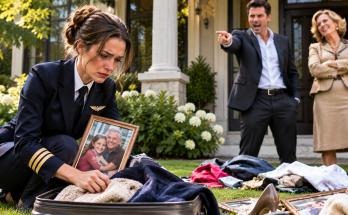
The Night Before My Wedding, I Overheard My Fiancé Planning to Take My Inheritance—So I Let Him Walk Into the Wedding He Would Never Forget
The night before my wedding, I returned to my fiancé’s mother’s mansion to retrieve a diamond bracelet I had forgotten. I expected to be inside for less than a minute. Instead, I heard my future mother-in-law say, “Once the marriage certificate is signed, we can finally get our hands on her father’s estate.” My fiancé laughed. “She trusts me completely. By next month, everything will be under my control.” I stood outside that half-open door, holding the bracelet my late father had given me, listening to the man I planned to marry explain exactly how he intended to use me. I didn’t scream. I didn’t confront him. I quietly recorded their conversation, walked back to my car, and made one phone call to my attorney. The next morning, I arrived at the wedding in a white dress, carrying a small envelope. My fiancé thought he was about to become a very wealthy husband. He had no idea that before the ceremony ended, his entire family would be begging me to explain what was inside that envelope.
Part 1 — The Conversation Behind the Door
My name is Natalie Hayes. I was thirty-three years old, successful in my career, and less than twelve hours away from marrying the man I believed was the love of my life.
My fiancé, Christopher Reed, and I had been together for four years.
He was charming, ambitious, and the kind of man who remembered every detail about the people he wanted to impress. He sent flowers to my office, planned romantic weekends, and always knew exactly what to say when I had a difficult day.
My friends adored him.
My colleagues thought I was lucky.
Even my late father, who had distrusted almost everyone I dated, had eventually admitted that Christopher seemed like a good man.
That was what made the truth so difficult to accept.
My father, Richard Hayes, had built a regional construction company from a single used truck and a handful of employees. By the time he retired, the business had grown into a valuable family enterprise with commercial properties, investments, and several long-term contracts.
He died two years before my wedding after a sudden heart attack.
His death left a hole in my life that money could never fill.
But he had prepared carefully for the future.
His will provided for me, and the family assets were administered through an estate plan designed with independent legal advice. Some of the investments were held in a trust, while other assets remained subject to the estate’s administration and business agreements.
I had learned enough from watching my father manage his affairs to understand one important principle.
Being wealthy did not mean I had to let someone else control my money.
Christopher knew that I had inherited a substantial estate, but he had never asked for exact figures. He always insisted that he loved me for who I was.
“I don’t care whether you own a mansion or live in a studio apartment,” he once told me. “I just want you.”
I believed him.
His mother, Patricia Reed, was another matter.
Patricia lived in an enormous stone house outside Boston. She wore designer clothes, hosted charity dinners, and spoke about people as if she were evaluating their market value.
From the beginning, she had treated me with a strange combination of affection and scrutiny.
She complimented my dresses, then asked how much they cost.
She praised my career, then suggested I would eventually abandon it once Christopher and I had children.
Whenever I mentioned my father, she asked increasingly specific questions about his company and investments.
I dismissed those questions as curiosity.
Christopher always reassured me.
“Mom is just interested in business,” he would say. “She likes to understand how people live.”
I wanted to believe that explanation.
The wedding had been planned for almost a year. The venue was a historic estate with gardens, a glass conservatory, and a ballroom that could accommodate two hundred guests.
My dress had been fitted twice.
My bridesmaids had arrived from different states.
The photographer had confirmed the schedule, and the florist had delivered samples of the white roses I had chosen.
Everything was ready.
On the evening before the wedding, Patricia invited me to her home for a small family gathering.
Christopher was there, along with his younger sister, Lauren.
We ate dinner in the formal dining room and discussed the ceremony.
Patricia raised her glass.
“Tomorrow, Natalie officially becomes part of our family.”
She smiled at me.
“I have waited a long time for this.”
At the time, I thought she meant she had waited a long time to see her son married.
Now, I understand that she meant something entirely different.
After dinner, Christopher received a call from one of his business partners. He stepped into the study to answer it.
Patricia asked me to help her look at some photographs for the wedding slideshow.
Lauren sat on the sofa, scrolling through her phone.
I had left my father’s diamond bracelet on the side table near the entrance when I arrived. It was an old-fashioned piece with small diamonds set in white gold, and I wore it only on important occasions.
My father had given it to me on my twenty-first birthday.
He had told me that it had belonged to my grandmother.
I didn’t want to lose it, so I decided to retrieve it before leaving.
“I’m going to grab my bracelet,” I told Patricia.
She waved casually.
“Of course, darling. It’s probably near the front hall.”
I walked toward the entrance.
The bracelet wasn’t on the table.
I checked my handbag, then remembered placing it on a small console near the study.
As I approached the hallway, I heard Christopher’s voice.
“Tomorrow changes everything.”
I stopped.
The study door was almost closed, but not completely.
Patricia answered him.
“Are you certain she hasn’t changed her mind about the financial agreement?”
Christopher laughed.
“Natalie trusts me. She thinks we’re building a future together. She won’t question anything I ask her to sign.”
My hand went cold.
I leaned closer to the doorway.
Patricia lowered her voice.
“Your father and I have waited long enough. That investment group won’t give us another extension. We need capital, and Natalie’s inheritance could solve the entire problem.”
Christopher sighed.
“Once we’re married, I can tell her that combining our finances is the responsible thing to do. I’ll say it’s about protecting our future children.”
“And if she refuses?”
“She won’t. I’ll tell her that if she really trusts me, she shouldn’t need separate accounts or lawyers reviewing every little thing.”
Patricia chuckled.
“You know exactly how to handle her.”
I felt as though the floor had shifted beneath me.
For four years, I had believed Christopher wanted a life with me.
Now I was hearing him describe my trust as a weakness he intended to exploit.
Then he said something that made my heart pound.
“The important thing is getting her to sign the authorization before she starts asking questions. Once the paperwork is submitted, we can discuss refinancing the properties and moving money into the new investment company.”
Patricia paused.
“What about the prenuptial agreement?”
Christopher laughed again.
“She thinks it protects her. It does protect her from certain things, but she hasn’t read the additional business proposal I sent her last week. She assumes it’s just paperwork for our financial adviser.”
I gripped the edge of the hallway table.
I remembered that document.
Christopher had sent me a series of forms two weeks earlier, explaining that his accountant needed some information before the wedding.
I had not signed them.
I had forwarded them to my attorney for review.
My attorney had told me that some of the language was unusually broad and that I should not sign anything until we discussed it in detail.
I had planned to speak with Christopher after the wedding.
Now I understood why he had been so eager for me to sign.
Patricia spoke again.
“And the company shares?”
Christopher answered confidently.
“We’ll deal with those later. The immediate goal is access to the investment accounts and enough authority to negotiate with the bank. Once the company is stable, we can work out the rest.”
I felt sick.
He wasn’t simply hoping I would help him financially.
He had been planning to use our marriage to gain access to assets that did not belong to him.
Then Lauren’s voice drifted from the living room.
“Are you two still talking about the money?”
Christopher sounded irritated.
“Keep your voice down.”
Lauren laughed.
“I’m just saying, Natalie is much easier to convince than you think. She wants a family so badly that she’ll do almost anything to keep everyone happy.”
Patricia replied, “Exactly. She’s been alone since her father died. Christopher is the future she wants, and she won’t risk losing it over a few signatures.”
I closed my eyes.
My father had died, and I had spent two years learning how to live without him.
Christopher had watched me grieve.
He had held me when I cried.
He had listened to me talk about the future I wanted.
And he had apparently been using all of that knowledge to calculate how much pressure I would tolerate.
I reached into my handbag and quietly opened my phone.
I did not know whether I should record the conversation. I only knew I needed to remember exactly what I had heard, and I wanted to avoid confronting them while I was alone in their house.
I started an audio recording, keeping the phone close to my side.
Christopher continued speaking.
“After the wedding, I’ll ask her to meet with the financial adviser. I’ll tell her it’s routine. By the time she realizes what the authorization allows, we’ll already have the financing arranged.”
Patricia sounded pleased.
“And if she finds out?”
“She won’t leave me. Not after everything we’ve planned.”
A terrible calm settled over me.
I had been so worried about whether Christopher loved me that I had ignored the question of whether he respected me.
Now I had my answer.
I stepped away from the door.
I didn’t burst into the study.
I didn’t throw my engagement ring at him.
I didn’t give him the satisfaction of watching me fall apart.
I found my bracelet on the console table, slipped it into my handbag, and walked toward the front entrance.
Patricia called after me.
“Leaving already, Natalie?”
I turned and forced myself to smile.
“I’m tired. Tomorrow is going to be a long day.”
She approached and kissed my cheek.
“Get some rest, darling. You’ll want to look your best.”
I looked directly into her eyes.
“I intend to.”
Then I left.
Outside, the night air felt cold against my skin.
I sat in my car without turning on the engine.
My engagement ring glittered beneath the dashboard light.
I had imagined wearing it for the rest of my life.
Now it looked like a warning.
I called my attorney, Evelyn Brooks.
She answered on the second ring.
“Natalie? Is everything all right?”
“No,” I whispered. “I think my fiancé is planning to use our marriage to get control of my inheritance.”
Evelyn did not interrupt.
I told her what I had heard, explained the documents Christopher had sent me, and described the conversation in as much detail as I could remember.
Then I sent her the recording.
She listened while I waited.
When she called back, her voice was serious.
“First, do not sign any financial documents. Second, do not send Christopher the recording or confront him tonight. We need to review the proposed authorization and establish exactly what it would permit.”
I swallowed.
“What should I do about the wedding?”
“That is your decision. But you should not enter a marriage under pressure, and you should not sign documents you don’t understand.”
I looked through the windshield at the city lights.
“Evelyn, I don’t think he ever intended to build a life with me.”
She paused.
“Then let’s make sure he cannot use your trust to put your future at risk.”
I ended the call and sat quietly for another minute.
Then I removed my engagement ring.
I placed it in the small compartment beneath the dashboard and started the car.
I was not going to marry Christopher Reed.
But I was not going to make a decision based on anger alone.
Before I canceled anything, I wanted the facts reviewed, my finances protected, and the wedding arrangements handled safely.
Christopher believed that the next day would give him access to my future.
He had no idea that I had already begun taking it back.
Part 2 — The Bride Who Refused to Sign
I barely slept that night.
Every time I closed my eyes, I heard Christopher saying that I wanted a family so badly I would do almost anything to keep one.
The words hurt because they were partly true.
I had wanted a family.
After losing my father, I had imagined that marrying Christopher would give me a new beginning. I had pictured Sunday dinners, children running through the garden, and a home filled with the kind of warmth I had missed after my father’s death.
I had mistaken the future I wanted for proof that Christopher wanted the same thing.
At seven the next morning, Evelyn called.
She had reviewed the financial documents Christopher had sent me.
“The proposed authorization is broader than he described,” she explained. “It could allow a representative to negotiate certain financing arrangements and access information about specified assets. It does not automatically transfer ownership of your entire estate, but signing it without clear limits could create serious problems.”
I sat on the edge of my bed.
“Could he take my father’s properties?”
“Not simply by signing this document. Property ownership, trust assets, and business interests are governed by separate agreements and legal requirements. But the authorization could give him opportunities to pursue transactions you may not want. We should not allow that ambiguity to continue.”
I closed my eyes.
“So he lied.”
“His statements about the purpose of the document do not match its language. We need to preserve the original emails and all related communications.”
Evelyn advised me to secure my accounts, contact my financial institutions if any unauthorized access was suspected, and avoid signing anything at the wedding.
She also reminded me that canceling a wedding could involve contractual obligations, so she would help me communicate with the venue and vendors.
I thanked her.
Then I called my best friend, Sienna.
She arrived twenty minutes later wearing sweatpants and carrying two coffees.
I told her everything.
When I finished, she sat silently for several seconds.
“Are you sure you don’t want me to drive to his house and throw something through a window?”
I almost laughed.
“Please don’t.”
“Fine. I’ll settle for helping you cancel the wedding.”
I looked at the dress hanging beside the window.
“I can’t believe I’m doing this.”
Sienna took my hand.
“You’re not ruining your wedding. You’re stopping yourself from marrying someone who was planning to take advantage of you.”
Those words helped me breathe.
At eight o’clock, the makeup artist arrived at the hotel suite.
I thanked her, explained that the wedding would not proceed, and asked her to wait while I contacted the coordinator.
I didn’t want to embarrass the vendors or leave them without information.
The wedding planner was shocked but professional. She helped me notify the venue and arrange the necessary cancellations.
Some deposits were nonrefundable.
I accepted that.
Losing money was painful, but it was nothing compared with spending years in a marriage built on deception.
At nine fifteen, Christopher called.
I watched his name flash across my phone.
I let it ring.
Then a message appeared.
Good morning, beautiful. Today is our day. I can’t wait to see you walk down the aisle.
I stared at the screen.
For four years, that message would have made me smile.
Now it felt like a performance.
I didn’t reply.
A second message arrived.
Don’t forget the financial documents I sent. My adviser needs them next week.
I took a screenshot and forwarded it to Evelyn.
Then I blocked him temporarily while we worked out the safest way to communicate.
At ten o’clock, Christopher called Sienna.
She put him on speaker only after checking with me.
“Where is Natalie?” he demanded.
“She’s safe,” Sienna replied.
“What does that mean? She’s supposed to be getting ready.”
“Christopher, the wedding is canceled.”
Silence.
Then he laughed.
“That’s not funny.”
“I’m not joking.”
He began shouting.
He demanded to know who had put the idea into my head. He accused Sienna of interfering in our relationship and threatened to come to the hotel.
Sienna ended the call.
Evelyn advised me not to meet him alone and to direct any necessary communication through her office.
Then Christopher’s mother called.
Patricia’s voice was smooth and controlled.
“Natalie, darling, Christopher tells me you’re having some kind of emotional crisis.”
I felt my hands tighten around the phone.
“I’m not having a crisis.”
“Of course you are. Weddings are stressful. You have been under a great deal of pressure, and perhaps you misunderstood something you overheard last night.”
I said nothing.
She continued.
“Christopher loves you. He has worked so hard for this marriage. You cannot throw away four years because of a private conversation about business.”
I looked at the bracelet in my handbag.
“What exactly did I misunderstand?”
She paused.
“Money can make people sound cold. That’s all.”
“Did you discuss getting access to my inheritance after the wedding?”
Her voice hardened.
“We were discussing the future.”
“Did Christopher plan to tell me the authorization was routine when he knew it gave him broader powers?”
Another pause.
“Natalie, you are being unfair.”
“No. I’m asking questions.”
Patricia sighed dramatically.
“Your father would be ashamed to see you behave this way.”
That was the moment I stopped feeling uncertain.
My father had taught me to ask questions and protect what I had worked for.
Patricia was trying to use his memory to silence me.
“Do not use my father to pressure me,” I said. “Any further communication about the documents should go through my attorney.”
I ended the call.
For the first time that morning, I cried.
Sienna wrapped her arms around me.
I cried for the man I thought Christopher was.
I cried for the wedding I had planned.
I cried for the future I had imagined.
But I did not change my decision.
At noon, Evelyn contacted Christopher’s attorney and formally notified him that I would not sign the proposed authorization and that the wedding had been canceled.
She requested that all relevant communications be preserved and that no one attempt to access or alter my financial arrangements.
Christopher’s attorney replied that he had not been informed of the alleged conversation and would review the documents.
That was the first moment I realized something important.
Christopher’s family had assumed that I would be too embarrassed to explain why I canceled the wedding.
They expected me to protect his reputation.
They expected me to stay quiet.
But I did not owe them silence.
I owed myself honesty.
Later that afternoon, Christopher sent an email through his attorney.
He claimed that the financial authorization had been intended to simplify future planning and that he had never intended to take my inheritance.
He denied planning any unauthorized transfer.
I read the message carefully.
Then I listened to the recording again.
The difference between his explanation and his words in Patricia’s study was impossible to ignore.
Still, Evelyn advised me not to make public accusations or post the recording online.
“We have what we need for the legal review,” she said. “Let the documents and communications speak for themselves. You don’t need to turn this into a public fight.”
I agreed.
That evening, I returned to my apartment and took off the dress I had planned to wear to the rehearsal dinner.
I folded it carefully and placed it in its garment bag.
Then I sat beside the window and watched the city lights come on.
The wedding was over before it had begun.
But my life was not.
For the first time in months, I was making a decision based on what I knew rather than what I hoped.
And there was one final thing I needed to do.
I needed to return the ring.
Part 3 — The Envelope That Ended Everything
Christopher asked to meet me three days later.
Evelyn advised that if I agreed, we should meet in a public place and keep the conversation focused on practical matters.
I chose a conference room at her office.
Christopher arrived wearing the navy suit he had planned to wear at the wedding.
He looked exhausted.
For a moment, seeing him brought back every happy memory I had tried to put aside.
Our first date.
The weekend he surprised me with a trip to the coast.
The evening he told me he wanted to spend his life with me.
I had loved him.
That was the hardest part.
He sat across from me and stared at the engagement ring on the table.
“You’re really doing this?”
“Yes.”
He shook his head.
“You heard one conversation and decided four years meant nothing.”
“I heard you discussing how to get access to my inheritance without being honest about what the documents would allow.”
“I was talking about financial planning.”
“You said you wanted to make me emotional so I would sign.”
He opened his mouth, then closed it.
I continued.
“You said I wanted a family so badly that I would do anything to keep one. You said I wouldn’t leave you. You described my trust as something you could use against me.”
He leaned forward.
“I was under pressure. The company has debts, and the investment group is threatening to pull out. My mother was panicking. I didn’t mean it the way it sounded.”
I looked at him.
“Then why didn’t you tell me the truth?”
He stared at the table.
“I was afraid you’d say no.”
That answer hurt more than any excuse.
Because it was honest.
He had known I might refuse if I understood the full situation.
So he had planned to persuade me through guilt and emotional pressure instead.
“Christopher, if you had come to me and explained the business problems honestly, I might have considered helping you. We could have spoken to independent advisers and discussed reasonable options.”
He looked up quickly.
“Then we can still do that.”
“No.”
“Why not?”
“Because I cannot build a marriage with someone who sees my boundaries as obstacles to overcome.”
He rubbed his face.
“I love you.”
I wanted to believe him.
Perhaps he did love me in his own way.
But love was not enough when trust had been deliberately used as leverage.
“I don’t know what you feel,” I said. “I know what you planned to do. And I know I cannot marry you.”
He looked at the ring.
“Is there anything I can say?”
I shook my head.
He sat silently for a long time.
Finally, he asked whether I would give him the recording.
“No. My attorney will retain it as part of the legal record. I will not publish it or use it to threaten you.”
He looked surprised.
“You could ruin me with that.”
“I’m not trying to ruin you. I’m protecting myself.”
I slid the ring across the table.
“This belongs to you now.”
He did not touch it.
I stood.
“Any further financial or legal issues should go through our attorneys.”
Then I left the room.
I did not feel triumphant.
I felt sad, tired, and strangely relieved.
The relationship was over, but the decision was finally mine.
Over the next several weeks, Evelyn worked with my financial advisers to confirm that my accounts and property arrangements remained secure.
The proposed authorization was withdrawn and was never used to transfer my assets.
The relevant communications were preserved in case any further questions arose.
Christopher’s business problems remained his responsibility to address through his company and its legitimate financing arrangements.
I did not become involved.
I also chose not to publish the recording or send it to our mutual friends.
People asked questions, of course.
Some assumed I had become frightened of marriage.
Others believed Christopher had done something terrible.
I gave only a brief explanation.
“We discovered a serious disagreement about financial trust and transparency. I decided not to proceed with the marriage.”
That was enough.
I did not need everyone to take my side.
I needed to move forward.
A month later, I visited my father’s grave.
I brought white flowers and wore the diamond bracelet he had given me.
The sky was gray, and the cemetery was quiet.
I sat beside the headstone and told him what had happened.
I told him I had nearly married a man who saw my inheritance as an opportunity.
I told him I had listened to the warning signs too late.
And I told him that I had finally understood the lesson he tried to teach me.
“Keep one thing in your own name,” he had once told me.
He had been talking about property.
But the lesson went deeper than that.
I needed to keep my judgment.
My independence.
My right to say no.
And my belief that I deserved a relationship built on honesty.
As I stood to leave, I felt the breeze move through the trees.
For the first time since the night outside Patricia’s study, I did not feel as though my future had been stolen.
I felt as though I had taken it back.
Months later, I moved into a new apartment closer to the lake. I kept my job, reconnected with friends I had neglected during the wedding preparations, and began traveling again.
I even took the vacation my father and I had once planned but never managed to make.
I went alone.
I walked along the water, ate dinner at small restaurants, and learned that solitude was not the same thing as loneliness.
I could enjoy my own company.
I could build a meaningful life without rushing to fill every empty space.
And I could love again someday without handing someone else the keys to my future.
Christopher eventually sent me a letter.
He apologized for the way he had handled the financial discussions and admitted that he had allowed fear about his business to influence his decisions.
I read it once.
Then I placed it in a drawer.
I did not reply.
I hoped he would learn from what had happened.
But his growth was no longer my responsibility.
I had spent enough time trying to understand the man I thought he was.
Now I wanted to understand the woman I was becoming.
One evening, while unpacking a box, I found the small photograph of my father that I had carried through three apartments.
I placed it on the shelf beside the bracelet.
Then I remembered my mother’s words from years earlier, when she had told me never to sign something simply because I trusted the person holding the pen.
I smiled sadly.
I had finally learned to listen.
The wedding that never happened became one of the most painful memories of my life.
But it also became the moment I stopped confusing promises with character.
Christopher had believed that love would make me surrender my judgment.
His mother had believed that my desire for a family would make me easy to control.
They had both underestimated me.
I did not expose them in front of two hundred guests.
I did not humiliate them online.
I simply refused to enter a marriage built on deception.
And sometimes, that is the strongest lesson a person can teach.
The night before my wedding, I thought I had lost the future I wanted. I didn’t realize I was being given the chance to save the future I actually deserved.
I had returned to that condo for a bracelet.
I left with the truth.
And the next morning, instead of walking down the aisle toward a man who planned to use my trust against me, I walked into a new chapter of my life with my independence, my dignity, and my father’s final lesson still close to my heart.
Love should never require you to surrender your safety.
Trust should never be used as a weapon.
And a wedding is never worth more than the life you will have to live after it.
Sometimes the bravest thing you can do is cancel the ceremony before the vows are spoken.
Because the right person will never need you to become powerless in order to prove that you love them.