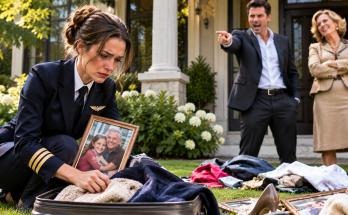
My Parents Humiliated My Adopted Daughter on Christmas—Then a Lawyer Revealed the Secret My Mother Had Buried for Six Years
My mother made my six-year-old adopted daughter wash dirty dishes while her biological granddaughters opened expensive Christmas presents. When I demanded an explanation, my father said, “That little girl needs to understand she will never have the same place in this family.” I was ready to take my daughter home and never look back—until I discovered a sealed envelope from a law firm hidden inside my mother’s desk. The moment she realized I had found it, she screamed, “Mauricio, you don’t understand what that letter means!” My father tried to snatch it from my hands. But when the attorney arrived and read the first paragraph aloud, my mother collapsed into a chair. The letter wasn’t about money alone. It contained a secret about my daughter’s past that could destroy everything my parents had spent six years hiding.
Part 1 — The Little Girl Nobody Wanted at the Christmas Table
My name is Mauricio DeLuca, and I used to believe that family meant standing together when life became difficult.
I was forty-one years old, a successful restaurant owner, and the proud father of a little girl named Renata.
Renata was adopted when she was two.
Her biological parents had died in an accident, and after a long legal process, I became the person she could call Dad.
From the first night she slept in my home, she changed my life.
She was quiet around strangers, loved drawing animals, and always asked permission before taking a cookie from the kitchen.
Whenever she became frightened, she reached for my hand.
I promised myself that she would never have to wonder whether she belonged.
Unfortunately, my parents had never fully accepted her.
My mother, Carmen, believed family relationships were defined by blood. My father, Mauricio Senior, believed a family name was something to protect at almost any cost.
My sister Paola had two daughters, Sofia and Emma, and my parents treated them like princesses.
They bought them designer clothes, expensive toys, and matching gold bracelets for every holiday.
Renata received occasional presents, usually something inexpensive that my mother claimed was more practical.
I tried not to compare gifts.
I told myself that affection could take time.
But the comments became harder to ignore.
When Renata called my mother Grandma, Carmen sometimes corrected her.
“Your real grandmother isn’t here, sweetheart.”
Renata never understood what she meant.
She would look at me with confused eyes, and I would pull her close.
“You can call her Grandma if you want,” I always told her. “You’re my daughter, and that’s what matters.”
Christmas was supposed to be different.
That year, I decided to host the celebration at my parents’ large home outside Boston. I thought a family gathering might help everyone grow closer.
I bought presents for all three girls.
Renata chose a little wooden art set for herself after seeing it in a store window. She wanted to paint pictures of our family.
On Christmas Eve, she wrapped a drawing in silver paper and told me it was a special gift for Grandma.
“I drew everyone,” she whispered. “Maybe she’ll put it on the wall.”
I kissed her forehead.
“She’ll love it.”
I should have known better.
When we arrived, the living room was glowing with Christmas lights. A tall tree stood beside the fireplace, surrounded by mountains of presents.
Sofia and Emma were already there, wearing matching red dresses.
Carmen greeted them with hugs and kisses.
Then she looked at Renata.
“Take your coat off and put it in the hallway.”
No hug.
No smile.
Renata obeyed.
For the first hour, everything seemed almost normal. The adults talked, the children played, and my father opened a bottle of expensive wine.
Then Paola announced that the girls were going to open their presents before dinner.
Sofia received a tablet.
Emma received a gold bracelet.
They screamed with excitement while my mother photographed every moment.
Renata sat quietly on the sofa, holding the wrapped drawing in her lap.
“Grandma,” she asked, “when can I open mine?”
Carmen barely looked at her.
“After we finish the kitchen.”
I frowned.
“What does that mean?”
“Someone has to help clean up,” my mother replied. “And the girls have already been very good today.”
Renata looked down at her shoes.
I was about to object when my father called me into the study to discuss a business matter.
I was gone for less than ten minutes.
When I returned, I heard my mother’s voice coming from the kitchen.
“Scrub harder, little one. You’re not here to decorate.”
I stopped in the doorway.
Renata stood on a wooden stool, washing a stack of greasy dishes. Her sleeves were wet, and her small hands looked red from the water.
Beside the sink sat plates covered in gravy, cake crumbs, and leftover food.
Across the hallway, Sofia and Emma were laughing as they opened another set of presents.
I stared at my mother.
“What are you doing?”
Carmen didn’t turn around.
“Teaching her responsibility.”
“She’s six years old.”
“Then she should learn to help.”
I looked at the room.
Paola was sitting at the kitchen island, eating a piece of cake. My father stood near the doorway, watching me with an irritated expression.
I pointed toward the living room.
“Why aren’t the other girls helping?”
My mother finally faced me.
“Those are my granddaughters.”
“And Renata is my daughter.”
My father set down his glass.
“Mauricio, don’t start a scene.”
I stepped toward the sink.
“Renata, sweetheart, come here.”
She carefully climbed down from the stool.
The moment her feet touched the floor, she ran to me and wrapped her arms around my waist.
“Daddy, I’m sorry.”
My heart broke.
“What are you sorry for?”
“I got water on Grandma’s floor.”
I knelt in front of her.
“You don’t have to apologize for that.”
She whispered something that made my blood run cold.
“Grandma said if I want to stay in the family, I have to be useful.”
I looked up at my mother.
She shrugged.
“Children need to understand their place.”
My father added, “Sofia and Emma are our blood. Renata needs to understand that she isn’t really one of us.”
For several seconds, I couldn’t speak.
I had spent years trying to earn my parents’ approval. I had convinced myself that if I remained patient, they would eventually love Renata the way I did.
But now my little girl was apologizing for existing in a room where she should have been welcomed.
I lifted her into my arms.
“Listen to me, Renata. You never have to earn your place in my family. You already belong.”
Her eyes filled with tears.
“Even if Grandma doesn’t want me?”
I held her tighter.
“Even then.”
I turned toward the living room.
“We’re leaving.”
Paola jumped up.
“You’re ruining Christmas over a few dishes?”
“No,” I said. “I’m ending a Christmas where my daughter is treated like a servant.”
My father stepped in front of the hallway.
“You’re being ridiculous.”
“Move.”
He stared at me.
Then he stepped aside.
I carried Renata toward the entrance, but something caught my attention.
On the small table beside the study door lay an envelope from a law firm.
It was addressed to me.
The return address belonged to a respected estate attorney in Boston. The envelope had been opened and carefully resealed.
I recognized the name because the same firm had handled part of my adoption paperwork years earlier.
I picked it up.
My mother turned so quickly that she knocked a spoon onto the floor.
“Mauricio, don’t open that!”
I froze.
“Why?”
“That’s private correspondence.”
“It’s addressed to me.”
My father suddenly looked pale.
“Give it here.”
I held the envelope away from him.
“What is going on?”
Neither answered.
Then Renata tugged gently at my collar.
“Daddy?”
I looked down.
“Yes, sweetheart?”
“Grandma opened that letter yesterday. She said the lawyer must never tell you who my first family was.”
The room went completely silent.
I looked at my mother.
Her face had lost every trace of color.
I had always known Renata’s adoption involved painful circumstances. I knew her biological parents had died, and I knew the court had approved the adoption after the required investigation.
But I had never been told that my parents knew anything about her biological family.
I turned the envelope over.
There was a handwritten note on the back.
Urgent: Please do not allow any family member to interfere with the enclosed records.
My father reached for the envelope again.
I stepped away.
“Don’t touch it.”
For the first time in my life, I saw fear in his eyes.
Not anger.
Not embarrassment.
Fear.
I took Renata’s coat from the hallway and helped her put it on.
Then I called the attorney whose name appeared on the envelope.
He answered after several rings.
“Mr. DeLuca? I’ve been trying to reach you. We need to discuss a matter concerning Renata’s adoption records.”
I looked at my parents.
“What matter?”
The attorney paused.
“Before I explain anything, I need to confirm that you have the original letter.”
“I do.”
“Good. Please don’t destroy it or let anyone remove it. I can come to your parents’ house this evening, provided you’re comfortable meeting there.”
I glanced at Renata, who was holding her wrapped drawing against her chest.
“We’ll be waiting.”
I ended the call.
My mother sat down heavily.
My father stared at the floor.
And I realized that the Christmas humiliation I had witnessed might have been only the smallest part of a much older secret.
Part 2 — The Truth Hidden in the Adoption Records
The attorney arrived forty minutes later.
His name was Daniel Foster. He was in his early sixties, wore a charcoal suit, and carried a leather briefcase.
He greeted me first, then asked whether Renata could spend some time with a trusted relative or friend while the adults discussed the documents.
I called my close friend Elena, who lived nearby. She arrived shortly afterward and took Renata to her house, promising to make hot chocolate and watch a Christmas movie with her.
Before leaving, Renata hugged me.
“Are you mad at Grandma?”
I swallowed.
“I’m upset about what happened, sweetheart. But none of this is your fault.”
She held up her drawing.
“I still want her to have this.”
I looked at the picture.
It showed three girls standing beside a Christmas tree. Two wore crowns. The third, Renata, stood a few steps away holding my hand.
I felt a knot tighten in my chest.
“Let’s keep it safe for now,” I told her.
After Elena left, Daniel placed the envelope on the dining table.
My parents sat across from him.
Paola remained near the staircase, arms folded.
Daniel removed several documents and arranged them in order.
“Before we begin,” he said, “I want to be clear that these records contain private information. We should discuss only what is necessary to understand the legal matter and protect Renata’s interests.”
My father cleared his throat.
“This is a misunderstanding.”
Daniel looked at him.
“Then the documents should clarify it.”
He began with the letter.
It explained that the firm had been asked to review certain information related to Renata’s adoption and an inheritance issue connected to her biological family.
The review had revealed inconsistencies in the records provided to the family years earlier.
I stared at him.
“What kind of inconsistencies?”
Daniel folded his hands.
“Renata’s biological parents had established a small trust for her before their deaths. The trust was intended to provide for her education and general welfare. The adoption itself did not automatically give anyone control over those funds. The trust had its own administrator and legal conditions.”
I looked at my parents.
Neither met my eyes.
Daniel continued.
“Several years ago, someone contacted the original trust administrator claiming that Renata’s legal circumstances had changed and that the family wished to redirect certain funds.”
My stomach tightened.
“Who?”
“We are still verifying the complete chain of communications. However, the correspondence includes your father’s name and a signature attributed to your mother.”
My father stood.
“This is outrageous.”
Daniel didn’t raise his voice.
“Please sit down, Mr. DeLuca. No final conclusion has been reached about who prepared or authorized the correspondence. But the records must be investigated.”
My mother pressed a hand to her mouth.
I looked at her.
“Did you know about Renata’s trust?”
She began crying.
“I was trying to protect the family.”
“From what?”
She looked toward my father.
He said nothing.
Daniel placed another document on the table.
It showed that the trust administrator had refused to release the disputed funds without additional verification. The money had remained under independent administration while the questions were investigated.
No funds had been transferred to my parents.
That was a relief, but it did not answer the most important question.
“Why was I never told?” I asked.
Daniel answered carefully.
“The original file contains a letter stating that you were not to be contacted until the administrator had completed a review. The person who submitted that request claimed that you were aware of the situation and preferred not to be involved.”
I shook my head.
“I never wrote that.”
“I understand.”
My father finally spoke.
“We thought you were already dealing with enough. You had just become a father, and the adoption was complicated.”
I stared at him.
“You thought hiding my daughter’s records was helping me?”
“It was supposed to keep everything simple.”
“For whom?”
He had no answer.
Daniel explained that the trust had been created by Renata’s biological grandparents. Her parents had been named as initial beneficiaries under certain conditions, and Renata was the intended beneficiary of the remaining assets after their deaths.
The exact amount and the terms would need to be confirmed by the administrator. It was not a fortune that would magically solve every problem, but it was money intended for Renata’s future.
Her education.
Her health.
Her security.
And my parents had apparently known about it.
I felt sick.
“Did you treat her differently because of the trust?”
My mother looked up sharply.
“No!”
“Then why did you tell a six-year-old that she had to earn her place in this family?”
She began sobbing harder.
“I didn’t mean it like that.”
“How did you mean it?”
She covered her face.
My father stood again.
“This conversation is over.”
Daniel calmly closed one folder.
“It is not over. The administrator has requested a complete account of the communications, and the firm will cooperate with any appropriate review. No one should alter or destroy relevant records.”
My father looked at the documents.
For the first time, he seemed to understand that he could not simply end the conversation by raising his voice.
I asked Daniel the question I had been afraid to ask.
“Does Renata’s biological family have any claim to her now?”
He shook his head.
“The records we have reviewed do not establish any basis for changing the adoption. Her adoption remains legally in place. The trust issue is separate and must be handled according to its governing documents.”
I exhaled slowly.
Renata was my daughter.
That was not in question.
But I still wanted to know why my parents had hidden the letter.
Daniel explained that he had discovered another document in the file.
It was a note from my mother to the original trust administrator, written six years earlier.
The note said that I was emotionally unstable after the adoption and should not be told about the trust until the family could determine how to manage it.
My hands began shaking.
I had been thirty-five years old when I adopted Renata.
I had a stable business, a home, and independent legal advice.
I had never asked my parents to manage my finances.
They had decided, without my permission, that they knew better.
Then Daniel showed me a final page.
It was a record of a meeting that had taken place shortly after Renata came to live with me.
My parents had attended.
The minutes indicated that my mother had expressed concern about Renata becoming a beneficiary of the family estate and asked whether the adoption could be structured to keep the child separate from certain inheritance arrangements.
The attorney who had prepared the notes had explained that my parents did not have the authority to dictate the terms of my adoption or to change Renata’s legal status.
I felt a deep, terrible sadness.
They had not merely failed to accept my daughter.
They had spent years trying to determine whether she deserved the same protection as other members of the family.
My father looked at me.
“You have to understand. We were concerned about the family assets.”
I stared at him.
“Renata is not an expense to be managed. She is a child.”
He lowered his voice.
“We never wanted her to suffer.”
“Then why did you make her wash your dishes while her cousins opened presents?”
He had no answer.
Daniel advised me to keep copies of all the records and to communicate with the trust administrator through independent counsel. He also recommended that I make a written record of the Christmas incident, including what Renata had told me and what I had witnessed.
I agreed.
Before leaving, Daniel placed the original envelope back in front of me.
“There is one more matter,” he said. “The administrator has requested that we arrange a meeting next week. There are questions about a document that was submitted recently, and we need to determine whether it was authorized.”
I looked at my father.
He was staring at the envelope as if it might explode.
I knew then that the truth was not finished unfolding.
And whatever came next, I would not allow Renata to face it alone.
Part 3 — The Christmas My Daughter Finally Belonged
The meeting with the trust administrator took place the following week.
I attended with Daniel and an independent attorney who represented Renata’s interests in the trust matter.
My parents were invited to provide information about their involvement in the earlier correspondence.
They were not permitted to control the meeting or speak on Renata’s behalf.
The administrator explained that the trust had remained intact while the disputed requests were reviewed. No money had been released to my parents, and no change in the beneficiary arrangements had been approved.
The administrator also confirmed that Renata’s adoption did not erase her rights under the trust.
I felt an enormous weight lift from my chest.
The trust was not the reason I had adopted Renata.
I would have loved her just as fiercely if she had never inherited a single dollar.
But knowing that resources intended for her future had been protected mattered.
It meant she could receive the education and support her biological family had hoped to provide.
The administrator then addressed the disputed correspondence.
The records suggested that my parents had attempted to influence how the trust was managed. However, the administrator made clear that responsibility for the communications had not yet been conclusively established.
The matter would be referred for the appropriate review.
I did not demand a public confession.
I did not threaten to destroy my parents’ reputations.
I wanted the facts established, Renata’s rights protected, and the behavior that had harmed my daughter to stop.
After the meeting, my father approached me in the hallway.
“Mauricio, we need to talk.”
I looked at him.
“We have talked for years. You just haven’t listened.”
He swallowed.
“I made mistakes.”
“You and Mom made decisions about Renata without telling me. You hid important information. And you treated her as if she were less valuable than her cousins.”
“We were worried about the inheritance.”
“Then you should have spoken honestly. You should never have made a child feel that she had to earn a place in her family.”
He stared at the floor.
My mother stood several steps behind him, crying quietly.
For a moment, I remembered the childhood version of myself who had always tried to make them proud.
That boy would have forgiven everything just to hear his parents say they were sorry.
But I was no longer that boy.
I was Renata’s father.
And my first responsibility was to her.
“I need distance from both of you,” I said. “Until I see genuine change, you will not be alone with Renata, and you will not make decisions about her life.”
My mother wiped her eyes.
“Are you going to keep our granddaughter away from us forever?”
“That depends on what you do next.”
She shook her head.
“We are her grandparents.”
“And I am her father. You don’t get to use that title to excuse cruelty.”
Then I walked away.
The following months were difficult.
The trust administrator completed the initial review and continued to manage the assets according to the governing documents. Any further questions about the disputed communications were handled through the appropriate channels.
My parents had to provide records and answer questions about the requests they had made.
I did not involve Renata in those discussions.
She was six years old. She needed to play, draw, learn to read, and feel safe.
She did not need to carry the burden of adult secrets.
I arranged counseling for her with a child therapist who helped children navigate family conflict and adoption-related questions.
I attended sessions with her when appropriate.
We talked about how families could look different and how love was shown through actions, not labels.
One afternoon, Renata asked me a question while we were coloring at the kitchen table.
“Daddy, if I wasn’t born in your family, why do you love me so much?”
I put down my pencil.
“Because being your dad isn’t about where you were born. It’s about who I choose to care for, protect, and love every day.”
She studied my face.
“Did you choose me?”
“Yes, sweetheart. And I would choose you again.”
She smiled and returned to her drawing.
It was such a small moment.
But it meant more to me than any document, inheritance, or legal victory.
Months passed.
My parents sent letters and asked to meet. At first, I declined.
Eventually, my mother sent a letter that did not mention money, the trust, or her fear of losing access to the family.
It simply said that she was sorry for making Renata feel unwanted.
She acknowledged that she had treated Sofia and Emma differently and that she had used family history as an excuse for behavior that had hurt a child.
I read it carefully.
Then I showed it to Renata’s therapist and discussed whether a short, supervised meeting might be appropriate.
We decided that any contact should be gradual and guided by Renata’s comfort.
The first meeting took place in a public garden.
My mother arrived carrying a small gift bag.
She did not try to hug Renata immediately.
Instead, she knelt a few feet away and said, “I owe you an apology.”
Renata held my hand.
My mother continued.
“I was wrong to make you wash the dishes while the other girls opened presents. You should never have been treated that way. I’m sorry.”
Renata looked at her for a long moment.
Then she asked, “Do I have to work before I can get a present?”
My mother began to cry.
“No, sweetheart. You don’t.”
Renata did not run into her arms.
She did not suddenly forget everything that had happened.
She simply nodded.
That was enough for the first meeting.
Trust would take time.
And if my parents wanted a relationship with her, they would have to prove that their behavior had changed.
The next Christmas, I made a different plan.
I hosted dinner at my own home.
There were no comparisons between the girls, no separate piles of presents, and no rules about who deserved what.
Sofia and Emma helped Renata decorate cookies.
My friends brought food.
We played music and laughed until the kitchen was a mess.
Renata wore a red sweater and a paper crown she had made herself.
After dinner, she carried a wrapped package toward me.
“Daddy, I made you something.”
Inside was a drawing.
It showed our house, a Christmas tree, and four figures holding hands: Renata, me, our dog, and a little heart floating above us.
At the bottom, she had written the words she had recently learned to spell:
MY FAMILY.
I held her close.
“This is beautiful.”
She looked up at me.
“Can I put it on the wall?”
“Anywhere you want.”
She ran toward the living room, laughing.
I stood in the doorway and watched her.
That was when I finally understood something I had struggled to accept.
I could not force my parents to become the people I needed them to be.
I could not rewrite my childhood or make them apologize for every hurtful thing they had done.
But I could choose what kind of home my daughter would grow up in.
I could protect her from cruelty disguised as tradition.
I could teach her that belonging was not a prize handed out by grandparents or determined by bloodlines.
And I could make sure that no child in my home ever had to scrub dirty dishes to prove she deserved a Christmas present.
The trust matter was eventually handled through the proper legal process. Renata’s interests remained protected, and the disputed communications were addressed by the professionals responsible for reviewing them.
My parents’ relationship with me remained complicated.
We did not return to the way things had been before.
Some wounds require more than an apology, and some relationships need boundaries to survive.
But Renata grew up knowing the truth that mattered most.
She was wanted.
She was loved.
She belonged.
One evening, while tucking her into bed, she reached for my hand.
“Daddy?”
“Yes, sweetheart?”
“Am I really your daughter?”
I felt tears gather in my eyes.
I kissed her forehead.
“You are my daughter in every way that matters. Nothing anyone says can change that.”
She smiled, closed her eyes, and drifted to sleep.
I remained beside her for a few minutes, listening to her quiet breathing.
I thought about the Christmas when she had stood on a stool at my mother’s sink, apologizing for getting water on the floor.
I thought about the little girl who had drawn herself standing apart from everyone else.
And I promised myself that she would never again have to wonder where she belonged.
My parents believed blood made a child worthy of love. They were wrong. Family is not the name on a birth certificate, the money in a trust, or the place someone occupies at a Christmas table. Family is the person who stands beside you when others tell you that you don’t belong.
That Christmas, my daughter did not need an inheritance to become part of my family.
She already was.
And the greatest lesson I could give her was not how to fight for a place among people who rejected her.
It was how to recognize that she deserved love without having to earn it.
Because no child should ever have to prove they belong in the family that claims to love them.