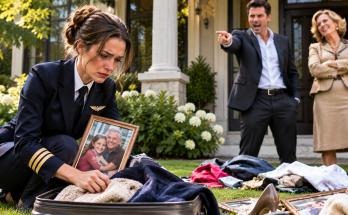
My Parents Made My Adopted Son Serve Dinner While His Cousins Celebrated Christmas—Then a Lawyer Revealed Why They Had Tried to Keep Him Out of the Family
My mother handed my seven-year-old adopted son a tray of dirty dishes on Christmas Eve while his cousins sat beside the fireplace opening presents worth thousands of dollars. When I demanded to know why, my father looked straight at me and said, “Those children carry our family name. Your boy doesn’t.” I was ready to take my son home and cut ties with them forever. Then a lawyer arrived carrying a sealed document addressed to me. My mother saw the envelope and whispered, “Please, don’t let him read that in front of everyone.” But it was too late. The letter revealed a secret about my son’s biological family—and a decision my parents had made years before I ever met him. By the time the lawyer finished reading, nobody in that Christmas mansion was looking at the presents anymore.
Part 1 — The Boy They Refused to Call Their Grandson
My name is Daniel Hayes. I was thirty-nine years old, ran a successful construction company in Denver, and had spent the previous three years learning that being a father was the greatest responsibility I would ever accept.
My son, Noah, was seven.
I had adopted him when he was four, after a long process that involved social workers, background checks, court hearings, and more paperwork than I had ever signed for a business deal.
Noah had arrived in my life carrying a small backpack, a worn stuffed bear, and a quietness that broke my heart.
He had already experienced more uncertainty than any child should.
At first, he barely spoke above a whisper. He asked permission before taking food from the refrigerator and apologized whenever he accidentally knocked something over.
The first time he called me Dad, we were sitting on the living-room floor building a toy airplane.
He looked up at me and asked, “Can I call you that forever?”
I put down the airplane.
“Forever,” I promised.
From that moment on, I considered myself the luckiest man alive.
Unfortunately, my parents did not share my feelings.
My mother, Evelyn, had always cared deeply about appearances. She loved expensive furniture, formal dinners, and photographs that made our family look perfect.
My father, Robert, believed the Hayes name represented generations of achievement. He often talked about bloodlines, family traditions, and the importance of passing a legacy to the next generation.
My younger sister, Lauren, had two biological children, eight-year-old Madison and six-year-old Oliver.
My parents adored them.
They bought them designer coats, enrolled them in private lessons, and celebrated every small achievement as though the children had discovered a new planet.
Noah received a different kind of attention.
When my mother introduced him to her friends, she called him “Daniel’s adopted boy” rather than her grandson.
When my father discussed the family business, he mentioned Madison and Oliver as the future of the Hayes family.
Noah was rarely included.
I confronted my parents privately more than once.
Each time, they offered excuses.
“It’s simply taking us longer to adjust,” my mother said.
“Don’t force a relationship,” my father advised. “The boy needs time, and so do we.”
I wanted to believe them.
I told myself that love sometimes developed slowly. I believed that if Noah spent enough time with his grandparents, they would eventually see what I saw.
A funny, thoughtful little boy who loved dinosaurs, drew elaborate pictures of spaceships, and always offered half his cookie to anyone who looked sad.
I was wrong about how much time could change.
Christmas Eve was supposed to be a fresh start.
My mother had invited everyone to the family mansion outside Denver. She promised a beautiful dinner, a huge tree, and presents for all the children.
Noah had been excited for weeks.
He helped me wrap a present for his grandmother: a framed drawing of our family.
In the picture, Noah had drawn himself holding my hand beneath a large yellow sun. He had included my parents, my sister, and his cousins.
He had even drawn a small dog we didn’t own yet.
At the bottom, in careful handwriting, he had written:
OUR FAMILY FOREVER.
“Do you think Grandma will hang it up?” he asked.
“I think she’ll be touched,” I replied.
I wanted that to be true.
When we arrived, the mansion looked like something from a holiday magazine. Garlands hung over the staircase, candles glowed on the dining table, and a towering Christmas tree stood in the center of the living room.
Madison and Oliver ran toward my mother.
She hugged them both, kissed their cheeks, and presented them with matching gift boxes.
Then she looked at Noah.
“Your coat goes in the hallway,” she said.
Noah obeyed without complaint.
I noticed the difference, but I kept my mouth shut. I wanted to give the evening a chance.
Dinner began pleasantly enough.
My father discussed business with Lauren’s husband. My mother complained about the caterer’s choice of flowers. The children ate mashed potatoes and roast chicken while I helped Noah cut his food.
Then the presents began.
My parents had purchased Madison a new tablet and Oliver an expensive remote-controlled car.
The children screamed with excitement.
Noah sat beside me, holding his wrapped drawing.
“Is it our turn?” he whispered.
I looked toward my mother.
She had just handed Oliver another gift.
“Grandma,” Noah asked politely, “would you like to open mine?”
My mother’s smile disappeared.
“Not now, Noah. We have other things to do.”
She turned toward the kitchen.
“And since you’re old enough to help, you can take these dishes in there.”
I thought she was joking.
She wasn’t.
A few minutes later, I found Noah standing beside the kitchen island with a tray of dirty plates. My mother was pointing toward the sink while my sister sat nearby, watching.
“Careful with those,” Evelyn instructed. “Some of them are more expensive than your toys.”
Noah nodded.
“Yes, Grandma.”
My mother corrected him immediately.
“Mrs. Hayes, please.”
I felt something inside me snap.
I crossed the kitchen and took the tray from his hands.
“What exactly is happening here?”
My mother looked offended.
“He wanted to help.”
“No, he didn’t. You told him to carry dirty dishes while the other children opened presents.”
“Someone has to help clean up.”
I pointed toward Madison and Oliver.
“Then ask everyone to help.”
My father appeared in the doorway.
“Daniel, lower your voice.”
I turned to him.
“Why is my son being treated like a servant?”
My father looked at Noah, then back at me.
“Those children carry our family name. Your boy doesn’t.”
The words landed like a slap.
Noah’s face changed.
He lowered his eyes and moved closer to my side.
I knelt beside him.
“Buddy, you haven’t done anything wrong.”
He whispered, “I can do more dishes if Grandma wants.”
My throat tightened.
“You don’t have to earn your place here.”
My mother folded her arms.
“Don’t make this dramatic. He’s adopted. He needs to understand that families have different responsibilities.”
I stood slowly.
“He is seven years old.”
“And you are raising him to believe the world owes him something,” my father replied.
I looked at the Christmas tree, the expensive gifts, and the children who were still laughing in the next room.
Then I looked at Noah.
He was clutching his stuffed bear, trying not to cry.
That was enough.
“We’re leaving.”
My mother stepped toward me.
“You wouldn’t dare ruin Christmas over this.”
“I didn’t ruin Christmas. You did.”
I helped Noah put on his coat.
Before we reached the front door, the doorbell rang.
My father frowned.
“Who could that be?”
A man in a dark overcoat stood outside, holding a leather briefcase.
“I’m looking for Daniel Hayes,” he said. “My name is Andrew Collins. I’m an attorney, and I need to deliver a document concerning a family trust.”
He glanced at the address on his envelope.
“I was told Mr. Robert Hayes would be here as well.”
My father went completely still.
My mother appeared behind him.
When she saw the firm’s name printed on the envelope, her face drained of color.
“Andrew,” she whispered. “Why are you here?”
The attorney looked at her.
“Because the trustee has requested that the relevant family members receive formal notice.”
My father stepped forward.
“This is a private family matter.”
“It’s a legal matter,” Andrew replied calmly. “And this letter is addressed to Daniel.”
He handed me the envelope.
I noticed that it had been opened before being carefully resealed.
My mother reached toward it.
“Daniel, don’t read that here.”
I moved it out of her reach.
“Why not?”
She opened her mouth but said nothing.
Noah tugged at my sleeve.
“Dad, are we still going home?”
I put one arm around his shoulders.
“Yes, buddy. But first, I need to understand what’s happening.”
I opened the envelope.
The first paragraph referred to Noah’s biological parents, a trust established before his birth, and a review of documents submitted several years earlier.
Then I saw my father’s signature on a photocopy.
My hands went cold.
I looked up.
“Dad, what did you sign?”
For the first time that evening, my father had no answer.
And my mother looked as though she was afraid the entire house was about to collapse around her.
Part 2 — The Secret My Parents Thought Would Stay Buried
Attorney Andrew Collins asked us to move into the study.
He made it clear that the documents contained private information and that he would explain only what was necessary to address the legal matter.
I wanted to take Noah home immediately.
But when I saw my parents’ faces, I realized that leaving without understanding the situation might allow them to hide the truth again.
I called my friend Michael, who lived nearby. He came to collect Noah and promised to make him hot chocolate and watch his favorite dinosaur movie.
Before Noah left, I knelt in front of him.
“I’m going to talk to the lawyer for a little while. Michael will take you home, and I’ll be there soon.”
Noah looked toward my parents.
“Are Grandma and Grandpa angry with me?”
“No,” I said firmly. “Whatever the adults are discussing, it has nothing to do with anything you did.”
He hugged me tightly before leaving.
Only then did I return to the study.
Andrew placed several documents on the desk.
“Mr. Hayes, I want to begin by saying that Noah’s adoption is not being challenged by this letter. The records we reviewed do not suggest that his legal relationship with you is in question.”
I released a breath I hadn’t realized I was holding.
“Then what is this about?”
Andrew opened the first folder.
“Before Noah’s biological parents died, his maternal grandparents established a trust intended to provide for his education, healthcare, and future needs.”
I frowned.
“I was never told about a trust.”
“According to the original records, the trust was created independently of the adoption process. The assets were to remain under the administration of a trustee until the relevant conditions were met.”
My father stared at the desk.
Andrew continued.
“Several years ago, the trustee received correspondence from someone claiming to represent the family’s interests. The correspondence requested changes to the way certain assets would be administered.”
“Who sent it?” I asked.
Andrew turned one page.
“The letter included your father’s name and a signature attributed to your mother.”
I looked at my parents.
My mother covered her mouth.
My father stood abruptly.
“This is being exaggerated.”
Andrew remained calm.
“No final finding has been made about who prepared or authorized the correspondence. That’s precisely why the trustee requested a formal review.”
I looked at the documents again.
“Were they trying to take Noah’s money?”
Andrew chose his words carefully.
“The correspondence proposed redirecting certain funds away from the arrangements originally established for Noah. The trustee did not approve the request. The assets remained under independent administration.”
I felt anger rising through my chest.
“Why?”
My father finally spoke.
“We were trying to protect the family.”
I stared at him.
“Which family?”
He hesitated.
“Our family.”
“And Noah isn’t part of it?”
My mother began crying.
“You don’t understand how complicated everything was.”
“Then explain it.”
She shook her head.
Andrew turned to another document.
“There is additional correspondence suggesting that your parents were concerned about how Noah’s adoption might affect future family arrangements. They appear to have asked whether the trust could be managed differently because Noah was not biologically related to you.”
I looked at my father.
“You tried to exclude a child from money his own grandparents left for him because he wasn’t related to me by blood?”
“We had concerns,” he replied.
“About what?”
“The family business. The estate. What would happen to everything we built.”
I laughed once, without humor.
“You don’t even own Noah’s trust.”
My father looked away.
Andrew explained that the trust had its own rules and could not be altered simply because someone disliked the beneficiary’s family circumstances.
The administrator had rejected the earlier request and preserved the original arrangement.
Noah’s funds had not been transferred to my parents.
That was a relief.
But it didn’t make their actions less disturbing.
I asked Andrew why he had contacted me now.
He explained that the trustee had recently received another request involving the trust. It was accompanied by a document that appeared to claim I had authorized a change in the administration of Noah’s assets.
I shook my head.
“I never signed anything like that.”
Andrew nodded.
“That is why the trustee wants to verify the document and determine who submitted it.”
He placed a photocopy in front of me.
The signature looked similar to mine, but I knew immediately that I had not written it.
My father stood again.
“This is a family disagreement. We can settle it without involving outsiders.”
Andrew closed the folder.
“The trust is managed by an independent administrator. No one here has authority to settle the matter privately or destroy the records.”
My mother looked at me.
“Daniel, please. We never wanted to hurt Noah.”
I remembered my son holding a tray of dirty dishes while his cousins opened presents.
“You didn’t want to hurt him,” I repeated. “But you told him he had to work for a place in this family.”
She cried harder.
“I was frustrated.”
“He is seven.”
“I know.”
“No. I don’t think you do.”
For years, I had tried to explain my decision to adopt Noah. I had answered questions about his background, his needs, and the responsibilities I had accepted.
I had thought that if I explained enough, my parents would eventually understand.
Now I realized that they had never needed more information.
They had needed more compassion.
Andrew recommended that I preserve the original letter, provide any relevant emails or financial records, and work through independent counsel to protect Noah’s interests.
I agreed.
He also advised that I keep Noah away from the ongoing adult dispute and avoid discussing unverified allegations in front of him.
That was easy.
Noah had already carried too much uncertainty.
When Andrew left, my father followed me into the hallway.
“Daniel, you can’t cut us out of your life over one mistake.”
I turned toward him.
“One mistake? You hid information about my son, tried to interfere with a trust meant for his future, and let my mother humiliate him in your home.”
“We made a bad decision.”
“You made several.”
My mother stood behind him.
“We can make this right.”
I looked at her.
“You can begin by understanding that Noah is not an outsider who has to prove himself.”
She nodded through her tears.
But I had heard apologies before.
I needed to see change.
I left without another word.
When I arrived home, Noah was sitting on the sofa beside Michael, watching a dinosaur movie with a mug of hot chocolate in his hands.
He ran toward me.
“Dad!”
I lifted him into my arms.
“I’m here, buddy.”
He rested his head on my shoulder.
“Are we going to Grandma’s house again?”
I looked at the Christmas tree in our living room.
“No, not for a while.”
He was quiet.
Then he asked the question I would remember for the rest of my life.
“Did I do something bad because I’m adopted?”
I felt my heart break all over again.
I knelt in front of him and held both his hands.
“Noah, listen to me. Being adopted is not something bad. It doesn’t make you less important, and it doesn’t mean you have to earn love. You are my son because I love you, and nothing that happened tonight can change that.”
He stared at me.
“Forever?”
“Forever.”
He wrapped his arms around my neck.
That night, after Noah fell asleep, I sat alone in the kitchen and reviewed the documents Andrew had left.
My parents had spent years worrying about a family legacy.
They had forgotten that a legacy was not a pile of money or a name carved into a building.
It was what you taught the next generation about kindness, fairness, and responsibility.
And on Christmas Eve, they had taught my son the wrong lesson.
I decided I would not allow that lesson to become part of his life.
But the trust review was not finished.
And the following week, the attorney called with information that changed how I understood everything.
Part 3 — The Christmas My Son Finally Learned What Family Meant
The meeting with the trust administrator took place five days after Christmas.
I attended with Andrew and an independent attorney who represented Noah’s interests.
My parents were invited to provide information about the correspondence and the disputed authorization.
They were not permitted to control the meeting or speak on Noah’s behalf.
The administrator explained that Noah’s trust remained intact. The original terms had not been changed, and the assets were still being managed independently.
That was the first good news.
The second was that the administrator had found no evidence that the disputed authorization had been accepted or used to transfer Noah’s funds.
The document still required review, but Noah’s interests had not been financially harmed.
I felt relief, although it did not erase my anger.
Andrew then explained the part of the story I had not known.
Noah’s maternal grandparents had established the trust after learning that their daughter and her husband were struggling financially. They wanted to ensure that their grandson would have resources available even if circumstances changed.
After Noah’s parents died, the trust administrator had continued managing the assets according to the original agreement.
My parents had learned about the trust during a discussion involving family records. Instead of telling me, they had contacted the administrator to ask whether the arrangements could be changed.
Their request had been rejected.
Years later, when I adopted Noah, they became concerned that he might be treated as an equal member of the family in future discussions about my own estate.
The recent authorization appeared to be another attempt to influence financial arrangements.
The administrator emphasized that responsibility for preparing and submitting the disputed document still needed to be established. No one was declaring a legal conclusion at the meeting.
But the history was clear enough to explain why the letter had been sent.
My parents had never simply been uncomfortable with adoption.
They had been afraid of losing control over the way they believed family assets should be distributed.
I looked at them across the conference table.
“You let a seven-year-old boy believe he wasn’t good enough to sit with his cousins because you were worried about money.”
My mother began crying.
“We never wanted him to think that.”
“But he did.”
My father rubbed his forehead.
“We thought we were protecting what belonged to the family.”
I shook my head.
“No. You were protecting your idea of the family.”
Nobody spoke.
The administrator confirmed that Noah’s trust would continue under its original terms, subject to the normal administration and review process.
I thanked everyone and left the meeting feeling exhausted.
Outside, my mother caught up with me.
“Daniel, please. Let me see Noah.”
I stopped.
“Why?”
“Because he’s my grandson.”
I looked at her.
“Last Christmas, you told him to call you Mrs. Hayes.”
She lowered her eyes.
“I was wrong.”
“Yes, you were.”
“I want to apologize to him.”
I studied her face.
For the first time, she did not mention the family name, the trust, or the importance of tradition.
She only looked ashamed.
“I will consider it,” I said. “But any meeting will happen when Noah feels ready. And you will not be alone with him until I am confident he is safe with you.”
She nodded.
I did not promise forgiveness.
An apology was a beginning, not a magic eraser.
The following weeks were quieter.
I focused on Noah’s routine. We returned to school, made pancakes on Saturday mornings, and started a new tradition of visiting the library every Sunday.
I also spoke with a child therapist who had experience helping adopted children navigate difficult family relationships.
I wanted Noah to have a safe place to ask questions without feeling responsible for the adults around him.
One evening, while we were putting together a puzzle, he asked whether his biological grandparents had known about him.
I explained what I knew.
“Your biological grandparents wanted you to have support for your future. They made arrangements to help with things like education and other needs. The lawyer is making sure those arrangements are respected.”
Noah considered that.
“Did they love me?”
I took a breath.
“The records show that they cared about your future. I can’t tell you everything they felt, but I can tell you that they wanted you to have opportunities.”
He nodded slowly.
Then he placed a puzzle piece on the table.
“I’m glad I have you.”
I pulled him into a hug.
“And I’m glad I have you.”
That was all he needed to know that night.
Eventually, my mother sent Noah a letter.
It was short.
She apologized for making him carry dishes while his cousins opened presents. She admitted that he had done nothing wrong and that he should never have been treated differently because he was adopted.
She did not ask him to forgive her.
She did not demand a visit.
She simply apologized.
I read the letter with Noah’s therapist and considered whether it was appropriate to share it with him.
When we did, I read it aloud and asked how he felt.
He was quiet for a while.
“Does Grandma mean it?”
“I hope she does,” I replied. “But she will need to show it through her actions.”
He folded the letter carefully.
“Can I think about it?”
“Of course.”
We left the decision there.
Months later, Noah agreed to meet my mother in a park, with me present.
She brought no expensive gifts and made no promises.
She simply sat on a bench and told him she was sorry.
Noah held my hand while she spoke.
When she finished, he asked, “Do I have to do chores before I can have Christmas presents?”
My mother covered her mouth.
“No, sweetheart. You never should have had to do that.”
He nodded.
He did not rush into her arms, and I did not encourage him to.
Trust would take time.
My father wrote to me separately. His apology was less polished, but it was more honest than anything he had said before.
He admitted that he had allowed his obsession with the family name to influence how he treated Noah.
He also agreed to cooperate with the review of the trust correspondence.
I accepted that he was beginning to take responsibility.
But I kept my boundaries.
Neither parent would make decisions about Noah’s finances, education, or future. Any relationship they built with him would depend on consistent respect, not their position as grandparents.
The next Christmas, I hosted dinner at my own home.
There was no grand mansion, no formal seating chart, and no mountain of expensive presents.
We decorated a small tree together.
Noah chose the ornaments, including a crooked dinosaur that he insisted belonged near the top.
My friends came over with food. The children played on the living-room floor, and everyone helped clear the table after dinner because we were a household, not a hierarchy.
When it was time for presents, Noah handed me a wrapped box.
Inside was a framed drawing.
It showed me holding his hand beneath a bright yellow sun. Beside us stood a little house, a Christmas tree, and a dog with enormous ears.
At the bottom, he had written:
DAD AND NOAH — FAMILY FOREVER.
I couldn’t speak for a moment.
He looked worried.
“Do you like it?”
I pulled him into my arms.
“I love it more than anything.”
He smiled.
“Can we put it where everyone can see?”
“Absolutely.”
We hung it on the wall above the fireplace.
That evening, after everyone had gone home, I sat beside Noah’s bed while he settled beneath his blanket.
“Dad?”
“Yeah, buddy?”
“Am I part of your family even when Grandma is mad?”
I took his hand.
“You are part of my family when people are happy, when people are angry, and when everything is difficult. You don’t have to earn your place. You already have it.”
He smiled sleepily.
“Forever?”
I kissed his forehead.
“Forever.”
He closed his eyes.
I remained beside him for a few minutes, listening to his quiet breathing.
I thought about the Christmas Eve when my parents had treated him like an outsider.
I thought about the documents, the trust, and the years of decisions made without my knowledge.
But most of all, I thought about the question Noah had asked while holding that tray of dirty dishes.
Had he done something wrong because he was adopted?
I could not erase the moment when he had felt unwanted.
I could not change my parents’ past choices.
But I could make sure he grew up knowing that their prejudice was never a reflection of his worth.
The trust matter continued through the appropriate legal process, and Noah’s interests remained protected under the original arrangements. My parents had to answer questions about the correspondence, and the disputed authorization was reviewed by the responsible professionals.
I did not need a dramatic public confrontation to prove I was right.
I needed a safe home for my son.
I needed honest boundaries with my parents.
And I needed Noah to understand that love was never a reward for being biologically related to someone.
My parents believed the family name determined who belonged. I learned that a family is defined by who shows up, who protects the vulnerable, and who makes a child feel safe enough to be himself.
Noah did not need to inherit my parents’ approval.
He did not need their money.
He did not need to carry a particular surname to deserve a place at the table.
He needed a father who would stand beside him when others tried to make him feel small.
And that was something I could promise him every day for the rest of my life.
Because the greatest legacy I could leave my son was not a company, a house, or a trust.
It was the certainty that he would never have to earn his place in my heart.