PART 1 — The Night My World Fell Apart
The hospital called me at 11:47 p.m.
“Mr. Bennett, your wife has been brought into the intensive care unit. You need to come immediately.”
I stood frozen in the middle of my office.
“Is my wife conscious?”
There was a brief silence.
“She’s in critical condition. Please come as quickly as you can.”
I dropped everything and ran.
When I reached the hospital, I found two security officers standing outside the ICU. A nurse led me through the double doors, and the moment I saw the woman lying in that bed, my legs nearly gave way.
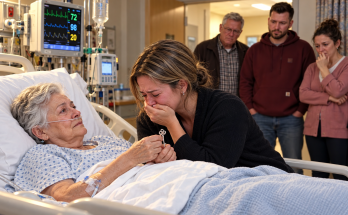
My wife, Eleanor, was covered in bandages.
Her beautiful face was swollen. A breathing tube helped her breathe, monitors beeped beside her bed, and bruises spread across her arms beneath the white hospital sheets.
Her wedding ring was still on her finger.
I had placed it there three years earlier and promised her that I would always protect her.
Now I stood beside her bed, unable to understand how I had failed to keep that promise.
“Doctor,” I whispered, struggling to control my voice. “Tell me what happened.”
The doctor led me into the corridor.
“Your wife suffered multiple traumatic injuries. Several ribs are fractured, and she has internal injuries. We’ve managed to stabilize her, but the next twenty-four hours are critical.”
I swallowed hard.
“And our baby?”
The doctor lowered his eyes.
“We’re deeply sorry. We couldn’t save the pregnancy.”
For a moment, the entire hospital seemed to disappear.
Our baby.
The little girl Eleanor had named Lily.
We had spent weeks discussing nursery colors, choosing tiny clothes, and arguing playfully about whose eyes she might inherit.
Yesterday morning, Eleanor had sent me a picture of a pair of pink baby shoes.
Only a few more weeks, sweetheart, she had written.
Now those shoes would remain empty.
I pressed my hand against the wall and closed my eyes.
For twenty-five years, I had served in the military. I had commanded troops through dangerous operations, made decisions under unbearable pressure, and watched young men and women depend on me when everything around them was falling apart.
But standing outside my wife’s ICU room, I discovered that there was a kind of pain no training could prepare a person to endure.
Then I heard laughter.
It came from the waiting area at the end of the hallway.
I turned.
Eleanor’s father, Richard Hayes, sat in a chair with his eight sons gathered around him. Some were drinking coffee. One was scrolling through his phone. Another was laughing so loudly that a passing nurse looked at him disapprovingly.
These were the people who had attacked my wife.
The people who had beaten a pregnant woman until she lost her child.
And they were laughing.
Richard noticed me and stood up.
“Well, look who’s finally here,” he said. “The perfect husband.”
His eldest son, Marcus, smirked.
“Your wife should have learned not to challenge this family.”
I stared at him.
“What did you do to her?”
Richard shrugged.
“She became disrespectful. We corrected her.”
“She’s your daughter.”
“She forgot her place.”
I felt something inside me go terribly quiet.
Richard stepped closer, straightened his expensive jacket, and looked me up and down.
“You’ve always been weak, Daniel. You married into this family, but you never had the courage to stand up to us.”
One of his sons laughed.
“What’s he going to do? Cry to the police?”
I looked at all nine men.
They had mistaken my silence for weakness for three years.
They had mistaken my simple clothes for insignificance, my quiet manner for fear, and my decision to keep my career private for proof that I was nobody.
They had no idea who they were speaking to.
I reached into my pocket and took out my phone.
Richard smiled.
“Calling your lawyer?”
“No,” I replied quietly. “Making a report.”
I dialed a number I had memorized long before I ever met Eleanor.
When the call connected, I spoke four words.
“This is General Daniel Bennett.”
For the first time that night, nobody laughed.
And when I gave the next instruction, the entire hallway changed.
“Activate the appropriate emergency response. I need law enforcement notified, hospital security coordinated, and all evidence preserved. My wife is the victim of a serious assault. Everything must be handled by the book.”
I ended the call.
Richard’s smile had disappeared.
But he still didn’t understand what was coming.
Not yet.
PART 2 — The Moment They Learned Who I Really Was
Within fifteen minutes, uniformed police officers entered the hospital.
Two detectives approached the ICU reception desk while additional officers spoke with hospital security. The hospital administrator arrived carrying a folder containing the initial incident report.
I had made one more call—to my attorney—to ensure that nobody could later claim I had used my position to interfere with the investigation.
I wanted the truth documented.
Every detail.
Every witness.
Every piece of evidence.
Richard watched the activity with growing irritation.
“What is all this nonsense?” he demanded. “We’re family. This is a private matter.”
One of the detectives stepped forward.
“Mr. Hayes, we’ve received information concerning an alleged assault. We need to speak with you and your sons separately.”
Richard laughed nervously.
“Do you know who I am?”
“Yes, sir. That’s why we’re speaking with you.”
His eldest son stood abruptly.
“This is ridiculous! Eleanor fell. Nobody did anything to her.”
A nurse who had been standing nearby turned around.
“I don’t think that’s what she told us when she was conscious.”
The young man’s face changed.
The detective immediately asked the nurse to provide a formal statement.
Richard pointed at me.
“This is his doing! He’s using his government connections to destroy us.”
I met his gaze.
“I haven’t asked anyone to destroy you.”
I paused.
“I’ve asked them to investigate what happened to my wife.”
He sneered.
“You think your government job makes you powerful?”
Before I could answer, a senior officer approached me.
“General Bennett, the investigators are ready to take your statement whenever you’re available.”
The word General seemed to echo through the hallway.
Richard slowly turned his head.
“What did he just call you?”
I said nothing.
Marcus stared at the officer, then at me.
“General? What kind of general?”
“Major General,” the officer clarified respectfully. “He has already requested that this matter remain under ordinary civilian investigative procedures wherever applicable.”
Richard’s face lost its color.
I watched him struggle to reconcile the man standing before him with the story he had invented about me.
For three years, he had told relatives that I was an insignificant government employee who survived on Eleanor’s family’s generosity.
He had mocked my modest home, my old car, and the fact that I rarely discussed my work.
He never knew that I had commanded thousands of personnel during my career.
He never knew that I had received commendations for decades of service.
And he never knew that I had deliberately kept my professional life separate from my marriage because Eleanor had wanted a peaceful home, far removed from my responsibilities.
But my rank wasn’t the reason he should have been afraid.
The evidence was.
The hospital had preserved the emergency team’s notes and the statements given when Eleanor was first brought in. Investigators were also seeking footage from nearby businesses and security cameras along the route where the assault was believed to have occurred.
Then a young woman approached the detectives.
She was one of Eleanor’s cousins.
Her hands trembled as she held a phone.
“I need to tell you something,” she whispered. “I saw what happened.”
Richard shot to his feet.
“Don’t you dare!”
The detective stepped between them.
“Sir, sit down.”
The cousin began to cry.
“I heard them arguing with Eleanor. She wanted to leave, but Uncle Richard blocked the door. Then the others surrounded her. I was terrified, so I hid in the car.”
She looked at me, tears running down her cheeks.
“I should have helped her. I’m so sorry.”
I couldn’t find the words to answer her.
My wife had been surrounded by nine members of her own family.
She had called out for help.
And the people who should have protected her had turned against her.
The cousin handed the phone to the detective, explaining that it contained messages exchanged before and after the incident. The detective documented the device and arranged for the material to be reviewed properly.
Richard suddenly became furious.
“She is lying! All of you are lying!”
One by one, his sons began arguing with one another.
“You told us she was fine!”
“You said nobody would find out!”
“Shut up!”
Their confidence was collapsing.
Then an officer approached Richard and asked him to accompany the investigators for questioning.
He turned toward me one last time.
“Daniel, you can’t do this to us. Eleanor is my daughter. Whatever happened, we can settle this privately.”
I looked at the ICU doors.
“No.”
My voice was calm, but every word carried the weight of everything I had lost.
“You had your chance to be her family before she ended up in that bed.”
The officer led him away.
For the first time since I had arrived, the corridor fell silent.
But I still had one person to fight for.
My wife.
And I wasn’t leaving her side.
PART 3 — My Wife Opened Her Eyes, and the Truth Finally Came Out
The next two days passed in a blur of medical updates, police interviews, and sleepless hours beside Eleanor’s bed.
I barely ate.
Whenever a nurse entered the room, I stood immediately, hoping she would bring news that Eleanor was recovering.
On the second evening, her doctor finally approached me with a cautious smile.
“Her condition is improving. She’s responding to treatment. We still need to monitor her closely, but we’re encouraged by what we’re seeing.”
I sat beside her and gently held her hand.
“You hear that, sweetheart?” I whispered. “You’re still here. I’m still here.”
My voice broke.
“I’m so sorry about Lily.”
I lowered my head against the edge of the bed and cried.
I didn’t cry because I was a general.
I didn’t cry because nine people had challenged me.
I cried because the woman I loved had suffered an unimaginable loss, and the child we had dreamed about would never come home.
A few hours later, I felt Eleanor’s fingers move.
At first, I thought I had imagined it.
Then her eyelids fluttered.
“Daniel?” she whispered through cracked lips.
I jumped to my feet.
“I’m here, sweetheart. I’m right here.”
Her eyes moved slowly around the room before returning to my face.
“Is Lily okay?”
The question shattered me.
I couldn’t lie to her.
I held her hand against my cheek and struggled to speak.
“I’m so sorry, Eleanor. The doctors did everything they could.”
She stared at me.
Then her face crumpled.
A sound escaped her that I will never forget—a broken, exhausted cry from a mother who had lost her child before she had the chance to hold her.
I climbed carefully into the chair beside her and let her cry.
I didn’t tell her to be strong.
I didn’t tell her everything happened for a reason.
I simply stayed.
After a long time, she whispered, “My father said I had embarrassed him.”
I looked at her.
“What?”
“He said I had no right to leave the family dinner. I told him I wouldn’t let them speak about you that way anymore.”
Her eyes filled with tears.
“They started shouting. My brothers blocked the doors. I tried to get away.”
She squeezed my fingers weakly.
“I kept thinking about you. I thought if I could just get home, everything would be okay.”
I bent forward and kissed her forehead.
“You don’t have to explain anything right now. The investigators will handle it. Your only job is to heal.”
She studied my face.
“Daniel, your phone kept ringing. I heard someone call you General before I passed out. Why didn’t you tell me?”
I took a long breath.
“I wanted our marriage to be about us, not my uniform or my position. I wanted you to know the man who loved you, not the man who commanded soldiers.”
She closed her eyes briefly.
“Does my father know now?”
“Yes.”
“And your men? Are they going to hurt him?”
“No.” I answered immediately. “Nobody is going to use my position to take revenge. The police will investigate, the evidence will be examined, and the courts will decide what happens next.”
She began to cry again.
“Lily deserved better.”
I held her hand tighter.
“Yes,” I whispered. “She did.”
Weeks later, Eleanor was finally discharged from the hospital, though her physical recovery would take much longer. The emotional wounds would remain even after the bruises faded.
The investigation continued.
The witness statements, medical documentation, and other evidence were reviewed by the authorities. The men who had once laughed outside her ICU room were now facing serious questions about their actions.
Richard’s wealth and family connections could not erase the hospital records.
His sons could not make the witnesses disappear simply by shouting louder.
And their claims that the assault was a private family matter did not change the fact that Eleanor had been seriously injured.
I never threatened them.
I never sent soldiers to frighten them.
I never asked anyone to treat them differently because of my rank.
I let the law do its work.
Months later, Eleanor and I stood together in a small garden behind our home. We had planted white flowers in memory of Lily.
Eleanor placed her hand over mine.
“Do you ever wish you had told me who you were earlier?” she asked.
I thought about it for a moment.
“No,” I said. “But I wish your family had understood who you were.”
She looked at me.
“What do you mean?”
“You were never someone they had the right to control. You were never someone they had the right to hurt. You were their daughter and their sister, and that should have been enough.”
She leaned against my shoulder.
For the first time in months, the silence between us felt peaceful.
I had spent decades believing that strength meant standing firm in the face of danger.
Eleanor taught me something different.
Sometimes strength means sitting beside someone who is broken and refusing to leave.
Sometimes justice means resisting the temptation to become the very thing you are fighting against.
And sometimes the quietest person in the room is not powerless at all.
The nine people who laughed outside my wife’s hospital room believed they had nothing to fear from an ordinary husband.
They were wrong about my rank.
But more importantly, they were wrong about the woman they had tried to silence.
Eleanor survived.
Her voice survived.
And this time, the truth would not be buried.
THE END.