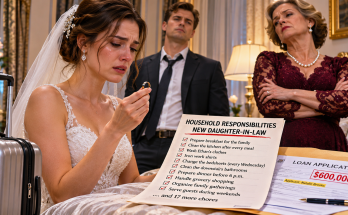
MY HUSBAND CHANGED THE LOCKS ON THE CONDO I OWNED BEFORE OUR MARRIAGE, THREW MY BELONGINGS INTO THE 29TH-FLOOR HALLWAY, AND LET HIS MOTHER MOVE IN. HE SMILED AND SAID, “YOU HAVE NOWHERE TO GO.” THEN THE POLICE ARRIVED, LOOKED INSIDE MY HOME, AND ASKED HIM ONE QUESTION THAT MADE HIS MOTHER DROP HER GLASS.
PART 1 — HE THOUGHT HE COULD THROW ME OUT OF MY OWN HOME
My husband changed the locks on the luxury condo I had purchased three years before meeting him, dumped my belongings outside on the twenty-ninth floor, and stood inside with his mother as though he had just won a war.
When I arrived home after a fourteen-hour workday, I found my suitcase lying beside the elevator.
My clothes were scattered across the carpet.
My laptop bag had been shoved beneath a console table.
And the framed photograph of my grandparents—the people who had helped me believe I could build a life of my own—lay face down against the wall.
I stared at the unfamiliar lock.
Then I tried my key again.
Nothing.
I knocked.
“Michael?”
No answer.
I knocked harder.
The door finally opened.
My husband stood there in gray sweatpants, holding a glass of water. He looked at me without a trace of guilt.
“What’s all this?” I asked, pointing toward the hallway.
He glanced at my belongings.
“I packed your things.”
“You packed my things?”
“You heard me.”
I looked past him.
My mother-in-law, Linda, sat comfortably on my living-room sofa wearing my white silk bathrobe. Her shoes were on the coffee table, beside a bowl of grapes I had bought that morning.
For several seconds, I couldn’t speak.
“Why is your mother here?”
Michael sighed as though I were the one creating a problem.
“She needed somewhere to stay.”
“So you moved her into my condo?”
“Our condo,” he corrected.
“No. My condo.”
His expression hardened.
“Here we go again.”
I took a breath.
Michael and I had been married for eighteen months. Before our wedding, I had purchased this property with money I had earned and saved over years of working in commercial real estate.
The deed was recorded in my name alone.
Michael knew that.
When we married, I had allowed him to move in because I believed marriage meant building a home together. I paid the mortgage and property taxes. He contributed to some household expenses, and we agreed to manage our finances separately while we figured out our long-term plans.
I had never used the condo to threaten him.
I had never told him he didn’t belong.
But lately, Michael had become obsessed with ownership.
He complained whenever I mentioned the mortgage.
He called the condo a symbol of my independence.
He once told me that a wife shouldn’t make her husband feel like a guest in his own home.
I had tried to explain that being married didn’t erase the sacrifices I had made before we met.
He never listened.
Now, apparently, he had decided to settle the argument by changing the locks.
“Give me the new key,” I said.
“No.”
“Michael, I’m exhausted. I want to come inside.”
“You can stay somewhere else tonight.”
I stared at him.
“Somewhere else?”
“You have money. Get a hotel.”
I looked at my suitcase, my work files, and the photograph lying on the floor.
“You put my personal belongings in a public hallway, and you’re telling me to get a hotel?”
He shrugged.
“You’ve made this marriage impossible.”
From the sofa, Linda finally spoke.
“My son deserves some peace.”
I turned toward her.
“Linda, this is between Michael and me.”
She stood up, tightening the belt of my bathrobe.
“Don’t speak to me like that. I have been trying to help my son through this terrible marriage.”
I almost laughed.
A terrible marriage?
I had spent the previous six months working overtime to save for a second property that Michael wanted us to purchase together. I had postponed vacations, canceled expensive plans, and taken on extra projects because he insisted we needed to build a future.
Meanwhile, he had been telling his mother that I was controlling him.
Now she was standing in my home, wearing my clothes, helping him keep me out.
I pulled my phone from my bag.
Michael noticed immediately.
“What are you doing?”
“Calling the police.”
His face changed.
“Don’t be ridiculous.”
I dialed anyway.
The dispatcher asked whether I lived at the address.
“Yes.”
“Do you have identification or proof of ownership?”
“The recorded deed is in my name. I can show it to the officers.”
Michael stepped closer.
“Emily, hang up.”
“No.”
“This is a private family matter.”
“Then you shouldn’t have put my belongings in a public hallway.”
Linda folded her arms.
“You’re making a scene.”
I looked directly at her.
“You’re wearing my bathrobe inside my home while your son refuses to let me enter. What would you call it?”
She opened her mouth.
Then closed it.
The dispatcher told me officers were being sent to the building.
Michael laughed, but the sound was forced.
“You really think the police are going to take your side?”
“I think they’ll look at the documents.”
He shook his head.
“You always have to make everything about money.”
I stared at him.
“This isn’t about money. It’s about you changing the locks on a property I own and refusing to let me inside.”
He leaned against the doorframe.
“You don’t get to control me just because your name is on a piece of paper.”
I looked at the new lock.
Then at my belongings.
Then at the man I had married.
Something inside me finally went quiet.
I no longer needed to convince him to respect me.
I only needed to protect what was mine.
A few minutes later, the elevator chimed.
Two Chicago police officers stepped into the hallway.
One was a tall man with graying hair. The other was a younger woman carrying a tablet.
The older officer introduced himself and asked everyone to remain calm.
Michael immediately began explaining.
“My wife and I are having a disagreement. She’s being dramatic, and I need her to stop harassing us.”
The officer looked at me.
“Ma’am, do you have proof that you own the property?”
I opened the property records on my phone and showed him the deed.
He examined it, asked a few questions, and then looked at Michael.
“Sir, is your name listed on this document?”
Michael crossed his arms.
“I’m her husband.”
“That wasn’t my question.”
For the first time, Michael had no immediate answer.
The younger officer asked me whether any of my belongings had been damaged.
I pointed toward the framed photograph.
“I don’t know yet. I haven’t been allowed inside.”
The older officer nodded.
Then he asked Michael to explain why the locks had been changed.
Michael launched into another speech about our marriage, my attitude, and his need for peace.
The officer listened without interrupting.
When Michael finished, the officer looked toward the open doorway.
His expression changed.
“Sir, who else is currently inside this residence?”
Michael froze.
Linda’s fingers tightened around the edge of the robe.
“What does that have to do with anything?” Michael demanded.
The officer didn’t answer immediately.
Instead, he looked past Michael toward the living room.
Then he asked a second question.
“Is there anyone else staying here who is not listed in the information you’ve provided?”
Michael’s face turned pale.
Linda stepped backward.
And suddenly, I remembered something Michael had said two weeks earlier.
Once everything is settled, nobody will be able to make me leave.
At the time, I had assumed he meant our marriage.
Now I wasn’t so sure.
The officer asked Michael to step outside.
Michael refused.
“I’m not leaving my own home.”
The officer’s voice became firmer.
“Sir, step into the hallway while we clarify the situation.”
Michael looked at me with pure hatred.
“You’re going to regret this.”
I didn’t respond.
Because as he finally stepped away from the doorway, I saw something inside my condo that made my stomach drop.
There was a second suitcase beside the guest-room door.
A man’s suitcase.
And taped to it was a piece of paper bearing a name I hadn’t heard in almost four years.
The name belonged to someone Michael had sworn he never wanted to see again.
PART 2 — THE PERSON HIDING INSIDE MY CONDO
For several seconds, I couldn’t take my eyes off the suitcase.
The name on the paper was Daniel Cross.
Michael’s former business partner.
The same man Michael had accused of stealing thousands of dollars from their company before it collapsed.
The same man he had threatened to sue.
And the same man Michael had told me had moved overseas and disappeared from his life.
Yet his suitcase was sitting inside my condo.
I turned toward my husband.
“Why is Daniel’s luggage in my guest room?”
Michael’s face hardened.
“You’re confused.”
“I can read his name.”
Linda suddenly spoke.
“Emily, please don’t make this worse than it already is.”
I looked at her.
“What does Daniel have to do with this?”
She said nothing.
The older police officer asked Michael whether Daniel was currently inside the unit.
Michael shook his head too quickly.
“No.”
The younger officer moved toward the doorway, but the older officer stopped her and asked Michael to clarify who had access to the residence.
Michael became defensive.
“You can’t just come into my home because my wife is upset.”
The officer remained calm.
“We’re here to investigate a reported lockout and determine whether anyone needs assistance. If further action is necessary, we’ll follow the appropriate procedures.”
I watched Michael carefully.
He had been confident when he thought I was alone.
He had mocked me when I called the police.
Now, with two officers asking ordinary questions, he seemed unable to settle on a consistent answer.
Linda tried to redirect the conversation.
“Daniel is an old friend. He only came by to help Michael.”
“Help him with what?” I asked.
Michael glared at me.
“Enough, Emily.”
I ignored him.
“Why did you change the locks?”
He rubbed his forehead.
“Because I needed space.”
“Then why did you pack my belongings?”
“I told you. I needed space.”
“And why is your mother wearing my bathrobe?”
Linda gasped.
“How dare you!”
The older officer raised a hand.
“Let’s keep this calm.”
Then he asked Michael to provide identification and explain his current living arrangements.
Michael handed over his driver’s license.
The officer checked it, then asked whether Michael had any documents establishing an ownership interest in the condo.
Michael’s jaw tightened.
“We’re married.”
“Do you have a deed, lease, or other relevant document?”
“No.”
“Has the owner authorized you to change the locks?”
Michael glanced at me.
Neither of us answered immediately.
Finally, I said, “I did not authorize it.”
Michael muttered something under his breath.
The officer asked whether the locks could be restored and whether my belongings could be brought inside while the dispute was addressed.
Michael objected.
Then Linda made a mistake.
“He can’t let her back in yet. Daniel hasn’t finished moving his things.”
Silence.
The younger officer turned toward her.
“Daniel is moving into the property?”
Linda’s face went white.
“I didn’t mean that.”
Michael closed his eyes.
I felt a cold sensation spread through my chest.
“What do you mean, Daniel is moving in?”
Neither of them answered.
I looked through the doorway again.
The guest-room door was partly open.
Inside, I could see several cardboard boxes, a folded mattress, and a stack of papers on my desk.
My desk.
The one I had used for years to review contracts and manage my investments.
Someone had moved my work files into a pile near the wall.
In their place sat a laptop, several folders, and a small printer.
This wasn’t simply a disagreement about where Michael’s mother should sleep.
Someone had been preparing my condo for a different purpose.
The older officer asked Michael to clarify the situation.
Michael insisted that Daniel was only visiting.
Linda insisted that Daniel had been helping with a personal matter.
Their stories didn’t match.
Then the officer asked a question that neither of them seemed prepared for.
“Has anyone been using this address to receive official mail or establish a residence without the owner’s knowledge?”
Michael’s expression changed so suddenly that I noticed.
Linda looked at him.
He looked at her.
And that silent exchange told me more than their words had.
I stepped toward the officer.
“Can you explain what you mean?”
He answered carefully.
“We need to establish who has access to the property and whether any relevant documents have been submitted. We haven’t reached any conclusions.”
Michael immediately interrupted.
“There are no documents.”
The officer looked at him.
“I haven’t asked you to answer for anyone else.”
Michael fell silent.
The younger officer asked me whether I had recently received unfamiliar mail or noticed any changes to my property records.
I thought about it.
Three weeks earlier, I had received a notification from my building’s management office asking me to confirm the names of people authorized to access my unit.
I had assumed it was a routine administrative update.
When I asked Michael about it, he told me he had requested a replacement access card because mine had stopped working.
I hadn’t thought much of it.
Now I wondered whether that explanation had been true.
I opened my email and found the message.
The officer examined it and asked me to preserve the original.
He did not tell me what it proved.
He simply noted that it might be relevant to the timeline.
Then he asked Michael whether he had contacted building management about access to the condo.
Michael hesitated.
“Yes.”
“Why?”
“Because I’m her husband.”
The officer nodded slowly.
“Being married does not automatically answer every property-access question. We’ll need to establish the relevant facts.”
Michael looked toward Linda.
She shook her head almost imperceptibly.
I saw it.
The officer saw it too.
He asked Linda whether she had helped Michael remove my belongings.
“No,” she said.
Then she added, “I only helped him organize the guest room.”
The younger officer looked at the suitcase.
“Whose suitcase is that?”
Linda didn’t answer.
Michael finally spoke.
“Daniel’s.”
“Is Daniel currently inside the unit?”
“No.”
“Where is he?”
Michael glanced toward the guest room.
“I don’t know.”
The older officer requested that Michael contact Daniel and clarify whether he was expected to return.
Michael refused.
“I don’t have to call anyone.”
“That’s your choice,” the officer replied. “But we’re documenting the information you’re providing.”
Something about that sentence unsettled Michael more than any threat would have.
He was used to winning arguments by making other people uncomfortable.
He could raise his voice.
He could accuse me of overreacting.
He could tell everyone that I was dramatic.
But he couldn’t make a documented question disappear simply by refusing to answer it.
While the officers continued speaking with him, I called the building manager.
I explained that my locks had been changed without my permission and asked whether any access cards or resident information had been altered.
The manager told me that he would review the records and contact me through the building’s official process.
He also asked whether I had authorized any additional occupant.
“No,” I said.
He paused.
“Then we need to speak privately as soon as possible.”
Before I could ask why, the call ended.
I turned toward the officers.
“Building management says there may have been changes to the resident records.”
The older officer made a note.
“Please request a copy of the relevant records. We can’t assume what they show until they’ve been reviewed.”
Michael suddenly became angry.
“That’s enough! She’s turning a private family argument into some ridiculous investigation.”
I looked at him.
“You changed my locks, threw my belongings into the hallway, and moved someone else’s things into my home. What exactly did you expect me to do?”
He stared at me.
For the first time, he had no convincing response.
Then a phone vibrated inside the condo.
It came from the guest room.
Everyone turned toward the sound.
Michael moved toward the doorway, but the older officer asked him to remain where he was while they clarified who owned the device.
A second vibration followed.
Then a third.
The screen lit up on a table near the door.
I couldn’t read the entire message from where I stood.
But I could see the first line.
“The documents are ready. Tell Michael we need Emily’s signature before Monday.”
My heart began racing.
I looked at my husband.
He looked as though he had just watched his entire future collapse.
“Michael,” I whispered, “what documents?”
He said nothing.
Linda began crying.
And then she spoke the words that changed the entire situation.
“He told me you had already agreed.”
I stared at her.
“Agreed to what?”
She covered her mouth.
Michael turned toward her.
“Mom, stop talking.”
But she had already begun.
She said Daniel had been helping Michael organize paperwork connected to a proposed financial arrangement. She claimed Michael had told her I would sign everything after a conversation that never actually happened.
I felt sick.
I had not agreed to sign anything.
I had not authorized anyone to use my condo as security for a loan.
And I had never given Michael permission to represent me in a financial transaction.
The officers did not declare that any crime had occurred. They explained that the documents would need to be examined and that I should contact an attorney promptly if my property or signature might be involved.
I agreed.
But before the officers could finish documenting the situation, my phone rang.
It was my attorney, Rachel Morgan.
She had been reviewing the building records I forwarded earlier.
“Emily,” she said, “I need you to listen carefully.”
I stepped away from the others.
“What happened?”
“Your building manager found a request to change the authorized occupant information. It was submitted using your unit number, but the signature on the form doesn’t appear to match the signature in your ownership file.”
My knees felt weak.
“Who submitted it?”
“I’m still verifying that. But there’s another issue.”
I gripped the phone.
“What issue?”
Rachel paused.
“Someone has also requested documentation relating to a proposed loan secured by the condo.”
I stared at Michael.
He was watching me from the doorway.
His face was pale.
Rachel continued.
“I can’t tell you the entire story until I’ve reviewed the records. But don’t sign anything, don’t agree to anything under pressure, and preserve every message you receive.”
I swallowed.
“Rachel, what do you think Michael is doing?”
Her answer was quiet.
“I think we need to find out whether someone has been trying to use your property without your authorization.”
When I ended the call, Michael was no longer looking at me.
He was staring at the guest-room door.
And for the first time, I understood why he had been so desperate to keep me outside.
He wasn’t just trying to win an argument.
He was trying to keep me from discovering something.
PART 3 — THE DOCUMENT THAT ENDED HIS CONTROL
My attorney arrived at the condo the following morning.
By then, I had spent the night at a hotel, not because Michael had the right to force me out, but because I wanted to avoid another confrontation while the facts were being reviewed.
My belongings remained documented in the hallway and storage area.
The building manager had arranged to preserve the access records.
And the police had recorded the initial complaint and the information provided by everyone involved.
Rachel met me in the lobby at eight-thirty.
She carried a leather folder and a small laptop.
“Before we go upstairs,” she said, “I want you to understand something. We know the condo is recorded in your name. We also have reason to investigate whether someone submitted documents connected to it without your authorization. But we need to distinguish what we know from what we’re still verifying.”
I nodded.
“I don’t want guesses. I want the truth.”
“Good,” she replied. “That’s exactly how we’ll approach this.”
We entered the elevator.
For the first time since the previous evening, I wasn’t alone.
When the doors opened on the twenty-ninth floor, my belongings were still there.
My suitcase.
My work files.
My laptop bag.
The photograph of my grandparents.
I picked up the photograph and checked the frame.
The glass was cracked, but the picture itself was intact.
I pressed it against my chest for a moment.
Then Rachel asked the building manager to accompany us to the unit.
Michael opened the door after several minutes.
He looked exhausted.
His mother stood behind him in ordinary clothes this time.
The bathrobe had disappeared.
“Emily,” Michael said, trying to sound reasonable. “We need to talk.”
Rachel stepped forward.
“She has legal representation. Any discussion about the property or disputed documents can go through me.”
Michael frowned.
“I’m her husband.”
“And she’s the registered owner of this property,” Rachel replied. “We’re here to address the lock change, the removal of her belongings, and the documents currently under review.”
He looked at me.
“You actually hired a lawyer?”
“Yes.”
“For a marriage dispute?”
“No, Michael. For a property and financial dispute that you created.”
He stepped aside reluctantly.
Rachel examined the door, the new lock, and the paperwork Michael had left on the entry table.
She photographed the condition of my belongings and asked the building manager to record the access arrangements.
Then she requested copies of any documents Michael believed gave him authority to exclude me.
He produced nothing.
He repeated that we were married.
Rachel explained that marriage alone did not resolve the questions before us. The recorded ownership, any applicable legal rights, and the circumstances of the lockout would need to be considered under the relevant law.
Michael’s confidence began to disappear.
“You’re making this sound like a criminal case,” he complained.
“I’m making sure we establish the facts,” Rachel replied.
Then she opened her folder.
Inside were copies of the building’s access records, the disputed occupant-change request, and a notice concerning a proposed secured loan.
The loan documents were incomplete.
No lender had confirmed approval.
No final transaction had been established.
But the request referenced my condo as collateral.
And the authorization attached to it contained a signature bearing my name.
I stared at the page.
It looked similar to mine at first glance.
But several letters were formed incorrectly, and the date beside the signature was a day I had spent at an out-of-state conference.
I had never signed it.
Rachel pointed to the relevant section.
“Emily denies authorizing this document. We’re requesting that the lender preserve the application records and suspend any processing while the signature and authorization are reviewed.”
Michael’s face turned gray.
“You don’t understand,” he said.
I looked at him.
“Then explain it.”
He glanced at his mother.
She looked away.
Rachel waited.
Finally, Michael admitted that he had been under financial pressure.
His business had accumulated debts.
He had borrowed money from several people and fallen behind on payments.
Daniel had offered to help him explore financing options.
Michael claimed that he believed he could arrange a loan and repay it before I ever needed to know.
I felt a wave of disbelief.
“You planned to use my condo as security?”
“I was going to tell you.”
“When?”
“When everything was settled.”
I stared at him.
“You changed the locks on my home, removed my belongings, and brought Daniel’s paperwork inside. You told me to get a hotel. When exactly were you planning to tell me?”
He rubbed his face.
“I needed time.”
“No,” I said. “You needed my signature.”
He didn’t answer.
Linda began crying again.
“I thought he had permission,” she whispered.
I turned toward her.
“You told me I was bullying your son. You defended him while he threw me out of my own home.”
“I didn’t know about the signature.”
“But you knew he had changed the locks.”
She lowered her eyes.
“Yes.”
I felt the familiar urge to soften my words, to make the conversation easier for everyone else.
Then I remembered how my belongings had looked in the hallway.
I remembered Michael’s calm expression as he told me to find a hotel.
And I decided that I would no longer protect people from the consequences of their own choices by pretending those choices hadn’t hurt me.
Rachel asked Michael to identify everyone involved in preparing the loan application.
He provided Daniel’s contact information.
He also acknowledged that he had asked the building manager to update the resident-access information.
He claimed he had done so because he wanted to prevent me from entering during an argument.
Rachel noted his statement.
Then she explained that the disputed signature and loan request would need to be investigated separately from the ownership and lockout issues.
She advised me to notify the lender in writing that I had not authorized the application, to preserve the original records, and to avoid signing anything until the matter was resolved.
She also discussed the options available for addressing access to my property and the marriage itself.
Nothing happened instantly.
There was no dramatic declaration that Michael was guilty of every suspicion.
There was no magic document that resolved every dispute.
There was simply evidence, a process, and a growing realization that Michael’s story could no longer be accepted without scrutiny.
Over the next several days, Rachel communicated with the lender and requested preservation of the application materials.
The lender confirmed that the proposed transaction had not closed and placed the application on hold while the disputed authorization was reviewed.
The building manager corrected the access records after verifying my ownership and confirming the appropriate procedures.
I regained access to my condo.
A locksmith restored the approved lock arrangement, and I collected my belongings.
The cracked photograph went to a repair shop.
My work files were returned to my desk.
The guest room was emptied of Daniel’s belongings.
And Michael was no longer permitted to treat the condo as though his wishes overruled my ownership.
The financial review continued.
Additional records were requested, and the people involved were asked to explain their roles.
I left those questions to the appropriate professionals rather than trying to solve everything through arguments with my husband.
Meanwhile, I began making decisions about the marriage.
Michael called repeatedly.
At first, he was angry.
“You’re destroying our relationship over paperwork.”
Then he became apologetic.
“I was scared. I made a mistake.”
Finally, he tried to bargain.
“If you withdraw the complaint, we can fix everything privately.”
That was when I understood that he still didn’t grasp the real problem.
He believed the damage came from my reaction.
He believed that if I stopped asking questions, his decisions would somehow become less serious.
I told him I would not withdraw truthful statements simply to protect his reputation. Any resolution would have to address the facts, the property, and the disputed financial application.
I also told him that I needed space to decide whether our marriage could continue.
He didn’t like that answer.
For once, I didn’t change it to make him comfortable.
Several weeks later, the review confirmed that the lender had received a disputed authorization that I had not approved. The application was canceled before any loan was issued against my condo.
The final findings concerning individual responsibility depended on the records and the relevant authorities’ assessment. I did not pretend to know every detail of what Daniel or Michael had intended.
What I knew was enough.
My signature had been used without my permission.
My property had been placed at risk without my consent.
And my husband had tried to keep me out of the very home that was the subject of the financial paperwork.
I began the process of separating our lives and consulting counsel about the appropriate next steps.
Linda eventually contacted me.
She apologized for wearing my bathrobe, for defending Michael without hearing my side, and for helping make the lockout possible.
I listened.
I accepted that she might genuinely regret what happened.
But I did not invite her back into my home.
An apology could begin a conversation.
It could not erase a boundary.
As for Michael, he continued insisting that he had never intended to hurt me.
Perhaps he had convinced himself that everything would work out.
Perhaps he thought that because we were married, I would eventually forgive him and help him solve his financial problems.
But love does not grant someone permission to risk another person’s home.
And marriage does not turn a refusal into consent.
Months later, I stood in the living room of my condo and looked out over Chicago.
The city lights stretched across the skyline.
My grandparents’ photograph sat in a new frame on the bookshelf.
The locks were secure.
The ownership records were in order.
And my home was finally quiet.
I thought about the woman who had stood in the hallway that night, exhausted and humiliated, while her husband told her she had nowhere to go.
She had believed she needed to convince him that she deserved respect.
She had believed that if she explained herself carefully enough, he might finally understand.
But she had been asking the wrong question.
The question was never whether Michael would acknowledge my rights.
The question was whether I would continue allowing his refusal to define my choices.
I had bought that condo before I met him.
I had paid for it through years of work, discipline, and sacrifice.
I had welcomed him into it because I loved him.
That generosity had never meant surrendering ownership of my life.
The police had not solved every problem that evening.
They had not decided the entire marriage.
They had not determined every question surrounding the disputed documents.
But their questions had forced the situation into the open, where it could finally be examined.
And that was the beginning of the end of Michael’s control.
He once stood inside my condo and told me to get a hotel.
He believed that changing a lock could change reality.
He believed that calling me dramatic could make my evidence disappear.
He believed that a marriage certificate gave him the right to make decisions about a property he did not own.
He was wrong.
My husband tried to lock me out of the home I had bought before I ever met him. He thought I would cry, apologize, and accept whatever explanation he offered. Instead, I documented the facts, protected my property, and refused to sign away my future.
The condo was never just a building.
It was proof of what I had built before anyone promised to stand beside me.
And when that promise failed, I learned that protecting myself wasn’t a betrayal of marriage.
It was a refusal to betray myself.
Sometimes, the most powerful thing you can do is stop arguing with someone who wants control—and start protecting the life they assumed you would never defend.