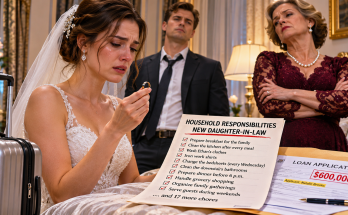
.My Mother Blamed Me for Destroying Christmas for 12 Years—So This Year, I Stayed Home. At 7 P.M., 70 Guests Discovered the Secret She Never Expected Me to Find.
PART 1 — THE DAUGHTER WHO FINALLY STOPPED PAYING
At exactly 7:00 p.m. on Christmas Eve, my phone began vibrating so violently across my coffee table that I thought it might fall onto the floor.
Thirty-one missed calls.
Twenty-three messages.
And one voicemail from my mother that began with a scream.
“CLAIRE! WHERE IS THE MONEY? THERE ARE SEVENTY PEOPLE WAITING FOR DINNER, AND YOU HAVE HUMILIATED THIS FAMILY AGAIN!”
I was sitting on my sofa in comfortable pajamas, holding a mug of hot chocolate, watching snow fall outside my apartment window.
For the first time in twelve years, I wasn’t standing in a hotel ballroom fixing my mother’s disasters.
I wasn’t arguing with caterers.
I wasn’t paying emergency invoices.
And I certainly wasn’t apologizing for something I hadn’t done.
I took another sip of hot chocolate and sent her a single message.
Mom, I thought you said Christmas would be better if I stayed away.
Then I turned my phone face down.
I wish I could tell you that was the moment my life changed.
It wasn’t.
The real turning point had happened three weeks earlier, when I discovered that the money I’d spent years providing for my family had been funding a secret that could destroy everything my mother had built.
My name is Claire Bennett. I’m thirty-five years old, and for most of my adult life, my family treated me like an ATM with a heartbeat.
My mother, Evelyn, was a woman who measured success by appearances.
The size of a Christmas tree.
The price of a dinner plate.
The number of influential people seated at her table.
And, most importantly, how impressed everyone looked when she entered a room.
Every Christmas Eve, she hosted an extravagant celebration for relatives, business associates, old friends, and people she barely knew but desperately wanted to impress.
Seventy guests had become her favorite number.
Seventy people to admire her decorations.
Seventy people to praise her cooking, even though she never entered the kitchen.
Seventy people to hear her annual speech about family, gratitude, and the importance of keeping traditions alive.
And seventy people who never knew that I was the one paying for nearly everything.
The hotel.
The catering.
The musicians.
The floral arrangements.
The champagne.
The presents stacked beneath the enormous Christmas tree.
All of it came from me.
I worked as a financial risk director for a major investment firm. I had spent years studying financial fraud, identifying suspicious transactions, and helping companies prevent catastrophic losses.
Ironically, I never applied those skills to the people who were taking advantage of me.
Not until it was almost too late.
My mother had been blaming me for ruining Christmas since I was seventeen.
That was the year my father, Daniel Bennett, collapsed beside our Christmas tree.
I was the only person who moved.
While my mother screamed for someone to help, I called emergency services and followed the operator’s instructions.
The paramedics arrived with flashing lights, rushed through our decorated living room, and carried my father away while our guests watched in stunned silence.
My father survived for another six weeks.
During that time, I visited him every evening after school.
One night, while my mother was downstairs arguing with an insurance representative, Dad took my hand and whispered something I have never forgotten.
“You don’t have to make everybody happy, Claire. Just make sure you can live with yourself.”
He died two days before Valentine’s Day.
And somehow, in my mother’s version of the story, I became responsible for everything that had happened.
“You called that ambulance during my Christmas party,” she told me at the funeral.
“If you’d kept everyone calm, perhaps we could have had one last peaceful evening together.”
I was seventeen.
I believed her.
For years, I carried that guilt like a debt I could never repay.
When I got my first well-paying job, I began paying for Christmas.
At first, it was a few thousand dollars to help my mother.
Then it became hotel reservations, expensive meals, and gifts for relatives who barely remembered my birthday.
Eventually, she stopped asking.
She simply sent me invoices.
If I hesitated, she reminded me of the night Dad died.
“Your father would be heartbroken to see how selfish you’ve become.”
And I paid.
For eleven Christmases, I paid.
Last year, I spent $34,600 on a celebration that ended with my mother standing beneath a chandelier, raising her glass to seventy guests.
“To family,” she announced, smiling beautifully. “And to hoping that next year, Claire finally learns how not to ruin everything.”
Several people chuckled.
My brother, Mason, laughed the loudest.
My sister, Natalie, stared at her wineglass.
I stood beside the dessert table, holding a folder of unpaid receipts that I had just settled from my phone.
I remember looking at my reflection in the ballroom windows.
I was thirty-four years old.
I had a successful career, a beautiful apartment, and enough money to travel anywhere in the world.
Yet I was terrified of disappointing a woman who had spent half my life telling me I was a disappointment.
That night, I made a promise to myself.
Next Christmas, I would not pay for anything.
I would not organize anything.
And I would not attend an event where my own humiliation was part of the entertainment.
In October, my mother called with her plans for the following Christmas Eve.
“This year will be extraordinary,” she announced. “We’re hosting the Winter Lights Charity Gala at the Grand Sterling Hotel.”
“Charity gala?”
“Of course. It’s for homeless families. We need to give something back.”
She explained that the event would feature a live orchestra, a celebrity auctioneer, luxury gift baskets, and a fundraising dinner for seventy guests.
Then she named the amount.
“Forty-five thousand dollars. That should cover the essentials.”
I put down my pen.
“Mom, why don’t we split the cost this year?”
She laughed as if I’d told her a joke.
“Mason is building his business. Natalie has her own family. You have money, Claire. And you don’t have children. Why are you always making everything difficult?”
“I have a life, too.”
Her voice immediately hardened.
“Don’t start this again. Your father would never have tolerated this kind of selfishness.”
There it was.
The same old weapon.
Only this time, it didn’t hurt quite as much.
“I’ll think about it,” I said.
Then I hung up.
I didn’t send a dollar.
Instead, I began reviewing the financial records of the Bennett Winter Foundation, the charity my mother claimed to run.
The foundation had been established in my father’s name shortly after his death. Its mission was simple: provide emergency housing, winter clothing, and financial assistance to families who had nowhere to go.
For years, I had donated money to it separately from the Christmas expenses.
I had trusted my mother to manage it.
But the more I examined the publicly available reports, the stranger things became.
Administrative expenses had increased dramatically.
Several vendors appeared to have identical mailing addresses.
A company listed as a major supplier had no meaningful online presence.
And some of the charitable grants reported in the annual summaries couldn’t be matched to any identifiable recipients.
At first, I assumed it was sloppy bookkeeping.
Then, three weeks before Christmas, I received a call from an unfamiliar number.
“Is this Claire Bennett?” a woman asked.
“Yes.”
“My name is Hazel Morgan. I’ve worked as the foundation’s bookkeeper for nine years.”
Her voice was trembling.
“I need to tell you something about your mother. And your brother.”
I sat upright.
“What about them?”
Hazel took a shaky breath.
“I think they’ve been using the foundation to pay for things that have nothing to do with charity.”
“Do you have proof?”
“I have copies of invoices, bank reconciliations, and emails. I kept them because I was afraid someone would eventually blame me.”
My heart began pounding.
“Why are you telling me now?”
“Because yesterday, your mother ordered me to destroy the older records. And when I refused, your brother told me I would lose everything if I ever spoke to you.”
I said nothing.
Then Hazel delivered the sentence that changed my understanding of the previous eleven Christmases.
“Claire, some of the money you gave your mother for those parties was charged to the foundation, too. I don’t think you were just paying for Christmas.”
She sent me seventeen files.
I opened the first one.
Then the second.
By midnight, I had uncovered invoices, questionable transfers, and payments to businesses connected to my brother.
But one document made my hands go cold.
It was a spreadsheet containing a list of donors, the amounts they had contributed, and the charitable expenses supposedly covered by their money.
Near the bottom was my name.
Beside it was a figure of $180,000.
I had never donated that amount to the foundation.
Someone had recorded my name against money I had never given.
And the transaction dates went back almost four years.
I leaned closer to my laptop.
Then I noticed the authorization field.
The initials weren’t mine.
They belonged to my mother.
I immediately called Hazel back.
“There’s a transfer here for $62,000. Where did that money go?”
She was silent for several seconds.
“Claire, I was hoping you wouldn’t find that one tonight.”
“Why?”
“Because that payment wasn’t made to a hotel or a caterer.”
Her voice dropped to a whisper.
“It went to a company your brother owns.”
I stared at the screen.
Then another message appeared on my phone.
It was from my mother.
Don’t embarrass this family by refusing to pay for Christmas. The entire guest list is expecting you to do your part.
For the first time, I understood something terrifying.
My family wasn’t simply relying on my money.
They were relying on my silence.
And this year, they had made one enormous mistake.
They had planned a charity gala around money they assumed I would provide, using a foundation bearing my father’s name, with seventy guests arriving in less than three weeks.
I looked at the documents again.
Then I called a lawyer.
“Good evening,” I said when she answered. “I need help investigating possible financial fraud involving a family charity.”
I paused, looking at the photograph of my father on the bookshelf.
“And I need to make sure nobody can destroy the evidence.”
For the first time in twelve years, I wasn’t going to rescue Christmas.
I was going to find out what had really been happening behind it.
And I had no idea that my mother was about to make the mistake that would expose everything.
PART 2 — THE SECRET BEHIND THE CHRISTMAS CHARITY
The next morning, I met Hazel Morgan at a quiet café two miles from the foundation’s office.
She arrived carrying a worn leather folder and looking over her shoulder every few seconds.
She was in her late fifties, with silver hair pulled into a loose bun and the exhausted expression of someone who had spent years being afraid of the wrong people.
“I should have spoken up sooner,” she said after sitting down.
“Why didn’t you?”
“Because your mother told me your brother would be arrested if the foundation collapsed. She said he had made one mistake, that she was helping him fix it, and that exposing him would destroy your father’s legacy.”
I opened the folder.
Inside were copies of invoices, payment approvals, emails, and bank statements.
Some payments had been made to legitimate suppliers.
Others were far harder to explain.
One company had charged the foundation $28,000 for winter clothing that appeared never to have been delivered.
Another had received $41,500 for emergency accommodation, but the listed address belonged to a vacant commercial building.
Then there were the transfers to a consulting company owned by my brother, Mason.
The descriptions were vague.
Community outreach.
Winter campaign support.
Emergency program administration.
But the amounts were enormous.
“Did anyone ever investigate these expenses?” I asked.
Hazel nodded.
“An independent auditor raised questions last year. Your mother told the board everything had been reviewed. Then the auditor was replaced.”
“Who authorized the payments?”
“Mostly your mother. Your brother handled the vendor relationships.”
“And what about the Christmas gala?”
Hazel looked down.
“The foundation has been paying some of the gala expenses for years. Your mother told the board the event was a fundraising expense.”
“Was it?”
“Not entirely. Some of the money went toward the gala. Some went toward your mother’s personal expenses. Some went to your brother’s company.”
I felt sick.
For years, I had believed I was paying for my mother’s extravagant parties because she couldn’t afford them herself.
I hadn’t realized the charity might also have been covering expenses that donors believed were helping vulnerable families.
“Why didn’t you tell me when this started?”
“Your mother controlled the records. Your brother controlled access to the bank. I was the only employee who knew enough to recognize the pattern, and I was afraid they’d accuse me of participating.”
I closed the folder.
“Did you participate?”
Hazel looked me directly in the eyes.
“I processed payments I was told were legitimate. I should have asked more questions. I’m prepared to explain everything to an independent investigator.”
That answer mattered.
I wasn’t interested in protecting anyone simply because they were afraid.
I wanted the truth.
My lawyer, Rachel Ellis, reviewed the documents that afternoon.
She warned me not to make accusations publicly or contact the suspected vendors on my own.
“We need to distinguish suspicious transactions from proven misconduct,” she said. “Preserve everything, document what you personally know, and let qualified investigators determine what happened.”
I agreed.
We arranged for Hazel to provide the records through appropriate channels. Rachel also helped me prepare a formal notice stating that I would not be funding the Christmas gala or accepting responsibility for any expenses incurred in my name.
Then I discovered something even more disturbing.
My mother had already advertised the gala to potential donors.
The invitations described a lavish Christmas Eve celebration benefiting families displaced by winter emergencies.
My name appeared beneath hers as a major sponsor.
The proposed fundraising target was $250,000.
I had never agreed to be a sponsor.
I had never authorized the use of my name.
And according to the documents, the foundation had already received donations from several businesses that believed I was personally guaranteeing the event.
I called my mother.
“Why is my name on the gala invitation?”
“Because you’re helping fund it.”
“I never agreed to that.”
“Oh, Claire, don’t be dramatic. You’ve paid for Christmas every year.”
“That doesn’t give you permission to use my name.”
She sighed impatiently.
“You always have to turn something beautiful into an argument.”
“Did you tell donors I was guaranteeing the event?”
“I told them our family would make sure everything was taken care of.”
“That’s not what I asked.”
Her tone sharpened.
“You have until Friday to transfer the money. The hotel needs its final payment.”
“No.”
The word came out so calmly that I almost didn’t recognize my own voice.
“What did you say?”
“I will not pay for the gala.”
There was a long silence.
Then my mother began crying.
Not the quiet, broken crying I remembered from the weeks after Dad died.
This was loud, angry, deliberate.
“You’re destroying everything your father worked for!”
I closed my eyes.
“No, Mom. I’m trying to find out what happened to the money people donated in his name.”
Her crying stopped.
“What does that mean?”
“I’ve reviewed the foundation’s financial reports.”
“You had no right to do that.”
“The reports are public.”
“You have absolutely no idea what you’re talking about.”
“Then you should have no problem explaining the payments to Mason’s company.”
For several seconds, neither of us spoke.
Then she said something I will never forget.
“If you ruin your brother’s future, you will never be welcome in this family again.”
I looked at the photograph of Dad beside my desk.
“I think you made that decision a long time ago.”
I ended the call.
Within an hour, my phone was flooded with messages.
My sister accused me of being jealous.
My aunt said I was making a private family matter public.
My cousin reminded me that the charity helped real people and that the gala couldn’t be allowed to fail.
Then Mason called.
He sounded different from the others.
Not angry.
Not hurt.
Frightened.
“Claire, listen to me. Whatever you think you’ve found, you need to stop digging.”
“Why?”
“Because you don’t understand the whole situation.”
“Then explain it.”
He hesitated.
“Some of the money was moved temporarily. The company had cash-flow problems. Mom was trying to help.”
“With charitable donations?”
“It was going to be replaced.”
“When?”
“Soon.”
“How much?”
He didn’t answer.
I gripped the edge of my desk.
“Mason, how much money are we talking about?”
He lowered his voice.
“More than you know.”
I waited.
Finally, he said, “If you go after Mom, she’ll take me down with her.”
“That sounds like something you should discuss with your lawyer.”
He hung up.
That evening, Rachel informed me that the foundation’s board had agreed to review the documents and suspend certain questionable payments while an independent investigation proceeded.
It wasn’t a declaration of guilt.
It was a first step toward finding out what had happened.
The hotel, meanwhile, had begun requesting confirmation of the gala’s outstanding balance.
My mother had apparently assured its events manager that I would pay.
I sent the hotel a written notice clarifying that I had not authorized any charges in my name and would not guarantee the event’s expenses.
I expected another furious phone call.
Instead, I received an email from the hotel’s finance department.
They wanted to know whether I could provide copies of the sponsorship documents bearing my name.
I forwarded them to Rachel.
By Thursday, the situation had become impossible for my family to control.
The foundation’s board had requested a full accounting.
Several donors wanted explanations.
The hotel had asked my mother to confirm how the remaining balance would be paid.
And my brother had stopped answering my calls.
Then, on Christmas Eve morning, my mother sent me an invitation.
Not a message.
Not an apology.
An actual printed invitation delivered by courier.
Inside was a handwritten note.
Claire, whatever has happened, you are still my daughter. Come tonight. Let us put this ugly business behind us. Your father would want the family together.
For one dangerous moment, I almost agreed.
Then I noticed the final line.
Please arrive by 5:30 p.m. We need you to sign the remaining financial documents before the guests arrive.
I read it twice.
She didn’t want me there because she missed me.
She wanted my signature.
I photographed the note and sent it to Rachel.
Then I wrote my mother one final message.
I will not attend. I will not sign anything. And I will not pay for the gala.
At 5:30 p.m., I turned off my work computer.
At 6:00 p.m., I put on my pajamas.
At 6:45 p.m., I made hot chocolate.
And at exactly 7:00 p.m., my phone began ringing.
The first call was from my mother.
The second was from Mason.
The third was from the hotel’s event manager.
By the seventeenth call, my mother had abandoned all pretense of civility.
“WHERE IS THE MONEY, CLAIRE?”
I gave her the answer she had never expected to hear.
“Mom, I thought you said Christmas would be perfect without me.”
Then I hung up.
For several minutes, I sat quietly, listening to the wind against my windows.
I thought the worst was over.
Then a new message arrived from an unknown number.
It contained a photograph of a document bearing my signature.
Underneath it were seven words.
Claire, someone has been signing your name.
I zoomed in on the image.
The signature looked almost exactly like mine.
But I had never seen the document before.
And the amount written at the top was $200,000.
I called Rachel immediately.
She answered on the second ring.
“Don’t reply to anyone,” she said after I explained what I had received. “Send me the original message. Don’t edit the image, don’t forward it through another service, and don’t contact your family about it.”
I followed her instructions.
Then she asked me a question that made my stomach drop.
“Claire, have you ever signed a personal guarantee for the Bennett Winter Foundation?”
“No.”
“Are you certain?”
“Absolutely.”
She paused.
“Then we may be looking at something much more serious than questionable bookkeeping.”
I stared at the document.
The signature was mine.
The date was six months earlier.
And at the bottom of the page, beneath a paragraph I had never read, was the name of the institution that had supposedly received my guarantee.
My mother hadn’t simply expected me to rescue Christmas.
She might have been preparing to make me responsible for money I had never borrowed.
And somewhere inside the Grand Sterling Hotel, seventy guests were waiting for a celebration that was beginning to fall apart.
PART 3 — THE CHRISTMAS NIGHT THAT EXPOSED EVERYTHING
At 7:18 p.m., Rachel called me back.
“The document you received needs to be authenticated,” she said. “We can’t conclude who created it or whether it’s valid from a photograph alone. But the institution named on it has confirmed that it received a guarantee bearing your name.”
I stood up so quickly that my hot chocolate spilled onto the coffee table.
“What happens now?”
“They’re reviewing it. We’ve also notified the appropriate people that you dispute the signature and did not authorize the guarantee.”
I pressed a hand against my forehead.
“Can they make me pay?”
“That’s precisely why we’re challenging it. Don’t assume you’re liable simply because a document exists. Let the investigation establish what happened.”
For years, I had been the person my family called when something went wrong.
Now, for the first time, I was letting qualified people handle a problem I hadn’t created.
It felt terrifying.
It also felt right.
At 7:26 p.m., my sister Natalie called.
“Claire, what have you done?”
I closed my eyes.
“Hello to you, too.”
“The hotel says the payment isn’t coming. Mom is crying in the ballroom. Mason has disappeared. People are asking questions about the foundation.”
“Then perhaps someone should answer them.”
“You can’t do this tonight!”
“I didn’t organize the gala.”
“You were supposed to pay for it!”
“I never agreed to.”
Natalie lowered her voice.
“Mom said you promised.”
“She lied.”
Silence.
Then Natalie said, “She told everyone you were sponsoring the whole thing.”
“Did you know my name was on the invitation?”
“Yes.”
“Did you know I never approved it?”
She didn’t answer.
That silence told me more than any accusation could have.
For years, Natalie had watched our mother humiliate me.
She had watched me pay.
And she had learned that staying quiet was easier than challenging the person who controlled the room.
“Claire,” she finally whispered, “I think there’s something else you should know.”
I waited.
“Mom has been telling people that you agreed to cover the entire gala. She even said you would personally guarantee the foundation’s new loan.”
My fingers tightened around the phone.
“Did she tell you about the document?”
“What document?”
I took a screenshot of the guarantee and sent it to her.
A minute passed.
Then another.
Finally, Natalie called back, crying.
“That signature looks exactly like yours.”
“Because someone copied it.”
“Oh my God.”
I heard her take a shaky breath.
“Claire, I didn’t know.”
I wanted to believe her.
But I had spent too many years confusing someone’s tears with evidence of their innocence.
“Then help establish the truth,” I said. “Tell Rachel everything you know. Don’t protect anyone because you’re afraid of upsetting Mom.”
She agreed.
At 7:41 p.m., the hotel manager called.
He explained that the remaining event balance had not been paid and that the hotel had received conflicting information about the person responsible for the account.
I told him the truth.
I had not contracted for the gala, I had not guaranteed the outstanding balance, and I had not authorized the use of my name.
He thanked me and said the hotel would handle the contractual issues through its normal procedures.
I didn’t celebrate.
There were real employees waiting to be paid, vendors who had provided services, and guests who had arrived believing they were supporting a good cause.
They deserved better than the chaos my family had created.
Then I received a message from Hazel.
The board has called an emergency meeting. They want you to attend tomorrow. There is one more document you need to see.
She attached a photograph of an old email.
It was dated three years earlier.
The subject line read: Daniel Bennett Foundation — Emergency Grant Approval.
The email was from my mother to Mason.
Use Claire’s previous donation records to support the application. She won’t object if we tell her it’s for Dad’s memorial program. We can correct the paperwork later.
Below it was Mason’s reply.
What if she asks to see the records?
My mother’s response was only one sentence.
She never asks questions when we remind her what happened to her father.
I read that sentence several times.
Then I began to cry.
Not because I missed the Christmas parties.
Not because I was afraid of losing my family.
I cried because I finally understood how carefully my guilt had been used against me.
My father’s death had been a tragedy.
Calling an ambulance had been an act of love.
And my mother had spent eighteen years turning that act into a chain around my neck.
I wiped my face and saved the email.
The following morning, I attended the foundation’s emergency board meeting with Rachel.
Hazel was there, along with the foundation’s remaining directors and an independent financial investigator.
No one shouted.
No one demanded that I pay for anything.
For the first time, the people in the room wanted documents, dates, explanations, and evidence.
We reviewed the records one by one.
The questionable vendor payments.
The missing invoices.
The charity’s use of gala funds.
The unauthorized appearance of my name on sponsorship materials.
And the disputed personal guarantee.
The investigator was careful to distinguish what could be established from what still required verification.
Some expenses had legitimate supporting documents.
Others did not.
Several payments appeared to have benefited businesses connected to Mason, but the full purpose and authorization of those transactions remained under investigation.
The board voted to commission a comprehensive independent audit, restrict access to certain financial accounts pending review, and refer the potentially fraudulent documents to the appropriate authorities.
My mother and brother would have an opportunity to respond.
No one declared them guilty that morning.
But no one could pretend that everything was fine, either.
Then Hazel placed one final document on the table.
It was a letter my father had written shortly before his death.
The foundation’s original attorney had kept a copy among the organization’s archived records.
It was addressed to the board.
My father had written it when the foundation was first established, explaining that its purpose was to provide direct assistance to families in crisis.
He had specifically warned against allowing fundraising events, personal relationships, or the desire to impress wealthy donors to overshadow the people the charity was created to help.
Near the bottom, he had written:
If my name is ever used to make vulnerable people feel forgotten, then the foundation has failed its purpose.
I couldn’t speak.
For eighteen years, my mother had invoked Dad’s memory to make me feel guilty.
Now, his own words reminded me what he had actually believed.
The foundation didn’t belong to my mother.
It didn’t belong to Mason.
And it certainly didn’t exist to fund an extravagant Christmas party.
It belonged to the mission my father had created.
I asked the board whether I could make an additional contribution toward verified emergency housing expenses, provided it was administered independently and accounted for transparently.
They agreed that any future donation would need to follow the foundation’s revised oversight procedures.
I didn’t offer to replace the money that might have been misused.
I didn’t offer to rescue the gala.
And I didn’t offer to make the scandal disappear.
I simply wanted the people the charity was meant to help to receive the assistance they needed.
Three months later, the independent audit identified substantial unsupported transactions and irregularities requiring further investigation. The disputed guarantee remained under review, and the relevant institutions were examining the evidence.
The foundation replaced its financial controls, brought in independent oversight, and began reviewing whether its reported charitable expenditures had reached their intended recipients.
The process was slow.
It was complicated.
And it did not produce a magical ending in which every dollar immediately returned.
But the truth was finally being examined by people who weren’t afraid of my mother.
As for my family, the consequences were painful.
Mason stopped speaking to me.
Natalie eventually admitted that she had known about some of the questionable expenses but had convinced herself that Mother would make everything right.
My mother sent me a letter accusing me of betrayal.
She wrote that I had destroyed her reputation, humiliated her friends, and ruined Christmas for everyone.
I read the letter once.
Then I put it away.
I no longer needed her to admit what she had done before I could accept what had happened to me.
The following Christmas Eve, I didn’t book a ballroom.
I didn’t hire an orchestra.
I didn’t purchase seventy expensive gifts.
Instead, I invited six people to my apartment.
Hazel came.
Rachel came.
Natalie came, after we had a long and difficult conversation about trust.
Two close friends brought food, and one arrived with a crooked little Christmas tree that barely fit beside my bookshelf.
It was the smallest Christmas celebration I had hosted in years.
It was also the first one where I didn’t spend the evening worrying about whether someone would accuse me of ruining it.
At 7:00 p.m., I raised my glass.
For a moment, I thought about my father.
I remembered his hand resting over mine in the hospital.
I remembered the words he had whispered.
You don’t have to make everybody happy, Claire. Just make sure you can live with yourself.
I finally understood them.
Family wasn’t a debt that could never be repaid.
Love wasn’t supposed to require humiliation.
And forgiveness didn’t mean handing someone the opportunity to hurt you again.
I looked around my little living room.
The tree was crooked.
The food was imperfect.
One of my friends had accidentally burned the first batch of cookies.
And nobody cared.
We laughed until our stomachs hurt.
Later that evening, my phone lit up with a message from my mother.
I hope you’re happy. You got what you wanted.
I looked at it for a long time.
Then I replied.
No, Mom. I didn’t want you to lose anything. I wanted you to stop making me pay for something that was never my fault.
I didn’t receive an answer.
Perhaps I never would.
But for the first time in my life, I didn’t need one.
I set my phone aside, walked over to the Christmas tree, and placed a small ornament on a branch near the top.
It was a photograph of my father.
I had kept it in a drawer for years because looking at it used to bring back the guilt.
That night, I finally put it where it belonged.
Not beside a list of debts.
Not beneath a shadow of blame.
But among the lights.
And as I stood there, watching the little tree glow in my quiet apartment, I realized something my mother had never understood.
I hadn’t ruined Christmas by staying away.
I had simply stopped paying for a celebration that had been built on my silence.
And that was the first Christmas in eighteen years when I could finally breathe.
What do you think Claire should do next?
A. Forgive her mother, but never give her access to her finances again.
B. Cut contact until the investigation is complete and the truth is acknowledged.
C. Give her mother one final chance to tell the truth to the entire family.
Tell me your choice in the comments.