My Family Called Me a Coward at My Husband’s Military Funeral—Until the Navy Secretary Walked In and Revealed the Secret He Had Kept for Seven Years
PART 1: “You Were Never Worthy of Him”
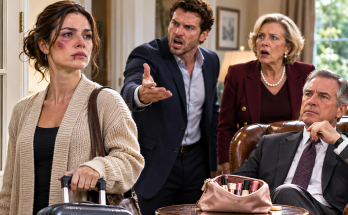
My mother-in-law grabbed my arm outside my husband’s military funeral and whispered, “You should be ashamed of yourself. My son deserved a better wife than you.”
I stood beneath the gray Virginia sky, wearing a black dress and holding a folded American flag against my chest.
Behind her, my husband’s military colleagues stood in perfect formation.
In front of me, hundreds of mourners had gathered to honor a man they believed had died a hero.
And beside the funeral tent, my husband’s older brother was telling anyone who would listen that I had never deserved to marry him.
I didn’t defend myself.
I didn’t explain why I had spent the previous seven years keeping secrets.
I simply looked at the flag in my hands and remembered the promise I had made to my husband on the night he left for his final assignment.
If anything happens to me, don’t let my family destroy what we built.
I had promised him.
And I intended to keep that promise.
My name is Olivia Bennett. I was thirty-six years old when my husband, Commander James Bennett, was laid to rest.
James had served in the United States Navy for fifteen years. He was respected by his colleagues, admired by younger officers, and known among his friends as a man who never abandoned anyone who needed him.
To his family, however, I had always been an outsider.
His mother, Margaret, never believed I was good enough for her son.
She came from an old military family, where reputation mattered more than kindness and every achievement was measured against someone else’s.
James’s older brother, Christopher, was her favorite.
Christopher had graduated from an elite university, married a wealthy woman, and eventually become a successful defense contractor.
He knew how to impress important people.
He knew what to say at dinners.
And he knew how to make someone feel small without raising his voice.
I was the opposite.
I rarely spoke about my work.
I avoided expensive parties.
And I had never explained to James’s family why certain military officials occasionally called me at unusual hours.
They assumed I had an ordinary government job.
I never corrected them.
Seven years earlier, James and I had married in a small ceremony attended by a handful of close friends.
Margaret had refused to attend.
She sent a note instead.
I hope you understand what you are asking my son to sacrifice.
James read it, folded it carefully, and placed it in a drawer.
Then he took my hands.
“Olivia, I didn’t marry my family. I married you.”
Those words became my anchor.
For the next seven years, we built a life together in a quiet house near the coast.
We had no extravagant vacations, no expensive cars, and no interest in impressing strangers.
Our favorite evenings were spent on the back porch, drinking coffee and talking about the future.
James wanted to retire near the ocean.
He wanted a garden.
He wanted to teach young sailors everything he had learned.
And he wanted us to grow old together.
Then, one evening, his orders changed.
He received a new assignment and was told to report within forty-eight hours.
He came home late that night, placed his uniform jacket over a chair, and sat beside me.
“There’s something I need you to understand,” he said.
I could tell he was struggling to find the right words.
“Whatever happens during this assignment, there are people who may try to make you question what you know about me.”
I frowned.
“James, what are you talking about?”
He took my hand.
“I can’t tell you everything. But I need you to trust me.”
“I do trust you.”
He looked into my eyes.
“Then promise me something.”
“Anything.”
“If I don’t come home, don’t let my family make decisions about your life. And don’t let anyone convince you that you owe them an explanation for the work we’ve done.”
I felt a chill run through me.
“You’re frightening me.”
He smiled sadly.
“I’m trying to protect you.”
That was the last private conversation we had before he left.
Six months later, two uniformed officers arrived at my front door.
James had died during an operation overseas.
I don’t remember much of what happened afterward.
I remember the officer’s voice.
I remember the cold railing beneath my hand.
I remember sitting on the kitchen floor long after they had left, staring at the coffee mug James had used that morning.
And I remember the phone call that came three days later.
A senior officer explained that some details surrounding James’s final assignment could not be discussed with the public.
He also told me that James had left instructions concerning certain personal documents.
I followed every instruction.
I answered every official question I was authorized to answer.
And I said nothing to his family about the parts of my life that remained confidential.
Margaret interpreted my silence as guilt.
Christopher interpreted it as an opportunity.
Within weeks, they began questioning my marriage.
They suggested I had never understood James’s career.
They hinted that I might be hiding something from the family.
Christopher even told one of James’s former colleagues that I had manipulated my husband into keeping his relatives at a distance.
I could have defended myself.
But James had asked me to protect certain matters, and I intended to honor his wishes.
So I stayed quiet.
Then came the funeral.
The military arranged a formal service with an honor guard, a ceremonial flag, and a procession of officers who had served alongside James.
I arrived early and stood alone near the front.
Margaret approached me wearing a black coat and a string of pearls.
She looked at the flag in my hands.
“Give that to Christopher,” she demanded.
I stared at her.
“Excuse me?”
“My son belonged to this family long before he met you. Christopher should receive his personal effects.”
“The flag is being presented according to military protocol,” I said gently.
She narrowed her eyes.
“Don’t lecture me about protocol. I raised James.”
Christopher appeared beside her.
“Olivia, let’s make this simple. Mom is grieving. You don’t need to turn today into another argument.”
“I’m not arguing.”
“Then give us the documents James left behind.”
My heart skipped.
“What documents?”
Christopher smiled without warmth.
“The ones you’ve been hiding.”
I suddenly understood.
He wasn’t simply grieving his brother.
He wanted something.
Before I could respond, Margaret turned toward a nearby security officer.
“She has no business standing with the family. Please move her away from the front.”
The officer looked uncomfortable.
“Ma’am, she’s the deceased officer’s wife.”
“His wife?” Margaret laughed bitterly. “You have no idea what that woman has done.”
Several people turned to look at us.
I could feel the humiliation spreading across my face, but I refused to lower my head.
Then Christopher leaned close.
“James told me things, Olivia. Things you clearly don’t know.”
I looked directly at him.
“Then you should have nothing to worry about.”
His smile disappeared.
The funeral began.
As the honor guard moved into position, a military chaplain stepped forward.
The wind carried the distant sound of traffic through the cemetery.
I held the flag against my chest and listened to the words being spoken about my husband.
Then something unexpected happened.
A black government vehicle pulled up near the entrance.
A senior officer stepped out and spoke briefly with the funeral coordinator.
The coordinator looked surprised.
He hurried toward the front of the gathering.
A moment later, a distinguished man in a dark suit entered the cemetery, accompanied by two senior military officers.
The conversations stopped.
Margaret straightened.
Christopher immediately adjusted his tie.
They recognized the visitor.
Everyone in military circles knew his name.
He was the Navy Secretary’s senior representative, a man whose presence at a private funeral was highly unusual.
He paused beside the honor guard.
Then he asked the funeral coordinator a question.
“Where is Mrs. Bennett?”
Margaret stepped forward.
“I’m James’s mother. Perhaps you should speak with me.”
The official gave her a polite nod.
“I’m sorry for your loss, ma’am. But I’m looking for Olivia Bennett.”
Margaret’s smile faltered.
I stepped forward.
“I’m Olivia.”
The official turned toward me.
For a moment, he simply studied my face.
Then he removed a sealed folder from his briefcase.
“Mrs. Bennett,” he said quietly, “your husband asked us to deliver this personally if he was unable to return.”
My hands began to tremble.
Margaret moved closer.
“What is that?”
The official held the folder against his chest.
“Something that concerns Mrs. Bennett and her husband’s final wishes.”
Christopher’s expression changed.
“That’s a family matter. Whatever James left behind should come to us.”
The official looked at him.
“Sir, I assure you that the proper procedures have been followed.”
Then he turned back to me.
“Mrs. Bennett, there is one more thing you should know.”
He paused.
“Your husband spent the final years of his service making certain that the truth about your work would eventually be recognized.”
I stared at him.
My mother-in-law went completely still.
Christopher’s face lost its color.
And the official opened the folder.
END OF PART 1
PART 2: The Letter My Husband Left Behind
The first page contained my full name.
The second contained an official seal.
The third contained a letter written in James’s handwriting.
I recognized the way he formed the letter J immediately.
For a moment, the cemetery disappeared.
I was back in our kitchen, watching him write grocery lists and leave small notes beside my coffee mug.
I pressed my lips together.
“May I read it privately?” I asked.
“Of course,” the official replied.
Margaret immediately protested.
“Why should she be the only one allowed to see it? James was my son!”
The official remained calm.
“Ma’am, your son’s instructions identify his wife as the recipient. Any additional information will be handled according to the applicable procedures.”
Christopher stepped forward.
“This is absurd. We are his immediate family.”
I looked at him.
“So am I.”
For once, he had no answer.
The official escorted me to a small room inside the cemetery administration building.
Before leaving, he gave me a moment to collect myself.
I unfolded James’s letter.
My Olivia,
If you’re reading this, I wasn’t able to keep my promise to come home.
I stopped.
Tears blurred the page.
I wiped my eyes and continued.
I know my family will have questions. Some will be sincere. Others may come from fear, pride, or a desire to control things they don’t understand.
You owe nobody a performance of grief. You don’t have to prove how much you loved me. And you don’t have to reveal anything that was entrusted to you in confidence.
You were my partner in every way that mattered. You were the person who understood the cost of the life we chose.
I need you to remember something, especially when the people around you make you feel small.
Your life was never a secret I was ashamed of. It was a life I was proud to share.
If the time comes when you can safely tell your story, let the truth speak for itself.
Until then, live. Please, Olivia. Live.
Forever yours,
James.
I pressed the letter against my heart.
For six months, I had forced myself to function.
I paid the bills.
I answered messages.
I returned to work.
I attended meetings.
I made decisions.
But every morning, I still expected to hear James’s footsteps in the hallway.
His letter didn’t erase my grief.
It reminded me that even in his final days, he had been thinking about how to protect me.
The official waited patiently until I was ready to speak.
“Thank you,” I whispered.
He nodded.
“Your husband was an exceptional man.”
“He was.”
“There is additional information in the folder. You should review it with your designated representative when you’re ready.”
I looked at the next document.
It was a formal letter concerning a professional recognition that had been approved before James’s death.
My name appeared at the top.
I read the first paragraph twice.
Then I looked up.
“This concerns my service?”
“Yes, ma’am.”
I had spent years working in a specialized government role that required discretion and careful coordination with military personnel.
My work had not made me famous.
It had not earned me a place in newspapers.
But it had mattered.
James had understood that better than anyone.
The document confirmed that my work had been formally recognized by the appropriate authorities.
It also stated that I had been selected for a senior advisory position.
I sat very still.
I had never expected James to arrange a public acknowledgment.
He knew I preferred to keep my career separate from my private life.
But he also knew that his family had mistaken my silence for weakness.
He had wanted to leave me something more important than an award.
He had wanted to leave me the freedom to stop apologizing for the life I had built.
When I returned to the cemetery, the funeral was nearing its conclusion.
The honor guard stood beside the flag-draped casket.
Margaret was waiting near the entrance.
“Well?” she demanded. “What did James leave you?”
I folded the documents carefully.
“A letter.”
“That’s all?”
I looked at her.
“That’s enough.”
Her eyes narrowed.
“Don’t play games with me, Olivia. Christopher says James had important records. We have a right to know what they contain.”
Christopher appeared behind her.
“I’d advise you to cooperate.”
I almost laughed.
“You’ve spent months accusing me of hiding things. Now you’re demanding documents you haven’t even identified.”
His face hardened.
“You married my brother. You didn’t own him.”
“No,” I replied. “I loved him.”
The difference seemed to confuse him.
Before he could respond, the senior official approached us.
“Mr. Bennett, I need to make something clear. Mrs. Bennett’s personal documents and professional records will be handled through the proper channels. Any request must follow the applicable procedures.”
Christopher straightened.
“I am a family member.”
“That does not automatically entitle you to another adult’s confidential records.”
Margaret looked furious.
“This is outrageous.”
The official remained composed.
“Ma’am, today is a day to honor your son. I encourage you to allow the service to proceed with dignity.”
The funeral continued.
When the time came for the flag presentation, a senior officer approached me.
He knelt slightly and presented the folded American flag.
“On behalf of a grateful nation, please accept this flag as a symbol of our appreciation for your husband’s honorable service.”
I accepted it with both hands.
My knees felt weak.
I wanted James.
I wanted his laugh, his steady voice, and the way he always squeezed my hand twice when he knew I was anxious.
I wanted one more ordinary evening.
One more cup of coffee.
One more chance to tell him that I loved him.
Instead, I held the flag and listened to the final salute.
The sound echoed across the cemetery.
Margaret cried openly.
Christopher stood rigidly beside her.
I cried, too.
But I was no longer ashamed of my grief.
After the ceremony, the official asked whether I would attend a private meeting the following week to review James’s remaining instructions.
I agreed.
Then I drove home alone.
For the first time since James’s death, I opened the small safe in our bedroom.
Inside were several envelopes, a few personal documents, and a photograph of us standing beside the ocean.
I lifted the photograph.
James was laughing.
I was looking at him instead of the camera.
I remembered the day it had been taken.
We had spent the afternoon walking along the shore, talking about retirement and the future.
He had asked me whether I regretted the choices I had made.
I told him no.
He smiled.
“Good. Because I wouldn’t change a thing about the woman I married.”
I sat on the edge of the bed and cried until the room grew dark.
The next morning, I returned to work.
I thought the funeral would mark the end of the conflict with James’s family.
I was wrong.
Two days later, Christopher sent me a legal letter.
He claimed James had promised him access to certain family assets and personal records.
He demanded that I provide copies of everything in my possession.
At the bottom, he had added a handwritten sentence.
Don’t make this more difficult than it needs to be.
I placed the letter on my desk.
Then I called the attorney James had named in his instructions.
She listened carefully.
When I finished explaining, she said something that made me sit upright.
“Olivia, I reviewed James’s documents this morning. Christopher’s claim is not supported by the estate records.”
I exhaled.
“Then why is he doing this?”
There was a brief silence.
“Because I don’t think this is really about the estate.”
“What do you mean?”
“I believe he is worried about a separate agreement James entered into several years ago. It concerns a matter Christopher hoped would never be examined.”
My stomach tightened.
“What matter?”
The attorney lowered her voice.
“Your husband left evidence that could explain why Christopher has been so determined to control the narrative about your marriage.”
I stared at the letter on my desk.
Suddenly, I understood why Christopher had looked so frightened when the official arrived.
He hadn’t been worried about what James had left me.
He had been worried about what James had preserved.
END OF PART 2
PART 3: The Truth My Husband Protected Until His Final Day
The following week, I entered the attorney’s office carrying James’s letter and the folder from the funeral.
Christopher was already there.
He sat beside Margaret, wearing an expensive suit and an expression of practiced confidence.
When I entered, he stood.
“Olivia. I’m glad you’ve decided to be reasonable.”
I took the empty chair opposite him.
“I came to hear what the attorney has to say.”
The attorney, a woman named Rebecca Collins, opened a file.
“Before we begin, I want everyone to understand that this meeting concerns documented matters. We will not make accusations without evidence, and no conclusions should be drawn beyond what the records support.”
Christopher smiled.
“Of course.”
Rebecca looked at him.
“Mr. Bennett, you submitted a claim concerning certain assets and documents you believe your brother intended to leave to you.”
“Correct.”
“The estate records do not support your claim to ownership of those assets.”
His smile faded.
Rebecca placed several pages on the table.
“Additionally, we have correspondence showing that James disputed your interpretation of a private business agreement three years ago.”
Margaret looked sharply at her son.
“What business agreement?”
Christopher shifted in his chair.
“That has nothing to do with this meeting.”
Rebecca remained calm.
“It is relevant because your recent correspondence refers to that agreement as the basis for your request.”
I looked at Christopher.
“What agreement?”
He turned toward me.
“You wouldn’t understand.”
I felt a familiar ache in my chest.
Even now, he believed that dismissing me was easier than answering a question.
Rebecca continued.
“James documented concerns about how certain family assets were being represented. He sought independent advice and preserved records of the transactions. We are reviewing those records to determine the appropriate next steps.”
Margaret looked stunned.
“Christopher, what is she talking about?”
He shook his head.
“This is being exaggerated. James misunderstood the arrangement.”
“Then the records should clarify it,” Rebecca replied.
She turned to me.
“Olivia, James also left a personal statement concerning your marriage and his wishes for your future. Would you like me to read it?”
I nodded.
Rebecca unfolded a letter.
“James wrote that his wife had been a consistent source of support throughout his service. He specifically asked that she not be pressured into disclosing confidential information or surrendering personal records simply because other relatives demanded them.”
I closed my eyes briefly.
That sounded exactly like James.
Rebecca continued.
“He also stated that he wanted his family to respect Olivia’s independence and professional achievements, regardless of whether they understood the details of her work.”
Margaret began to cry.
Christopher stared at the table.
Rebecca placed the letter down.
“Finally, James requested that any disputed business matters be handled independently of his military service and funeral arrangements.”
That was the moment I understood the full meaning of his final instructions.
James hadn’t wanted to embarrass his brother.
He hadn’t wanted to punish his mother.
He had wanted to prevent his death from becoming an opportunity for someone else to control the truth.
Rebecca explained that the relevant records would be reviewed through the proper legal process.
If the evidence supported further action, the appropriate authorities would decide what happened next.
No one in the room was entitled to declare the outcome in advance.
Christopher objected.
He insisted that the agreement had been misunderstood.
He accused the attorney of taking sides.
He even suggested that I had influenced James.
But each time he made a claim, Rebecca returned to the documents.
Dates.
Signatures.
Correspondence.
Recorded decisions.
The records did not change simply because Christopher disliked what they said.
Eventually, he fell silent.
Margaret looked at me.
“Olivia, did you know about this?”
“Not until after the funeral.”
“Then why didn’t you tell us?”
I held her gaze.
“Because you never asked me what I knew. You accused me of hiding things before you understood what they were.”
Her face crumpled.
“I thought you had taken James away from us.”
“No,” I said quietly. “James made his own decisions. He loved you, even when he disagreed with you.”
She wiped her eyes.
“He rarely spoke about your work.”
“Because I couldn’t share every detail. But he knew what I did, and he respected it.”
Margaret looked down at her hands.
“I should have trusted him.”
I said nothing.
It was not my responsibility to rescue her from the consequences of her choices.
Christopher stood abruptly.
“This meeting is over.”
Rebecca closed the file.
“For today, yes. You will receive any necessary communication through the appropriate channels.”
He turned toward me.
“You must be pleased with yourself.”
I stood.
“No, Christopher. I’m grieving my husband. I would give anything to have him back.”
For the first time, he looked genuinely ashamed.
I continued.
“I never wanted this family to suffer. I wanted to be treated with basic respect. Those are not the same thing.”
He opened his mouth, but nothing came out.
I left the office with Rebecca.
Outside, the rain had stopped, and the afternoon sunlight was breaking through the clouds.
She walked with me toward the parking lot.
“James was very clear about one thing,” she said. “He wanted you to keep living your life.”
I nodded.
“I’m trying.”
“You don’t have to solve everything today.”
I looked at the folder in my hands.
For months, I had believed that the hardest part of losing James was learning how to live without him.
I was beginning to understand that another challenge lay ahead.
I had to learn how to live without constantly defending myself against people who refused to understand me.
A few days later, Margaret called.
I almost let it go to voicemail.
But something made me answer.
“Olivia?”
“Yes.”
Her voice was fragile.
“I’ve been thinking about the funeral.”
I waited.
“What I said to you was cruel. I was angry and frightened, and I blamed you because I couldn’t bear the thought of losing James.”
I closed my eyes.
“I’m sorry,” she whispered. “You were his wife. You deserved better from me.”
For a moment, I couldn’t speak.
I had imagined hearing those words for years.
But now that they had arrived, they didn’t magically repair the damage.
“Thank you for apologizing,” I finally said.
“Will you ever forgive me?”
“I don’t know yet. But I appreciate that you asked.”
She began crying softly.
“I miss my son.”
“So do I.”
For the first time, we shared the same grief without turning it into a competition.
Christopher never called to apologize.
The legal review continued independently, and I left the matter in the hands of the professionals responsible for it.
I didn’t seek revenge.
I didn’t need to.
My husband’s records would speak for themselves.
Several weeks later, I attended a small ceremony recognizing the contributions of people working in specialized government service.
My name appeared on the program.
There were no dramatic announcements.
No family members were humiliated.
No one had to be proven wrong in front of a crowd.
I accepted the recognition, thanked my colleagues, and returned home.
That evening, I placed the commendation beside James’s photograph.
Then I sat on the back porch with a cup of coffee.
The ocean was quiet.
The air smelled of salt and rain.
I imagined James sitting beside me, asking whether I had finally taken a day off.
I smiled through my tears.
“I miss you,” I whispered.
The wind moved gently through the trees.
I knew it was only the wind.
But I also knew what he would have told me.
Keep living.
So I did.
I returned to work.
I visited friends.
I began planning the small garden James had always wanted.
And slowly, I stopped measuring my worth by whether his family approved of me.
They had called me an outsider.
They had questioned my marriage.
They had mistaken my silence for weakness.
But they had never understood the truth.
I had not been hiding because I was ashamed.
I had been quiet because I knew some things were more important than winning an argument.
And when the truth finally emerged, it did not make me a better person.
It simply revealed the person I had been all along.
On the anniversary of James’s death, I returned to his grave with a single white rose.
I placed it beside the headstone and unfolded the letter he had written me.
I read the final paragraph once more.
Your life was never a secret I was ashamed of. It was a life I was proud to share.
I pressed the paper against my heart.
Then I stood, brushed the grass from my dress, and walked toward the gate.
For the first time since his death, I wasn’t walking away from the past.
I was walking toward the future we had once imagined together.
And I finally understood the greatest gift James had left me.
Not money.
Not recognition.
Not the chance to prove his family wrong.
He had left me the courage to live without their judgment.
THE END