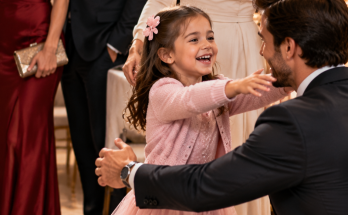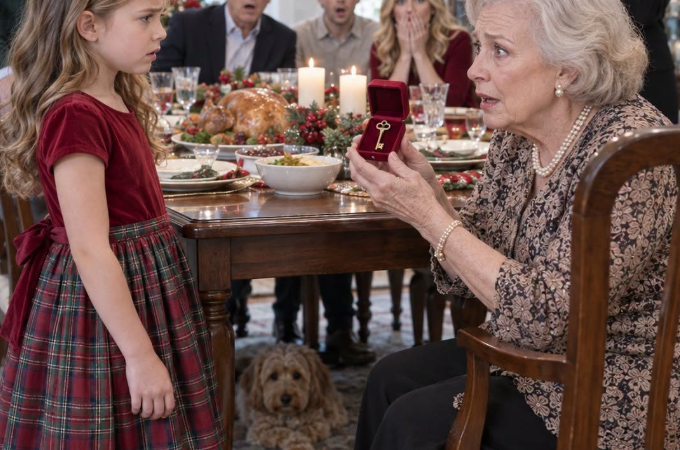
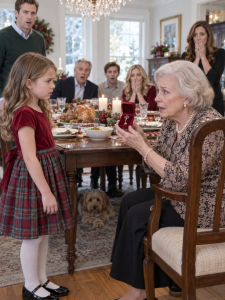
I never told my mother-in-law that my daughter, the child she had treated like a “stray dog,” was the one person who could ultimately remove her from our lives. On Christmas morning, she handed the other grandchildren cash and tablets, but when it was my daughter’s turn, she gave her a cheap candle with a tag that said, “To Caleb’s Girl.” The entire room fell silent. My seven-year-old rose from her chair in her gold dress, completely calm. “Grandma,” she said, “Dad told me to give this to you if you ever ignored me again.” She set a small red box in front of her. “Open it, Mom,” he said. Beatrice lifted the lid and immediately let out a scream.
Beatrice’s dining room in Minneapolis looked perfect in the way a room can look perfect when everyone inside is carefully trying not to breathe too loudly. Pine garlands surrounded the doorway. Cinnamon rolls were cooling under sheets of foil. The chandelier shimmered across the silver napkin rings, while outside, a small American flag tapped quietly against the porch railing in the cold winter wind.
Everyone knew Beatrice’s rules. Smile, stay polite, and never question her when she decided someone needed to be reminded of where they belonged.
That Christmas, she decided it was my daughter’s turn.
Chloe sat beside me in the gold dress Caleb had steamed twice before we left the house in Duluth. She was seven years old, her black Mary Janes tucked underneath the chair, both hands resting neatly in her lap. Before we walked inside, Caleb had spotted a scuff on one of her shoes, wiped it clean, and quietly told her, “You deserve at least one holiday where you feel chosen.”
Beatrice had spent the previous three years making certain she never felt that way.
Chloe was my daughter from my first marriage, but Caleb had never once treated that fact as if it made her any less important. He packed her lunches, remembered that her stuffed rabbit needed to face the bedroom door every night, and could tell the difference between her real laugh and the careful little laugh she used around adults who made her uncomfortable.
Beatrice had never called Chloe her granddaughter.
Instead, she referred to her as “Caleb’s girl,” “your child,” or “that sweet little visitor.” Chloe was always almost part of the family.
But never completely.
At 8:47 a.m. on December 25, Beatrice began handing out presents as if she were presiding over some elaborate ceremony. One cousin opened an iPad. Another received the exact same gift. The older children pulled thick envelopes filled with cash from shiny Christmas cards.
Then Beatrice looked over at Chloe.
“Oh. Chloe.”
She extended a thin drugstore gift bag with a crooked bow attached to it.
“This is for you, sweetheart. I didn’t want you to feel completely left out.”
Chloe took the bag with both hands. She slowly removed the tissue paper.
Inside was a cheap vanilla candle.
The candle itself wasn’t what hurt.
It was the handwritten tag hanging from it.
To Caleb’s Girl.
A fork stopped halfway to someone’s mouth. One cousin suddenly seemed extremely interested in the carpet. The golden retriever hiding under the table retreated farther from the chair legs. Beside me, Caleb crushed the side of his paper coffee cup without even seeming to notice.
Beatrice kept smiling, already behaving as though the insult was far too trivial for anyone with decent manners to mention.
I quietly said Caleb’s name.
He leaned closer to me.
“I told her to give Mom the red box if this happened again.”
“What red box?”
“The one in her overnight bag.”
I stared at him.
“You planned this?”
“No,” he said. “I prepared for it.”
Later that evening, at 9:12 p.m., I found Chloe sitting on the guest-room bed with the candle in her lap. Her gold dress was wrinkled, and she kept looking at the tag as though staring at it long enough might somehow make the words change.
“Mom,” she asked softly, “am I only Dad’s girl?”
Before I could respond, Caleb knelt down in front of her.
“You are my daughter,” he told her. “No tag gets to decide who you are.”
Then he reached into her overnight bag and placed a small red velvet box in her hands.
“If Grandma ever makes you feel invisible again, you get to decide whether she receives this. Not me. Not your mom. You.”
Chloe slowly turned the box over in her hands.
“Will she be mad?”
“Probably.”
“Will you still be my dad?”
For half a second, Caleb looked completely shattered.
“Always.”
The next morning, Beatrice hosted brunch. Once again, the table had been arranged with white dishes, silver napkin rings, and handwritten place cards.
Everyone had a name.
Except Chloe.
Her card simply said:
GUEST.
Chloe noticed it at exactly the same moment Caleb and I did. She didn’t cry. She didn’t ask either of us to fix it. Instead, she reached into the tiny purse Caleb had given her, wrapped both hands around the red velvet box, and stood up.
She crossed the dining room while every aunt, uncle, cousin, and in-law watched her.
“Grandma,” Chloe said, loudly and clearly enough that everyone at the far end of the table could hear, “Dad told me to give this to you if you ever ignored me again.”
Beatrice’s polished smile became tense.
“Well, isn’t that dramatic.”
Caleb stood behind our daughter.
“Open it, Mom,” he said.
Beatrice lifted the lid while still wearing that smug expression, as though she already had a speech prepared about overly sensitive children and modern parenting.
Then she screamed.
The cousin standing near the window flinched. Everyone leaned forward.
Inside the red velvet box was a single small brass key and a folded white card.
The first words written on it were…