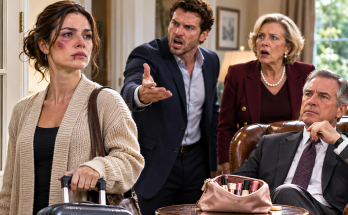
My Son Abandoned Me in a Nursing Home and Sold My House Without Permission—Then He Discovered the Secret Trust His Grandfather Had Left Behind
Part 1: The Son Who Returned When the Money Arrived
“Dad, sign these papers, and everything will be easier for everyone.”
My son said those words while standing beside my hospital bed, holding a folder that would have transferred control of my house, my savings, and the business I had spent thirty-five years building.
He had not visited me in eight months.
He had not called on my birthday.
And when I was rushed to the hospital after collapsing in my workshop, he had arrived only after learning that my property had recently been valued at nearly $2.7 million.
My name is Robert Hayes, and I was seventy-four years old when I finally understood that the boy I had raised could look at his own father and see nothing but an opportunity.
My wife, Eleanor, had died six years earlier.
After her funeral, I poured myself into running our family construction company.
It was never a glamorous business.
I spent decades repairing roofs, building homes, and managing small commercial projects while other men chased contracts worth millions.
But I worked honestly, paid my employees fairly, and saved carefully.
By the time I turned seventy, I owned a comfortable house outside Philadelphia, a small warehouse, and a construction business that had become profitable enough to attract a regional buyer.
My son, Daniel, had always believed I was too cautious.
When he was thirty, he asked me for $180,000 to launch a luxury car dealership with two friends.
I reviewed his proposal and discovered that he had borrowed heavily already.
I offered to help him prepare a realistic business plan, but I refused to hand over my retirement savings.
He called me a coward.
His wife, Melissa, told me I cared more about money than my own family.
Daniel stopped bringing my grandchildren to visit.
For years, I tried to repair the relationship.
I sent birthday cards.
I invited them to dinner.
I even offered to pay for a family vacation so we could spend time together without discussing business.
Every offer was rejected.
Then, eight months before my hospitalization, Daniel sent me a short message.
“Don’t contact us again until you learn to respect our decisions.”
I read it several times before putting my phone away.
I never answered.
When I collapsed in my workshop, my neighbor found me and called an ambulance.
The doctors discovered a serious heart condition and kept me in the hospital for observation.
I was frightened, but I was recovering when Daniel finally appeared.
He arrived wearing an expensive suit and carrying a leather folder.
“Dad,” he said, leaning over my bed, “you should have told me you were sick.”
I looked at him.
“You haven’t spoken to me in eight months.”
He sighed.
“We’re not going to argue about the past.”
Then he opened the folder.
Inside were documents granting him authority to manage my finances, make decisions about my property, and handle several business matters on my behalf.
“I’ve arranged everything,” he said.
“You need someone younger to take care of these things.”
I slowly turned the first page.
The document gave him far more authority than I was comfortable granting.
“Who prepared this?”
“My attorney.”
“Did your attorney speak with mine?”
Daniel frowned.
“Why would we need two attorneys?”
“Because these are my assets.”
His expression hardened.
“Dad, you’re seventy-four. You can’t keep running everything forever.”
“I never said I would.”
“Then sign.”
I put the papers down.
“No.”
For a moment, he looked genuinely shocked.
Then he leaned closer.
“You’re making this difficult for no reason.”
I studied his face.
“Daniel, you haven’t asked how I’m feeling.”
He glanced at the hospital monitor.
“You’re recovering.”
“You haven’t asked whether I’m afraid.”
He said nothing.
“You haven’t even asked what the doctors told me.”
He straightened his jacket.
“I came here to help you.”
I looked at the folder again.
“No,” I said quietly.
“You came here to take control.”
His face turned red.
“Everything you’ve built will eventually belong to me anyway.”
The words hung in the room.
I had spent years wondering why my son seemed to resent me.
Now I finally understood.
He believed my life was an asset waiting to be transferred.
I called my attorney, Margaret Collins, and asked her to visit the hospital.
When she arrived, Daniel immediately began explaining why I needed his assistance.
Margaret listened without interrupting.
Then she examined the documents.
“Robert will not sign anything today,” she said.
Daniel stood up.
“This is a family matter.”
“Then you should have allowed your father to make the decision without pressure.”
Daniel grabbed his folder.
“You’ll regret this, Dad.”
He left the room without saying goodbye.
I watched him disappear through the doorway.
For a long time, I said nothing.
Then I turned toward Margaret.
“There’s something I need you to check.”
“What is it?”
I reached into the drawer beside my bed and removed a small envelope.
It contained an old document my father had given me shortly before he died.
I had kept it for nearly forty years.
My father had been a quiet man who never trusted promises without paperwork.
Before his death, he established a family trust connected to a parcel of commercial land he owned.
I had never touched the land.
I had never needed to.
But the trust contained specific instructions about who could control or sell certain assets if I became unable to manage them myself.
Margaret read the first page, then looked up.
“Robert, has Daniel ever seen this?”
“No.”
“Does he know the trust exists?”
“I doubt it.”
She carefully placed the document back in the envelope.
“Then I think we need to review the entire trust before your son makes another move.”
I looked toward the hospital window.
For the first time since Daniel had entered my room, I felt something other than disappointment.
I felt prepared.
Because my son believed that my age made me powerless.
He believed that my illness made me vulnerable.
And he believed that everything I owned would eventually become his without question.
But my father had anticipated a day when someone might confuse inheritance with ownership.
And the instructions he left behind were about to change everything.
Part 2: The House He Tried to Take
Three weeks after I left the hospital, I returned home.
My neighbor, Thomas, had watered the garden and collected my mail while I was away.
He also told me something that made my stomach tighten.
“Robert, your son came by last week with a real estate agent.”
I looked at him.
“An agent?”
“They walked around the property and took photographs.”
“Did Daniel say why?”
Thomas shook his head.
“He told me he was helping you prepare for retirement.”
I thanked him and went inside.
The house looked exactly as I had left it.
Eleanor’s photographs remained on the mantel.
Her favorite blue vase stood beside the kitchen window.
But something felt wrong.
A drawer in my office was open.
Several folders had been moved.
And the envelope containing the trust documents was no longer where I remembered leaving it.
I searched the desk, the filing cabinet, and the locked drawer beneath my workbench.
Nothing.
I immediately called Margaret.
“Someone has been through my office,” I told her.
“Was anything else missing?”
“Not that I can see.”
“Do not confront Daniel yet,” she advised.
“Let me check whether any documents have been filed or whether anyone has attempted to act on your behalf.”
The following morning, Margaret called me back.
Daniel had contacted a property agent and claimed that I was considering selling the house.
He had also asked questions about transferring ownership of the warehouse.
Neither transaction had been completed.
But the agent had received information suggesting that Daniel believed he was authorized to handle the properties.
Margaret advised me to secure my records, notify the relevant parties that I had not authorized any sale, and have my capacity and estate documents reviewed independently.
I followed her advice.
Then I called Daniel.
He answered on the fourth ring.
“What is it, Dad?”
“Why did you bring a real estate agent to my house?”
Silence.
“I was looking into options for you.”
“Did I ask you to sell my property?”
“You’re going to need help eventually.”
“That isn’t an answer.”
He sighed.
“You’re making this into a bigger problem than it is.”
I felt my anger rising, but I kept my voice steady.
“Do not contact another agent about my property unless I authorize it.”
He laughed bitterly.
“You really think you can manage everything yourself forever?”
“I can make my own decisions today.”
“What happens when you can’t?”
“That is why I have an attorney.”
Daniel lowered his voice.
“Dad, I have responsibilities. Melissa and I have debts. The children need stability.”
I closed my eyes.
For a moment, I remembered the little boy who used to fall asleep on my shoulder during long car rides.
I remembered teaching him to ride a bicycle.
I remembered standing in the rain at his high school graduation because he had forgotten his umbrella.
I had always wanted to help him.
But love could not mean giving him permission to take what was not his.
“I am sorry you’re struggling,” I said.
“But my property is not your emergency fund.”
He ended the call.
Two days later, Margaret arrived at my house with a second attorney who specialized in trusts and estate planning.
They spent the afternoon reviewing my father’s documents.
By evening, they had confirmed that the trust remained active and that its terms limited certain transfers without the required independent approval.
The exact scope of those restrictions depended on the assets and the trust’s provisions, so the attorneys began checking the property records and original agreements.
One discovery stood out.
The commercial parcel connected to the trust had increased dramatically in value because a major redevelopment project had been proposed nearby.
The parcel was worth considerably more than it had been when my father established the trust.
Daniel had recently asked the property agent whether the land could be sold together with my warehouse.
He appeared to believe both properties were part of my personal estate.
They were not.
Margaret explained that my father’s trust did not automatically give me control over every asset I owned, nor did it make Daniel guilty of wrongdoing simply because he had asked about a sale.
But it did mean that he could not assume he had authority over the protected property.
We needed to establish exactly what he had attempted to do and ensure that no unauthorized transaction proceeded.
Then Margaret found something else.
A letter from my father, dated three months before his death.
I had read it many times, but never alongside the full trust agreement.
This time, I noticed a paragraph I had overlooked.
Robert, if someone ever comes to you demanding what they believe is already theirs, do not confuse their confidence with a legal right.
Give them the chance to explain themselves, but never surrender your judgment simply because they share your blood.
I sat quietly after reading those words.
My father had known that money could turn family relationships into something ugly.
He had also understood that a person could love a child without handing that child the keys to every decision.
Margaret placed the letter beside the trust documents.
“Your father was careful,” she said.
“Yes.”
“Now you need to be equally careful.”
That evening, Daniel sent me a message.
“We need to meet. There are things you don’t understand about what I’ve been planning.”
I replied that he could come the following Saturday, provided Margaret was present.
He agreed.
When he arrived, he brought Melissa and a folder filled with property estimates.
They sat across from me in the living room.
Daniel spoke first.
“I know you’re upset about the agent.”
“I’m concerned that you acted without my permission.”
He nodded impatiently.
“Fine. I should have spoken to you first.”
It was the closest thing to an apology I had heard from him in years.
Then he opened the folder.
“Here’s the thing. If we sell the house and the warehouse, we can pay off our debts, buy a smaller place for you, and invest the rest.”
I stared at him.
“You’ve already decided what happens to my money.”
“We’re trying to protect your future.”
“My future is not yours to arrange without my consent.”
Melissa leaned forward.
“Robert, nobody is trying to hurt you.”
“Then why have you brought me another plan I never requested?”
She looked toward Daniel.
He rubbed his forehead.
“Because we’re running out of time.”
The room became silent.
I looked at him carefully.
“How much debt do you have?”
He hesitated.
“That’s not important.”
“It is if you are trying to sell my property to pay it.”
Daniel finally admitted that his real estate venture had lost money.
He had borrowed more than he could repay, hoping that another investment would rescue the business.
Now several creditors were demanding payment.
He had seen the news about my company sale and believed that I could solve the problem.
I listened without interrupting.
When he finished, I asked one question.
“If I had not sold my company, would you have come to visit me?”
He stared at me.
Melissa looked down.
Daniel’s mouth opened, but no answer came.
I nodded slowly.
“That is what I thought.”
He pushed the folder toward me.
“Dad, I am your son.”
“And I am your father.”
I placed my hand on the folder without opening it.
“But being your father does not mean I must put my entire future at risk to rescue you from decisions you made.”
Daniel stood abruptly.
“You would rather let me lose everything?”
“No,” I said.
“I would rather help you face the truth before you lose more.”
He looked at me with anger and disbelief.
Then he left with Melissa.
After they were gone, Margaret sat beside me.
“You could still offer him financial help,” she said.
“I know.”
“But you do not have to decide today.”
I looked at the old photograph of Eleanor on the mantel.
“No,” I replied.
“This time, I am going to make a decision that protects everyone—including me.”
And before I could decide whether Daniel deserved another chance, Margaret received a call from the trust attorney.
A document had been submitted requesting information about the protected commercial parcel.
It had not transferred ownership.
But someone had tried to obtain details about selling it.
And the name on the inquiry was Daniel Hayes.
Part 3: The Inheritance Was Never His to Demand
The trust attorney confirmed that Daniel had contacted a property representative seeking information about the commercial parcel.
He had not completed a sale.
He had not acquired ownership.
And the inquiry alone did not establish that he had committed a crime.
But it confirmed that he had been pursuing assets whose ownership and transfer restrictions he had not properly understood.
Margaret sent Daniel a formal notice explaining that he had no authority to act on my behalf or represent that he could sell my property.
She also arranged for the relevant property records and trust documents to be reviewed and secured.
I wanted the matter resolved without unnecessary public conflict.
I had no interest in humiliating my son.
I wanted him to understand that the boundaries were real.
Two weeks later, Daniel came to see me alone.
He looked exhausted.
His expensive suit had been replaced by a plain jacket, and he carried no folder.
“Dad, can we talk?”
I invited him inside.
We sat at the kitchen table.
For a while, he stared at his hands.
Then he said, “I made a mess of things.”
I waited.
“The business is failing. I borrowed too much, and I thought one more investment would fix everything.”
He took a deep breath.
“When I heard you had sold your company, I convinced myself that you could save me.”
“Did you ask me?”
He shook his head.
“No.”
“Why not?”
“Because I thought you would refuse.”
I looked at him.
“So you decided to act as though you had already agreed.”
He nodded.
“Yes.”
It was the first honest answer he had given me in years.
He told me that Melissa had been frightened about their finances.
Their debts had grown, and Daniel had been trying to hide the seriousness of the situation from her.
When he learned about the trust, he had assumed it was simply another obstacle between him and the money he believed he would inherit.
He had not understood that my father’s instructions placed limits on how certain assets could be transferred.
“I thought everything would eventually come to me,” he admitted.
“Maybe it will. Maybe it won’t. That’s your decision.”
He looked up sharply.
“You can leave me nothing?”
“Yes.”
He flinched.
I continued before he could respond.
“And I can also choose to help you, if I believe the help is responsible and if the arrangements are fair.”
He looked at the table again.
“I don’t deserve your help.”
“That is not the question.”
“What is?”
“Whether you are willing to take responsibility for your own life.”
Daniel wiped his eyes.
For the first time since he had arrived at the hospital, I saw something other than entitlement in his face.
I saw shame.
“I am sorry, Dad.”
I let the words settle.
“I am sorry I stayed away after Mom died.”
My throat tightened.
“I am sorry I made you feel like you were only worth something when you could give me money.”
I looked at him.
“And I am sorry I tried to take control of your property without your permission.”
I had waited years to hear those words.
But an apology could not erase what had happened.
“Daniel, I love you,” I said.
“I have never stopped loving you.”
He began to cry.
“But I will not pretend those years did not happen. I will not sign away my independence, and I will not hand you money simply because you are in trouble.”
He nodded.
“I understand.”
“Do you?”
“Yes.”
I leaned back in my chair.
“Then here’s what I can offer.”
I would not pay Daniel’s debts outright.
I would not transfer property to him.
And I would not give him access to my accounts.
Instead, I offered to pay for a limited session with an independent financial adviser, provided Daniel agreed to disclose his debts honestly and work out a realistic repayment plan.
If he chose to pursue a new business, he would need a viable plan and independent professional advice.
Any future financial assistance would be considered separately, documented properly, and given only if I could afford it without risking my own retirement.
Daniel listened without interrupting.
When I finished, he nodded.
“That’s fair.”
It was not the answer I had expected.
For the first time, he seemed to understand that help was not the same as rescue.
Over the next several months, Daniel worked with a financial adviser.
He sold some personal assets, negotiated with creditors, and closed the parts of his business that could no longer operate responsibly.
The process was difficult.
He had to tell Melissa the full extent of their financial problems.
Their marriage went through a painful period, but they began making decisions based on the truth rather than promises of an easy recovery.
I did not intervene in their private disagreements.
I had learned that love could offer support without taking responsibility for every consequence.
Meanwhile, Margaret and the trust attorney finalized the review of my father’s estate documents.
The trust remained intact.
The protected parcel was not sold.
And my estate plan was updated to reflect my wishes clearly, with safeguards designed to protect my independence and ensure that any future distributions would be handled properly.
I did not write Daniel out of my life.
But I also did not guarantee him an inheritance.
I wanted him to build a life that did not depend on waiting for me to die.
A year later, I invited Daniel and his family to dinner.
Melissa arrived with the grandchildren.
They ran through the garden, laughing as I showed them the old wooden workbench where I had repaired furniture for decades.
Daniel stood beside me while I tightened a loose handle on a toy truck.
“Dad,” he said quietly, “I used to think you were selfish because you wouldn’t give me the money I wanted.”
I kept working.
“And now?”
“Now I think you were trying to teach me something I didn’t want to learn.”
I put the screwdriver down.
“What was that?”
He looked toward his children.
“That love doesn’t mean someone owes you everything they have.”
I smiled faintly.
“No, it doesn’t.”
He swallowed.
“I wish I had understood that before Mom died.”
“So do I.”
We stood quietly for a moment.
There was no grand reconciliation.
No dramatic promise that the past would never hurt again.
There was simply a father and a son standing in a garden, finally speaking honestly.
After dinner, Daniel helped me clear the table.
Before he left, he paused at the front door.
“Dad, thank you for giving me another chance.”
I looked at him.
“Don’t thank me yet.”
He frowned.
“Why?”
“Because trust is rebuilt through what you do next, not what you promise tonight.”
He nodded.
“I understand.”
After the family left, I sat in Eleanor’s favorite chair and looked at the photograph on the mantel.
I had spent years wondering whether refusing to give Daniel money had cost me my son.
Now I understood that the money had never been the real issue.
The real issue was whether our relationship could survive the truth.
I could not recover the years we had lost.
I could not give Eleanor another chance to see her son.
And I could not guarantee that Daniel would never disappoint me again.
But I could choose not to let fear, guilt, or money determine every decision we made from that day forward.
My father had created the trust to protect what he had worked for.
I had spent my life building a company to support the people I loved.
Neither of those things meant that my son was entitled to take control of everything I owned.
And neither meant I had to close my heart forever.
Daniel had arrived at my hospital bed believing that my illness gave him an opportunity.
He had come to my house believing my retirement made my property available.
He had treated inheritance as a promise he could collect before I was even gone.
But the secret my father left behind was not simply a legal document.
It was a reminder that responsibility mattered more than entitlement.
And the most important lesson I could leave my son was not how to claim an inheritance.
It was how to become the kind of man who no longer needed to demand one.
My son thought he was returning to collect his share of my fortune.
Instead, he discovered that the only inheritance worth saving was the relationship he had nearly thrown away.