My Sister Arrived at Our Grandmother’s Funeral Carrying a Baby Nobody Knew Existed—Then the Lawyer Opened a Letter That Exposed Our Family’s Cruelest Secret
Part 1 — The baby at the funeral
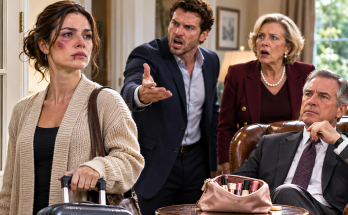
The morning we buried our grandmother, my entire family watched my older sister walk into the chapel carrying a newborn baby—and when my father demanded to know whose child she was, she looked straight at him and said, “Ask yourself why Mom paid me to disappear.”
Nobody moved.
My sister, Claire, had been missing for almost three years.
My father had told everyone she was selfish, unstable, and ashamed of our family.
My mother refused to discuss her.
And my grandmother, the one person who had defended Claire, had spent the last two years of her life asking me the same strange question.
“If Claire ever comes home, will you promise to listen before you judge her?”
I had promised, although I never understood why it mattered so much.
Now Claire stood beside the coffin in a simple black dress, her hair tied back, her eyes swollen from crying.
The baby in her arms was wrapped in a pale blue blanket.
My father rose from the front row so quickly that his chair scraped loudly against the chapel floor.
“You have some nerve coming here,” he snapped.
Claire tightened her arms around the baby.
“I came to say goodbye to Grandma.”
“You disappeared without a word,” he shouted. “You embarrassed this family, and now you think you can walk back in here with a child and pretend nothing happened?”
My mother began crying.
But she wasn’t looking at Claire.
She was staring at the baby.
I noticed it immediately.
Her face had gone completely pale, and her fingers were trembling against the black handbag resting on her lap.
“Who is the father?” I asked my sister.
Claire looked at me for a long moment.
Then she answered with five words that made my mother cover her mouth.
“Your mother knows exactly who.”
My father turned toward my mother.
“What is she talking about?”
My mother shook her head, whispering that Claire was lying.
But Claire reached into her handbag and removed a small silver locket.
I recognized it because our grandmother had worn the matching one every day until she died.
Claire opened it.
Inside was a tiny photograph of a young man standing beside my mother outside a hospital.
The photograph had been folded so many times that the edges were almost white.
On the back, someone had written a date from twenty-nine years earlier.
The date my mother had always claimed she spent alone in the hospital recovering from a serious illness.
My father stared at the photograph.
Then he looked at the baby.
“What does this mean?” he demanded.
Claire swallowed hard.
“It means Grandma didn’t leave me money when she died because she loved me more than you.”
She placed a sealed envelope on the coffin.
“She left it because she knew you would try to keep the truth buried with her.”
Before anyone could stop her, the chapel doors opened again.
A gray-haired lawyer entered carrying a leather briefcase.
He introduced himself as the attorney who had managed our grandmother’s estate.
Then he looked at my father and said, “Before we proceed with the will, your mother instructed me to read a letter in front of the entire family.”
He removed a document from his briefcase.
My father suddenly sat down.
My mother began shaking her head.
And Claire pulled the baby closer as the lawyer read the first line aloud.
“To my family: the child you were told had died was never dead.”
Part 2 — The child they said had died
The lawyer stopped reading and looked around the chapel.
My father stood again.
“This is a funeral, not a courtroom,” he said. “Whatever nonsense my mother wrote, it can wait.”
The lawyer calmly closed the briefcase.
“I was specifically instructed to read this letter at the funeral, in front of every member of the family.”
Then he continued.
“Twenty-nine years ago, my daughter gave birth to a baby boy before she married the man she now calls her husband.”
My mother’s knees nearly buckled.
I looked at my father, expecting him to explode.
Instead, he stared at the floor as if he had already heard every word.
The lawyer continued reading.
“The baby’s father was a young man named Daniel, whom my daughter loved before our family pressured her to marry someone wealthier and more respectable.”
My father finally spoke.
“That’s enough.”
But the lawyer didn’t stop.
“Daniel was told that the baby had died shortly after birth, while my daughter was told that Daniel had abandoned her.”
My mother covered her face.
For the first time, I understood that the story had never been about an unknown child.
It was about two young people who had been separated by a lie.
The lawyer turned the page.
“My husband and I helped keep that lie alive because we believed we were protecting our daughter’s future.”
He paused.
“I have regretted that decision every day since.”
Claire began crying silently.
I turned toward her.
“Why did you disappear?”
She looked down at the baby.
“Because Grandma discovered the truth three years ago, and she asked me to help her find Daniel.”
“Who is Daniel?”
Claire looked at my father.
“Your real father.”
The words struck me so hard that I reached for the back of a pew.
My father wasn’t my biological father.
The man who had raised me, taught me to ride a bicycle, attended my school performances, and told me that family loyalty mattered above everything else was not the man whose name appeared on my birth certificate.
I looked at my mother.
“Is it true?”
She couldn’t answer.
She only cried harder.
Claire explained that our grandmother had discovered an old hospital record while organizing her late husband’s documents.
The record showed that my mother had delivered twin boys.
One baby had been placed under another name, and the other had remained with her.
Our grandmother began searching for the missing child and eventually located Daniel, who had built a quiet life in another state.
But when she contacted him, he refused to believe her.
He had spent nearly three decades believing that the woman he loved had chosen money over him and that their child had died.
Grandmother needed proof.
Claire helped her collect the medical records, old letters, and hospital documents that could finally expose the truth.
Then my mother discovered what they were doing.
She begged Claire to stop.
When Claire refused, my mother threatened to cut her off financially and tell the entire family that she had stolen money from Grandmother.
My father supported her.
Claire left town because she feared that any attempt to expose the truth would destroy the evidence before the lawyer could verify it.
For nearly three years, she worked two jobs, raised her newborn son, and waited for the investigation to finish.
“Why didn’t you tell me?” I asked.
“Because I didn’t know whether you would believe me,” she whispered. “And because Grandma asked me to wait until she could protect the evidence.”
The lawyer opened another envelope.
Inside was a photograph of two newborn babies lying beside each other in a hospital nursery.
One wore a blue bracelet.
The other wore a white one.
Beneath the photograph was a document bearing my mother’s signature.
My father stared at it in disbelief.
Then the lawyer said something that made my mother sink into her chair.
“The child your mother was told had died was not your sister’s baby, as you were led to believe.”
He looked directly at me.
“The missing child is you.”
I felt the room tilt around me.
But the lawyer wasn’t finished.
He removed one final document from his briefcase and placed it on the coffin.
It was a letter written by Daniel, the man who had been separated from my mother before I was born.
At the bottom were six words.
“I have been searching for my sons.”
Part 3 — The truth that finally brought them home
I read the letter three times before I could understand what it meant.
Daniel had never stopped searching for his children.
For years, he had hired investigators, contacted hospitals, and written letters to agencies that had handled adoptions.
Every lead had ended in disappointment.
Eventually, he had been told that the babies’ records were sealed and that no further information could be released.
He had grown old believing that he had failed two children he had never been allowed to hold.
Then, six months before Grandmother died, he received a letter from her.
It contained copies of the hospital records, a photograph of the twins, and an apology for the family’s deception.
Daniel had immediately agreed to a DNA test.
The results confirmed what the old documents had suggested.
He was my biological father.
My mother had known the truth for years.
She had been told that one baby had died, while the other had been given to another family after a medical emergency.
She believed the explanation because she was recovering from a difficult delivery and was pressured to sign papers she barely understood.
My father, who had been her husband for years, eventually discovered the truth.
Instead of helping her find Daniel, he persuaded her to keep quiet.
He feared losing the family he had built and believed that revealing the secret would ruin our lives.
So he made a terrible choice.
He allowed me to grow up believing that my biological father had abandoned me.
He allowed Daniel to believe his sons were gone forever.
And he allowed my mother to carry the guilt of a story she had never fully understood.
I looked at the man who had raised me.
“Did you know all along?”
He opened his mouth, but no words came out.
Finally, he nodded.
“I loved you,” he whispered. “I was there for every birthday, every school day, every time you needed me.”
“I know,” I said, fighting back tears. “But you didn’t have to steal another man’s chance to know his son.”
My father lowered his head.
For the first time in my life, I saw him not as the man who always had an answer, but as someone who had spent years terrified of the truth catching up with him.
Then Claire stepped forward.
“There is something else Grandma wanted us to know.”
The lawyer opened the final page of the letter.
Grandmother had left the family home in a trust, with instructions that it could not be sold until the truth about the twins had been revealed and both biological parents had been given the opportunity to reconnect with their children.
She had also left a separate inheritance for Claire and her baby, enough to give them a safe home and a fresh start.
But her final instruction was not about money.
It was about forgiveness.
“She wrote that no inheritance could repair the years we lost,” the lawyer explained. “She only hoped that the truth would give this family a chance to make different choices.”
At that moment, a man appeared in the chapel doorway.
He was older than my father, with silver hair and tired eyes.
He wore a dark suit and held a small bouquet of white flowers.
Claire looked at him and whispered, “Daniel.”
He walked toward us slowly.
When he reached the coffin, he placed the flowers beside Grandmother’s photograph.
Then he turned toward me.
“I don’t expect you to call me Dad,” he said. “I know I missed your childhood, and I know I cannot ask you to pretend those years never happened.”
His voice broke.
“I only wanted the chance to tell you that I never abandoned you.”
I couldn’t speak.
I had spent my entire life believing that the man who raised me was my father and that the man who had never appeared in our photographs simply didn’t care enough to stay.
Now I was standing between two men, each carrying a different kind of pain.
One had loved me while hiding the truth.
The other had loved me without knowing where to find me.
I stepped forward and embraced Daniel.
He held me as if he were afraid I might disappear.
My mother approached us, but she stopped several feet away.
“I don’t expect you to forgive me,” she whispered.
I looked at her.
For years, I had thought the worst thing a parent could do was leave.
Now I understood that a person could remain beside you every day and still leave an enormous part of your life hidden.
“I need time,” I told her. “But I don’t want any more lies.”
She nodded through her tears.
Then Claire placed her baby in my arms.
“This is your nephew,” she said. “And he deserves to grow up knowing where he came from.”
The baby opened his eyes and wrapped his tiny fingers around mine.
I looked at my sister, the woman our family had called selfish for disappearing, and realized she had been carrying a burden none of us had understood.
She had not returned to steal an inheritance.
She had returned to give us the truth.
After the funeral, we gathered at Grandmother’s house.
Daniel sat beside my mother for the first time in nearly thirty years.
They spoke quietly about their youth, the life they might have shared, and the children they had lost without ever knowing their names.
My father sat alone near the window.
Nobody forced him to leave, but nobody pretended that everything was forgiven, either.
Rebuilding our family would take time.
There would be difficult conversations, unanswered questions, and wounds that money could never heal.
But that evening, for the first time, we began speaking honestly.
Before we left, I returned to Grandmother’s bedroom and found a small note tucked inside her favorite book.
It read:
“If the truth hurts, let it hurt honestly. A family built on lies may look perfect from the outside, but only the truth can give it a future.”
I folded the note carefully and placed it in my pocket.
For years, I had believed that family meant protecting one another from painful secrets.
Now I understood that real love sometimes means risking everything to bring those secrets into the light.
My grandmother had died before she could see all of us sitting together.
But she had given us one final gift.
She had given two fathers the chance to be known, two children the chance to understand their past, and one little baby the chance to grow up without inheriting our family’s lies.
And as I watched Claire cradle her son beside the man who had searched for me for nearly thirty years, I finally understood why she had returned to the funeral carrying a child nobody knew existed.
She hadn’t come to expose a scandal.
She had come to give our family back the people it had lost.