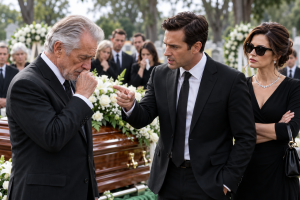
PART 1 — The Cruelest Words Spoken Beside My Wife’s Coffin
My wife had been buried for less than an hour when my only son pulled me away from the mourners, looked me straight in the eyes, and announced, “Dad, we’re cutting off your allowance. You’re going to have to support yourself from now on.”
His wife stood behind him in an elegant black dress, wearing a diamond necklace my wife had once admired, and smiled as if she had just won something.
I looked at the two people I had spent decades protecting, nodded quietly, and said, “You’re right. It’s time everyone learned to stand on their own.”
Neither of them realized that four days later, I would disappear with a single suitcase, and by midnight, my phone would show 140 missed calls.
They thought they had finally freed themselves from a helpless old man.
What they didn’t know was that the luxurious six-bedroom mansion they called home belonged to me—and I was about to stop protecting them from the consequences of their own greed.
My name is Robert Mitchell. I am seventy-one years old, and until that terrible week, I believed I understood the difference between family and strangers.
I had spent forty-six years married to Evelyn Mitchell, a woman whose kindness never diminished, even when life gave her every reason to become bitter.
She was the sort of person who remembered the names of restaurant waiters, sent birthday cards to distant relatives, and kept extra blankets in her car because someone might need them on a cold night.
When we were young, we had almost nothing.
I worked long days managing a small construction supply business, while Evelyn taught at an elementary school.
We lived in a modest two-bedroom house, drove an old car that frequently refused to start, and saved every spare dollar we could.
We had one son, Brandon.
He was the center of our world.
When he was a little boy, he used to fall asleep on my chest while Evelyn read stories beside the bed.
He would grab my finger with his tiny hand and whisper, “Daddy, you’ll always take care of me, right?”
I would kiss his forehead and promise, “Always, son.”
I never imagined that one day he would use that promise against me.
Over the years, my small business grew into a successful construction and property company.
I worked through recessions, difficult contracts, sleepless nights, and business deals that nearly destroyed everything we had built.
Evelyn stood beside me through every setback.
Eventually, we purchased several commercial properties and invested in residential real estate.
We became wealthy, although Evelyn never liked the word.
“Money is only useful when it makes someone’s life better,” she often reminded me.
When Brandon married Melissa, we welcomed her into our family.
She was charming, ambitious, and always impeccably dressed.
At first, I believed she genuinely loved our son.
But over time, I noticed something troubling.
Melissa remembered every gift we gave her, but rarely remembered to thank us.
She knew the estimated value of our properties, the brands of our watches, and the prices of our vacations.
Yet she rarely asked Evelyn how she was feeling or whether I had been sleeping well.
Whenever we gathered for dinner, she somehow steered the conversation toward money.
“Robert, that waterfront property must be worth a fortune now.”
“Evelyn, have you thought about transferring the house to Brandon before inheritance becomes complicated?”
“Brandon deserves to enjoy the things you’ve worked so hard to build.”
Evelyn would smile politely and change the subject.
After one particularly uncomfortable dinner, I found her standing alone in our kitchen, washing a plate that was already clean.
“Something is bothering you,” I said.
She turned off the faucet.
“Robert, I worry that our son has started confusing what we give him with what he deserves.”
I dismissed her concerns.
“He’s still learning. We’ll help him find his way.”
Evelyn looked at me for a long moment.
“Helping someone is not the same as preventing them from ever facing consequences.”
I wish I had listened more carefully.
Fourteen years before her death, Brandon and Melissa had been struggling financially.
Brandon’s business venture had failed, their rent was rising, and they were expecting their second child.
Evelyn and I stepped in.
I purchased a beautiful six-bedroom house in an exclusive neighborhood through one of my property companies.
It had a grand staircase, a landscaped garden, a three-car garage, a swimming pool, and enough bedrooms for Brandon’s growing family.
I allowed them to move in without paying rent.
I covered the property taxes, insurance, and major repairs.
When the roof needed replacing, I paid for it.
When their kitchen was renovated, I paid for that, too.
I even arranged for the gardener and maintenance crew to keep the property in perfect condition.
Brandon told his friends that he had finally made it.
Melissa posted photographs of the house online, describing it as the home they had worked so hard to achieve.
I never corrected them.
Evelyn believed that giving our son a secure place to raise his children was a gift worth making.
She only asked that I keep the financial arrangement private.
“Let him feel proud of his life,” she said. “But don’t let him forget who helped him build it.”
I agreed.
Then, three years before Evelyn died, Brandon began insisting that I accept a monthly allowance from him.
At first, I laughed.
“Son, I have more money than I need.”
He looked offended.
“You’ve supported me for years, Dad. Let me take care of you for once.”
Evelyn was delighted by the gesture.
So I agreed to let him transfer two thousand dollars a month into my personal checking account.
What Brandon didn’t know was that I had quietly been transferring four thousand dollars a month into education funds for his children.
I also paid for their medical expenses, school trips, extracurricular activities, and other needs whenever the bills appeared.
His allowance was a symbolic gesture.
The financial support I provided his family was worth many times more.
Then Evelyn became ill.
The diagnosis was cancer.
For months, our lives revolved around hospital appointments, medication schedules, and whispered conversations in the dark.
I slept beside her whenever the hospital allowed it.
I held her hand through treatments that left her exhausted.
Brandon visited occasionally, but Melissa often complained that the hospital was too far away or that their children had activities.
As Evelyn grew weaker, she noticed things I tried to ignore.
One evening, while rain tapped against the hospital window, she squeezed my hand.
“Promise me something, Robert.”
“Anything.”
“When I’m gone, don’t let your love for Brandon become a reason to let him mistreat you.”
I tried to smile.
“You’re going to be here for a long time.”
She shook her head gently.
“Promise me.”
My throat tightened.
“I promise.”
She reached toward the drawer beside her bed and took out a sealed envelope.
“Give yourself permission to live, even if your son doesn’t understand.”
I placed the envelope in my jacket pocket and kissed her forehead.
Two days later, Evelyn died.
At her funeral, I stood beside her coffin, feeling as though someone had removed the foundation beneath my entire life.
Friends embraced me.
Former employees shook my hand.
Neighbors told me how much Evelyn had meant to them.
I barely heard anything.
I was staring at the flowers surrounding her coffin when Brandon approached me.
“Dad, we need to discuss something.”
I looked at him in disbelief.
“Can it wait until tomorrow?”
“No. Melissa and I have been talking, and we need to make some changes.”
Melissa stood a few steps behind him, checking her phone before slipping it into her designer handbag.
Brandon cleared his throat.
“We’ve decided that we can’t keep supporting you financially. Starting next month, the allowance is over.”
For a moment, I thought grief had made me misunderstand him.
“Your allowance?” I asked quietly.
He sighed impatiently.
“The two thousand dollars every month. You’re seventy-one, Dad. You need to learn to manage your expenses without depending on us.”
I stared at my son.
My wife was not even an hour in the ground.
Melissa stepped forward.
“We have our own future to think about, Robert. The children are getting older, and everything is expensive. We can’t carry you forever.”
Carry me.
Those two words struck harder than anything else she could have said.
I remembered the money I had spent helping them buy their first car.
I remembered paying off Brandon’s business debts without telling Evelyn how much it had cost.
I remembered the sleepless nights I spent making sure his family would never lose their home.
And now, beside his mother’s coffin, my son was explaining how burdensome I had become.
I could have told him everything.
I could have reminded him that the house where he slept, the cars he drove, and much of the comfort he enjoyed had come from my work.
Instead, I looked at my son and saw a grown man who had forgotten the meaning of gratitude.
So I nodded.
“You’re right, Brandon. Everyone should be responsible for their own expenses.”
His expression softened immediately.
“I’m glad you understand, Dad.”
Melissa gave me a small, satisfied smile.
“It’s the right decision for everyone.”
I turned away before either of them could see the tears in my eyes.
That evening, I returned to the small guest suite behind the mansion, where Evelyn and I had stayed during the final weeks of her illness because it was closer to Brandon’s family.
Her slippers were still beside the bed.
Her reading glasses rested on the nightstand.
A cardigan hung over the back of a chair, carrying the faint scent of her perfume.
I sat down and finally opened the envelope she had given me at the hospital.
Inside was a handwritten letter.
My dearest Robert,
If you are reading this, I hope you have finally stopped trying to make everyone happy at the expense of yourself.
You have spent your whole life building things for other people. You built a business, a home, and a future for our son. But somewhere along the way, you began believing that loving him meant protecting him from every difficult truth.
Please remember that you are not a bank account. You are not an obligation. You are my husband, my best friend, and a man who deserves peace.
If Brandon ever makes you feel that you are no longer welcome in the life you helped build, walk away.
Do not argue. Do not beg. Do not try to prove your worth.
Just walk away, Robert.
Love, Evelyn.
I read the letter three times.
Then I pressed it against my chest and cried until the room grew dark.
At ten that night, I called my attorney, Daniel Hayes.
He had handled our family’s property holdings for more than twenty years and knew every detail of the arrangements I had made for Brandon.
When he answered, I told him what had happened at the funeral.
There was a long silence.
Then Daniel asked, “Robert, are you ready to stop protecting your son from the truth?”
I looked at Evelyn’s empty chair.
“Yes,” I whispered. “I think I finally am.”
“Then come to my office tomorrow morning. Bring the envelope, your identification, and the property documents you have at home.”
Before hanging up, he added one sentence.
“Robert, there is something about that house you need to understand before you make your next move.”
I sat upright.
“What is it?”
“I would rather explain it in person. But your son has considerably less control over his future than he believes.”
For the first time since Evelyn’s death, I felt something other than grief.
I felt clarity.
And by Saturday morning, Brandon would discover what happened when the man he had treated as a burden finally stopped carrying him.
PART 2 — I Packed One Suitcase and Left Without Saying Goodbye
I arrived at Daniel’s office at nine the next morning.
He had prepared coffee, but neither of us touched it.
Instead, he placed a thick folder on the desk and turned it toward me.
Inside were property deeds, company records, insurance statements, and a copy of the original purchase agreement for Brandon’s mansion.
“Your son believes this house is his,” Daniel said.
“He has lived there for fourteen years. I suppose I allowed him to believe whatever made him happy.”
Daniel adjusted his glasses.
“Legally, the property belongs to Mitchell Residential Holdings, the company you established years ago. You are its controlling owner. Brandon has no ownership interest in the company, and there is no deed transferring the house to him.”
I stared at the documents.
“So the house is still mine.”
“Yes. And the company has paid the property’s taxes, insurance, maintenance, and other approved expenses for years.”
Daniel turned another page.
“Your son’s family has received substantial financial benefits from you. But there is something else.”
He showed me a spreadsheet detailing the money that had flowed through the property company.
The figures were more than I had imagined.
The house alone had appreciated considerably.
The annual expenses were substantial, and the total value of the financial assistance we had provided Brandon’s family over the years was enormous.
Then Daniel placed a separate document on the desk.
“This is the occupancy agreement.”
I frowned.
“I don’t remember signing one.”
“You did. Fourteen years ago, when Brandon moved in, we established a written family occupancy arrangement. It allows him to live there under specific conditions. It does not transfer ownership.”
I remembered signing stacks of paperwork during the purchase.
“What happens if I decide to end the arrangement?”
Daniel leaned back.
“That depends on the agreement, applicable property law, and the required notice. We can review the process and make sure everything is handled properly.”
I looked at the papers for a long time.
I wasn’t interested in throwing my son onto the street.
But I could no longer accept the idea that he had the right to treat me as an inconvenience while enjoying the benefits of my work.
“Daniel,” I said, “I want to stop paying their household expenses. I want to protect the education funds for my grandchildren. And I want to end the arrangement that allows Brandon to live in my property as though he owns it.”
Daniel nodded.
“We can address each of those things carefully. We’ll preserve your grandchildren’s funds, review every financial arrangement, and give Brandon whatever notice the law requires.”
“Good.”
He hesitated.
“Are you certain? This will change your relationship with your son.”
I thought about Evelyn’s funeral.
I remembered Melissa’s smile and Brandon’s impatient voice.
“I didn’t change our relationship, Daniel. They did that when they decided my grief was an appropriate time to tell me I was a burden.”
He lowered his eyes.
“Then we’ll proceed properly.”
Before I left, I made three more decisions.
First, I arranged for my retirement accounts and personal finances to be reviewed so that no one else could access them without my permission.
Second, I instructed Daniel to establish independent arrangements for my grandchildren’s education, with clear protections ensuring the money could only be used for their benefit.
Third, I asked him to help me find a comfortable apartment where I could live privately, close to the medical center and the park where Evelyn and I had walked every Sunday.
I wanted a small place with sunlight, a balcony, and enough room for my books.
For the first time in years, I was choosing something because I wanted it, not because it would make someone else’s life easier.
That afternoon, I returned to the mansion.
Brandon was in the kitchen, speaking loudly into his phone about a business meeting.
Melissa sat at the island, scrolling through photographs of a luxury resort.
Neither of them asked how my meeting with Daniel had gone.
When Brandon finally noticed me, he covered the phone’s microphone.
“Hey, Dad. Are you okay?”
“I’m fine.”
“Good. Listen, we’ll transfer your final allowance payment at the end of the month. After that, you’ll need to arrange everything yourself.”
I nodded.
“Understood.”
He returned to his call.
Melissa glanced at me.
“Have you thought about finding a smaller place? The guest suite isn’t really suitable for you long-term, and the children need more privacy.”
I looked around the kitchen.
The marble countertops had cost more than my first house.
The expensive refrigerator was filled with food.
Through the windows, I could see the swimming pool and the garden Evelyn had loved.
“You’re right,” I said. “I should find somewhere that feels like home.”
Melissa smiled.
“Exactly. Somewhere more appropriate for your stage of life.”
I walked away before I said something I might regret.
That evening, I began packing.
I took one suitcase from the closet and filled it with a week’s worth of clothes, my shaving kit, a few photographs, and the watch Evelyn had given me for our fortieth anniversary.
I packed her letter last.
Then I stood in the bedroom we had shared and looked at the empty space where her suitcase had once stood.
“I’m going to be okay, sweetheart,” I whispered.
“I promise.”
At seven on Saturday morning, I carried my suitcase through the side entrance.
The household staff were not yet on duty, and the driveway was quiet.
I left my house keys on the kitchen counter beside a short note.
Brandon,
I’m taking some time for myself. Please do not worry about my safety. I am well, and I will contact you when I am ready.
Dad.
I didn’t mention the property documents.
I didn’t mention Daniel.
I didn’t mention the financial arrangements that were about to change.
I simply walked away.
A driver took me to a furnished apartment on the other side of town.
Daniel had arranged the lease in advance, and the apartment was ready when I arrived.
It wasn’t luxurious.
The living room was small, the kitchen was simple, and the balcony overlooked a quiet street lined with trees.
But when I opened the curtains, sunlight filled the room.
For the first time in months, I could hear myself think.
I switched off my phone and spent the afternoon unpacking.
I bought fresh bread, made myself a sandwich, and ate lunch beside the window.
Then I walked to a nearby park.
There were children playing on the grass, couples pushing strollers, and older people sitting on benches beneath the trees.
I watched them for a while and realized how long it had been since I had done something so ordinary without worrying about someone else’s needs.
That evening, I cooked soup and sat on the balcony with Evelyn’s letter.
I didn’t feel triumphant.
I felt lonely.
But beneath the loneliness was a small, unfamiliar sense of freedom.
At eight thirty, I turned on my phone.
There were twelve missed calls from Brandon.
At nine, there were twenty-seven.
By ten, there were fifty-three.
Messages began arriving one after another.
Dad, where are you?
Call me immediately.
We need to talk.
Then Melissa began calling.
At first, her messages sounded irritated.
Robert, this isn’t funny. The children are asking where you are.
Then they became anxious.
Please answer. Brandon is getting worried.
At eleven, Brandon left a voicemail.
“Dad, I went to the guest suite and your things are gone. Where did you go? You can’t just disappear without telling anyone.”
I listened without responding.
At eleven thirty, he called again.
This time, his voice was sharper.
“Dad, I need you to call me. There are some problems with the house, and I don’t understand what’s happening.”
I sat down.
The house.
I wondered what he had discovered.
At eleven forty-five, another voicemail arrived.
“Dad, the property manager came by. He says there have been changes to the account arrangements. Why weren’t we told about this?”
I called Daniel.
He answered immediately.
“Robert, I expected your son to contact you.”
“What happened?”
“We sent formal notices regarding the changes to the property’s operating expenses and the review of his occupancy arrangement. Nothing improper has been done. The documents explain the process and the next steps.”
“Has he read them?”
“I believe he has.”
I thanked Daniel and ended the call.
At midnight, I looked at my phone.
One hundred and forty missed calls.
One hundred and forty attempts to reach the man they had told to become independent.
I placed the phone face down on the table.
For years, I had believed that if I stopped giving, I would stop being loved.
Now I was beginning to understand something far more painful.
Perhaps they had never noticed how much I gave because they had never imagined I would stop.
I went to bed, but sleep did not come easily.
Around two in the morning, my phone rang again.
It was Brandon.
I nearly let it go to voicemail.
Then I remembered the little boy who had once fallen asleep against my chest and asked whether I would always take care of him.
I answered.
“Hello, son.”
His voice sounded frightened.
“Dad, please tell me you’re coming back.”
I looked toward the dark balcony.
“Why?”
He hesitated.
“Because we need to talk about the house.”
I closed my eyes.
“No, Brandon. You need to talk to Daniel. He has the documents.”
“Dad, what documents?”
“The documents that explain who owns the property.”
Silence.
Then he whispered, “What are you talking about?”
I took a slow breath.
“The house was never yours, son.”
For several seconds, he said nothing.
Then his voice rose.
“You can’t be serious. We’ve lived here for fourteen years!”
“I know.”
“You let us raise our children here! You told us it was our home!”
“I told you it was your home. I never told you that you owned it.”
“But we thought—”
“I know what you thought.”
He sounded as though he could barely breathe.
“Dad, please. We need to discuss this in person.”
“Tomorrow, you can speak with Daniel about the legal arrangements. Tonight, I need to sleep.”
“Dad—”
I ended the call.
Then I turned off the phone again.
I sat beside the window until the first light of morning appeared over the rooftops.
I had lost my wife.
I had lost the illusion that my son understood me.
But I had not lost myself.
And for the first time in my life, I was no longer willing to disappear inside someone else’s expectations.
PART 3 — They Finally Discovered Who Owned the Six-Bedroom Mansion
On Sunday morning, I woke to the sound of birds outside my window.
For a moment, I forgot everything that had happened.
Then I remembered Evelyn.
I made coffee and sat at the small kitchen table, looking at the empty chair opposite me.
For forty-six years, she had been the first person I spoke to in the morning.
I wanted to tell her about the apartment, the sunlight, and the strange relief I felt after walking away from the mansion.
I wanted to hear her laugh and tell me that I had finally done what she had asked.
Instead, I opened her letter and read it again.
You are not a bank account. You are not an obligation.
I folded the letter carefully and placed it in the drawer beside my bed.
At ten, Daniel called.
“Brandon and Melissa want to meet with us,” he said.
“When?”
“They’re already at my office.”
I almost smiled.
“That was quick.”
“They seem to have several questions about the property.”
“I imagine they do.”
“Robert, before you decide how to proceed, I want you to know that they are not being evicted today. We will follow the occupancy agreement and all applicable legal requirements. They have time to understand the situation and make arrangements.”
“Good. I don’t want my grandchildren frightened or caught in the middle.”
“I understand.”
I agreed to attend the meeting that afternoon.
When I arrived, Brandon was pacing outside Daniel’s conference room.
Melissa sat in a chair, clutching her handbag so tightly that her knuckles had turned pale.
Neither looked as confident as they had at the funeral.
Brandon approached me immediately.
“Dad, what is going on?”
I looked at him.
“Good afternoon, Brandon.”
“Please don’t do this. We’ve been calling you all night.”
“I noticed.”
He swallowed.
“We didn’t know the house belonged to your company.”
I waited.
He glanced at Melissa, who finally spoke.
“Robert, this has all been a misunderstanding. We thought you had arranged everything so the property would eventually become Brandon’s.”
“Why did you think that?”
She opened her mouth, then closed it.
Brandon stepped forward.
“Dad, you should have told us.”
I looked at my son for a long moment.
“I could ask you the same thing. Why didn’t you ask me before deciding I was a financial burden?”
He looked down.
“We didn’t mean it like that.”
“You told me I needed to learn independence less than an hour after we buried your mother.”
“Dad, I was trying to be practical.”
“Practical?”
My voice remained quiet.
“Your mother had just died. I had spent weeks sleeping in a hospital chair, watching the person I loved most in the world disappear before my eyes. And you chose that moment to tell me that the two thousand dollars you gave me every month was too much for you to continue.”
Brandon rubbed his face.
“I was under pressure.”
“So was I.”
The room fell silent.
I turned toward Melissa.
“And you told me that I was at a stage in life when I needed to find somewhere more appropriate.”
Her eyes filled with tears.
“I didn’t realize how hurt you were.”
“You didn’t ask.”
She looked away.
Daniel opened the conference room door and invited us inside.
On the table were copies of the property records, the occupancy agreement, and a summary of the expenses that had been covered by my company.
Brandon stared at the paperwork.
“Dad, you’ve been paying the taxes all these years?”
“Yes.”
“And the insurance?”
“Yes.”
“The repairs?”
“Yes.”
He looked at the figures again.
“How much has this cost you?”
“That’s not the question you should be asking.”
He lifted his head.
“What should I be asking?”
I leaned forward.
“You should be asking why you believed I owed you an explanation for protecting my own money, while you believed you owed me no kindness after your mother died.”
His face crumpled.
For the first time, he seemed to understand that this wasn’t really about a house.
It was about everything that had happened long before the funeral.
Daniel explained the legal situation carefully.
The property remained owned by my company.
Brandon’s family had permission to occupy it under the existing arrangement, but they had no ownership rights.
The company would stop covering their discretionary household expenses, and the occupancy agreement would be reviewed according to its terms and applicable law.
If the arrangement ended, Brandon would receive the required notice and time to make alternative plans.
No one would be forced out overnight.
No one would be denied access to their personal belongings.
And my grandchildren’s education funds would remain protected.
Melissa listened with growing disbelief.
“So all this time, the house wasn’t ours?”
“No,” I said.
She pressed her fingers against her forehead.
“But everyone thinks it’s ours. Our friends, our colleagues, everyone.”
I looked at her.
“Then perhaps you should tell them the truth.”
She stared at me as if I had struck her.
Brandon stood abruptly.
“Dad, you can’t take away everything we’ve built!”
I looked at him with a sadness I could barely describe.
“What have you built, Brandon?”
He froze.
“You have lived in a house I purchased. Your household expenses have been subsidized by my company. Your children’s education has been supported by funds I established. When your business struggled, I helped you. When you needed somewhere to live, I opened my doors.”
I paused.
“And when I needed a little compassion, you told me to become independent.”
Brandon sank back into his chair.
Melissa began to cry.
Brandon stared at the table.
For several minutes, no one spoke.
Finally, he whispered, “What do you want us to do?”
I had thought about that question many times during the previous night.
I could have demanded apologies, ordered them to leave immediately if the law allowed it, or made their lives as uncomfortable as they had made mine.
But Evelyn would never have wanted me to turn pain into cruelty.
“I want you to take responsibility for your own life,” I said. “I want you to stop treating my money as though it belongs to you. And I want you to understand that being my son does not give you permission to humiliate me.”
Brandon wiped his eyes.
“Are you going to stop helping the children?”
“No.”
He looked up quickly.
“Their education funds are protected. I will continue to support their education according to the arrangements I have made. But that money is for them, not for your household expenses.”
Melissa’s expression changed.
She had expected me to withdraw everything.
Instead, I was drawing a boundary between innocent children and the decisions their parents had made.
I stood.
“Daniel will communicate with you about the property. You have time to make a plan. Use it wisely.”
Brandon followed me into the hallway.
“Dad, wait.”
I stopped.
He looked exhausted.
“Can I visit you? At your apartment?”
I studied his face.
“Why do you want to visit?”
He hesitated.
“Because you’re my father.”
“That wasn’t the answer I was hoping for.”
He looked at the floor.
“Because I miss you.”
I wanted to believe him.
But love without accountability can become another way of repeating the same hurt.
“Then start by understanding what you did,” I said. “Don’t come to me because you are afraid of losing the house. Come to me when you are ready to see me as a person, not a source of money.”
I left before he could answer.
The following weeks were difficult.
Brandon called repeatedly.
Some conversations were angry, others desperate, and a few were painfully sincere.
Melissa sent messages explaining that she had been under pressure and had not intended to hurt me.
I did not respond to every message.
I needed time.
Daniel handled the property arrangements professionally, ensuring that all notices and deadlines were respected.
Brandon and Melissa began exploring their financial options and eventually found a smaller house they could afford independently.
It was not the luxurious mansion they had grown accustomed to.
There was no swimming pool, no grand staircase, and no landscaped garden maintained by my staff.
But it was theirs to manage, and they had to make their own decisions about its expenses.
I sold the mansion through my company after the occupancy arrangement was properly concluded.
The proceeds went toward my retirement plans, charitable commitments, and a fund established in Evelyn’s memory to help families facing serious medical hardship.
I didn’t announce any of this publicly.
I didn’t need to.
For the first time, my money was being used according to my values rather than other people’s expectations.
I also began building a new life.
I joined a local walking group, started cooking meals I actually enjoyed, and visited the library every Thursday.
I reconnected with old friends I had neglected while spending so much time managing my son’s affairs.
On Sundays, I visited the park where Evelyn and I had walked together for decades.
I would sit on our favorite bench and remember her telling me that the best parts of life were often the simplest.
One afternoon, nearly three months after the funeral, Brandon arrived at my apartment.
He carried no expensive gifts.
He wore an ordinary jacket, and his eyes looked tired.
I opened the door but didn’t immediately invite him inside.
“Hello, Dad,” he said.
“Hello, Brandon.”
He took a breath.
“I’ve been thinking about what you said.”
I waited.
He looked down at his hands.
“I used to tell myself that the money you gave us was just help between family members. I thought the house was something you wanted us to have. And when you needed support, I assumed you had enough money that you wouldn’t really miss ours.”
His voice broke.
“I never stopped to think about what you needed from me.”
I said nothing.
He continued.
“At the funeral, I was worried about our expenses and our plans. I convinced myself that I was being responsible. But I wasn’t responsible. I was selfish.”
He looked at me, tears gathering in his eyes.
“And Melissa was wrong, too. We both treated you like you were something we had to manage instead of our father.”
For a long time, I watched him.
I remembered the little boy who had once held my finger and asked whether I would always take care of him.
“I loved you before you had anything,” I said. “I loved you when you were a baby, when you failed your first exam, when your business struggled, and when you made mistakes. I never expected you to repay me with money.”
Brandon nodded, crying silently.
“I know.”
“No, son. I don’t think you understood that until now.”
He lowered his head.
“You’re right.”
I stepped aside and opened the door wider.
“Come inside. I’ll make coffee.”
He looked surprised.
“Really?”
“Yes. But we need to understand something.”
He stood still.
“I will always be your father. I will always love you. But things cannot return to the way they were. I will not pay your household expenses, and I will not allow you to make decisions about my life or my money.”
“I understand.”
“And if you want a relationship with me, it must be built on respect, not financial expectations.”
He nodded.
“I understand, Dad.”
We sat at the kitchen table.
For the first time in a long while, we spoke about things other than money.
He told me about the children, his work, and the difficulties of adjusting to a smaller home.
I listened.
I didn’t offer to solve every problem.
I didn’t reach for my checkbook.
And when he asked for advice, I gave it honestly without taking responsibility for the decisions he needed to make himself.
Before leaving, Brandon stood beside the door.
“Dad, I wish Mom were here.”
I felt the familiar ache in my chest.
“So do I.”
“She would have been disappointed in me.”
I looked at him.
“She would have wanted you to become a better man. That’s different from giving up on you.”
He wiped his face and hugged me.
It was the first time he had hugged me without asking for anything afterward.
I held him for a moment, then let him go.
Our relationship did not become perfect overnight.
Trust takes longer to rebuild than it takes to break.
There were still difficult conversations, misunderstandings, and moments when Brandon slipped into old habits.
But I learned to say no without feeling guilty, and he slowly learned that love did not guarantee financial rescue.
He began making his own household decisions.
He learned to budget, save, and plan for expenses without assuming I would cover the difference.
And when he visited me, he started asking how I was doing.
Not what I could provide.
How I was doing.
That simple question meant more to me than any apology.
A year after Evelyn’s funeral, I returned to the cemetery with a bouquet of white roses.
I stood beside her grave and told her about my apartment, the walking group, and the quiet Sunday mornings I had learned to enjoy.
I told her that Brandon was trying.
Then I sat on the grass and unfolded her letter one final time.
You are my husband, my best friend, and a man who deserves peace.
I pressed the paper against my heart.
“You were right, Evelyn,” I whispered. “I finally started living for myself.”
The wind moved gently through the trees.
I stayed until the afternoon light began to fade.
I had once believed that being a good father meant giving my son everything I could.
Now I understood that being a good father sometimes meant refusing to give him what he had not learned to appreciate.
I had not walked away because I stopped loving Brandon.
I had walked away because I finally understood that love should never require me to surrender my dignity.
My son had once believed that he was cutting off my allowance.
He never imagined that I was the one who could withdraw the support holding his luxurious life together.
But the greatest lesson was not that I owned the mansion.
It was not the property records, the financial statements, or the 140 missed calls.
It was the moment I realized that my worth had never depended on what I could give another person.
I was Robert Mitchell.
I was seventy-one years old.
I was a grieving husband, a father who had made mistakes, and a man who still had a life worth living.
And after forty-six years of loving Evelyn, I finally understood the last gift she had left me.
Sometimes, the most powerful thing you can do for the people you love is to stop carrying them—and give yourself permission to stand on your own.