My Sister Moved Into My Grandmother’s Abandoned Cabin Without Permission—But When I Opened the Hidden Compartment in the Attic, I Discovered Why She Had Changed the Locks and What She Was Desperately Trying to Hide
PART 1: The Strangers Living in My House
The attorney handling the sale of my grandmother’s mountain cabin called me at 8:17 on a Thursday morning and said six words that made my blood run cold.
“You need to get here immediately.”
When I asked what had happened, he lowered his voice.
“Someone is living inside your property, and whoever they are, they’ve changed every lock on the house.”
I was standing in my kitchen with a cup of coffee when he told me that.
For several seconds, I couldn’t speak.
The cabin was supposed to be empty.
It had belonged to my grandmother, Eleanor Whitmore, for nearly forty years, and after she passed away, she left the property to me alone.
I had spent the previous six months preparing it for sale.
I had paid the property taxes, arranged repairs, and hired an attorney to handle the paperwork.
Nobody had permission to live there.
Nobody had been given a key.
And yet, according to Michael, the attorney, someone had not only moved in but had gone to considerable trouble to make sure nobody could enter.
“I’m leaving now,” I told him.
Then I grabbed my keys and drove toward the mountains outside Asheville, North Carolina.
The entire journey, I kept trying to convince myself that there had to be a reasonable explanation.
Perhaps a contractor had misunderstood the instructions.
Perhaps someone had broken in and was using the cabin temporarily.
Perhaps Michael had gotten the address wrong.
But when I turned onto the narrow gravel road leading to the property, every hopeful explanation disappeared.
A black SUV sat beneath the old oak tree.
Smoke curled from the chimney.
And through the front window, I could see a television glowing inside my grandmother’s living room.
Someone had made themselves comfortable.
I parked behind Michael’s car and stepped out.
He was standing near the porch, holding a folder beneath one arm.
His expression told me everything I needed to know.
“I’m sorry,” he said quietly. “I tried to handle this without involving you, but they refuse to leave.”
“Who are they?”
Before he could answer, the front door opened.
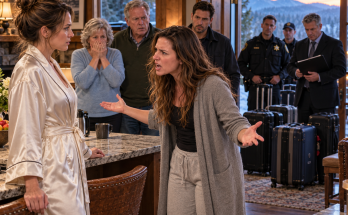
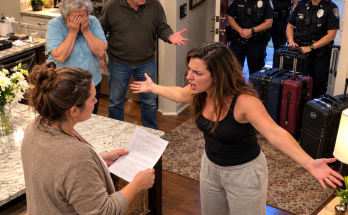
My sister, Jasmine, stepped outside.
She wore a cream-colored sweater, expensive jeans, and the expression of someone who had been interrupted during an important meeting.
Behind her stood her husband, Ryan, holding a mug that I recognized immediately.
It was my grandmother’s favorite blue ceramic mug.
The one she had used every morning while sitting beside the kitchen window.
Jasmine looked at me, sighed, and folded her arms.
“Oh, good. You’re finally here.”
I stared at her.
“What are you doing in this house?”
She glanced over her shoulder at Ryan before answering.
“We needed somewhere to stay for a while.”
“You could have called me.”
“Would you have said yes?”
The question hung between us.
I slowly shook my head.
“Not without discussing it first.”
Jasmine gave a dismissive laugh.
“Exactly. That’s why we didn’t bother.”
For a moment, I couldn’t believe what I was hearing.
This was the same sister who had called me selfish three years earlier because I refused to lend her money for a luxury vacation.
The same sister who had once told our mother that I cared more about property than family.
And now she was standing inside a house that legally belonged to me, acting as though I had arrived uninvited.
Ryan took a sip from Grandma’s mug.
“You have several properties,” he said casually. “This place was sitting empty. We figured you’d understand.”
I looked at Michael.
He opened his folder and removed a copy of the property deed.
“The ownership is clear,” he said. “Your sister has no authorization to occupy the property, and the locks were changed without your consent.”
Jasmine rolled her eyes.
“Must everything become a legal issue with you?”
“No,” I replied. “Only the things people refuse to discuss honestly.”
Her expression hardened.
Then she stepped aside, gesturing toward the doorway.
“Fine. Come in and see for yourself.”
I walked past her.
The moment I entered the living room, I stopped breathing for a second.
Grandma’s old bookshelves were gone.
Her floral curtains had been replaced with thick gray blinds.
A heavy metal cabinet stood against the wall where her antique writing desk used to sit.
Two computer monitors glowed on a folding table.
Black cables ran along the floor and disappeared behind a newly installed wooden panel.
There were boxes everywhere.
Some were labeled with ordinary household items.
Others had no labels at all.
“What happened to Grandma’s furniture?” I asked.
Ryan shrugged.
“We put most of it in storage.”
“Where?”
“Somewhere safe.”
I turned toward Jasmine.
“You moved her belongings out of her own home without asking me?”
“Our home now,” she snapped.
The words struck harder than I expected.
I looked at my sister, waiting for her to smile or admit that she was joking.
She didn’t.
Instead, she pointed toward the hallway.
“We’re family. You can’t seriously expect us to ask permission for everything.”
I had spent years making excuses for Jasmine.
When she borrowed money and forgot to repay it, I told myself she was struggling.
When she spread rumors about me, I blamed jealousy.
When she insulted Grandma for refusing to give her money, I convinced myself that people sometimes said terrible things when they were disappointed.
But standing inside that cabin, surrounded by unfamiliar equipment and my grandmother’s missing belongings, I finally admitted something I had avoided for most of my life.
Jasmine didn’t see family as people she was responsible for protecting.
She saw family as people she could use.
I was about to demand that she explain the equipment when I noticed something strange.
The door to the basement was locked.
Grandma had never locked that door.
In fact, she had always told me that the basement was the safest place in the house during a mountain storm.
I reached for the handle.
Jasmine moved so quickly that she nearly knocked over a chair.
“Don’t go down there!”
Her voice was sharper than anything I had heard from her that morning.
I slowly turned toward her.
“Why not?”
“It’s dangerous.”
“What’s dangerous about it?”
“Old stairs. Loose boards. You could fall.”
I glanced at the door.
Then at the heavy metal cabinet.
Then at the cables disappearing behind the wooden panel.
Something about the room suddenly felt wrong.
Not merely because my sister had taken over the property.
Not because she had changed the locks.
But because she seemed terrified of one particular room in a house she claimed was now hers.
I remembered something Grandma had told me shortly before she died.
She had been lying in her hospital bed, her hands thin beneath a white blanket, when she suddenly grabbed my wrist.
“Claire,” she whispered, “if Jasmine ever comes looking for something in that cabin, don’t let her find it first.”
I had asked what she meant.
Grandma had looked toward the window.
Then she said something I never forgot.
“There’s a place in that house where the light doesn’t belong. If you ever see it, you’ll know where to look.”
At the time, I thought the medication was making her confused.
Now, standing inside her cabin, I wasn’t so sure.
I looked at Michael.
“Can you give us a few minutes?”
He nodded and stepped onto the porch.
Jasmine watched him leave before turning back to me.
“You’re making a mistake,” she whispered.
“Maybe,” I answered. “But I think I’m about to find out what it is.”
Then I walked toward the stairs leading to the attic.
Behind me, Jasmine stopped pretending to be calm.
“Claire, wait!”
But I was already climbing.
And when I reached the top, I saw the one thing that didn’t belong.
A small, warm light was glowing behind a section of wooden wall.
Grandma had been right.
The light didn’t belong there.
I pressed my fingers against the boards.
One of them moved.
Behind it was a narrow seam, almost invisible beneath years of dust.
I pulled gently.
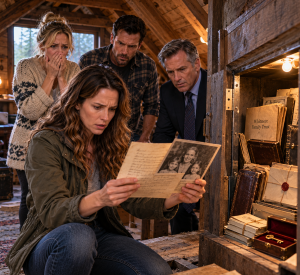
The panel shifted outward, revealing a small brass handle and a hidden compartment built deep into the wall.
I heard Jasmine rushing up the stairs behind me.
“Claire, don’t open that!”
I turned.
For the first time in my life, my sister looked genuinely frightened.
I wrapped my fingers around the handle.
Then I pulled.
And what I saw inside made me forget, for one terrifying moment, how to breathe.
Because my grandmother hadn’t hidden jewelry.
She hadn’t hidden cash.
She had hidden a collection of documents bearing my sister’s signature—and the first page carried a date from three months before Grandma died.
PART 2: The Secret My Grandmother Took to Her Grave
I stared at the documents without touching them.
There were bank statements, property records, handwritten letters, and several photographs sealed inside clear plastic sleeves.
At the bottom of the compartment sat a small wooden box with a brass lock.
Jasmine reached for the papers.
I pulled them away.
“Don’t touch anything.”
She froze.
Then her expression changed.
The fear disappeared, replaced by the familiar anger she used whenever she wanted someone else to feel guilty.
“You have no idea what you’re looking at,” she said.
“Then explain it.”
“It’s private.”
“Private?”
I held up the first document.
“Why is your signature on a property transfer dated three months before Grandma died?”
Jasmine’s face went pale.
Ryan appeared at the attic entrance.
“What did you find?” he asked.
Neither of us answered.
I looked down at the document again.
It appeared to be an application to transfer ownership of the cabin into a private company.
The company name meant nothing to me.
But the signature at the bottom belonged to Jasmine.
Beside it was another signature, one that looked remarkably similar to Grandma’s.
Only something was wrong.
The date indicated that the document had been signed on a day when Grandma had been hospitalized and unable to leave her bed.
I felt a chill travel down my spine.
“Jasmine, did Grandma sign this?”
She stared at the paper.
“I don’t remember.”
“You don’t remember?”
“It was a long time ago.”
“Three months ago?”
She looked away.
Ryan stepped forward.
“Claire, let’s not jump to conclusions.”
I turned toward him.
“Then help me understand why my sister has been living in my house, changing the locks, removing furniture, and hiding documents about transferring the property.”
He opened his mouth.
Then closed it.
For the first time since I had arrived, neither of them had an answer.
I carefully placed the documents back inside the compartment.
Then I took out my phone and photographed every page.
Jasmine watched me with growing panic.
“What are you doing?”
“Making sure these records don’t disappear.”
“You can’t do that!”
“Why not?”
She stepped closer.
“Because you don’t understand what Grandma promised me.”
I stopped.
“What did she promise you?”
Jasmine pressed her lips together.
Then she looked toward Ryan.
He shook his head slightly, warning her not to continue.
That small exchange told me more than either of them intended.
They knew something.
And they were afraid I was getting close to it.
I closed the compartment and went downstairs.
Michael was waiting in the living room.
I handed him the photographs on my phone.
He examined them silently, his expression becoming more serious with every image.
Finally, he looked up.
“Claire, I need to ask you something.”
“Go ahead.”
“Did your grandmother ever tell you that she had created a trust?”
I shook my head.
“No. She left me the cabin and a small investment account. That’s all I knew about.”
Michael exchanged a glance with me.
“Your grandmother’s estate records mention a sealed supplemental document. I assumed it concerned an old insurance policy, but the original was never located.”
“Could it be in that compartment?”
“Possibly.”
He looked toward the stairs.
“But we need to proceed carefully. If those signatures are not authentic, this could be much more serious than an unauthorized occupation.”
Jasmine suddenly appeared in the doorway.
“That’s enough!”
Her voice echoed through the cabin.
“You’re treating me like a criminal because I wanted a place to stay.”
I faced her.
“If that were all this was, we wouldn’t be having this conversation.”
She stared at me for several seconds.
Then she said something that changed everything.
“Grandma knew what was in that wall, Claire. She knew about the money, and she knew who was supposed to receive it.”
The room went silent.
Michael slowly lowered his phone.
I could hear the old refrigerator humming in the kitchen.
“What money?” I asked.
Jasmine realized her mistake immediately.
Her eyes widened.
“I didn’t mean—”
“What money?”
Ryan grabbed her arm.
“Stop talking.”
She jerked away from him.
For one brief moment, I saw something in her face that I had never seen before.
Not anger.
Not jealousy.
Desperation.
Then she turned and walked into the kitchen.
I followed her.
She stood beside the counter, staring at the window overlooking the trees.
“You always got everything,” she whispered.
I couldn’t believe she had said that.
“What exactly did I get?”
“The cabin. Grandma’s attention. Her trust. Everything.”
“Grandma left me the cabin because I spent every weekend caring for her when she was sick. You visited twice in the final year.”
Jasmine spun around.
“Because I had a life!”
“And I didn’t?”
She said nothing.
I took a breath.
“I worked two jobs to pay my bills. I drove four hours every weekend to bring Grandma groceries, clean her house, and take her to appointments. I never asked her for money.”
Jasmine’s eyes filled with tears, but I couldn’t tell whether they came from regret or frustration.
“She said she would help me,” she whispered.
“With what?”
“My business.”
I stared at her.
“What business?”
She hesitated.
Then Ryan entered the kitchen and answered for her.
“The investment company we were trying to start.”
I looked between them.
“How much money did Grandma promise you?”
Neither answered.
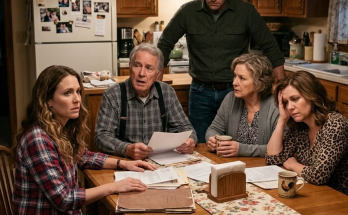
Michael appeared behind me, holding a sheet of paper from the hidden compartment.
“I think we should all sit down,” he said.
We returned to the living room.
He placed the paper on the coffee table.
It was a letter written in Grandma’s unmistakable handwriting.
The date was two weeks before she died.
The first line read:
To my granddaughter Claire, if you are reading this, then someone has opened the place I told you about.
My hands began to tremble.
I continued reading.
I know Jasmine believes I have hidden something valuable in this house. She is partly right.
But what she doesn’t understand is that the money was never meant to reward the person who found it.
It was meant to protect the person who deserved it.
I swallowed hard and kept reading.
Years ago, I discovered that someone I trusted had been using my name to authorize financial transactions I never approved.
I kept quiet because I wanted to understand how far the deception went.
By the time I learned the truth, I was too ill to confront everyone involved.
The next paragraph had been underlined twice.
Claire, if the documents are still there, take them to the attorney whose name appears on the final page. Do not sign anything Jasmine gives you. Do not let her convince you that the cabin was only the beginning.
I looked at Michael.
He was already reading the name at the bottom.
His expression changed.
“Who is it?” I asked.
He turned the page toward me.
The name belonged to a man who had died nearly twenty years earlier.
My grandfather.
I looked back at the letter, confused.
Grandpa had passed away long before Grandma became ill.
Why would his name appear on a document written decades later?
Then Michael noticed a second page tucked behind the letter.
It was a copy of a trust agreement.
The document listed three beneficiaries.
My grandmother.
My grandfather.
And one person whose name had been crossed out in thick black ink.
Someone had written another name beside it.
Jasmine Whitmore.
My sister leaned forward.
For a moment, I thought she might faint.
“That was supposed to be mine,” she whispered.
Michael looked at her sharply.
“What’s supposed to be yours?”
Jasmine didn’t answer.
Instead, she stared at the trust agreement and began to cry.
Ryan stepped toward the coffee table, but Michael moved the documents out of his reach.
I looked at my sister.
“Tell me the truth.”
She shook her head.
“You won’t understand.”
“Then make me understand.”
Her voice dropped to a whisper.
“Because the person who originally owned that trust wasn’t Grandma.”
I felt the room tilt around me.
“Who was it?”
Jasmine looked directly at me.
Then she said the words I had never expected to hear.
“It was our mother—and Grandma spent thirty years trying to keep us from discovering what really happened to her.”
PART 3: The Truth Behind the Hidden Trust
For several seconds, nobody moved.
Our mother had died when Jasmine was twelve and I was nine.
We had been told that she died in a car accident on a rainy highway.
Our grandmother raised us afterward, and whenever we asked questions about the accident, she became quiet.
As we grew older, the subject gradually disappeared from family conversations.
I had never questioned the official explanation.
Jasmine, apparently, had.
“What do you mean the trust belonged to Mom?” I asked.
My sister wiped her face.
“Grandma told me pieces of the story when I was younger. She said Mom had inherited money from our grandfather, but that someone had taken control of it before she could use it.”
“Who?”
Jasmine looked toward the documents.
“I thought it was Dad.”
Our father had died six years earlier.
He had been a quiet man who rarely discussed money and never explained why Grandma had insisted on handling every major family document.
But I remembered something else.
The year before he died, he had visited the cabin alone.
When I asked why, he told me he needed to repair a loose window.
At the time, I hadn’t thought anything of it.
Now I wondered whether he had known about the hidden compartment.
Michael examined the trust agreement more closely.
“This document references an original financial instrument and a separate set of ownership records,” he said. “We need to locate the final page mentioned in the letter.”
I returned to the attic.
This time, Jasmine followed without arguing.
Together, we examined the compartment.
Behind the trust agreement was a small envelope containing an old photograph.
It showed our mother standing beside a younger version of Grandma in front of the cabin.
Both women were smiling.
On the back, someone had written:
For my girls, when the time is right.
I turned the photograph over again.
There was a small brass key taped to the back.
It fit the lock on the wooden box.
Inside the box lay a stack of bank statements, a handwritten ledger, and a sealed envelope addressed to both of us.
I opened the envelope.
The letter was written by Grandma.
My dear girls,
If you are reading this together, then perhaps I have finally succeeded in bringing you to the truth.
Your mother did not die without leaving you anything.
She established a financial trust shortly before her death, intending that it would support both of you when you became adults.
But after the accident, the money was moved through a series of accounts, and the records were altered.
I spent years trying to discover where it went.
I eventually found evidence that your father had signed documents transferring control of the trust to a private company without your mother’s authorization.
I stopped reading.
Jasmine covered her mouth.
Our father?
The man who had taught me to ride a bicycle.
The man who had sat beside my bed when I was sick.
The man who had cried at our mother’s funeral.
I couldn’t make the words fit the person I remembered.
I continued.
I confronted him.
He told me he had been pressured by someone he trusted and that he believed the money would be returned.
I wanted to believe him.
But the money never came back.
I could not undo what had happened, so I spent the remaining years of my life gathering evidence.
The trust was not mine to give away, and it was never meant to become a prize between my granddaughters.
The documents in this box will explain everything.
At the bottom of the letter was one final sentence.
Please remember that discovering the truth does not require you to destroy each other.
I lowered the page.
Jasmine was crying openly now.
“I didn’t know all of that,” she whispered.
“Then why did you move into the cabin?”
She stared at the floor.
“Because Ryan found an old document in Dad’s office after he died. It mentioned the trust and the cabin.”
Ryan shifted uncomfortably.
Jasmine continued.
“We thought Grandma had hidden the original records here. We believed that if we found them before the property was sold, we could prove that the money belonged to us.”
“Why change the locks?”
“Because we were afraid you would find the documents first.”
“And the equipment downstairs?”
Ryan finally spoke.
“We were scanning the records and trying to trace the accounts.”
I looked at him.
“You could have told me.”
He had no answer.
Michael gathered the documents carefully.
“We’re going to need a forensic accountant and an attorney who specializes in trusts and estates. These records may establish what happened, but we cannot assume that every transaction was unlawful without further investigation.”
He looked at Jasmine and Ryan.
“And until the ownership and occupancy issues are resolved, neither of you should remove or alter anything else.”
For once, Jasmine didn’t argue.
Over the following weeks, the documents were examined by financial investigators.
The records revealed a complicated history of transfers, questionable authorizations, and accounts that had been opened under the names of several family members.
Some transactions appeared to have been made without proper authority.
Others required additional investigation.
The evidence also showed that Grandma had spent years trying to recover the assets and protect what remained for us.
She had not hidden the money because she wanted one granddaughter to defeat the other.
She had hidden the records because she knew that the truth could be manipulated if the wrong person found them first.
The cabin sale was postponed.
Jasmine and Ryan eventually left the property after the legal process began, and the original locks were restored.
The investigation continued for months.
Some assets were recovered, while others remained tied up in legal disputes.
I never received a magical fortune overnight.
Real life doesn’t work that way.
But I finally understood why Grandma had been so determined to protect that little house in the mountains.
It was never just a property.
It was the last place where she had kept the truth safe.
One afternoon, after the investigators had finished examining the attic, I returned to the cabin alone.
The rooms were quiet again.
Sunlight fell across the old wooden floor.
I placed Grandma’s blue ceramic mug beside the kitchen window and opened the curtains she had loved.
Then I found the photograph of her and our mother.
I held it for a long time.
Jasmine called that evening.
For once, she didn’t ask about the property, the trust, or the money.
She simply said, “Claire, I’m sorry.”
I believed that she meant it.
But forgiveness, I learned, doesn’t mean pretending nothing happened.
It means deciding what happens next without allowing the past to control every decision.
I told her that we could talk again when we were both ready.
Then I hung up and returned to the attic.
There was one final document I hadn’t examined closely.
It was tucked beneath the wooden box, folded into a narrow strip of paper.
Grandma had written only two sentences.
The person who moved the money was not the person who benefited most from it.
If you want to understand why your mother died, look at the name on the original accident report.
I read those words twice.
Then I reached for my phone and called Michael.
Because suddenly, I wasn’t wondering who had stolen the family trust.
I was wondering whether the accident that took our mother had ever been investigated properly.
And when Michael called me back the next morning, his first words made my hands go cold.