.A LITTLE GIRL ASKED ME TO BUY HER A $45 PAIR OF SHOES—THEN PROMISED TO REPAY ME WHEN SHE GREW UP. HOURS LATER, HER DYING MOTHER SENT ME A PHOTO AND WROTE, “YOU HAVE NO IDEA WHO MY DAUGHTER REALLY IS…” WHAT I DISCOVERED NEXT DESTROYED THE LIFE I THOUGHT I KNEW.
## PART 1 — THE LITTLE GIRL WHO ASKED A STRANGER FOR SHOES
The little girl standing outside my office building had shoes so worn that her toes poked through the fabric.
She looked up at me and asked a question I would remember for the rest of my life.
“Sir, would you buy me a pair of shoes? They cost forty-five dollars. I promise I’ll pay you back when I’m grown-up.”
I almost walked past her.
Not because I was cruel, but because I’d spent twenty years teaching myself not to get involved in other people’s problems.
My name is Nathan Cole. I was forty-four, the founder of a successful construction company in Boston, and the kind of man business magazines described as disciplined, ambitious, and exceptionally wealthy.
They never mentioned how empty my house felt after sunset.
My wife had died seven years earlier. We had no children. Since losing her, I’d buried myself in work, convinced that building something impressive could somehow make the rest of my life feel less broken.
That Thursday afternoon, I’d just left a meeting about a multimillion-dollar property development when a tiny voice stopped me.
“Excuse me, mister?”
I turned.
The girl couldn’t have been more than six. Her brown hair was tied in two uneven ponytails, and her purple backpack had a broken zipper secured with a safety pin.
Her name, she told me, was Lily.
I glanced at her shoes.
The soles were separating from the uppers, and the left shoe had a hole near the heel.
“Where are your parents, Lily?”
“My mommy is at the hospital.”
Her answer was so quiet that I almost didn’t hear it.
“Is she sick?”
Lily nodded.
“She says she’s going to get better. But sometimes she can’t talk very much.”
Something about that sentence made me pause.
“Who takes care of you while she’s at the hospital?”
“My aunt watches me sometimes. But today she had to work, so a neighbor brought me to see Mommy.”
She looked down at her shoes.
“I don’t want the other kids to laugh at me when I go to school tomorrow. And I want to look nice when I visit Mommy.”
There was no dramatic speech. No attempt to make me feel guilty.
Just a little girl trying to solve the only problem she believed she could fix.
I looked across the street and saw a shoe store.
“All right,” I said. “Let’s find you something comfortable.”
Her eyes widened.
“Really?”
“Really.”
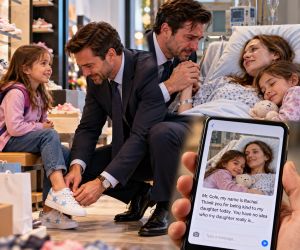
Inside the store, she carefully tried on several pairs. She rejected the first because it pinched her toes and the second because the heel rubbed against her skin.
Then she found a pair of white sneakers with tiny blue stars on the sides.
She stood up and took three steps.
A smile slowly spread across her face.
“These don’t hurt!”
She walked around the store, then turned toward me with a grin so bright that the employee began smiling, too.
The shoes cost forty-five dollars.
I paid the bill.
Outside, Lily sat on a low wall and admired her new sneakers.
“Thank you,” she said.
“You’re welcome. And you don’t owe me anything.”
She shook her head with surprising seriousness.
“Yes, I do. Mommy says a promise is something you carry in your heart until you keep it.”
I laughed softly.
“Then promise me you’ll grow up to be kind to somebody else. That’s all the repayment I want.”
She thought about that.
“Okay. I promise.”
Then she wrapped her little arms around my waist.
For a moment, I stood frozen.
I couldn’t remember the last time someone had hugged me without wanting money, a business favor, or something in return.
“Thank you, Mr. Nathan.”
“How do you know my name?”
She pointed at the name printed on my company badge.
“Oh.”
We both laughed.
Then she hurried down the sidewalk, calling over her shoulder, “I’ll remember you!”
I watched until she disappeared around the corner.
For the first time in months, I walked back to my car feeling lighter.
I thought I’d simply bought a little girl a pair of shoes.
I had no idea that, before midnight, those forty-five dollars would lead me to a secret that had been buried for twenty-six years.
At 7:18 that evening, my phone buzzed.
An unknown number had sent me a photograph.
I opened it.
Lily was standing beside a hospital bed, holding the hand of a pale woman whose face looked frighteningly familiar.
I enlarged the image.
Then I noticed a thin silver bracelet around the woman’s wrist.
My late wife’s bracelet.
The one I’d searched for after her funeral, believing it had been lost years before she died.
My heart began pounding.
A message appeared beneath the photograph.
*Mr. Cole, my name is Rachel. I’m Lily’s mother. Thank you for being kind to my daughter today.*
Another message followed.
*The doctors say I may not have much time left. Before I go, I need to tell you something about your wife, Emily.*
I stopped breathing.
Then a final message arrived.
*Your wife didn’t die without leaving a child behind.*
I read the sentence again and again.
Then my phone rang.
The woman on the screen was calling me from the hospital.
And the first words she spoke were:
“Mr. Cole, Lily is your daughter.”
## PART 2 — THE SECRET MY WIFE TOOK TO HER GRAVE
I drove to the hospital so quickly that I barely remembered the journey.
The entire way, Rachel’s words echoed through my mind.
*Lily is your daughter.*
It was impossible.
Emily and I had spent years trying to have a child. We had visited specialists, endured painful disappointments, and eventually stopped talking about the subject because every conversation ended in heartbreak.
After Emily died, I’d convinced myself that fatherhood simply wasn’t part of my life.
Now a stranger was telling me that I had a six-year-old daughter.
A daughter who had asked me for forty-five dollars because she couldn’t afford shoes.
When I entered Rachel’s hospital room, Lily was asleep in a chair beside the bed, her new sneakers resting neatly beneath her feet.
Rachel looked frail, but her eyes were clear.
She studied my face.
“You look just like Emily described you.”
I stood at the end of the bed.
“Who are you? And how can you possibly know anything about my wife?”
Rachel took a slow breath.
“Twenty-six years ago, I worked at a small fertility clinic in Massachusetts. Emily was a patient there.”
I remembered the clinic. Emily and I had visited it for months before we eventually gave up.
Rachel continued.
“Your wife became pregnant after one of her treatments. But there was a terrible mistake involving patient records. The clinic discovered that an embryo had been transferred incorrectly.”
My hands began to shake.
“Are you saying Lily was born because of a mistake?”
Rachel nodded.
“She was conceived through a treatment involving your family’s genetic material. But the clinic mishandled the records, and Emily was never given the full explanation.”
I stared at her.
“That doesn’t make sense. Lily is six. Emily died seven years ago.”
Rachel closed her eyes.
“You’re right. Let me explain.”
She told me that Lily had been born to another woman, a patient whose treatment had been connected to the same medical investigation. Rachel had adopted Lily as an infant after the child’s birth mother died shortly after delivery.
The clinic had concealed the connection between the families while trying to avoid a scandal.
Years later, Rachel discovered a sealed document in her own medical records. It identified a genetic connection between Lily and Emily’s family.
Rachel had spent years trying to confirm the truth.
But she had no money for legal battles, and the clinic had closed. The people who might have explained what happened had scattered.
“Why didn’t you contact me sooner?” I demanded.
“Because I wasn’t certain. I didn’t want to destroy your life with an accusation I couldn’t prove.”
She reached toward the bedside table and picked up a small envelope.
“Then, three months ago, I received a letter from Emily’s former attorney. He had been trying to locate you.”
I stared at the envelope.
Rachel handed it to me.
Inside was a copy of a letter written in Emily’s handwriting.
I knew her writing instantly. The rounded letters. The tiny hearts she sometimes drew above the letter i. The way she always underlined my name.
My eyes blurred as I read.
*Nathan, if you ever discover the truth about what happened at the clinic, please don’t blame yourself. I wanted to tell you everything, but I was afraid of giving you hope and then losing it again.*
I gripped the paper.
Rachel continued.
“Emily discovered evidence of the clinic’s mistake shortly before she became ill. She hired a lawyer to investigate. She believed there might be a child connected to your treatment, but she never received a confirmed identity.”
“Why didn’t she tell me?”
“Because she didn’t know whether the child was alive, who was raising her, or whether the information was accurate. She was afraid you’d spend the rest of your life searching for someone who might not exist.”
I sank into the chair beside the bed.
For seven years, I’d mourned my wife without knowing that a part of her unfinished story might still be alive.
I looked at Lily.
She had woken up and was rubbing her eyes.
“Mr. Nathan?”
I tried to smile.
“Hi, sweetheart.”
“Is Mommy going to be okay?”
Rachel turned her face toward the window.
I wanted to promise Lily that her mother would recover. I wanted to tell her that everything would be fine.
But I couldn’t lie to a child who had already endured too much uncertainty.
“I don’t know, Lily,” I said gently. “But I’m here with you.”
She climbed down from the chair and walked toward me.
“Can you stay until Mommy falls asleep?”
I nodded.
“Of course.”
She took my hand as if she’d known me for years.
And something inside me shifted.
I didn’t yet know whether the story Rachel had told me was true. I needed documents, independent medical review, and a DNA test before making a life-changing decision.
But I knew one thing with absolute certainty.
I would not abandon this little girl while the adults tried to untangle the mistakes of the past.
Over the next few days, I contacted an attorney and arranged for an independent genetic test with Rachel’s consent and the appropriate legal safeguards.
I also asked my late wife’s former lawyer to meet me.
He arrived carrying a locked file box.
“Emily asked me to keep this safe,” he said. “She gave me strict instructions not to release it unless credible evidence emerged that the child she suspected existed had been identified.”
He placed a sealed envelope on the table.
On the front, in Emily’s handwriting, were four words:
**For Nathan and our child.**
I opened it with trembling fingers.
Inside was a photograph of a newborn baby wrapped in a pale yellow blanket.
On the back, Emily had written a single sentence:
*If you ever find her, tell her she was loved before we even knew her name.*
I began to cry.
But the lawyer wasn’t finished.
“There is something else,” he said. “The clinic’s former director left behind a statement. It may explain why your wife’s investigation was stopped.”
He slid a second document across the table.
And as I read the first paragraph, I realized that the secret wasn’t merely about a child.
It was about someone who had spent years making sure the truth never came out.
## PART 3 — THE PROMISE THAT CHANGED BOTH OUR LIVES
The genetic test results arrived twelve days later.
I was sitting alone in my office when my attorney called.
“Nathan, the results are conclusive. The test strongly supports a biological relationship between you and Lily.”
I lowered my head.
For several seconds, I couldn’t speak.
The child who had approached me on the sidewalk, embarrassed by her worn-out shoes, was my daughter.
My daughter.
I had missed her first words, her first birthday, her first day of school, and every ordinary moment that parents carry in their memories.
I couldn’t recover those years.
But I could decide what happened next.
The legal investigation uncovered a disturbing history of mishandled records at the fertility clinic. Several former employees had raised concerns about errors years earlier, but the clinic had closed before the full extent of the problem could be established.
The evidence did not support every claim Rachel had feared might be true. Some records were incomplete, and certain questions could no longer be answered.
But the genetic result was clear.
Lily was my child.
And Emily had spent the final months of her life trying to discover whether a little girl somewhere in the world might be connected to the family we’d dreamed of building.
I returned to the hospital with the test results.
Rachel was awake, sitting by the window while Lily colored in a notebook.
When she saw me, she searched my face.
“Did you get the results?”
I nodded.
“She’s my daughter.”
Rachel began to cry.
Lily looked up.
“Why is everyone crying?”
I knelt beside her.
“Because I have something important to tell you.”
She put down her pencil.
“Am I in trouble?”
“No, sweetheart. Not even a little.”
I took a breath.
“Your mother and I have discovered that I’m your biological father.”
Lily stared at me.
Then she looked at Rachel.
“Does that mean I have a daddy?”
Rachel reached for her hand.
“Yes, baby.”
Lily turned back toward me.
“Are you going to leave?”
The question broke my heart more than anything else that day.
I took her small hand in mine.
“No, Lily. I’m not going to disappear just because life has become complicated.”
She studied me for a moment, trying to decide whether she could believe me.
Then she asked, “Do you remember when you bought me my shoes?”
“I do.”
“You said I didn’t have to pay you back.”
I smiled through my tears.
“That’s right.”
She thought about that.
“Then can I call you Daddy?”
I had imagined many moments in my life. Business victories. Expensive celebrations. The day I’d finally feel that all my hard work had been worth it.
I had never imagined that the most important question anyone would ever ask me would come from a little girl sitting beside a hospital bed.
I nodded.
“If that’s what you want, sweetheart.”
She wrapped her arms around my neck.
“Okay, Daddy.”
I held her close and cried into her hair.
For the first time in seven years, I didn’t feel like a man living inside the ruins of his old life.
I felt like someone who had been given a chance to build a new one.
But there was still one promise I needed to keep.
Rachel’s condition worsened over the following weeks. Her doctors did everything they could, but she had been ill for a long time.
I spent every day at the hospital with Lily. I learned how she liked her sandwiches cut, which bedtime stories she asked for twice, and how she always lined her shoes up beside the bed before sleeping.
Rachel watched us together, sometimes smiling, sometimes crying quietly.
One evening, she asked to speak with me alone.
“I need you to understand something,” she said. “Lily doesn’t need a rich father. She needs a father who shows up.”
I nodded.
“I know.”
“Don’t try to fix every problem by buying something. I know you can afford almost anything, but she needs your time more than your money.”
Her words reminded me of the forty-five-dollar shoes.
I’d thought I was giving Lily something simple.
Now I understood that the shoes had only opened the door. The real gift was the responsibility that came after.
“I promise,” I told Rachel. “I’ll be there for her.”
She reached for my hand.
“Then I can rest.”
Rachel passed away peacefully several days later, with Lily beside her and my hand resting on the little girl’s shoulder.
There was no dramatic miracle. No last-minute recovery.
There was only grief, love, and a child who needed someone to help her understand why her mother would not be coming home.
I stayed with Lily through the funeral and the difficult weeks afterward. With the help of attorneys and social workers, we worked through the appropriate legal steps for her care. We moved slowly, allowing her to keep her routines, her memories, and the people she trusted.
I didn’t ask her to forget Rachel.
I encouraged her to talk about her mother whenever she wanted.
And I kept my promise.
I attended school meetings. I learned how to braid her hair, badly at first. I read bedtime stories even when I was exhausted. I took her to the park, where she insisted on racing me to every bench.
Months later, we visited Emily’s grave together.
I brought flowers.
Lily brought a drawing of three people holding hands beneath a bright yellow sun.
She placed it beside the flowers.
“That’s Mommy Emily,” she explained. “And that’s me. And that’s Daddy.”
I stared at the drawing, unable to speak.
For years, I’d believed my wife’s death had ended every possibility of the family we’d wanted.
Now I stood beside her grave with the daughter neither of us had known how to find.
I couldn’t explain why the truth had taken so long to emerge. I couldn’t undo the mistakes, the lost years, or the grief that had shaped all our lives.
But I could give Lily the future she deserved.
On her seventh birthday, I took her back to the little shoe store.
She chose a pair of bright red sneakers with white stars.
At the checkout, she reached into her pocket and pulled out a folded piece of paper.
“What’s that?” I asked.
“My repayment.”
She handed it to me.
It was a drawing of a pair of shoes, with forty-five tiny hearts scattered around them.
At the bottom, in careful, uneven letters, she’d written:
*Dear Daddy, I can’t pay you back with money because you said I don’t have to. So I’m paying you back with love.*
I pressed the paper against my chest.
Then I knelt and hugged her.
“You’ve already paid me back more than you could ever know.”
She smiled.
“Good. Because I still want ice cream.”
I laughed so hard that people in the store turned to look.
That evening, we walked home together beneath the city lights.
Lily held my hand, her red sneakers flashing with every step.
I thought about the man I’d been before I met her: wealthy, respected, and convinced that the most important things in life were things a person could build, buy, or control.
I understood now how wrong I’d been.
Sometimes, the smallest act of kindness leads us toward the truth we’ve spent years avoiding.
Sometimes, a promise made by a child becomes the beginning of a new life.
And sometimes, the family we thought we’d lost forever finds its way back to us—not all at once, and not without pain, but one honest step at a time.
That afternoon, I thought I was buying a little girl a pair of shoes.
In reality, I was taking the first step toward becoming her father.
And it was the most valuable thing I had ever received.